If a bond's coupon rate is smaller than the yield to maturity, then a) Not enough...
If a bond's coupon rate is smaller than the yield to maturity, then
a) Not enough information
b) The face value payment must equal the initial purchase cost
c) The face value payment must exceed the initial purchase cost
d) The face value payment must fall short of the initial purchase cost
Which of the following bonds is different than the others?
a) (-90, 15, 15, 15, 105)
b) (-18, 3, 3, 3, 21)
c) (-45, 7.5, 7.5, 7.5, 50)
d) (-6, 1, 1, 1, 7)
Homework Answers
Coupon Rate < YTM
The Face value must be more than the Value of Bond in the market.
Option C is correct.
Add Answer to:
If a bond's coupon rate is smaller than the yield to maturity,
then
a) Not enough...
If a bond's coupon rate is smaller than the yield to maturity, then a) Not enough...
If a bond's coupon rate is smaller than the yield to maturity, then a) Not enough information b) The face value payment must equal the initial purchase cost c) The face value payment must exceed the initial purchase cost d) The face value payment must fall short of the initial purchase cost Which of the following bonds is different than the others? a) (-90, 15, 15, 15, 105) b) (-18, 3, 3, 3, 21) c) (-45, 7.5, 7.5, 7.5, 50)...
4. Mr. Peanutbutter and Princess Buttercup are both evaluating the same cash flow stream. Princess Buttercup,...
4. Mr. Peanutbutter and Princess Buttercup are both evaluating the same cash flow stream. Princess Buttercup, however, has better outside investment opportunities than Mr. Peanutbutter does and she faces a higher opportunity cost of time as a result. Which of the following will be true? a) Buttercup and Peanutbutter will have identical willingness to pay for the same cash flow stream b) Buttercup will be willing to pay more than Peanutbutter for the same cash flow stream c) Not enough...
1. If your effective annual discount rate is 7%, what is your effective quarterly interest rate?...
1. If your effective annual discount rate is 7%, what is your effective quarterly interest rate? (express as a decimal to 3 digits, e.g. 7% should be written as 0.070) 2. If you had to amortize a $120,000 loan over a 10-year period into a payment stream that looks like a uniform annuity flow taking the time value of money into an account, then the value of the monthly payments at an APR of 9% on the loan must be...
1. The term structure of interest rates refers to the relationship between _____. a bond's time to maturity and its coupon rate a bond's age since issue and its coupon rate a bond's age si...
1. The term structure of interest rates refers to the relationship between _____. a bond's time to maturity and its coupon rate a bond's age since issue and its coupon rate a bond's age since issue and its yield a bond's time to maturity and its yield. 2. The yield on 12-month treasury bills is 1.4% and the yield on 2-year treasury STRIPS is 2%. a. What is the implied 1-year forward rate one year from now? 3. The term...
How to calculate coupon bond's Yields to Maturity? Table 1 Yields to Maturity on a 10%-coupon-Rate...
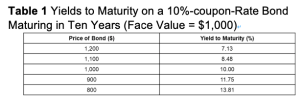 How to calculate coupon bond's Yields to Maturity?
Table 1 Yields to Maturity on a 10%-coupon-Rate Bond Maturing in Ten Years (Face Value = $1,000) Price of Bond (s) Yield to Maturity (%) 1,200 1,100 7.13 8.48 10.00 1,000 900 11.75 800 13.81
How to calculate coupon bond's Yields to Maturity?
Table 1 Yields to Maturity on a 10%-coupon-Rate Bond Maturing in Ten Years (Face Value = $1,000) Price of Bond (s) Yield to Maturity (%) 1,200 1,100 7.13 8.48 10.00 1,000 900 11.75 800 13.81
1. 4T Corp. will issue a zero-coupon bond this coming month. The bond's projected yield is...
1. 4T Corp. will issue a zero-coupon bond this coming month. The bond's projected yield is 6%. If the par value is $1,000 and the maturity is 15 years, What is the bond's price using semiannual convention? 1,000.00 417.27 411.19 233.00 228.11 315.24 308.32 2. The coupon payment for an annual-coupon corporate bond is equal to the yield to maturity multiplied by the par value of the bond. 1) True 2) False
1. What is the bond's yield to maturity? 2. What happens to the bond's yield to...
 1. What is the bond's yield to maturity?
2. What happens to the bond's yield to maturity if the bond
matures in 20 years?
3. What if it matures in 5 years?
(Yield to maturity) A bond's market price is $1,200. It has a $1,000 par value, will mature in 10 years, and has a coupon interest rate of 11 percent annual interest, but makes its interest payments semiannually. What is the bonds yield to maturity? What happens to the...
1. What is the bond's yield to maturity?
2. What happens to the bond's yield to maturity if the bond
matures in 20 years?
3. What if it matures in 5 years?
(Yield to maturity) A bond's market price is $1,200. It has a $1,000 par value, will mature in 10 years, and has a coupon interest rate of 11 percent annual interest, but makes its interest payments semiannually. What is the bonds yield to maturity? What happens to the...
Which of the following bonds is different than the others? a) (-90, 15, 15, 15, 105)...
Which of the following bonds is different than the others? a) (-90, 15, 15, 15, 105) b) (-18, 3, 3, 3, 21) c) (-45, 7.5, 7.5, 7.5, 50) d) (-6, 1, 1, 1, 7) Which of the following cash flow streams represent bonds that are trading at par? (select all that apply) a) (-50, 2, 2, 50) b) (-100, 5, 5, 105) c) (-10, 1, 1, 12) d) (-20, 1, 1, 21) Which of the following must be true regarding...
QUESTION 23 When a bond's coupon rate is less than its yield-to-maturity the bond will be...
 QUESTION 23 When a bond's coupon rate is less than its yield-to-maturity the bond will be a discount bond. True False QUESTION 24 Exposure to non-systematic risk is rewarded with higher expected return. Conversely, exposure to systematic risk is not rewarded with higher expected returns True False QUESTION 25 You invest the same dollar amount in 5 different securities. All else equal, diversification produces the greatest benefits if the correlation coefficients for the returns of the 5 securities are close...
Some of my answers are incorrect I need help please . When the bond's coupon rate...
 Some of my answers are
incorrect I need help please
. When the bond's coupon rate is equal to the bondholder's required return, the bond's intrinsic value will equal its par value, and the bond will trade at par. . When the bond's coupon rate is greater than the bondholder's required return, the bond's intrinsic value will exceed its par value, and the bond will trade at a premium . When the bond's coupon rate is less than the bondholder's...
Some of my answers are
incorrect I need help please
. When the bond's coupon rate is equal to the bondholder's required return, the bond's intrinsic value will equal its par value, and the bond will trade at par. . When the bond's coupon rate is greater than the bondholder's required return, the bond's intrinsic value will exceed its par value, and the bond will trade at a premium . When the bond's coupon rate is less than the bondholder's...
 How to calculate coupon bond's Yields to Maturity?
Table 1 Yields to Maturity on a 10%-coupon-Rate Bond Maturing in Ten Years (Face Value = $1,000) Price of Bond (s) Yield to Maturity (%) 1,200 1,100 7.13 8.48 10.00 1,000 900 11.75 800 13.81
How to calculate coupon bond's Yields to Maturity?
Table 1 Yields to Maturity on a 10%-coupon-Rate Bond Maturing in Ten Years (Face Value = $1,000) Price of Bond (s) Yield to Maturity (%) 1,200 1,100 7.13 8.48 10.00 1,000 900 11.75 800 13.81
 1. What is the bond's yield to maturity?
2. What happens to the bond's yield to maturity if the bond
matures in 20 years?
3. What if it matures in 5 years?
(Yield to maturity) A bond's market price is $1,200. It has a $1,000 par value, will mature in 10 years, and has a coupon interest rate of 11 percent annual interest, but makes its interest payments semiannually. What is the bonds yield to maturity? What happens to the...
1. What is the bond's yield to maturity?
2. What happens to the bond's yield to maturity if the bond
matures in 20 years?
3. What if it matures in 5 years?
(Yield to maturity) A bond's market price is $1,200. It has a $1,000 par value, will mature in 10 years, and has a coupon interest rate of 11 percent annual interest, but makes its interest payments semiannually. What is the bonds yield to maturity? What happens to the...
 QUESTION 23 When a bond's coupon rate is less than its yield-to-maturity the bond will be a discount bond. True False QUESTION 24 Exposure to non-systematic risk is rewarded with higher expected return. Conversely, exposure to systematic risk is not rewarded with higher expected returns True False QUESTION 25 You invest the same dollar amount in 5 different securities. All else equal, diversification produces the greatest benefits if the correlation coefficients for the returns of the 5 securities are close...
 Some of my answers are
incorrect I need help please
. When the bond's coupon rate is equal to the bondholder's required return, the bond's intrinsic value will equal its par value, and the bond will trade at par. . When the bond's coupon rate is greater than the bondholder's required return, the bond's intrinsic value will exceed its par value, and the bond will trade at a premium . When the bond's coupon rate is less than the bondholder's...
Some of my answers are
incorrect I need help please
. When the bond's coupon rate is equal to the bondholder's required return, the bond's intrinsic value will equal its par value, and the bond will trade at par. . When the bond's coupon rate is greater than the bondholder's required return, the bond's intrinsic value will exceed its par value, and the bond will trade at a premium . When the bond's coupon rate is less than the bondholder's...
Most questions answered within 3 hours.
-
Where is the error in this code sequence?
String s1 = "Hello";
String s2 = "ello";...
asked 10 months ago -
Financial data for Joel de Paris, Inc., for last year
follow:
Joel de Paris, Inc.
Balance...
asked 10 months ago -
Consider this reaction:
Al2(SO4)3 (aq)+ BaCl3
(aq) Al2Cl6 (aq)- +
3BaSO4(s) . What is the...
asked 10 months ago -
Suppose that Savneet is considering increasing her
recent random sample from 20 car rentals to 40...
asked 10 months ago -
Trucks arrive at an unloading terminal at an average rate of 120
per hour.
Trucks arrive...
asked 10 months ago -
Why are methanol and ethanol completely soluble in water while
octanol is not very little soluble....
asked 10 months ago -
A facilities manager at a university reads in a research report
that the mean amount of...
asked 10 months ago -
When the CuSO4 is rehydrated by adding water to the anhydrous
compound, is this an endothermic...
asked 10 months ago -
A ray of sunlight is passing from diamond into crown glass; the
angle of incidence is...
asked 10 months ago -
A block of mass 0.249 kg is placed on top of a light, vertical
spring of...
asked 10 months ago -
how do the kidneys compensate in the presences of acidosis
a) trigger hyperventilate
b) reserve acid...
asked 10 months ago -
Question 501 pts
The rental rate of capital to the firm increases. Which of the
following...
asked 10 months ago