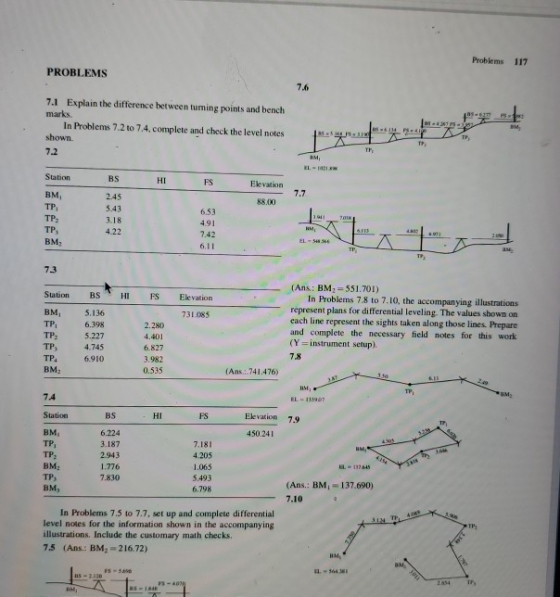
please I need assistance with exercises 7.3 & 7.9
thank you!!

Homework Answers
7.3 Height of Instrument method is used to solve this problem.
In height of instrument method,
Height of instrument = Elevation ( or Reduced Level) + Backsight
Elevation of any point = Height of Instrument - Foresight
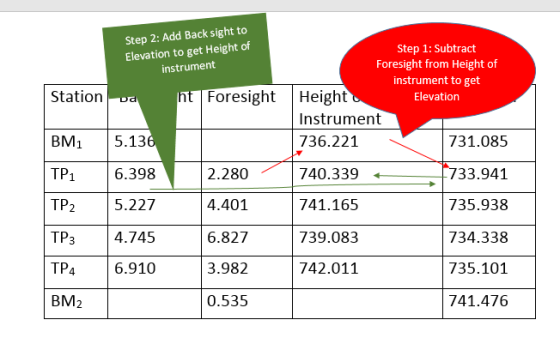
First Follow Red arrow and then follow green one. Repeat the step till last point.
The final Table after calculation is shown below:

7.9 The data is blurred due to smaller size and poor quality of image. Please capture the image again possibly that part only and again post it for solution.
In general, This question will also be solved with the height of instruent method.
For every station, you need to calculate the height of instrument and for every other point (turning point), you need to calculate Elevation of that point.
Height of instrument = Elevation ( or Reduced Level) + Backsight ( one reading before station)
Elevation of any point = Height of Instrument - Foresight ( one reading before turning point or one reading after station)
Add Answer to:
please I need assistance with exercises 7.3 & 7.9
thank you!!
Problems 117 PROBLEMS 7.6 PS...
4. In Problems 4() and 4(ii) below, the accompanying illustrations represent plans for differential levelling. The...
 4. In Problems 4() and 4(ii) below, the accompanying illustrations represent plans for differential levelling. The values shown on each line represent the sights taken along those lines. All measurements are in metres. Prepare and complete the necessary filed notes for these surveys using the Height of Instrument Method. Perform all necessary checks and corrections if applicable. (Notes: • represents staff, while denotes instrument setup: BM = bench mark; TP = turning point; EL = elevation) (7.5 marks for each...
please answer all or as man as you can please and thank you RCISES 7.1. Name...
 please answer all or as man as you can please and thank you
RCISES 7.1. Name five factors that enter into the decision to manufacture a part by CNC operations. 7.2. a. What is methodizing? b. In a large shop the person is responsible for th is job, whereas in a small shop it is the person. 7.3. a. What is the purpose of the operations sheet? b. List three specifications that can be given in the operations sheet. 7.4....
please answer all or as man as you can please and thank you
RCISES 7.1. Name five factors that enter into the decision to manufacture a part by CNC operations. 7.2. a. What is methodizing? b. In a large shop the person is responsible for th is job, whereas in a small shop it is the person. 7.3. a. What is the purpose of the operations sheet? b. List three specifications that can be given in the operations sheet. 7.4....
 4. In Problems 4() and 4(ii) below, the accompanying illustrations represent plans for differential levelling. The values shown on each line represent the sights taken along those lines. All measurements are in metres. Prepare and complete the necessary filed notes for these surveys using the Height of Instrument Method. Perform all necessary checks and corrections if applicable. (Notes: • represents staff, while denotes instrument setup: BM = bench mark; TP = turning point; EL = elevation) (7.5 marks for each...
 please answer all or as man as you can please and thank you
RCISES 7.1. Name five factors that enter into the decision to manufacture a part by CNC operations. 7.2. a. What is methodizing? b. In a large shop the person is responsible for th is job, whereas in a small shop it is the person. 7.3. a. What is the purpose of the operations sheet? b. List three specifications that can be given in the operations sheet. 7.4....
please answer all or as man as you can please and thank you
RCISES 7.1. Name five factors that enter into the decision to manufacture a part by CNC operations. 7.2. a. What is methodizing? b. In a large shop the person is responsible for th is job, whereas in a small shop it is the person. 7.3. a. What is the purpose of the operations sheet? b. List three specifications that can be given in the operations sheet. 7.4....
Most questions answered within 3 hours.
-
Where is the error in this code sequence?
String s1 = "Hello";
String s2 = "ello";...
asked 10 months ago -
Financial data for Joel de Paris, Inc., for last year
follow:
Joel de Paris, Inc.
Balance...
asked 10 months ago -
Consider this reaction:
Al2(SO4)3 (aq)+ BaCl3
(aq) Al2Cl6 (aq)- +
3BaSO4(s) . What is the...
asked 10 months ago -
Suppose that Savneet is considering increasing her
recent random sample from 20 car rentals to 40...
asked 10 months ago -
Trucks arrive at an unloading terminal at an average rate of 120
per hour.
Trucks arrive...
asked 10 months ago -
Why are methanol and ethanol completely soluble in water while
octanol is not very little soluble....
asked 10 months ago -
A facilities manager at a university reads in a research report
that the mean amount of...
asked 10 months ago -
When the CuSO4 is rehydrated by adding water to the anhydrous
compound, is this an endothermic...
asked 10 months ago -
A ray of sunlight is passing from diamond into crown glass; the
angle of incidence is...
asked 10 months ago -
A block of mass 0.249 kg is placed on top of a light, vertical
spring of...
asked 10 months ago -
how do the kidneys compensate in the presences of acidosis
a) trigger hyperventilate
b) reserve acid...
asked 10 months ago -
Question 501 pts
The rental rate of capital to the firm increases. Which of the
following...
asked 10 months ago