

Homework Answers
Request Answer!
We need at least 10 more requests to produce the answer.
0 / 10 have requested this problem solution
The more requests, the faster the answer.
Add Answer to:
When this compound is heated which carboxyl group would be lost most readily as CO2? с...
Upon heating this compound, which carboxyl group will be readily lost as CO2? 2 COOH COOH...
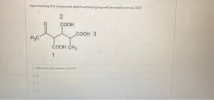 Upon heating this compound, which carboxyl group will be readily lost as CO2? 2 COOH COOH 3 H3C COOH CH3 1 More than one answer is correct 3 O2
Ос OB ОЕ ОА D Question 23 4 pts Which sets of reagents would most readily...
 Ос OB ОЕ ОА D Question 23 4 pts Which sets of reagents would most readily undergo the following transformation? 7 anconote - Yo'l-oylering А B с None. All would liminate OD OA a O
Which proton would be abstracted first when this compound is treated with NaNH2? OH B H...
 Which proton would be abstracted first when this compound is treated with NaNH2? OH B H D H3C A с А B C D Which method will accomplish this transformation? å-a O A. 1. BH3.THE 2. H202, OH 3. EtBr B. 1. EtMgBr 2. H20/H30+ OC. 1. EtzCuli 2. H2O/H30+ OD. 1. HBr 2. EtLi
QUESTION 2 When adenosine diphosphate is phosphorylated, what small molecule is lost? H20 CO2 HCI 02...
 QUESTION 2 When adenosine diphosphate is phosphorylated, what small molecule is lost? H20 CO2 HCI 02 QUESTION 4 How many carbon atoms enter the citric acid cycle at a time? 2. 4 3 6 QUESTION 7 How many molecules of ATP (NET) are produced directly from the GLYCOLYSIS of 5 molecules of glucose? 5 12.5 10 QUESTION 8 Which of the following is(are) NOT found in the electron transport chain? O2 CO2 OH ions Fe ions QUESTION 9 Which letter...
18. Which of the following compound(s) would undergo mutarotation in aqueous solution? 19. Draw the chair...
 18.
Which of the following compound(s) would undergo mutarotation in
aqueous solution?
19. Draw the chair conformation of a-D-galactopyranose.
20. Which of the following compound(s) is a glycoside?
21. Provide the reagents neccesary to carry out the following
conversion.
22. Predict the product(s) for the following reaction.
23. D-glucose & D-galactose are ______epimers of each
other.
24. Predict the product(s) for the following reaction.
25. Which of the following compound(s) would produce D-glucose
and D-mannose when treated with HCN followed...
18.
Which of the following compound(s) would undergo mutarotation in
aqueous solution?
19. Draw the chair conformation of a-D-galactopyranose.
20. Which of the following compound(s) is a glycoside?
21. Provide the reagents neccesary to carry out the following
conversion.
22. Predict the product(s) for the following reaction.
23. D-glucose & D-galactose are ______epimers of each
other.
24. Predict the product(s) for the following reaction.
25. Which of the following compound(s) would produce D-glucose
and D-mannose when treated with HCN followed...
____ 1. The diagram below represents serine, a polar, uncharged amino acid. Which functional group gives...
 ____ 1. The diagram below represents serine, a polar, uncharged
amino acid. Which functional group gives serine its
distinct property?
a. H3
b. CH2OH
c. –H
d. COO–
____ 2. The monomers shown below are monomers for which of the
following natural polymers?
a. polysaccharides
b. plastics
c. DNA
d. proteins
____ 3. Which of the following processes illustrates the production
of a protein?
a. specific code for amino acids --> amino acid chain -->
gene --> DNA --> specific...
____ 1. The diagram below represents serine, a polar, uncharged
amino acid. Which functional group gives serine its
distinct property?
a. H3
b. CH2OH
c. –H
d. COO–
____ 2. The monomers shown below are monomers for which of the
following natural polymers?
a. polysaccharides
b. plastics
c. DNA
d. proteins
____ 3. Which of the following processes illustrates the production
of a protein?
a. specific code for amino acids --> amino acid chain -->
gene --> DNA --> specific...
Please complete for Tuesday, we will go through the questions and mark them in class. pg 156 - 4.23,...
 Please complete for Tuesday, we will go through the questions and mark them in class. pg 156 - 4.23, 4.24, 4.26 pg 170 - 4.29, 4.31, pg 171-4.36 pg 175 - 4.59 pg 176- 4.74, 4.75, 4.80 pg 177-4.81, 4.82 pg 188- 5.1, 5.4, 5.5, 5.6, 5.11 - Using Table 5.1 pg 198-5.22, 5.25 pg 203 - 5.29 pg 206 - 5.37 pg 209 - 5.39 pg 2.14 5.61 pg 235-6.11, 6.14, 6.16 156 CHAPTER 4 Introduction to Organic Compounds...
 Upon heating this compound, which carboxyl group will be readily lost as CO2? 2 COOH COOH 3 H3C COOH CH3 1 More than one answer is correct 3 O2
 Ос OB ОЕ ОА D Question 23 4 pts Which sets of reagents would most readily undergo the following transformation? 7 anconote - Yo'l-oylering А B с None. All would liminate OD OA a O
 Which proton would be abstracted first when this compound is treated with NaNH2? OH B H D H3C A с А B C D Which method will accomplish this transformation? å-a O A. 1. BH3.THE 2. H202, OH 3. EtBr B. 1. EtMgBr 2. H20/H30+ OC. 1. EtzCuli 2. H2O/H30+ OD. 1. HBr 2. EtLi
 QUESTION 2 When adenosine diphosphate is phosphorylated, what small molecule is lost? H20 CO2 HCI 02 QUESTION 4 How many carbon atoms enter the citric acid cycle at a time? 2. 4 3 6 QUESTION 7 How many molecules of ATP (NET) are produced directly from the GLYCOLYSIS of 5 molecules of glucose? 5 12.5 10 QUESTION 8 Which of the following is(are) NOT found in the electron transport chain? O2 CO2 OH ions Fe ions QUESTION 9 Which letter...
 18.
Which of the following compound(s) would undergo mutarotation in
aqueous solution?
19. Draw the chair conformation of a-D-galactopyranose.
20. Which of the following compound(s) is a glycoside?
21. Provide the reagents neccesary to carry out the following
conversion.
22. Predict the product(s) for the following reaction.
23. D-glucose & D-galactose are ______epimers of each
other.
24. Predict the product(s) for the following reaction.
25. Which of the following compound(s) would produce D-glucose
and D-mannose when treated with HCN followed...
18.
Which of the following compound(s) would undergo mutarotation in
aqueous solution?
19. Draw the chair conformation of a-D-galactopyranose.
20. Which of the following compound(s) is a glycoside?
21. Provide the reagents neccesary to carry out the following
conversion.
22. Predict the product(s) for the following reaction.
23. D-glucose & D-galactose are ______epimers of each
other.
24. Predict the product(s) for the following reaction.
25. Which of the following compound(s) would produce D-glucose
and D-mannose when treated with HCN followed...
 ____ 1. The diagram below represents serine, a polar, uncharged
amino acid. Which functional group gives serine its
distinct property?
a. H3
b. CH2OH
c. –H
d. COO–
____ 2. The monomers shown below are monomers for which of the
following natural polymers?
a. polysaccharides
b. plastics
c. DNA
d. proteins
____ 3. Which of the following processes illustrates the production
of a protein?
a. specific code for amino acids --> amino acid chain -->
gene --> DNA --> specific...
____ 1. The diagram below represents serine, a polar, uncharged
amino acid. Which functional group gives serine its
distinct property?
a. H3
b. CH2OH
c. –H
d. COO–
____ 2. The monomers shown below are monomers for which of the
following natural polymers?
a. polysaccharides
b. plastics
c. DNA
d. proteins
____ 3. Which of the following processes illustrates the production
of a protein?
a. specific code for amino acids --> amino acid chain -->
gene --> DNA --> specific...
 Please complete for Tuesday, we will go through the questions and mark them in class. pg 156 - 4.23, 4.24, 4.26 pg 170 - 4.29, 4.31, pg 171-4.36 pg 175 - 4.59 pg 176- 4.74, 4.75, 4.80 pg 177-4.81, 4.82 pg 188- 5.1, 5.4, 5.5, 5.6, 5.11 - Using Table 5.1 pg 198-5.22, 5.25 pg 203 - 5.29 pg 206 - 5.37 pg 209 - 5.39 pg 2.14 5.61 pg 235-6.11, 6.14, 6.16 156 CHAPTER 4 Introduction to Organic Compounds...
Most questions answered within 3 hours.
-
Where is the error in this code sequence?
String s1 = "Hello";
String s2 = "ello";...
asked 10 months ago -
Financial data for Joel de Paris, Inc., for last year
follow:
Joel de Paris, Inc.
Balance...
asked 10 months ago -
Consider this reaction:
Al2(SO4)3 (aq)+ BaCl3
(aq) Al2Cl6 (aq)- +
3BaSO4(s) . What is the...
asked 10 months ago -
Suppose that Savneet is considering increasing her
recent random sample from 20 car rentals to 40...
asked 10 months ago -
Trucks arrive at an unloading terminal at an average rate of 120
per hour.
Trucks arrive...
asked 10 months ago -
Why are methanol and ethanol completely soluble in water while
octanol is not very little soluble....
asked 10 months ago -
A facilities manager at a university reads in a research report
that the mean amount of...
asked 10 months ago -
When the CuSO4 is rehydrated by adding water to the anhydrous
compound, is this an endothermic...
asked 10 months ago -
A ray of sunlight is passing from diamond into crown glass; the
angle of incidence is...
asked 10 months ago -
A block of mass 0.249 kg is placed on top of a light, vertical
spring of...
asked 10 months ago -
how do the kidneys compensate in the presences of acidosis
a) trigger hyperventilate
b) reserve acid...
asked 10 months ago -
Question 501 pts
The rental rate of capital to the firm increases. Which of the
following...
asked 10 months ago