
Homework Answers
Answer a)
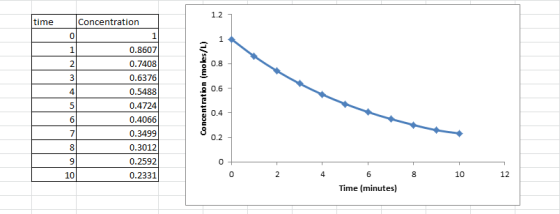
As the plot of concentration v/s time shows that concentration is decreasing with time.
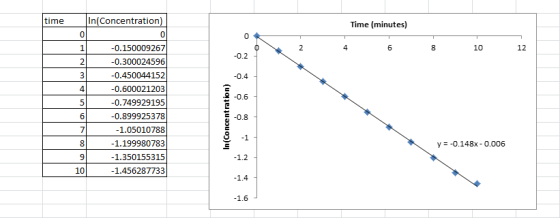
Further plot of natural logarithm of concentration v/s time is a straight line curve with negative slope which confirms that it is a first order reaction.
Answer b)
Slope of ln(concentration) v/s time graph is equal to rate constant.
Slope = change in y-axis/change in x-axis
From ln(concentration) at time = zero and time = 2 minutes,
change in ln(concentration) =- 0.3000 -(0.00) = -0.3000
change in time = 2 minutes
Slope = -0.3000/2 minutes
= -0.1500 minutes-1
This is approximately equal to that from best fit line of the curve.
Negative sign indicates that concentration of reactants is decreasing with time
Rate law = k[A] i.e. rate = (0.1500 minutes-1) [A]
Answer c)
Integrated rate law for first order reaction is ln[Ao] = ln[A] + kt
Here, [Ao] = initial concentration i.e. 1.00 mol/L
[A] = final concentration
k is rate constant = 0.1500 minutes-1
t is time
Case 1: [A] = 0.500 mol/L
ln(1.00) = ln(0.500) + (0.1500 minutes-1)t
0.00 = -0.693 + 0.1500t
t = 4.62 minutes
Case 2: [A] = 0.250 mol/L
ln(1.00) = ln(0.250) + (0.1500 minutes-1)t
0.00 = -1.386 + 0.1500t
t = 9.24 minutes
Case 3: [A] = 0.125 mol/L
ln(1.00) = ln(0.125) + (0.1500 minutes-1)t
0.00 = -2.080 + 0.1500t
t = 13.86 minutes
Answer d)
Half life = 0.693/k
= 0.693/0.1500 minutes-1
= 4.62 minutes
Yes, the values are related to times calculated in c)
It is so because, when concentration drops to 0.500 M, it is halved and takes one half-life.
when concentration drops to 0.250 M, it is one-fourth and takes two half-lives.
when concentration drops to 0.125 M, it is one-eighth and takes four half-lives.
Add Answer to:
1. (a) Plot the concentrations listed below as a function of time. Then, plot any other...
(a) Plot the concentrations listed below as a function of time. Then, plot any other graphs...
(a) Plot the concentrations listed below as a function of time. Then, plot any other graphs required to verify that the data is consistent with a first-order reaction. time concentration (in minutes) (in moles / liter) 0.00 1.0000 1.00 0.8607 2.00 0.7408 3.00 0.6376 4.00 0.5488 5.00 0.4724 6.00 0.4066 7.00 0.3499 8.00 0.3012 9.00 0.2592 10.00 0.2331 (b) Determine the value of the rate constant k. Write an expression for the rate law. (c) Determine the time at which...
Plot the concentrations listed below as a function of time. Then, plot any other graphs required...
Plot the concentrations listed below as a function of time. Then, plot any other graphs required to verify that the data is consistent with a second-order reaction. time Concentration (in minutes) (in moles / liter) 0.00 1.0000 1.00 0.8696 2.00 0.7692 3.00 0.6896 4.00 0.6250 5.00 0.5714 6.00 0.5263 7.00 0.4878 8.00 0.4545 9.00 0.4255 10.00 0.4000 (b) Determine the value of the rate constant k. Write an expression for the rate law. (c) Determine the time at which [A]...
2. Plot the concentrations listed below as a function of time. Then, plot any other graphs...
 2. Plot the concentrations listed below as a function of time. Then, plot any other graphs required to verify that the data is consistent with a second-order reaction. time Concentration (in minutes)(in moles/liter) 0.00 1.0000 1.00 0.8696 2.00 0.7692 3.00 0.6896 4.00 0.6250 5.00 0.5714 6.00 0.5263 7.00 0.4878 8.00 0.4545 9.00 0.4255 10.00 0.40001 (b) Determine the value of the rate constant k. Write an expression for the rate law. (c) Determine the time at which [A] =0.500 mol/L....
The reaction below was monitored as a function of time: AB A + B A plot...
The reaction below was monitored as a function of time: AB A + B A plot of ln[AB] vs. time yields a straight line with slope = -0.0025 sec-1 . a) What is the value of the rate constant (k) for this reaction at this temperature? b) Write the rate law for this reaction. c) What is the half-life (t1/2)? d) If the initial concentration of AB is 0.500 M, what is the concentration after 300 sec?
can you do the 6-12 number 8 is multiple choice 6. The initial rates listed in...
 can
you do the 6-12 number 8 is multiple choice
6. The initial rates listed in the table below were determined for the reaction CO(g) + NO2(g) + CO2(g) + NO(g) at varied concentration of the reactants, CO and NO2. Determine the rate law of this reaction. Experiment Initial [CO] (mol/L) Initial [NO] (mol/L) Initial rate (mol/Ls) 5.0x10+ 3.5x10 3.4x10⁻⁸ 5.0x10+ 7.0x10- 6.8x10⁻⁸ 1.5x10 3.5x10 1.02x10⁻⁷ 7. The half-life of the reaction C&H:(8) ► 2CH.g) at constant temperature is independent...
can
you do the 6-12 number 8 is multiple choice
6. The initial rates listed in the table below were determined for the reaction CO(g) + NO2(g) + CO2(g) + NO(g) at varied concentration of the reactants, CO and NO2. Determine the rate law of this reaction. Experiment Initial [CO] (mol/L) Initial [NO] (mol/L) Initial rate (mol/Ls) 5.0x10+ 3.5x10 3.4x10⁻⁸ 5.0x10+ 7.0x10- 6.8x10⁻⁸ 1.5x10 3.5x10 1.02x10⁻⁷ 7. The half-life of the reaction C&H:(8) ► 2CH.g) at constant temperature is independent...
This reaction was monitored as a function of time: A rightarrow B + C A plot...
 This reaction was monitored as a function of time: A rightarrow B + C A plot of ln[A] versus time yields a straight line with slope -0.0045/s. a. What is the value of the rate constant (k) for this reaction at this temperature? b. Write the rate law for the reaction. c. What is the half-life? d. If the initial concentration of A is 0.250 M, what is the concentration after 225 s?
The following reaction was monitored as a function of time: A→B+C A plot of ln[A] versus...
The following reaction was monitored as a function of time: A→B+C A plot of ln[A] versus time yields a straight line with slope −4.0×10⁻³ /s . What is the value of the rate constant (k) for this reaction at this temperature? Write the rate law for the reaction. What is the half-life? If the initial concentration of A is 0.240 M , what is the concentration after 220 s ?
URGENT please show work and write clearly. Thank you. Use the data above to answer the...
 URGENT please show work and write clearly. Thank you.
Use the data above to answer the questions.
The original Absorbance vs. Time graph
Absorbance vs. Time (min) 035 Ln(Absorbance) vs. Time (min) y = 1.174681-0.0733 R'9.990 Absoba Ice I absorbat) Time in Time (MI) 1/Absorbance vs. Time Y 0.62518x1.79428 R'-0.987 12Absotele ad Ln Time Absorbance 1/Absorbance Absorbance 0 0.3397 -1.07969 2.943774 1.5366 0.2806 -1.27083 3.563792 2.6937 0.255 -1.36649 3.921569 3.7872 0.2271 -1.48236 4.403347 5.0772 0.2105 -1.55827 4.750594 6.6 0.1809 -1.70981...
URGENT please show work and write clearly. Thank you.
Use the data above to answer the questions.
The original Absorbance vs. Time graph
Absorbance vs. Time (min) 035 Ln(Absorbance) vs. Time (min) y = 1.174681-0.0733 R'9.990 Absoba Ice I absorbat) Time in Time (MI) 1/Absorbance vs. Time Y 0.62518x1.79428 R'-0.987 12Absotele ad Ln Time Absorbance 1/Absorbance Absorbance 0 0.3397 -1.07969 2.943774 1.5366 0.2806 -1.27083 3.563792 2.6937 0.255 -1.36649 3.921569 3.7872 0.2271 -1.48236 4.403347 5.0772 0.2105 -1.55827 4.750594 6.6 0.1809 -1.70981...
Which of the following statements is true concerning second order reactions? A. A plot of concentration...
Which of the following statements is true concerning second order reactions? A. A plot of concentration vs. time will be a straight line. B. A plot of the reciprocal of concentration vs. time will be a straight line. C. A plot of ln of the concentration vs. time will be a straight line. D. None of the statements are true. E. The half-life of the reaction may be calculated using the equation: t1/2 = 1/k.
1-The rate constant of a chemical reaction was measured at several temperature values and a plot...
1-The rate constant of a chemical reaction was measured at several temperature values and a plot of ln k (on the y-axis) was plotted against 1/T (on the x-axis, temperature was measured in Kelvin). If the slope of the plot was -9.21 x 10³ K and the y-intercept was 13.0, what is the activation energy (EA) of the reaction in kJ mol-1? 2-In an enzyme-catalyzed reaction, the rate of the reaction depends on which of the following at very low...
 2. Plot the concentrations listed below as a function of time. Then, plot any other graphs required to verify that the data is consistent with a second-order reaction. time Concentration (in minutes)(in moles/liter) 0.00 1.0000 1.00 0.8696 2.00 0.7692 3.00 0.6896 4.00 0.6250 5.00 0.5714 6.00 0.5263 7.00 0.4878 8.00 0.4545 9.00 0.4255 10.00 0.40001 (b) Determine the value of the rate constant k. Write an expression for the rate law. (c) Determine the time at which [A] =0.500 mol/L....
 can
you do the 6-12 number 8 is multiple choice
6. The initial rates listed in the table below were determined for the reaction CO(g) + NO2(g) + CO2(g) + NO(g) at varied concentration of the reactants, CO and NO2. Determine the rate law of this reaction. Experiment Initial [CO] (mol/L) Initial [NO] (mol/L) Initial rate (mol/Ls) 5.0x10+ 3.5x10 3.4x10⁻⁸ 5.0x10+ 7.0x10- 6.8x10⁻⁸ 1.5x10 3.5x10 1.02x10⁻⁷ 7. The half-life of the reaction C&H:(8) ► 2CH.g) at constant temperature is independent...
can
you do the 6-12 number 8 is multiple choice
6. The initial rates listed in the table below were determined for the reaction CO(g) + NO2(g) + CO2(g) + NO(g) at varied concentration of the reactants, CO and NO2. Determine the rate law of this reaction. Experiment Initial [CO] (mol/L) Initial [NO] (mol/L) Initial rate (mol/Ls) 5.0x10+ 3.5x10 3.4x10⁻⁸ 5.0x10+ 7.0x10- 6.8x10⁻⁸ 1.5x10 3.5x10 1.02x10⁻⁷ 7. The half-life of the reaction C&H:(8) ► 2CH.g) at constant temperature is independent...
 This reaction was monitored as a function of time: A rightarrow B + C A plot of ln[A] versus time yields a straight line with slope -0.0045/s. a. What is the value of the rate constant (k) for this reaction at this temperature? b. Write the rate law for the reaction. c. What is the half-life? d. If the initial concentration of A is 0.250 M, what is the concentration after 225 s?
 URGENT please show work and write clearly. Thank you.
Use the data above to answer the questions.
The original Absorbance vs. Time graph
Absorbance vs. Time (min) 035 Ln(Absorbance) vs. Time (min) y = 1.174681-0.0733 R'9.990 Absoba Ice I absorbat) Time in Time (MI) 1/Absorbance vs. Time Y 0.62518x1.79428 R'-0.987 12Absotele ad Ln Time Absorbance 1/Absorbance Absorbance 0 0.3397 -1.07969 2.943774 1.5366 0.2806 -1.27083 3.563792 2.6937 0.255 -1.36649 3.921569 3.7872 0.2271 -1.48236 4.403347 5.0772 0.2105 -1.55827 4.750594 6.6 0.1809 -1.70981...
URGENT please show work and write clearly. Thank you.
Use the data above to answer the questions.
The original Absorbance vs. Time graph
Absorbance vs. Time (min) 035 Ln(Absorbance) vs. Time (min) y = 1.174681-0.0733 R'9.990 Absoba Ice I absorbat) Time in Time (MI) 1/Absorbance vs. Time Y 0.62518x1.79428 R'-0.987 12Absotele ad Ln Time Absorbance 1/Absorbance Absorbance 0 0.3397 -1.07969 2.943774 1.5366 0.2806 -1.27083 3.563792 2.6937 0.255 -1.36649 3.921569 3.7872 0.2271 -1.48236 4.403347 5.0772 0.2105 -1.55827 4.750594 6.6 0.1809 -1.70981...
Most questions answered within 3 hours.
-
Where is the error in this code sequence?
String s1 = "Hello";
String s2 = "ello";...
asked 1 year ago -
Financial data for Joel de Paris, Inc., for last year
follow:
Joel de Paris, Inc.
Balance...
asked 1 year ago -
Consider this reaction:
Al2(SO4)3 (aq)+ BaCl3
(aq) Al2Cl6 (aq)- +
3BaSO4(s) . What is the...
asked 1 year ago -
Suppose that Savneet is considering increasing her
recent random sample from 20 car rentals to 40...
asked 1 year ago -
Trucks arrive at an unloading terminal at an average rate of 120
per hour.
Trucks arrive...
asked 1 year ago -
Why are methanol and ethanol completely soluble in water while
octanol is not very little soluble....
asked 1 year ago -
A facilities manager at a university reads in a research report
that the mean amount of...
asked 1 year ago -
When the CuSO4 is rehydrated by adding water to the anhydrous
compound, is this an endothermic...
asked 1 year ago -
A ray of sunlight is passing from diamond into crown glass; the
angle of incidence is...
asked 1 year ago -
A block of mass 0.249 kg is placed on top of a light, vertical
spring of...
asked 1 year ago -
how do the kidneys compensate in the presences of acidosis
a) trigger hyperventilate
b) reserve acid...
asked 1 year ago -
Question 501 pts
The rental rate of capital to the firm increases. Which of the
following...
asked 1 year ago