
Homework Answers
Request Answer!
We need at least 10 more requests to produce the answer.
0 / 10 have requested this problem solution
The more requests, the faster the answer.
Add Answer to:
Review Coristas Petole Table Natural gas burns in air to form carbon dioxide and water releasinghe...
Natural gas burns in air to form carbon dioxide and water, releasing heat. CH4(g)+2O2(g)→CO2(g)+2H2O(g) ΔHorxn =...
Natural gas burns in air to form carbon dioxide and water, releasing heat. CH4(g)+2O2(g)→CO2(g)+2H2O(g) ΔHorxn = -802.3 kJ You may want to reference (Page 269) Section 6.6 while completing this problem.What minimum mass of CH4 is required to heat 85.0 g of water by 23.0 ∘C? (Assume 100% heating efficiency.) (For water,Cs= 4.18 J/g∘C).
Ethane, a minority component of natural gas, burns to form carbon dioxide and water according to...
 Ethane, a minority component of natural gas, burns to form carbon dioxide and water according to this reaction: 2H,C - CH3(g) + 702(g) +4CO2(g) + 6H2O(g) Note that the average bond energy for the breaking of a bond in CO2 is 799 kJ/mol Use average bond energies to calculate AH.. for this reaction. Η ΑΣΦ « ο ο _ ? ΔΗ,
4) Isooctane burns in air to give water and carbon dioxide (8pts) 2 C,H, + 25...
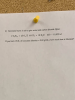 4) Isooctane burns in air to give water and carbon dioxide (8pts) 2 C,H, + 25 0, 0 16 CO, + 18 H,O AH = -10,922 kJ If you burn 15.0L of isooctane (density = 0.69 g/mL), how much heat is liberated?
MISSED THIS? Read Section 7.4 (Pages 272-278), 7.6 (Pages 281-284); Watch KCV 7.4, 7.6, IWE 7.2,...
 MISSED THIS? Read Section 7.4 (Pages 272-278), 7.6 (Pages 281-284); Watch KCV 7.4, 7.6, IWE 7.2, 7.7. Natural gas burns in air to form carbon dioxide and water, releasing heat. CH&(g) +O2(g)->CO2(g) + H20(g) AH 802.3kJ What minimum mass of CH4 is required to heat 50.0 g of water by 24.0 °C? (Assume 100% heating efficiency) (For water.C 4.18 J/g "C). o 10.0 g e 0.100 g o 9.97 g 2.50 x 10 g Request Answer Submit
Ethane, a minority component of natural gas, burns to form carbon dioxide and water according to...
Ethane, a minority component of natural gas, burns to form carbon dioxide and water according to this reaction: 2H3C−CH3(g)+7O2(g)→4CO2(g)+6H2O(g) 2 H 3 C − C H 3 ( g ) + 7 O 2 ( g ) → 4 C O 2 ( g ) + 6 H 2 O ( g ) Note that the average bond energy for the breaking of a bond in CO2 C O 2 is 799 kJ/mol k J / m o l ....
Methane (CH4) burns in air to form carbon dioxide and water as shown below. CH4(g) +...
Methane (CH4) burns in air to form carbon dioxide and water as shown below. CH4(g) + 2 O2(g) → CO2(g) + 2 H2O(l) If a sample of methane occupies 426. mL at 2.31 atm, what volume (in mL) of oxygen gas at the same temperature and pressure is required to complete the reaction?
Liquid heptane, C7H16, burns in oxygen gas to yield carbon dioxide and water. What is the...
Liquid heptane, C7H16, burns in oxygen gas to yield carbon dioxide and water. What is the minimum mass of oxygen required for the complete reaction of 25.5 mL of heptane? (density of heptane = 0.6838 g/mL) a)5.57 g b)8.14 g c)30.6 g d)61.3 g e)89.6 g
Please help with these questions 1. Methane (CH4) burns in air to form carbon dioxide and...
 Please help with these questions
1. Methane (CH4) burns in air to form carbon dioxide
and water as shown below.
CH4(g) + 2 O2(g) → CO2(g) + 2
H2O(l)
If a sample of methane occupies 802. mL at 3.23 atm, what
pressure (in atm) of oxygen gas with the same temperature and
volume is required to complete the reaction?
2. Consider the reaction between hydrogen gas and nitrogen gas
to form ammonia:
3 H2(g) + N2(g) → 2 NH3(g).
What...
Please help with these questions
1. Methane (CH4) burns in air to form carbon dioxide
and water as shown below.
CH4(g) + 2 O2(g) → CO2(g) + 2
H2O(l)
If a sample of methane occupies 802. mL at 3.23 atm, what
pressure (in atm) of oxygen gas with the same temperature and
volume is required to complete the reaction?
2. Consider the reaction between hydrogen gas and nitrogen gas
to form ammonia:
3 H2(g) + N2(g) → 2 NH3(g).
What...
Liquid heptane, C7H16 (100.21 g/mol) burns in oxygen gas to yield carbon dioxide and water. What...
Liquid heptane, C7H16 (100.21 g/mol) burns in oxygen gas to yield carbon dioxide and water. What mass of carbon dioxide (44.01 g/mol) is produced when 10.3 g of heptane burns completely? C7H16 + 11O2 --> 7CO2 +8H2O
18. Propane (CH) burns in oxygen to form carbon dioxide and water. A2.00 sample of propane...
 18. Propane (CH) burns in oxygen to form carbon dioxide and water. A2.00 sample of propane was burned bomb calorimeter whose total heat capacity is 15.77 kJ/K. The temperature of the calorimeter apparatus Inc 6.34 K Calculate the heat of combustion per mole of propane. (a) -221 x 10' /mol (b)-5.00 K TO' 'mol (c)-1.00 x 10' /mol (d) -2.21 x 10' mol (e)-4.41 x 10' mol
 Ethane, a minority component of natural gas, burns to form carbon dioxide and water according to this reaction: 2H,C - CH3(g) + 702(g) +4CO2(g) + 6H2O(g) Note that the average bond energy for the breaking of a bond in CO2 is 799 kJ/mol Use average bond energies to calculate AH.. for this reaction. Η ΑΣΦ « ο ο _ ? ΔΗ,
 4) Isooctane burns in air to give water and carbon dioxide (8pts) 2 C,H, + 25 0, 0 16 CO, + 18 H,O AH = -10,922 kJ If you burn 15.0L of isooctane (density = 0.69 g/mL), how much heat is liberated?
 MISSED THIS? Read Section 7.4 (Pages 272-278), 7.6 (Pages 281-284); Watch KCV 7.4, 7.6, IWE 7.2, 7.7. Natural gas burns in air to form carbon dioxide and water, releasing heat. CH&(g) +O2(g)->CO2(g) + H20(g) AH 802.3kJ What minimum mass of CH4 is required to heat 50.0 g of water by 24.0 °C? (Assume 100% heating efficiency) (For water.C 4.18 J/g "C). o 10.0 g e 0.100 g o 9.97 g 2.50 x 10 g Request Answer Submit
 Please help with these questions
1. Methane (CH4) burns in air to form carbon dioxide
and water as shown below.
CH4(g) + 2 O2(g) → CO2(g) + 2
H2O(l)
If a sample of methane occupies 802. mL at 3.23 atm, what
pressure (in atm) of oxygen gas with the same temperature and
volume is required to complete the reaction?
2. Consider the reaction between hydrogen gas and nitrogen gas
to form ammonia:
3 H2(g) + N2(g) → 2 NH3(g).
What...
Please help with these questions
1. Methane (CH4) burns in air to form carbon dioxide
and water as shown below.
CH4(g) + 2 O2(g) → CO2(g) + 2
H2O(l)
If a sample of methane occupies 802. mL at 3.23 atm, what
pressure (in atm) of oxygen gas with the same temperature and
volume is required to complete the reaction?
2. Consider the reaction between hydrogen gas and nitrogen gas
to form ammonia:
3 H2(g) + N2(g) → 2 NH3(g).
What...
 18. Propane (CH) burns in oxygen to form carbon dioxide and water. A2.00 sample of propane was burned bomb calorimeter whose total heat capacity is 15.77 kJ/K. The temperature of the calorimeter apparatus Inc 6.34 K Calculate the heat of combustion per mole of propane. (a) -221 x 10' /mol (b)-5.00 K TO' 'mol (c)-1.00 x 10' /mol (d) -2.21 x 10' mol (e)-4.41 x 10' mol
Most questions answered within 3 hours.
-
Where is the error in this code sequence?
String s1 = "Hello";
String s2 = "ello";...
asked 11 months ago -
Financial data for Joel de Paris, Inc., for last year
follow:
Joel de Paris, Inc.
Balance...
asked 11 months ago -
Consider this reaction:
Al2(SO4)3 (aq)+ BaCl3
(aq) Al2Cl6 (aq)- +
3BaSO4(s) . What is the...
asked 11 months ago -
Suppose that Savneet is considering increasing her
recent random sample from 20 car rentals to 40...
asked 11 months ago -
Trucks arrive at an unloading terminal at an average rate of 120
per hour.
Trucks arrive...
asked 11 months ago -
Why are methanol and ethanol completely soluble in water while
octanol is not very little soluble....
asked 11 months ago -
A facilities manager at a university reads in a research report
that the mean amount of...
asked 11 months ago -
When the CuSO4 is rehydrated by adding water to the anhydrous
compound, is this an endothermic...
asked 11 months ago -
A ray of sunlight is passing from diamond into crown glass; the
angle of incidence is...
asked 11 months ago -
A block of mass 0.249 kg is placed on top of a light, vertical
spring of...
asked 11 months ago -
how do the kidneys compensate in the presences of acidosis
a) trigger hyperventilate
b) reserve acid...
asked 11 months ago -
Question 501 pts
The rental rate of capital to the firm increases. Which of the
following...
asked 11 months ago