
Homework Answers


Add Answer to:
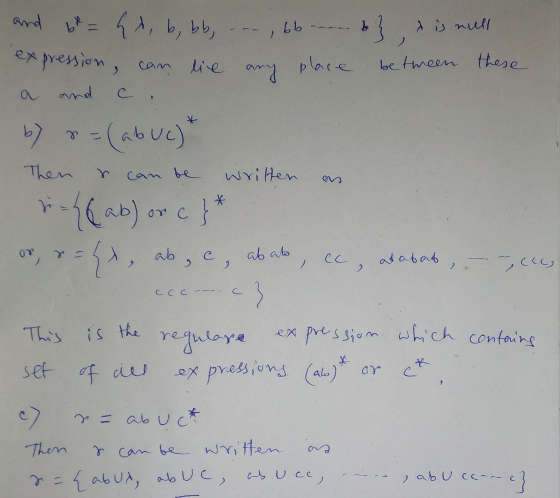
Let A={a,b,c}. Describe the language L(r) for each of the following regular expressions: (a) rFab*c; (b)r=(abuc)*;...
7. 15 Points For a regular expression r, we use L(r) to denote the language it represents. For each of the following regular expressions r, find an NFA that accepts L(r). (b). L((a +b+A) b(a bb)) し(...
 7. 15 Points For a regular expression r, we use L(r) to denote the language it represents. For each of the following regular expressions r, find an NFA that accepts L(r). (b). L((a +b+A) b(a bb)) し(((aa
7. 15 Points For a regular expression r, we use L(r) to denote the language it represents. For each of the following regular expressions r, find an NFA that accepts L(r). (b). L((a +b+A) b(a bb)) し(((aa
7. 15 Points For a regular expression r, we use L(r) to denote the language it represents. For each of the following regular expressions r, find an NFA that accepts L(r). (b). L((a +b+A) b(a bb)) し(((aa
Describe, as precisely as possible, the language generated by each of the following regular expressions. The...
 Describe, as precisely as possible, the language generated by each of the following regular expressions. The alphabet is {a, b} (1) (aaa)* b(bb)* (2) abab(ab)* (3) b (e U a) b (4) a(aa) (bb)* UE*baa
1. For each of the following regular expressions find a language (i.e., a set of strings)...
 1. For each of the following regular expressions find a language (i.e., a set of strings) over A = {a,b,c} that can be represented/described by that expression. (6 points) a. bac + bc b. b*ac + bc C. b*ccca* a. 2. Find a regular expression to describe the given language: {b, ac, bac, bc, ..., b”ac, bc”, ... } (3 points)
Let L be a regular language on sigma = {a, b, d, e}. Let L' be...
 Let L be a regular language on sigma = {a, b, d, e}. Let L' be the set of strings in L that contain the substring aab. Show that L' is a regular language.
3. (8) Let L be the language accepted by the following finite state machine: q0 q1...
 3. (8) Let L be the language accepted by the following finite state machine: q0 q1 q2 q3 Answer Yes or No: Does each of the following regular expressions correctly describe L? (1) (a uba)bb'a (2) (EU b)a(bb%)* (3) ba u ab*a (4) (a ba)(bb*a)*
Prove that for each regular language L the following language is regular: shift(L) = {uv |...
Prove that for each regular language L the following language is regular: shift(L) = {uv | vu ∈ L}
Theoretical Computer Science | Regular Expressions Let R be the regular expression (bba∗a + b) *...
Theoretical Computer Science | Regular Expressions Let R be the regular expression (bba∗a + b) * (a + abb). Give anE-NFA that is equivalent to R. Show all steps and do not simplify.
The grammartofsm algorithm: Let L be the language described by the following regular grammar: a. For...
 The grammartofsm algorithm:
Let L be the language described by the following regular grammar: a. For each of the following strings, indicate whether it is a member of L: v. zyyzz b. Use grammartofsm (Rich 2008; page 157) to construct an FSM that accepts L c. Give a concise (but complete) description of L in plain English. We were unable to transcribe this image
The grammartofsm algorithm:
Let L be the language described by the following regular grammar: a. For each of the following strings, indicate whether it is a member of L: v. zyyzz b. Use grammartofsm (Rich 2008; page 157) to construct an FSM that accepts L c. Give a concise (but complete) description of L in plain English. We were unable to transcribe this image
Let A be a regular language, B = A*, and C = A o B. In...
Let A be a regular language, B = A*, and C = A o B. In each case, argue briefly why. a) Is A = B? b) Is B = C? c) Is C = A?
Give regular expressions for the following languages: (a) The language of all strings over {a,b} except...
Give regular expressions for the following languages: (a) The language of all strings over {a,b} except the empty string. (b) The language of all strings over {a,b} that contain both bab and bba as substrings. (c)L k = {w ∈ {a,b} * | w contains a substring having 3 more b’s than a’s}. (d) The language of all strings over {a,b} that have a b in every odd position (first symbol is considered position 1; empty string should be accepted)...
 7. 15 Points For a regular expression r, we use L(r) to denote the language it represents. For each of the following regular expressions r, find an NFA that accepts L(r). (b). L((a +b+A) b(a bb)) し(((aa
7. 15 Points For a regular expression r, we use L(r) to denote the language it represents. For each of the following regular expressions r, find an NFA that accepts L(r). (b). L((a +b+A) b(a bb)) し(((aa
7. 15 Points For a regular expression r, we use L(r) to denote the language it represents. For each of the following regular expressions r, find an NFA that accepts L(r). (b). L((a +b+A) b(a bb)) し(((aa
 Describe, as precisely as possible, the language generated by each of the following regular expressions. The alphabet is {a, b} (1) (aaa)* b(bb)* (2) abab(ab)* (3) b (e U a) b (4) a(aa) (bb)* UE*baa
 1. For each of the following regular expressions find a language (i.e., a set of strings) over A = {a,b,c} that can be represented/described by that expression. (6 points) a. bac + bc b. b*ac + bc C. b*ccca* a. 2. Find a regular expression to describe the given language: {b, ac, bac, bc, ..., b”ac, bc”, ... } (3 points)
 Let L be a regular language on sigma = {a, b, d, e}. Let L' be the set of strings in L that contain the substring aab. Show that L' is a regular language.
 3. (8) Let L be the language accepted by the following finite state machine: q0 q1 q2 q3 Answer Yes or No: Does each of the following regular expressions correctly describe L? (1) (a uba)bb'a (2) (EU b)a(bb%)* (3) ba u ab*a (4) (a ba)(bb*a)*
 The grammartofsm algorithm:
Let L be the language described by the following regular grammar: a. For each of the following strings, indicate whether it is a member of L: v. zyyzz b. Use grammartofsm (Rich 2008; page 157) to construct an FSM that accepts L c. Give a concise (but complete) description of L in plain English. We were unable to transcribe this image
The grammartofsm algorithm:
Let L be the language described by the following regular grammar: a. For each of the following strings, indicate whether it is a member of L: v. zyyzz b. Use grammartofsm (Rich 2008; page 157) to construct an FSM that accepts L c. Give a concise (but complete) description of L in plain English. We were unable to transcribe this image
Most questions answered within 3 hours.
-
Where is the error in this code sequence?
String s1 = "Hello";
String s2 = "ello";...
asked 11 months ago -
Financial data for Joel de Paris, Inc., for last year
follow:
Joel de Paris, Inc.
Balance...
asked 11 months ago -
Consider this reaction:
Al2(SO4)3 (aq)+ BaCl3
(aq) Al2Cl6 (aq)- +
3BaSO4(s) . What is the...
asked 11 months ago -
Suppose that Savneet is considering increasing her
recent random sample from 20 car rentals to 40...
asked 11 months ago -
Trucks arrive at an unloading terminal at an average rate of 120
per hour.
Trucks arrive...
asked 11 months ago -
Why are methanol and ethanol completely soluble in water while
octanol is not very little soluble....
asked 11 months ago -
A facilities manager at a university reads in a research report
that the mean amount of...
asked 11 months ago -
When the CuSO4 is rehydrated by adding water to the anhydrous
compound, is this an endothermic...
asked 11 months ago -
A ray of sunlight is passing from diamond into crown glass; the
angle of incidence is...
asked 11 months ago -
A block of mass 0.249 kg is placed on top of a light, vertical
spring of...
asked 11 months ago -
how do the kidneys compensate in the presences of acidosis
a) trigger hyperventilate
b) reserve acid...
asked 11 months ago -
Question 501 pts
The rental rate of capital to the firm increases. Which of the
following...
asked 11 months ago