Homework Answers
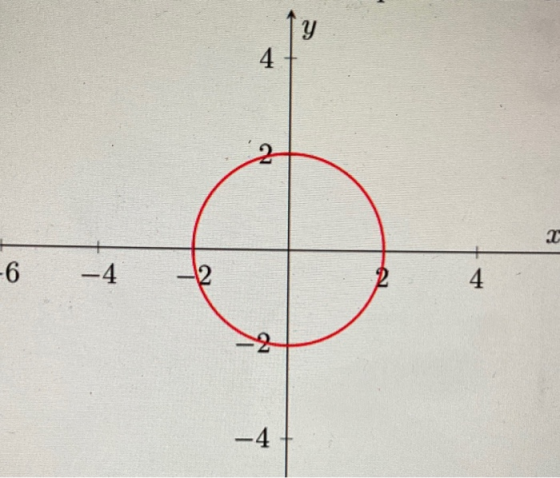
![\mathbf{a.}$From the graph we see that the radius of the circle is 2 and centre is (0,0),therefore the equation of the circle is $ (x-0)^2+(y-0)^2=2^2\\$In Cartesian co-ordinate system we have $ x=rcos\theta ,y=rsin\theta,$ then $ \\x^2+y^2=r^2cos^2\theta+r^2sin^2\theta =2^2\Rightarrow r=2,$this is the polar equation the circle $.\\ \mathbf{b.}$The area bounded by the circle is $ A=\int_{0}^{2\pi}\frac{1}{2}r^2d\theta\\=\frac{1}{2}\int_{0}^{2\pi}2^2d\theta =[2\theta]_{0}^{2\pi}=4\pi\\ \mathbf{c.}$We know $ \frac{dy}{dx}=\frac{\frac{dy}{d\theta}}{\frac{dx}{d\theta}}=\frac{f'(\theta)sin\theta-f(\theta)cos\theta}{f'(\theta)cos\theta-f(\theta)sin\theta}\\$The circle has verticle tangent if $\frac{dx}{d\theta }=0\Rightarrow f'(\theta)cos\theta-f(\theta)sin\theta=0\\$Here $ r=f(\theta)=2,$ then $ f'(\theta)=0\\ $Therefore $ \frac{dx}{d\theta }=0\Rightarrow 2sin\theta=0\Rightarrow sin\theta=0=sin0$ or $ sin\pi\Rightarrow \theta =0,\pi \\$Therefore the required points are (2,0) and $(2,\pi).](http://img.homeworklib.com/questions/29977720-e6f4-11ea-b268-93c6fe1bc4a0.png?x-oss-process=image/resize,w_560)
Add Answer to:
a- find equation in terms of polar coordinates that represent
the figure
b - determine the...
5. (a) Give an equation in polar coordinates that represents the circle below y 4 4...
 5. (a) Give an equation in polar coordinates that represents the circle below y 4 4 6 (b) Find the area contained within the circle given in part (a) by using the definite integral for area in polar coordinates Use the definition of the derivitive in polar coordinates to find the points, (,0), on the circle where vertical tangent lines exist
5. (a) Give an equation in polar coordinates that represents the circle below y 4 4...
 5. (a) Give an equation in polar coordinates that represents the circle below y 4 4 6 (b) Find the area contained within the circle given in part (a) by using the definite integral for area in polar coordinates Use the definition of the derivitive in polar coordinates to find the points, (,0), on the circle where vertical tangent lines exist
5. (a) Give an equation in polar coordinates that represents the circle below y 4 4...
 5. (a) Give an equation in polar coordinates that represents the circle below y 4 4 6 (b) Find the area contained within the circle given in part (a) by using the definite integral for area in polar coordinates Use the definition of the derivitive in polar coordinates to find the points, (,0), on the circle where vertical tangent lines exist
Consider the polar graph r=1-sin theta and r= sin theta, shown below. Please help with B,...
 Consider the polar graph r=1-sin theta and r= sin theta, shown
below.
Please help with B, D, and E
5. Consider the polar graphs r = 1-sin 0 and r = sin 0, shown below. a. Find the polar coordinates (r, 2) for all points of intersection on the figure. Hint: Not all points can be found algebraically. For b.-d., set up an integral that represents the area of the indicated region. b. The region inside of the circle, but...
Consider the polar graph r=1-sin theta and r= sin theta, shown
below.
Please help with B, D, and E
5. Consider the polar graphs r = 1-sin 0 and r = sin 0, shown below. a. Find the polar coordinates (r, 2) for all points of intersection on the figure. Hint: Not all points can be found algebraically. For b.-d., set up an integral that represents the area of the indicated region. b. The region inside of the circle, but...
5. Consider the polar graphs, r = 1-sin θ and r = sin θ , shown in the figure below. Find the p...
 5. Consider the polar graphs, r = 1-sin θ and r = sin θ , shown in the figure below. Find the polar coordinates (r, θ) for all the points of intersection on the figure. a) b) Find the area of the region that lies inside both the graph of r-1-sin θ and Find the slope of the line tangent to the graph of r-1-sin θ at θ-- Find a Cartesian equation for the line tangent to the graph of...
For the polar equation r= 1-sinθ a) Sketch the graph for 0 ≤ t ≤ 2pi b) Find the points on the cardioid where the tangent line is horizontal c)Find the equation of the tangent line when theta=pi/3
For the polar equation r= 1-sinθ a) Sketch the graph for 0 ≤ t ≤ 2pi b) Find the points on the cardioid where the tangent line is horizontal c)Find the equation of the tangent line when theta=pi/3
Use a double integral in polar coordinates to find the area of the region bounded on...
 Use a double integral in polar
coordinates to find the area of the region bounded on the inside by
the circle of radius 5 and on the outside by the cardioid
r=5(1+cos(θ))r=5(1+cos(θ))
Use a double integral in polar
coordinates to find the area of the region bounded on the inside by
the circle of radius 5 and on the outside by the cardioid
r=5(1+cos(θ))r=5(1+cos(θ))
1. The polar curves r@) = 1 + 2 sin(39), r = 2, are graphed below. 2 (a) Find the area inside the larger loops and outside the smaller loops of the graph of r 12 sin(30). [Hint: Use symmetry, the ans...
 1. The polar curves r@) = 1 + 2 sin(39), r = 2, are graphed below. 2 (a) Find the area inside the larger loops and outside the smaller loops of the graph of r 12 sin(30). [Hint: Use symmetry, the answer is 3v3.] [Answer: sf-i.] quadrant where r is maximum? (b) Find the area outside the circle r 2 but inside the curve r 1+2 sin(30) (c) What is the tangent line to the curve r-1+2sin(30) at the point...
just make circle questions which 2,(b) and 3,(i) thank you 2. (Polar Coordinates: Polar Plots). (a) Consider the curve given in polar coordinates (i) Use a scientific calculator to fill in the fol...
 just make circle questions which 2,(b) and 3,(i) thank
you
2. (Polar Coordinates: Polar Plots). (a) Consider the curve given in polar coordinates (i) Use a scientific calculator to fill in the following table with the (approximations of) values of the function r(0) on π, π r(e) (the approximations of the values r(e) must be good to at least two decimal places). (i) Use the graph paper for the polar coordinate system (attached to the assignment sheet) to plot the...
just make circle questions which 2,(b) and 3,(i) thank
you
2. (Polar Coordinates: Polar Plots). (a) Consider the curve given in polar coordinates (i) Use a scientific calculator to fill in the following table with the (approximations of) values of the function r(0) on π, π r(e) (the approximations of the values r(e) must be good to at least two decimal places). (i) Use the graph paper for the polar coordinate system (attached to the assignment sheet) to plot the...
6. (3 pts.) Let R be the region colored in black in the figure below. The two curves bounding R a...
 Any help would be appreciated!
6. (3 pts.) Let R be the region colored in black in the figure below. The two curves bounding R are the circle 12 + y2-= 1 and the curve described in polar coordinates by the equation r-2 sin(20). Set up but do NOT evaluate a (sum of) double integral(s) in polar coordinates to find the area of R. We were unable to transcribe this image
6. (3 pts.) Let R be the region colored...
Any help would be appreciated!
6. (3 pts.) Let R be the region colored in black in the figure below. The two curves bounding R are the circle 12 + y2-= 1 and the curve described in polar coordinates by the equation r-2 sin(20). Set up but do NOT evaluate a (sum of) double integral(s) in polar coordinates to find the area of R. We were unable to transcribe this image
6. (3 pts.) Let R be the region colored...
 5. (a) Give an equation in polar coordinates that represents the circle below y 4 4 6 (b) Find the area contained within the circle given in part (a) by using the definite integral for area in polar coordinates Use the definition of the derivitive in polar coordinates to find the points, (,0), on the circle where vertical tangent lines exist
 5. (a) Give an equation in polar coordinates that represents the circle below y 4 4 6 (b) Find the area contained within the circle given in part (a) by using the definite integral for area in polar coordinates Use the definition of the derivitive in polar coordinates to find the points, (,0), on the circle where vertical tangent lines exist
 5. (a) Give an equation in polar coordinates that represents the circle below y 4 4 6 (b) Find the area contained within the circle given in part (a) by using the definite integral for area in polar coordinates Use the definition of the derivitive in polar coordinates to find the points, (,0), on the circle where vertical tangent lines exist
 Consider the polar graph r=1-sin theta and r= sin theta, shown
below.
Please help with B, D, and E
5. Consider the polar graphs r = 1-sin 0 and r = sin 0, shown below. a. Find the polar coordinates (r, 2) for all points of intersection on the figure. Hint: Not all points can be found algebraically. For b.-d., set up an integral that represents the area of the indicated region. b. The region inside of the circle, but...
Consider the polar graph r=1-sin theta and r= sin theta, shown
below.
Please help with B, D, and E
5. Consider the polar graphs r = 1-sin 0 and r = sin 0, shown below. a. Find the polar coordinates (r, 2) for all points of intersection on the figure. Hint: Not all points can be found algebraically. For b.-d., set up an integral that represents the area of the indicated region. b. The region inside of the circle, but...
 5. Consider the polar graphs, r = 1-sin θ and r = sin θ , shown in the figure below. Find the polar coordinates (r, θ) for all the points of intersection on the figure. a) b) Find the area of the region that lies inside both the graph of r-1-sin θ and Find the slope of the line tangent to the graph of r-1-sin θ at θ-- Find a Cartesian equation for the line tangent to the graph of...
 Use a double integral in polar
coordinates to find the area of the region bounded on the inside by
the circle of radius 5 and on the outside by the cardioid
r=5(1+cos(θ))r=5(1+cos(θ))
Use a double integral in polar
coordinates to find the area of the region bounded on the inside by
the circle of radius 5 and on the outside by the cardioid
r=5(1+cos(θ))r=5(1+cos(θ))
 1. The polar curves r@) = 1 + 2 sin(39), r = 2, are graphed below. 2 (a) Find the area inside the larger loops and outside the smaller loops of the graph of r 12 sin(30). [Hint: Use symmetry, the answer is 3v3.] [Answer: sf-i.] quadrant where r is maximum? (b) Find the area outside the circle r 2 but inside the curve r 1+2 sin(30) (c) What is the tangent line to the curve r-1+2sin(30) at the point...
 just make circle questions which 2,(b) and 3,(i) thank
you
2. (Polar Coordinates: Polar Plots). (a) Consider the curve given in polar coordinates (i) Use a scientific calculator to fill in the following table with the (approximations of) values of the function r(0) on π, π r(e) (the approximations of the values r(e) must be good to at least two decimal places). (i) Use the graph paper for the polar coordinate system (attached to the assignment sheet) to plot the...
just make circle questions which 2,(b) and 3,(i) thank
you
2. (Polar Coordinates: Polar Plots). (a) Consider the curve given in polar coordinates (i) Use a scientific calculator to fill in the following table with the (approximations of) values of the function r(0) on π, π r(e) (the approximations of the values r(e) must be good to at least two decimal places). (i) Use the graph paper for the polar coordinate system (attached to the assignment sheet) to plot the...
 Any help would be appreciated!
6. (3 pts.) Let R be the region colored in black in the figure below. The two curves bounding R are the circle 12 + y2-= 1 and the curve described in polar coordinates by the equation r-2 sin(20). Set up but do NOT evaluate a (sum of) double integral(s) in polar coordinates to find the area of R. We were unable to transcribe this image
6. (3 pts.) Let R be the region colored...
Any help would be appreciated!
6. (3 pts.) Let R be the region colored in black in the figure below. The two curves bounding R are the circle 12 + y2-= 1 and the curve described in polar coordinates by the equation r-2 sin(20). Set up but do NOT evaluate a (sum of) double integral(s) in polar coordinates to find the area of R. We were unable to transcribe this image
6. (3 pts.) Let R be the region colored...
Most questions answered within 3 hours.
-
Where is the error in this code sequence?
String s1 = "Hello";
String s2 = "ello";...
asked 11 months ago -
Financial data for Joel de Paris, Inc., for last year
follow:
Joel de Paris, Inc.
Balance...
asked 11 months ago -
Consider this reaction:
Al2(SO4)3 (aq)+ BaCl3
(aq) Al2Cl6 (aq)- +
3BaSO4(s) . What is the...
asked 11 months ago -
Suppose that Savneet is considering increasing her
recent random sample from 20 car rentals to 40...
asked 11 months ago -
Trucks arrive at an unloading terminal at an average rate of 120
per hour.
Trucks arrive...
asked 11 months ago -
Why are methanol and ethanol completely soluble in water while
octanol is not very little soluble....
asked 11 months ago -
A facilities manager at a university reads in a research report
that the mean amount of...
asked 11 months ago -
When the CuSO4 is rehydrated by adding water to the anhydrous
compound, is this an endothermic...
asked 11 months ago -
A ray of sunlight is passing from diamond into crown glass; the
angle of incidence is...
asked 11 months ago -
A block of mass 0.249 kg is placed on top of a light, vertical
spring of...
asked 11 months ago -
how do the kidneys compensate in the presences of acidosis
a) trigger hyperventilate
b) reserve acid...
asked 11 months ago -
Question 501 pts
The rental rate of capital to the firm increases. Which of the
following...
asked 11 months ago