

Homework Answers
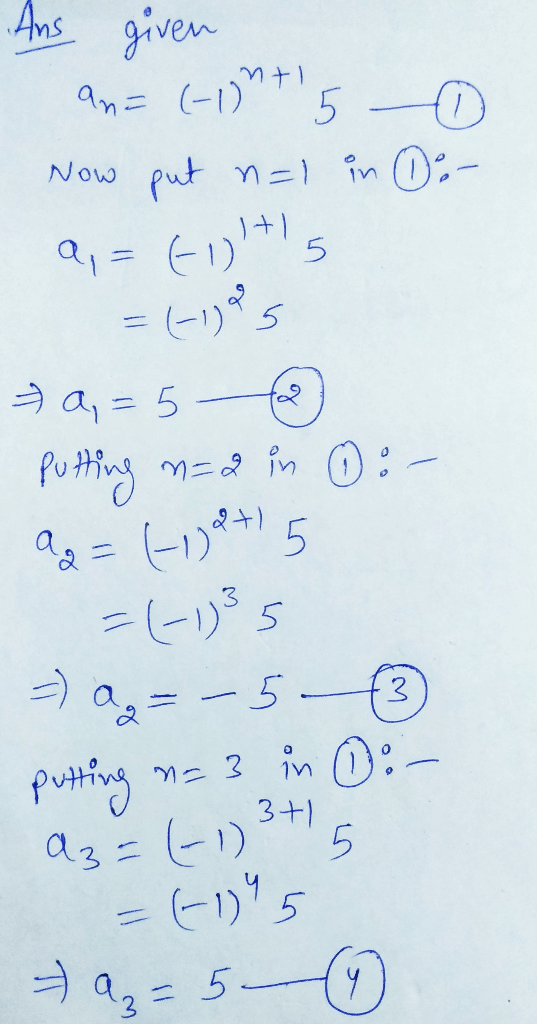
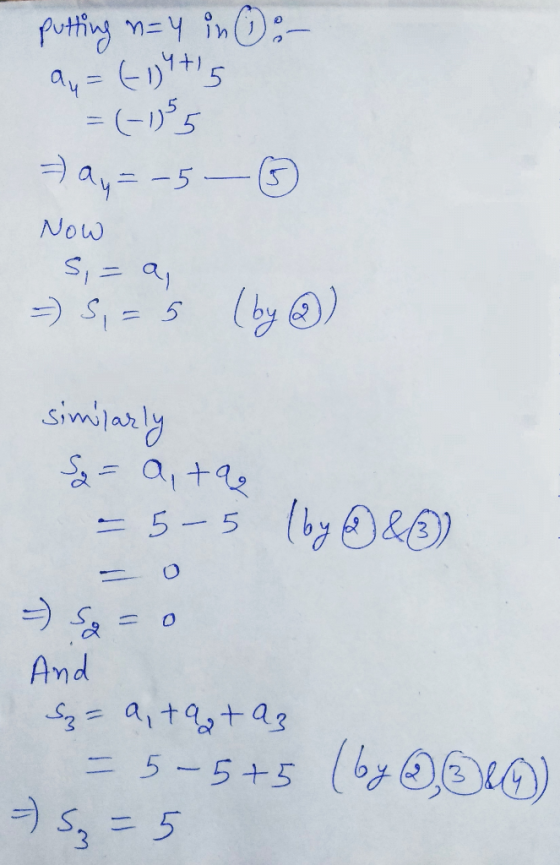
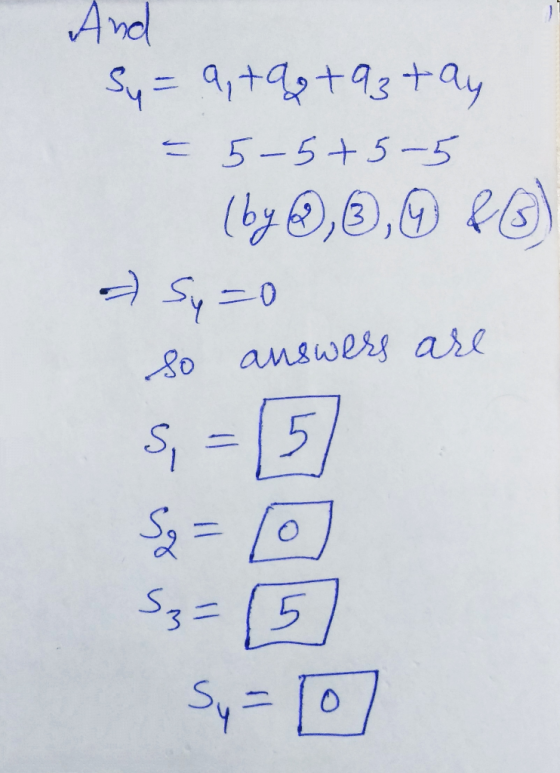
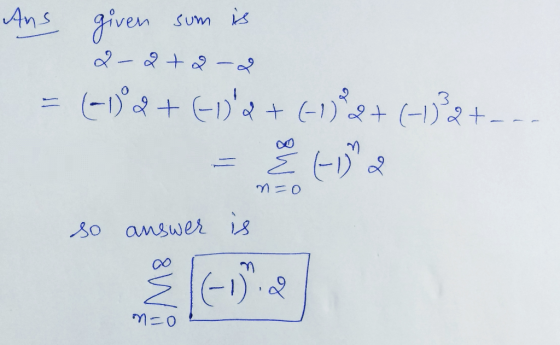
I am attaching the pictures of solution. If you find my answer helpful please press thumbs up button. Thanks
Add Answer to:
Compute the first four partial sums S1, 2=1 as follows. 3 SĄ for the series having...
Find the first four partial sums and the nth partial sum of the sequence an an...
 Find the first four partial sums and the nth partial sum of the sequence an an = 3 4h S1 = II S2 S3 S4 II Sn =
Question 18 Find the first four partial sums and the nth partial sum of the sequence...
 Question 18 Find the first four partial sums and the nth partial sum of the sequence an 2 ܚ | ܀ 4 Give your answers as fractions. Si S2= S3- S4 - S.
Find the first six partial sums S1, S2. S3, S4, S5, S. of the sequence. 1...
 Find the first six partial sums S1, S2. S3, S4, S5, S. of the sequence. 1 1 1 1 3° 32' 33 34 3 Give your answers as fractions. S, = S2 S3 = S4= Ss = So
Find Fourier coefficients for the following function defined on x E [-π, π] Plot the original function and the first three partial sums of the Fourier series S1, S2, S3 on the same plot. Partial sum...
 Find Fourier coefficients for the following function defined on x E [-π, π] Plot the original function and the first three partial sums of the Fourier series S1, S2, S3 on the same plot. Partial sum Sn is the sum of all contributions from the frequencies less than or equal to n, i.e. Sn(x) = a0+ Σ 1 (ak cos(kx) +br sin(kx))
Find Fourier coefficients for the following function defined on x E [-π, π] Plot the original function and...
Find Fourier coefficients for the following function defined on x E [-π, π] Plot the original function and the first three partial sums of the Fourier series S1, S2, S3 on the same plot. Partial sum Sn is the sum of all contributions from the frequencies less than or equal to n, i.e. Sn(x) = a0+ Σ 1 (ak cos(kx) +br sin(kx))
Find Fourier coefficients for the following function defined on x E [-π, π] Plot the original function and...
2. Prove that the infinite series Ex=1(-1)k diverges. (Hint: Compute the first few terms of the...
 2. Prove that the infinite series Ex=1(-1)k diverges. (Hint: Compute the first few terms of the sequence of partial sums and determine a formula for the nth partial sum, Sn. Using this, give a formal proof, starting with the definition for divergence of this series. (Additional reference: Workshop Week #7)
Previous Problem Problem List Next Problem (1 point) Compute the first four partial sums for the...
 Previous Problem Problem List Next Problem (1 point) Compute the first four partial sums for the series 4 sin Enter answers as exact values. help (numbers) help (numbers) help (numbers) S4= help (numbers) Note: You can earn partial credit on this problem Preview My Answers Submit Answers Show me a ll
1. Use the Limit Comparison Test to prove that the series S(a, b) converges unless a or b is a negative integer. Why must this restriction on a and b be imposed? 2. In all that follows we assume with...
 1. Use the Limit Comparison Test to prove that the series S(a, b) converges unless a or b is a negative integer. Why must this restriction on a and b be imposed? 2. In all that follows we assume without losing generality that a >b. Use partial fractions to show that 3. To get warmed up, write the first few terms of the series S(1,0) k(k + I )-4 k--J . Write the nth term of the sequence of partial...
(1 point) Consider the following series. Σε 25 Find the first five partial sums of the...
 (1 point) Consider the following series. Σε 25 Find the first five partial sums of the series. S2 = 2/8 0.4166666
1 4) Consider the infinite series En=1 zn+(-1) a) Find the first four partial sums: Sn...
 1 4) Consider the infinite series En=1 zn+(-1) a) Find the first four partial sums: Sn b) Show that the Ratio Test is inconclusive for this series. c) Use the Root Test to determine the convergence or divergence of the series.
Calculate the first eight terms of the sequence of partial sums correct to four decimal places. 1...
 Calculate the first eight terms of the sequence of partial sums correct to four decimal places. 1 6,0000 3 4 6 7 8 Does it appear that the series is convergent or divergent? convergent divergent Need Help? Read It Talk to a Tutor
Calculate the first eight terms of the sequence of partial sums correct to four decimal places. 1 6,0000 3 4 6 7 8 Does it appear that the series is convergent or divergent? convergent divergent Need Help?...
Calculate the first eight terms of the sequence of partial sums correct to four decimal places. 1 6,0000 3 4 6 7 8 Does it appear that the series is convergent or divergent? convergent divergent Need Help? Read It Talk to a Tutor
Calculate the first eight terms of the sequence of partial sums correct to four decimal places. 1 6,0000 3 4 6 7 8 Does it appear that the series is convergent or divergent? convergent divergent Need Help?...
 Find the first four partial sums and the nth partial sum of the sequence an an = 3 4h S1 = II S2 S3 S4 II Sn =
 Question 18 Find the first four partial sums and the nth partial sum of the sequence an 2 ܚ | ܀ 4 Give your answers as fractions. Si S2= S3- S4 - S.
 Find the first six partial sums S1, S2. S3, S4, S5, S. of the sequence. 1 1 1 1 3° 32' 33 34 3 Give your answers as fractions. S, = S2 S3 = S4= Ss = So
 Find Fourier coefficients for the following function defined on x E [-π, π] Plot the original function and the first three partial sums of the Fourier series S1, S2, S3 on the same plot. Partial sum Sn is the sum of all contributions from the frequencies less than or equal to n, i.e. Sn(x) = a0+ Σ 1 (ak cos(kx) +br sin(kx))
Find Fourier coefficients for the following function defined on x E [-π, π] Plot the original function and...
Find Fourier coefficients for the following function defined on x E [-π, π] Plot the original function and the first three partial sums of the Fourier series S1, S2, S3 on the same plot. Partial sum Sn is the sum of all contributions from the frequencies less than or equal to n, i.e. Sn(x) = a0+ Σ 1 (ak cos(kx) +br sin(kx))
Find Fourier coefficients for the following function defined on x E [-π, π] Plot the original function and...
 2. Prove that the infinite series Ex=1(-1)k diverges. (Hint: Compute the first few terms of the sequence of partial sums and determine a formula for the nth partial sum, Sn. Using this, give a formal proof, starting with the definition for divergence of this series. (Additional reference: Workshop Week #7)
 Previous Problem Problem List Next Problem (1 point) Compute the first four partial sums for the series 4 sin Enter answers as exact values. help (numbers) help (numbers) help (numbers) S4= help (numbers) Note: You can earn partial credit on this problem Preview My Answers Submit Answers Show me a ll
 1. Use the Limit Comparison Test to prove that the series S(a, b) converges unless a or b is a negative integer. Why must this restriction on a and b be imposed? 2. In all that follows we assume without losing generality that a >b. Use partial fractions to show that 3. To get warmed up, write the first few terms of the series S(1,0) k(k + I )-4 k--J . Write the nth term of the sequence of partial...
 (1 point) Consider the following series. Σε 25 Find the first five partial sums of the series. S2 = 2/8 0.4166666
 1 4) Consider the infinite series En=1 zn+(-1) a) Find the first four partial sums: Sn b) Show that the Ratio Test is inconclusive for this series. c) Use the Root Test to determine the convergence or divergence of the series.
 Calculate the first eight terms of the sequence of partial sums correct to four decimal places. 1 6,0000 3 4 6 7 8 Does it appear that the series is convergent or divergent? convergent divergent Need Help? Read It Talk to a Tutor
Calculate the first eight terms of the sequence of partial sums correct to four decimal places. 1 6,0000 3 4 6 7 8 Does it appear that the series is convergent or divergent? convergent divergent Need Help?...
Calculate the first eight terms of the sequence of partial sums correct to four decimal places. 1 6,0000 3 4 6 7 8 Does it appear that the series is convergent or divergent? convergent divergent Need Help? Read It Talk to a Tutor
Calculate the first eight terms of the sequence of partial sums correct to four decimal places. 1 6,0000 3 4 6 7 8 Does it appear that the series is convergent or divergent? convergent divergent Need Help?...
Most questions answered within 3 hours.
-
Where is the error in this code sequence?
String s1 = "Hello";
String s2 = "ello";...
asked 10 months ago -
Financial data for Joel de Paris, Inc., for last year
follow:
Joel de Paris, Inc.
Balance...
asked 10 months ago -
Consider this reaction:
Al2(SO4)3 (aq)+ BaCl3
(aq) Al2Cl6 (aq)- +
3BaSO4(s) . What is the...
asked 10 months ago -
Suppose that Savneet is considering increasing her
recent random sample from 20 car rentals to 40...
asked 10 months ago -
Trucks arrive at an unloading terminal at an average rate of 120
per hour.
Trucks arrive...
asked 10 months ago -
Why are methanol and ethanol completely soluble in water while
octanol is not very little soluble....
asked 10 months ago -
A facilities manager at a university reads in a research report
that the mean amount of...
asked 10 months ago -
When the CuSO4 is rehydrated by adding water to the anhydrous
compound, is this an endothermic...
asked 10 months ago -
A ray of sunlight is passing from diamond into crown glass; the
angle of incidence is...
asked 10 months ago -
A block of mass 0.249 kg is placed on top of a light, vertical
spring of...
asked 10 months ago -
how do the kidneys compensate in the presences of acidosis
a) trigger hyperventilate
b) reserve acid...
asked 10 months ago -
Question 501 pts
The rental rate of capital to the firm increases. Which of the
following...
asked 10 months ago