If M2+ is Ca2+ and Z2- is CO32-, would you raise or lower the pH if...
If M2+ is Ca2+ and Z2- is CO32-, would you raise or lower the pH if you wanted to make a precipitate? Why?
Homework Answers
Answer :
We have to raise the pH (basic conditions) to make more precipitate of CaCO3.
Explanation :
Solubility of CaCO3 increase in acidic conditions because of formation of CO2. Reaction is :
CaCO3 (s) + 2 H+ (aq) ---> Ca2+ (aq) + CO2 (g) + H2O (l)
So in acidic conditions, CaCO3 will dissolve and no precipitate formation. So for precipitate formation we have to reverse the reaction. If we add base then it will consume all H+ and reaction will proceed in backward direction and more and more of precipitate of CaCO3 will produced.
Note : low pH ( 0-7) = acidic conditions
High pH ( 7-14) = basic conditions
At pH 7 = neutral conditions
Add Answer to:
If M2+ is Ca2+ and Z2- is CO32-, would you raise or lower the pH
if...
If M2+ is Ca2+ and Z2- is CO3 2- , would you raise or lower the...
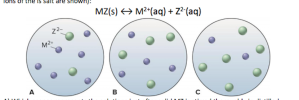 If M2+ is Ca2+ and Z2- is CO3 2- , would you raise or lower the
pH if you wanted to make a precipitate? Why? {Ca(OH)2 is a strong
base and H2CO3 is a weak acid}
ron are shown): MZ(s) 6M2+(aq) + 22-(aq) 22- M2+ A B с
If M2+ is Ca2+ and Z2- is CO3 2- , would you raise or lower the
pH if you wanted to make a precipitate? Why? {Ca(OH)2 is a strong
base and H2CO3 is a weak acid}
ron are shown): MZ(s) 6M2+(aq) + 22-(aq) 22- M2+ A B с
What is the pH at which a buffer composed of CO32- and HCO3- would be most...
What is the pH at which a buffer composed of CO32- and HCO3- would be most effective at resisting pH change? I think the answer is 10.32 but I wanted to check.
You have a solution with Nat (aq), OH (aq), CO32- (aq), and PO43-(aq) in the same...
 You have a solution with Nat (aq), OH (aq), CO32- (aq), and PO43-(aq) in the same container. You have three different solutions available to you: solution A: Ba2+ (aq) and NO3- (aq) solution B: Cu2+ (aq) and NO3(aq) solution C: NH4+ (aq) and NO3- (aq) a. If you add solution A to your mixture, which anion or anions (OH, CO32- or PO43.) would Ba2+ precipitate? Which anion would Ba2+ have no effect on? b. If you add solution B to...
Q2) What is the pH at which a buffer composed of CO32- and HCO3- would be...
Q2) What is the pH at which a buffer composed of CO32- and HCO3- would be most effective at resisting pH change? Round your answer to 2 decimal places. Remember you can find KA and/or KB values in your textbook
Considering each of your suggested reagents (CO32- and OH-) one at a time, would it be...
Considering each of your suggested reagents (CO32- and OH-) one at a time, would it be useful by itself in detecting and/or distinguishing between Ca2+ and Al(H2O)63+ if you knew that only one of these ions was present in the solution? How? (Make sure that you discuss each reagent that you have suggested in enough detail.)
3. Give a simple test that would allow you to distinguish between the following pairs of...
 3. Give a simple test that would allow you to distinguish between the following pairs of anions. Tell what you would do and what you should observe for each anion. a. CO32- and SO42- b. Cl and SO42- c. CO32- and CI 4. Give a simple test that would allow you to distinguish between the following pairs of cations. Tell what you would do and what you should observe for each cation. a. B3+ and Ca2+ b. Ca2+ and Sr+...
Would you expect the pH at the equivalence point to be higher, lower or the same?...
 Would you expect the pH at the equivalence point to be higher,
lower or the same? Explain.
3. If the weak acid titration was repeated with the same weak acid used in this experiment but 150 ml of distilled water was added to the beaker instead of 80 ml, would you expect the pH at the equivalence point to be higher, lower, or the same? Explain.
Would you expect the pH at the equivalence point to be higher,
lower or the same? Explain.
3. If the weak acid titration was repeated with the same weak acid used in this experiment but 150 ml of distilled water was added to the beaker instead of 80 ml, would you expect the pH at the equivalence point to be higher, lower, or the same? Explain.
Suppose you wanted to make a buffer with pH 3.00. What chemicals would you grab off...
Suppose you wanted to make a buffer with pH 3.00. What chemicals would you grab off the shelf and how would you make the buffer?
You are titrating 130.0 mL of 0.050 M Ca2 with 0.050 M EDTA at pH 9.00....
 You are titrating 130.0 mL of 0.050 M Ca2 with 0.050 M EDTA at pH 9.00. Log K for the Ca2 EDTA complex is 10.65, and the fraction of free EDTA in the Y4-form, *. is 0.041 at pH 9.00. (a) What is Kt, the conditional formation constant, for Ca2 at pH 9.00? Number K: (pH 9.00) = 110 (b) What is the equivalence volume, Ve, in milliliters? Number mL (c) Calculate the concentration of Ca+ at V- 1/2 Ve...
16. (a) Determine the concentration of free Ca* at equilibrium in a solution that initially starts with 0.10 M CaY at a pH of 6.00. Note that the formation constant (Kr) for Ca2+ is 4.47x10¹⁰ and...
 16. (a) Determine the concentration of free Ca* at equilibrium in a solution that initially starts with 0.10 M CaY at a pH of 6.00. Note that the formation constant (Kr) for Ca2+ is 4.47x10¹⁰ and the fraction of EDTA in the deprotonated form (av4) at a pH of 6.00 is 1.8x10. (b) Would you expect there to be more or less free Ca2 at a higher pH? (8 pts) Ca2+ + EDTA CaY2
16. (a) Determine the concentration of...
16. (a) Determine the concentration of free Ca* at equilibrium in a solution that initially starts with 0.10 M CaY at a pH of 6.00. Note that the formation constant (Kr) for Ca2+ is 4.47x10¹⁰ and the fraction of EDTA in the deprotonated form (av4) at a pH of 6.00 is 1.8x10. (b) Would you expect there to be more or less free Ca2 at a higher pH? (8 pts) Ca2+ + EDTA CaY2
16. (a) Determine the concentration of...
 If M2+ is Ca2+ and Z2- is CO3 2- , would you raise or lower the
pH if you wanted to make a precipitate? Why? {Ca(OH)2 is a strong
base and H2CO3 is a weak acid}
ron are shown): MZ(s) 6M2+(aq) + 22-(aq) 22- M2+ A B с
If M2+ is Ca2+ and Z2- is CO3 2- , would you raise or lower the
pH if you wanted to make a precipitate? Why? {Ca(OH)2 is a strong
base and H2CO3 is a weak acid}
ron are shown): MZ(s) 6M2+(aq) + 22-(aq) 22- M2+ A B с
 You have a solution with Nat (aq), OH (aq), CO32- (aq), and PO43-(aq) in the same container. You have three different solutions available to you: solution A: Ba2+ (aq) and NO3- (aq) solution B: Cu2+ (aq) and NO3(aq) solution C: NH4+ (aq) and NO3- (aq) a. If you add solution A to your mixture, which anion or anions (OH, CO32- or PO43.) would Ba2+ precipitate? Which anion would Ba2+ have no effect on? b. If you add solution B to...
 3. Give a simple test that would allow you to distinguish between the following pairs of anions. Tell what you would do and what you should observe for each anion. a. CO32- and SO42- b. Cl and SO42- c. CO32- and CI 4. Give a simple test that would allow you to distinguish between the following pairs of cations. Tell what you would do and what you should observe for each cation. a. B3+ and Ca2+ b. Ca2+ and Sr+...
 Would you expect the pH at the equivalence point to be higher,
lower or the same? Explain.
3. If the weak acid titration was repeated with the same weak acid used in this experiment but 150 ml of distilled water was added to the beaker instead of 80 ml, would you expect the pH at the equivalence point to be higher, lower, or the same? Explain.
Would you expect the pH at the equivalence point to be higher,
lower or the same? Explain.
3. If the weak acid titration was repeated with the same weak acid used in this experiment but 150 ml of distilled water was added to the beaker instead of 80 ml, would you expect the pH at the equivalence point to be higher, lower, or the same? Explain.
 You are titrating 130.0 mL of 0.050 M Ca2 with 0.050 M EDTA at pH 9.00. Log K for the Ca2 EDTA complex is 10.65, and the fraction of free EDTA in the Y4-form, *. is 0.041 at pH 9.00. (a) What is Kt, the conditional formation constant, for Ca2 at pH 9.00? Number K: (pH 9.00) = 110 (b) What is the equivalence volume, Ve, in milliliters? Number mL (c) Calculate the concentration of Ca+ at V- 1/2 Ve...
 16. (a) Determine the concentration of free Ca* at equilibrium in a solution that initially starts with 0.10 M CaY at a pH of 6.00. Note that the formation constant (Kr) for Ca2+ is 4.47x10¹⁰ and the fraction of EDTA in the deprotonated form (av4) at a pH of 6.00 is 1.8x10. (b) Would you expect there to be more or less free Ca2 at a higher pH? (8 pts) Ca2+ + EDTA CaY2
16. (a) Determine the concentration of...
16. (a) Determine the concentration of free Ca* at equilibrium in a solution that initially starts with 0.10 M CaY at a pH of 6.00. Note that the formation constant (Kr) for Ca2+ is 4.47x10¹⁰ and the fraction of EDTA in the deprotonated form (av4) at a pH of 6.00 is 1.8x10. (b) Would you expect there to be more or less free Ca2 at a higher pH? (8 pts) Ca2+ + EDTA CaY2
16. (a) Determine the concentration of...
Most questions answered within 3 hours.
-
Where is the error in this code sequence?
String s1 = "Hello";
String s2 = "ello";...
asked 11 months ago -
Financial data for Joel de Paris, Inc., for last year
follow:
Joel de Paris, Inc.
Balance...
asked 11 months ago -
Consider this reaction:
Al2(SO4)3 (aq)+ BaCl3
(aq) Al2Cl6 (aq)- +
3BaSO4(s) . What is the...
asked 11 months ago -
Suppose that Savneet is considering increasing her
recent random sample from 20 car rentals to 40...
asked 11 months ago -
Trucks arrive at an unloading terminal at an average rate of 120
per hour.
Trucks arrive...
asked 11 months ago -
Why are methanol and ethanol completely soluble in water while
octanol is not very little soluble....
asked 11 months ago -
A facilities manager at a university reads in a research report
that the mean amount of...
asked 11 months ago -
When the CuSO4 is rehydrated by adding water to the anhydrous
compound, is this an endothermic...
asked 11 months ago -
A ray of sunlight is passing from diamond into crown glass; the
angle of incidence is...
asked 11 months ago -
A block of mass 0.249 kg is placed on top of a light, vertical
spring of...
asked 11 months ago -
how do the kidneys compensate in the presences of acidosis
a) trigger hyperventilate
b) reserve acid...
asked 11 months ago -
Question 501 pts
The rental rate of capital to the firm increases. Which of the
following...
asked 11 months ago