
Homework Answers
Detailed and step wise solution to this question is provided in the images down below. If you have any doubt regarding solution, you may put a comment, i will definitely help. And if you like the work please give a thumbs up. Thank you!


Add Answer to:
Develop a minimal circuit to solve the 4 variable function below, using a single 8-to-1 multiplexer....
2. Develop a minimal circuit to solve the 4 variable function below, using a single 8-to-1...
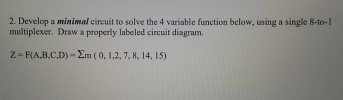 2. Develop a minimal circuit to solve the 4 variable function below, using a single 8-to-1 multiplexer. Draw a properly labeled circuit diagram. Z= F(A,B,C,D) = 2m ( 0, 1,2, 7, 8, 14, 15)
Implement the function F (x,y,z)= (not x)(not z)+ xy using a. One 4-to-1 multiplexer and any...
Implement the function F (x,y,z)= (not x)(not z)+ xy using a. One 4-to-1 multiplexer and any additional inverters. Show your truth-table and justify your choice of select inputs. b. One 2-to-1 multiplexer and the minimal number of gates. Show the truth table used to derive your circuit.
(a) The truth table below shows a certain function F(P,Q,R,S). Implement the function F using an 8:1 multiplexer, withou...
 (a) The truth table below shows a certain function
F(P,Q,R,S).
Implement the function F using an 8:1 multiplexer, without any
other logic gate. Only the constants 0 and 1, and the literals (but
not their complements) are available.
Fill in the inputs in the multiplexer diagram.
(b). Implement the function F
using a 24 decoder and a 4:1 multiplexer, and at most one logic
gate. Only the constants 0 and 1, and the literals (but not their
complements) are available....
(a) The truth table below shows a certain function
F(P,Q,R,S).
Implement the function F using an 8:1 multiplexer, without any
other logic gate. Only the constants 0 and 1, and the literals (but
not their complements) are available.
Fill in the inputs in the multiplexer diagram.
(b). Implement the function F
using a 24 decoder and a 4:1 multiplexer, and at most one logic
gate. Only the constants 0 and 1, and the literals (but not their
complements) are available....
Implement the following Boolean function with an 8 x 1 multiplexer and with variable D as its input.
Implement the following Boolean function with an 8 x 1 multiplexer and with variable D as its input. F(A, B, C, D) = ∑m(2, 4, 6, 9, 10, 11, 15)
Implement Full adder using 8 times 1 multiplexer. Implement Full adder using 4 times 1 multiplexer....
 Implement Full adder using 8 times 1 multiplexer. Implement Full adder using 4 times 1 multiplexer. Show the Implementation adding two (4-bit numbers) using full adders. What is the main difference between pulse-trigger, positive-edge trigger and negative-edge trigger D Flip-flop? Design and implement a sequential circuit that can detect the code "111"with repetition. Show the state diagram, stale table and the circuit.
7. (24 pts.) Implement the following Boolean function with an 8-to-1 multiplexer, a 2-to-4-line d...
 7. (24 pts.) Implement the following Boolean function with an 8-to-1 multiplexer, a 2-to-4-line decoder, 3 x inverters and a OR-gate. (20 pts.) F(A, B, C, D, E) -2 (0,1,2,3,5,6,7,8,9,10,13,14,16,19,23,24)
7. (24 pts.) Implement the following Boolean function with an 8-to-1 multiplexer, a 2-to-4-line decoder, 3 x inverters and a OR-gate. (20 pts.) F(A, B, C, D, E) -2 (0,1,2,3,5,6,7,8,9,10,13,14,16,19,23,24)
7. (24 pts.) Implement the following Boolean function with an 8-to-1 multiplexer, a 2-to-4-line decoder, 3 x inverters and a OR-gate. (20 pts.) F(A, B, C, D, E) -2 (0,1,2,3,5,6,7,8,9,10,13,14,16,19,23,24)
Implement the Boolean function F(w,x,y,z) = Σm(3, 4, 5, 1 1, 12, 13, 14, 15) using a minimum number of NAND gates only.
Implement the Boolean function F(w,x,y,z) = Σm(3, 4, 5, 1 1, 12, 13, 14, 15) using a minimum number of NAND gates only. Write the minimal logic expression (no need to draw the circuit).
Determine the inputs (10, 11, 17) of the 8-to-1 multiplexer shown in Figure 1 such that...
 Determine the inputs (10, 11, 17) of the 8-to-1 multiplexer shown in Figure 1 such that the given multiplexer implements the Boolean function Y(A,B,C,D)= m(1,2,6,7,8,9,13,14). 10 11 12 13 14 15 16 17 S2 S1 So А в с Figure 1 (The symbol 'is corresponding to complement operation. For instance, A' means "complement of A") 10 1. 0 11 2.1 3. A 12 4 A 13 < 5. B 14 6. B с 15 7. < 16 < 9. D...
Using Karnaugh maps, find a minimal sum-of-products expression for each of the following logic functions. F_a...
 Using Karnaugh maps, find a minimal sum-of-products expression for each of the following logic functions. F_a = sigma_w, x, y, z(0, 1, 3, 5, 14) + d(8, 15) F_b = sigma_w, x, y, z(0, 1, 2, 8, 11) + d(3, 9, 15) F_c = sigma_A, B, C, D (4, 6, 7, 9, 13) + d(12) F_d = sigma_W, X, Y, Z (4, 5, 9, 13, 15) + d{0, 1, 7, 11, 12)
Realizing the following functions using only 8-to-1 multiplexer: F_1(x, y, z) = Sigma m(0, 2, 3,...
 Realizing the following functions using only 8-to-1 multiplexer: F_1(x, y, z) = Sigma m(0, 2, 3, 5, 7) F-(x, y, z)=y' + z
 2. Develop a minimal circuit to solve the 4 variable function below, using a single 8-to-1 multiplexer. Draw a properly labeled circuit diagram. Z= F(A,B,C,D) = 2m ( 0, 1,2, 7, 8, 14, 15)
 (a) The truth table below shows a certain function
F(P,Q,R,S).
Implement the function F using an 8:1 multiplexer, without any
other logic gate. Only the constants 0 and 1, and the literals (but
not their complements) are available.
Fill in the inputs in the multiplexer diagram.
(b). Implement the function F
using a 24 decoder and a 4:1 multiplexer, and at most one logic
gate. Only the constants 0 and 1, and the literals (but not their
complements) are available....
(a) The truth table below shows a certain function
F(P,Q,R,S).
Implement the function F using an 8:1 multiplexer, without any
other logic gate. Only the constants 0 and 1, and the literals (but
not their complements) are available.
Fill in the inputs in the multiplexer diagram.
(b). Implement the function F
using a 24 decoder and a 4:1 multiplexer, and at most one logic
gate. Only the constants 0 and 1, and the literals (but not their
complements) are available....
 Implement Full adder using 8 times 1 multiplexer. Implement Full adder using 4 times 1 multiplexer. Show the Implementation adding two (4-bit numbers) using full adders. What is the main difference between pulse-trigger, positive-edge trigger and negative-edge trigger D Flip-flop? Design and implement a sequential circuit that can detect the code "111"with repetition. Show the state diagram, stale table and the circuit.
 7. (24 pts.) Implement the following Boolean function with an 8-to-1 multiplexer, a 2-to-4-line decoder, 3 x inverters and a OR-gate. (20 pts.) F(A, B, C, D, E) -2 (0,1,2,3,5,6,7,8,9,10,13,14,16,19,23,24)
7. (24 pts.) Implement the following Boolean function with an 8-to-1 multiplexer, a 2-to-4-line decoder, 3 x inverters and a OR-gate. (20 pts.) F(A, B, C, D, E) -2 (0,1,2,3,5,6,7,8,9,10,13,14,16,19,23,24)
7. (24 pts.) Implement the following Boolean function with an 8-to-1 multiplexer, a 2-to-4-line decoder, 3 x inverters and a OR-gate. (20 pts.) F(A, B, C, D, E) -2 (0,1,2,3,5,6,7,8,9,10,13,14,16,19,23,24)
 Determine the inputs (10, 11, 17) of the 8-to-1 multiplexer shown in Figure 1 such that the given multiplexer implements the Boolean function Y(A,B,C,D)= m(1,2,6,7,8,9,13,14). 10 11 12 13 14 15 16 17 S2 S1 So А в с Figure 1 (The symbol 'is corresponding to complement operation. For instance, A' means "complement of A") 10 1. 0 11 2.1 3. A 12 4 A 13 < 5. B 14 6. B с 15 7. < 16 < 9. D...
 Using Karnaugh maps, find a minimal sum-of-products expression for each of the following logic functions. F_a = sigma_w, x, y, z(0, 1, 3, 5, 14) + d(8, 15) F_b = sigma_w, x, y, z(0, 1, 2, 8, 11) + d(3, 9, 15) F_c = sigma_A, B, C, D (4, 6, 7, 9, 13) + d(12) F_d = sigma_W, X, Y, Z (4, 5, 9, 13, 15) + d{0, 1, 7, 11, 12)
 Realizing the following functions using only 8-to-1 multiplexer: F_1(x, y, z) = Sigma m(0, 2, 3, 5, 7) F-(x, y, z)=y' + z
Most questions answered within 3 hours.
-
Where is the error in this code sequence?
String s1 = "Hello";
String s2 = "ello";...
asked 10 months ago -
Financial data for Joel de Paris, Inc., for last year
follow:
Joel de Paris, Inc.
Balance...
asked 10 months ago -
Consider this reaction:
Al2(SO4)3 (aq)+ BaCl3
(aq) Al2Cl6 (aq)- +
3BaSO4(s) . What is the...
asked 10 months ago -
Suppose that Savneet is considering increasing her
recent random sample from 20 car rentals to 40...
asked 10 months ago -
Trucks arrive at an unloading terminal at an average rate of 120
per hour.
Trucks arrive...
asked 10 months ago -
Why are methanol and ethanol completely soluble in water while
octanol is not very little soluble....
asked 10 months ago -
A facilities manager at a university reads in a research report
that the mean amount of...
asked 10 months ago -
When the CuSO4 is rehydrated by adding water to the anhydrous
compound, is this an endothermic...
asked 10 months ago -
A ray of sunlight is passing from diamond into crown glass; the
angle of incidence is...
asked 10 months ago -
A block of mass 0.249 kg is placed on top of a light, vertical
spring of...
asked 10 months ago -
how do the kidneys compensate in the presences of acidosis
a) trigger hyperventilate
b) reserve acid...
asked 10 months ago -
Question 501 pts
The rental rate of capital to the firm increases. Which of the
following...
asked 10 months ago