Can someone please explain how to solve the problem below? I keep getting the answer incorrect.
Homework Answers
Answer:
Given that:
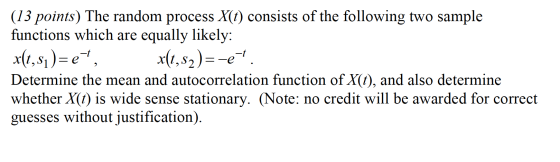
The random process X(t) consists of the following two sample functions which are equally likely:

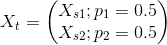
Where  and
and 
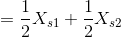
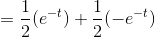
Mean of  ,
, 

Variance of  ,
, ![\sigma _t^2=E[(X_t-\mu _t)^2]](http://img.homeworklib.com/questions/bafda4d0-e76b-11ea-a0d8-615488c7335d.png?x-oss-process=image/resize,w_560)

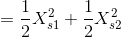
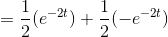

Autocorrelation function of
, ![R_X(t_1,t_2)=\frac{E[(X_{t1}-\mu _{t1})(X_{t2}-\mu _{t2})]}{\sigma _{t1}\sigma _{t2}}](http://img.homeworklib.com/questions/bcc6f330-e76b-11ea-802b-89576c00ee61.png?x-oss-process=image/resize,w_560)
![=\frac{E[X_{t1}X_{t2}]}{e^{-2t_1}e^{-2t_2}}](http://img.homeworklib.com/questions/bd1ea200-e76b-11ea-8e57-1ba0fc1fc7ce.png?x-oss-process=image/resize,w_560)


Covariance of ![X_t=E[(X_{t1}-\mu _{t1})(X_{t2}-\mu _{t2})]](http://img.homeworklib.com/questions/be67c860-e76b-11ea-b8db-a5a9d469b111.png?x-oss-process=image/resize,w_560)
Since,Mean and covariance of
are independent of t
is WSS
Add Answer to:
Can someone please explain how to solve the problem below? I
keep getting the answer incorrect....
(13 points) The random process X(t) consists of the following two sample functions which are equally...
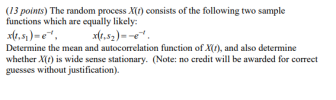 (13 points) The random process X(t) consists of the following two sample functions which are equally likely: x(t,sı)=e?, x(t,52)=-e Determine the mean and autocorrelation function of X(t), and also determine whether X(t) is wide sense stationary. (Note: no credit will be awarded for correct guesses without justification).
Can someone please help solve the problem below? I keep getting the answer incorrect. = (12...
 Can someone please help solve the problem below? I keep getting
the answer incorrect.
= (12 points) The random variables X1, X2, and X3 are jointly Gaussian with the following mean vector and covariance matrix: [4 2 0 = 2 5 -1 0-1 The random variable Y is formed from X1, X2, and X; as follows: Y=X1 - X2 + X: +4. Determine P(Y> 3). X x 3 1
Can someone please help solve the problem below? I keep getting
the answer incorrect.
= (12 points) The random variables X1, X2, and X3 are jointly Gaussian with the following mean vector and covariance matrix: [4 2 0 = 2 5 -1 0-1 The random variable Y is formed from X1, X2, and X; as follows: Y=X1 - X2 + X: +4. Determine P(Y> 3). X x 3 1
Can someone please help solve the problem below? I keep getting the answer incorrect. = (12...
 Can someone please help solve the problem below? I keep getting
the answer incorrect.
= (12 points) The random variables X1, X2, and X3 are jointly Gaussian with the following mean vector and covariance matrix: [4 2 0 = 2 5 -1 0-1 The random variable Y is formed from X1, X2, and X; as follows: Y=X1 - X2 + X: +4. Determine P(Y> 3). X x 3 1
Can someone please help solve the problem below? I keep getting
the answer incorrect.
= (12 points) The random variables X1, X2, and X3 are jointly Gaussian with the following mean vector and covariance matrix: [4 2 0 = 2 5 -1 0-1 The random variable Y is formed from X1, X2, and X; as follows: Y=X1 - X2 + X: +4. Determine P(Y> 3). X x 3 1
Can someone please help solve the problem below? I keep getting the answer incorrect. = (12...
 Can someone please help solve the problem below? I keep getting
the answer incorrect.
= (12 points) The random variables X1, X2, and X3 are jointly Gaussian with the following mean vector and covariance matrix: [4 2 0 = 2 5 -1 0-1 The random variable Y is formed from X1, X2, and X; as follows: Y=X1 - X2 + X: +4. Determine P(Y> 3). X x 3 1
Can someone please help solve the problem below? I keep getting
the answer incorrect.
= (12 points) The random variables X1, X2, and X3 are jointly Gaussian with the following mean vector and covariance matrix: [4 2 0 = 2 5 -1 0-1 The random variable Y is formed from X1, X2, and X; as follows: Y=X1 - X2 + X: +4. Determine P(Y> 3). X x 3 1
Can someone please help solve the problem below? I keep getting the answer incorrect. 12 (13...
 Can someone please help solve the problem below? I keep getting
the answer incorrect.
12 (13 points) The random variables X and Y both have the same mean value of Their joint probability density function is (x+y, 0SX S1, 0 s y si fxy(x, y)= 0, otherwise. Determine the covariance of X and Y.
Can someone please help solve the problem below? I keep getting
the answer incorrect.
12 (13 points) The random variables X and Y both have the same mean value of Their joint probability density function is (x+y, 0SX S1, 0 s y si fxy(x, y)= 0, otherwise. Determine the covariance of X and Y.
Can someone please help solve the problem below? I keep getting the answer incorrect. 12 (13...
 Can someone please help solve the problem below? I keep getting
the answer incorrect.
12 (13 points) The random variables X and Y both have the same mean value of Their joint probability density function is (x+y, 0SX S1, 0 s y si fxy(x, y)= 0, otherwise. Determine the covariance of X and Y.
Can someone please help solve the problem below? I keep getting
the answer incorrect.
12 (13 points) The random variables X and Y both have the same mean value of Their joint probability density function is (x+y, 0SX S1, 0 s y si fxy(x, y)= 0, otherwise. Determine the covariance of X and Y.
Can someone please help solve the problem below? I keep getting the answer incorrect. 12 (13...
 Can someone please help solve the problem below? I keep getting
the answer incorrect.
12 (13 points) The random variables X and Y both have the same mean value of Their joint probability density function is (x+y, 0SX S1, 0 s y si fxy(x, y)= 0, otherwise. Determine the covariance of X and Y.
Can someone please help solve the problem below? I keep getting
the answer incorrect.
12 (13 points) The random variables X and Y both have the same mean value of Their joint probability density function is (x+y, 0SX S1, 0 s y si fxy(x, y)= 0, otherwise. Determine the covariance of X and Y.
Will someone please solve this and explain every single step? I keep getting lost. Thank you!...
 Will someone please solve this and explain every single step? I
keep getting lost. Thank you!
The figure shows the magnetic flux through a single loop coil as a function of time. If phi_0 = 2 times 10^-2 Wb, calculate the induced emf in the coil at the following times. t = 0.05 s Your response differs from the correct answer by more than 10%. Double check your calculations. V t = 0.15 s t = 0.5 s V
Will someone please solve this and explain every single step? I
keep getting lost. Thank you!
The figure shows the magnetic flux through a single loop coil as a function of time. If phi_0 = 2 times 10^-2 Wb, calculate the induced emf in the coil at the following times. t = 0.05 s Your response differs from the correct answer by more than 10%. Double check your calculations. V t = 0.15 s t = 0.5 s V
I keep getting question incorrect. Not sure what I am doing wrong. Can someone please help....
 I keep getting question incorrect. Not sure what I am doing
wrong. Can someone please help.
Answer I got was -4.3225N
Use the data in the table below, which gives the position of a block connected to a horizontal spring at several times, for a block of mass m = 0.290 kg and assume friction is negligible. Time of measurement, t(s) Position of block, x (m) 0 4.75 0.25 3.36 0.50 0 0.75 -3.36 1.00 -4.75 1.25 1 -3.36 1.50...
I keep getting question incorrect. Not sure what I am doing
wrong. Can someone please help.
Answer I got was -4.3225N
Use the data in the table below, which gives the position of a block connected to a horizontal spring at several times, for a block of mass m = 0.290 kg and assume friction is negligible. Time of measurement, t(s) Position of block, x (m) 0 4.75 0.25 3.36 0.50 0 0.75 -3.36 1.00 -4.75 1.25 1 -3.36 1.50...
Can someone please explain to me the solution to this problem! I don't understand the solution,...
 Can someone please explain to me the solution to this
problem! I don't understand the solution, I just need a detail
explanation step by step so I can understand this problem with all
the subparts! Thanks!
3.5 Find the power spectrum for each of the following wide-sense stationary random processes that have the given autocorrelation sequences (a) rx(k) 26(k)j8(k -1)-j(k+1) (b) T(k)(k)2(0.5) (c) T(k)26(k)+cos(Tk/4) (d) rx(k)=' 10 k k< 10 ; otherwise Solutioin (a) This autocorrelation sequence is finite in...
Can someone please explain to me the solution to this
problem! I don't understand the solution, I just need a detail
explanation step by step so I can understand this problem with all
the subparts! Thanks!
3.5 Find the power spectrum for each of the following wide-sense stationary random processes that have the given autocorrelation sequences (a) rx(k) 26(k)j8(k -1)-j(k+1) (b) T(k)(k)2(0.5) (c) T(k)26(k)+cos(Tk/4) (d) rx(k)=' 10 k k< 10 ; otherwise Solutioin (a) This autocorrelation sequence is finite in...
 (13 points) The random process X(t) consists of the following two sample functions which are equally likely: x(t,sı)=e?, x(t,52)=-e Determine the mean and autocorrelation function of X(t), and also determine whether X(t) is wide sense stationary. (Note: no credit will be awarded for correct guesses without justification).
 Can someone please help solve the problem below? I keep getting
the answer incorrect.
= (12 points) The random variables X1, X2, and X3 are jointly Gaussian with the following mean vector and covariance matrix: [4 2 0 = 2 5 -1 0-1 The random variable Y is formed from X1, X2, and X; as follows: Y=X1 - X2 + X: +4. Determine P(Y> 3). X x 3 1
Can someone please help solve the problem below? I keep getting
the answer incorrect.
= (12 points) The random variables X1, X2, and X3 are jointly Gaussian with the following mean vector and covariance matrix: [4 2 0 = 2 5 -1 0-1 The random variable Y is formed from X1, X2, and X; as follows: Y=X1 - X2 + X: +4. Determine P(Y> 3). X x 3 1
 Can someone please help solve the problem below? I keep getting
the answer incorrect.
= (12 points) The random variables X1, X2, and X3 are jointly Gaussian with the following mean vector and covariance matrix: [4 2 0 = 2 5 -1 0-1 The random variable Y is formed from X1, X2, and X; as follows: Y=X1 - X2 + X: +4. Determine P(Y> 3). X x 3 1
Can someone please help solve the problem below? I keep getting
the answer incorrect.
= (12 points) The random variables X1, X2, and X3 are jointly Gaussian with the following mean vector and covariance matrix: [4 2 0 = 2 5 -1 0-1 The random variable Y is formed from X1, X2, and X; as follows: Y=X1 - X2 + X: +4. Determine P(Y> 3). X x 3 1
 Can someone please help solve the problem below? I keep getting
the answer incorrect.
= (12 points) The random variables X1, X2, and X3 are jointly Gaussian with the following mean vector and covariance matrix: [4 2 0 = 2 5 -1 0-1 The random variable Y is formed from X1, X2, and X; as follows: Y=X1 - X2 + X: +4. Determine P(Y> 3). X x 3 1
Can someone please help solve the problem below? I keep getting
the answer incorrect.
= (12 points) The random variables X1, X2, and X3 are jointly Gaussian with the following mean vector and covariance matrix: [4 2 0 = 2 5 -1 0-1 The random variable Y is formed from X1, X2, and X; as follows: Y=X1 - X2 + X: +4. Determine P(Y> 3). X x 3 1
 Can someone please help solve the problem below? I keep getting
the answer incorrect.
12 (13 points) The random variables X and Y both have the same mean value of Their joint probability density function is (x+y, 0SX S1, 0 s y si fxy(x, y)= 0, otherwise. Determine the covariance of X and Y.
Can someone please help solve the problem below? I keep getting
the answer incorrect.
12 (13 points) The random variables X and Y both have the same mean value of Their joint probability density function is (x+y, 0SX S1, 0 s y si fxy(x, y)= 0, otherwise. Determine the covariance of X and Y.
 Can someone please help solve the problem below? I keep getting
the answer incorrect.
12 (13 points) The random variables X and Y both have the same mean value of Their joint probability density function is (x+y, 0SX S1, 0 s y si fxy(x, y)= 0, otherwise. Determine the covariance of X and Y.
Can someone please help solve the problem below? I keep getting
the answer incorrect.
12 (13 points) The random variables X and Y both have the same mean value of Their joint probability density function is (x+y, 0SX S1, 0 s y si fxy(x, y)= 0, otherwise. Determine the covariance of X and Y.
 Can someone please help solve the problem below? I keep getting
the answer incorrect.
12 (13 points) The random variables X and Y both have the same mean value of Their joint probability density function is (x+y, 0SX S1, 0 s y si fxy(x, y)= 0, otherwise. Determine the covariance of X and Y.
Can someone please help solve the problem below? I keep getting
the answer incorrect.
12 (13 points) The random variables X and Y both have the same mean value of Their joint probability density function is (x+y, 0SX S1, 0 s y si fxy(x, y)= 0, otherwise. Determine the covariance of X and Y.
 Will someone please solve this and explain every single step? I
keep getting lost. Thank you!
The figure shows the magnetic flux through a single loop coil as a function of time. If phi_0 = 2 times 10^-2 Wb, calculate the induced emf in the coil at the following times. t = 0.05 s Your response differs from the correct answer by more than 10%. Double check your calculations. V t = 0.15 s t = 0.5 s V
Will someone please solve this and explain every single step? I
keep getting lost. Thank you!
The figure shows the magnetic flux through a single loop coil as a function of time. If phi_0 = 2 times 10^-2 Wb, calculate the induced emf in the coil at the following times. t = 0.05 s Your response differs from the correct answer by more than 10%. Double check your calculations. V t = 0.15 s t = 0.5 s V
 I keep getting question incorrect. Not sure what I am doing
wrong. Can someone please help.
Answer I got was -4.3225N
Use the data in the table below, which gives the position of a block connected to a horizontal spring at several times, for a block of mass m = 0.290 kg and assume friction is negligible. Time of measurement, t(s) Position of block, x (m) 0 4.75 0.25 3.36 0.50 0 0.75 -3.36 1.00 -4.75 1.25 1 -3.36 1.50...
I keep getting question incorrect. Not sure what I am doing
wrong. Can someone please help.
Answer I got was -4.3225N
Use the data in the table below, which gives the position of a block connected to a horizontal spring at several times, for a block of mass m = 0.290 kg and assume friction is negligible. Time of measurement, t(s) Position of block, x (m) 0 4.75 0.25 3.36 0.50 0 0.75 -3.36 1.00 -4.75 1.25 1 -3.36 1.50...
 Can someone please explain to me the solution to this
problem! I don't understand the solution, I just need a detail
explanation step by step so I can understand this problem with all
the subparts! Thanks!
3.5 Find the power spectrum for each of the following wide-sense stationary random processes that have the given autocorrelation sequences (a) rx(k) 26(k)j8(k -1)-j(k+1) (b) T(k)(k)2(0.5) (c) T(k)26(k)+cos(Tk/4) (d) rx(k)=' 10 k k< 10 ; otherwise Solutioin (a) This autocorrelation sequence is finite in...
Can someone please explain to me the solution to this
problem! I don't understand the solution, I just need a detail
explanation step by step so I can understand this problem with all
the subparts! Thanks!
3.5 Find the power spectrum for each of the following wide-sense stationary random processes that have the given autocorrelation sequences (a) rx(k) 26(k)j8(k -1)-j(k+1) (b) T(k)(k)2(0.5) (c) T(k)26(k)+cos(Tk/4) (d) rx(k)=' 10 k k< 10 ; otherwise Solutioin (a) This autocorrelation sequence is finite in...
Most questions answered within 3 hours.
-
Where is the error in this code sequence?
String s1 = "Hello";
String s2 = "ello";...
asked 10 months ago -
Financial data for Joel de Paris, Inc., for last year
follow:
Joel de Paris, Inc.
Balance...
asked 10 months ago -
Consider this reaction:
Al2(SO4)3 (aq)+ BaCl3
(aq) Al2Cl6 (aq)- +
3BaSO4(s) . What is the...
asked 10 months ago -
Suppose that Savneet is considering increasing her
recent random sample from 20 car rentals to 40...
asked 10 months ago -
Trucks arrive at an unloading terminal at an average rate of 120
per hour.
Trucks arrive...
asked 10 months ago -
Why are methanol and ethanol completely soluble in water while
octanol is not very little soluble....
asked 10 months ago -
A facilities manager at a university reads in a research report
that the mean amount of...
asked 10 months ago -
When the CuSO4 is rehydrated by adding water to the anhydrous
compound, is this an endothermic...
asked 10 months ago -
A ray of sunlight is passing from diamond into crown glass; the
angle of incidence is...
asked 10 months ago -
A block of mass 0.249 kg is placed on top of a light, vertical
spring of...
asked 10 months ago -
how do the kidneys compensate in the presences of acidosis
a) trigger hyperventilate
b) reserve acid...
asked 10 months ago -
Question 501 pts
The rental rate of capital to the firm increases. Which of the
following...
asked 10 months ago