
Homework Answers

9 2. For i = 1, ..., k, let T; be open subsets of Rņi and...
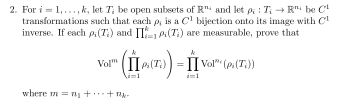 9 2. For i = 1, ..., k, let T; be open subsets of Rņi and let pi: Ti → Rni be Cl transformations such that each pi is a C1 bijection onto its image with C1 inverse. If each pi(T;) and II-1 Pi(Ti) are measurable, prove that ん Vol ( II Pi(T;) II Vol":(pi(T;)) where m= Ni +...+nk:
Let n > 1, and let S = {1, 2, 3}" (the cartesian product of {1,2,3}...
 Let n > 1, and let S = {1, 2, 3}" (the cartesian product of {1,2,3} n times). (a) What is Sl? Give a brief explanation. (b) For 0 <k <n, let T be the set of all elements of S with exactly k occurrences of 3's. Determine |Tx I, and prove it using a bijection. In your solution, you need to define a set Ax that involves subsets and/or cartesian products with known cardinalities. Then clearly define your bijection...
8 arbitrary set. K is Cousider E} n=1 nieU and Let (X, K) be a measure space where X is an sigma-algebra of subsets...
 8 arbitrary set. K is Cousider E} n=1 nieU and Let (X, K) be a measure space where X is an sigma-algebra of subsets of X and is a measure sequenc o clemenis of K We delin lim supn(Fn) liminfn(En)- U then prove: (a) lim in(E)) lim inf(u(E,) (b) T J (c) If sum E,)x, then (lim sup(E)) = 0 x X) <oc lor somc nE N, then lim supn (Fn)> lim sup(u(F,n ))
8 arbitrary set. K is Cousider...
8 arbitrary set. K is Cousider E} n=1 nieU and Let (X, K) be a measure space where X is an sigma-algebra of subsets of X and is a measure sequenc o clemenis of K We delin lim supn(Fn) liminfn(En)- U then prove: (a) lim in(E)) lim inf(u(E,) (b) T J (c) If sum E,)x, then (lim sup(E)) = 0 x X) <oc lor somc nE N, then lim supn (Fn)> lim sup(u(F,n ))
8 arbitrary set. K is Cousider...
Please provide the theorems and definitions you use. 1. Let K be a subgroup of a...
 Please provide the theorems and definitions you use.
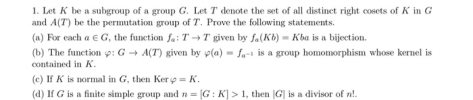
1. Let K be a subgroup of a group G. Let T denote the set of all distinct right cosets of K in G and A(T) be the permutation group of T. Prove the following statements. (a) For each a EG, the function fa:T T given by fa(Kb) = Kba is a bijection. (b) The function : G + A(T) given by pla) = fa-1 is a group homomorphism whose kernel is...
Please provide the theorems and definitions you use.
1. Let K be a subgroup of a group G. Let T denote the set of all distinct right cosets of K in G and A(T) be the permutation group of T. Prove the following statements. (a) For each a EG, the function fa:T T given by fa(Kb) = Kba is a bijection. (b) The function : G + A(T) given by pla) = fa-1 is a group homomorphism whose kernel is...
Topology (a) For each subset A of NV0), define eA є loo such that the k-th component of eA is 1 if k є A and 0 otherwise. Define B-(Bde (eA; 1/2) : A N\ {0)). Recall I. (i) If AメB are subsets of N \...
 Topology
(a) For each subset A of NV0), define eA є loo such that the k-th component of eA is 1 if k є A and 0 otherwise. Define B-(Bde (eA; 1/2) : A N\ {0)). Recall I. (i) If AメB are subsets of N \ {0), find the value of doc (eA, eB). (ii) Show that B is a collection of disjoint open balls in 100. iii) By quoting relevant results, justify whether or not the collection B is...
Topology
(a) For each subset A of NV0), define eA є loo such that the k-th component of eA is 1 if k є A and 0 otherwise. Define B-(Bde (eA; 1/2) : A N\ {0)). Recall I. (i) If AメB are subsets of N \ {0), find the value of doc (eA, eB). (ii) Show that B is a collection of disjoint open balls in 100. iii) By quoting relevant results, justify whether or not the collection B is...
Please help, and provide some explanation if possible! Thank you :) (1) Answer the following questions (a) Let T : R3 → R2 be such that (i) Find a matrix A such that T(E) Az. (i) Find T(2,-3,5). (iii...
 Please help, and provide some explanation if possible! Thank you
:)
(1) Answer the following questions (a) Let T : R3 → R2 be such that (i) Find a matrix A such that T(E) Az. (i) Find T(2,-3,5). (iii) Is the transformation T invertible? YES No (b) The smiley face shown at the top of the figure is transformed by various linear transformations represented by matrices A - F. Find out which matrix does which transformation. Write the letter of...
Please help, and provide some explanation if possible! Thank you
:)
(1) Answer the following questions (a) Let T : R3 → R2 be such that (i) Find a matrix A such that T(E) Az. (i) Find T(2,-3,5). (iii) Is the transformation T invertible? YES No (b) The smiley face shown at the top of the figure is transformed by various linear transformations represented by matrices A - F. Find out which matrix does which transformation. Write the letter of...
I need help trying to understand what (S1) and (S2) are saying. Maybe in other words or pictures because the book is more confusing 3.1.1. Let M CR" be a nonempty set and 1 s k n. Then k . Then...
 I need help trying to understand what (S1) and (S2) are saying.
Maybe in other words or pictures because the book is more
confusing
3.1.1. Let M CR" be a nonempty set and 1 s k n. Then k . Then M is a -dimensional regular surface (briefly, regul each point xo there ar kf class CP (p)i nd amapping of class C e M there exist an open set AC such that (SI) there exists an open set U...
I need help trying to understand what (S1) and (S2) are saying.
Maybe in other words or pictures because the book is more
confusing
3.1.1. Let M CR" be a nonempty set and 1 s k n. Then k . Then M is a -dimensional regular surface (briefly, regul each point xo there ar kf class CP (p)i nd amapping of class C e M there exist an open set AC such that (SI) there exists an open set U...
Can someone please check to see if I am doing this right? Please write legibly if...
 Can someone please check to see if I am doing this right? Please
write legibly if you post revisions in comments, thank you!
(5) Let A {q, r, s, t and B = {17, 18, 19, 20}. Determine which of the following are functions. Explain why or why not. а. fSAX В, where f — 1. q, 17), (r, 18), (s, 19), (s, 20) Answer: this is a function because in function 'f element 's' is related to 1 element...
Can someone please check to see if I am doing this right? Please
write legibly if you post revisions in comments, thank you!
(5) Let A {q, r, s, t and B = {17, 18, 19, 20}. Determine which of the following are functions. Explain why or why not. а. fSAX В, where f — 1. q, 17), (r, 18), (s, 19), (s, 20) Answer: this is a function because in function 'f element 's' is related to 1 element...
Can someone please tell me what chapters (1-5) these questions are based on? I have already answered the questions and u...
 Can someone please tell me what chapters (1-5) these questions
are based on? I have already answered the questions and understand
how to solve the material, but i want to be able to pinpoint where
i can find this info. in the book. I am using Brigham’s
Fundamentals of Financial Management (pictures attached). If it is
hard to read, please let me know. i will post better pictures. i
know the time vale of money stuff already
EDIT: HERE IS...
Can someone please tell me what chapters (1-5) these questions
are based on? I have already answered the questions and understand
how to solve the material, but i want to be able to pinpoint where
i can find this info. in the book. I am using Brigham’s
Fundamentals of Financial Management (pictures attached). If it is
hard to read, please let me know. i will post better pictures. i
know the time vale of money stuff already
EDIT: HERE IS...
1) Discuss the company's top risks? 2) Discuss whether the company treats risk reactively or proactively?...
 1) Discuss the company's top risks? 2) Discuss whether the company treats risk reactively or proactively? 3) Do you observe a lack of understanding of potential exposures? 4) Does the company focus on internal risks or external risks? 5) Do you think the company is well prepared to respond to potential risks? Orange County he t die Following the debocie Orange County o dmorych of control procedures and financial gove nonce and d e setof o n policies December 1994...
 9 2. For i = 1, ..., k, let T; be open subsets of Rņi and let pi: Ti → Rni be Cl transformations such that each pi is a C1 bijection onto its image with C1 inverse. If each pi(T;) and II-1 Pi(Ti) are measurable, prove that ん Vol ( II Pi(T;) II Vol":(pi(T;)) where m= Ni +...+nk:
 Let n > 1, and let S = {1, 2, 3}" (the cartesian product of {1,2,3} n times). (a) What is Sl? Give a brief explanation. (b) For 0 <k <n, let T be the set of all elements of S with exactly k occurrences of 3's. Determine |Tx I, and prove it using a bijection. In your solution, you need to define a set Ax that involves subsets and/or cartesian products with known cardinalities. Then clearly define your bijection...
 8 arbitrary set. K is Cousider E} n=1 nieU and Let (X, K) be a measure space where X is an sigma-algebra of subsets of X and is a measure sequenc o clemenis of K We delin lim supn(Fn) liminfn(En)- U then prove: (a) lim in(E)) lim inf(u(E,) (b) T J (c) If sum E,)x, then (lim sup(E)) = 0 x X) <oc lor somc nE N, then lim supn (Fn)> lim sup(u(F,n ))
8 arbitrary set. K is Cousider...
8 arbitrary set. K is Cousider E} n=1 nieU and Let (X, K) be a measure space where X is an sigma-algebra of subsets of X and is a measure sequenc o clemenis of K We delin lim supn(Fn) liminfn(En)- U then prove: (a) lim in(E)) lim inf(u(E,) (b) T J (c) If sum E,)x, then (lim sup(E)) = 0 x X) <oc lor somc nE N, then lim supn (Fn)> lim sup(u(F,n ))
8 arbitrary set. K is Cousider...
 Please provide the theorems and definitions you use.
1. Let K be a subgroup of a group G. Let T denote the set of all distinct right cosets of K in G and A(T) be the permutation group of T. Prove the following statements. (a) For each a EG, the function fa:T T given by fa(Kb) = Kba is a bijection. (b) The function : G + A(T) given by pla) = fa-1 is a group homomorphism whose kernel is...
Please provide the theorems and definitions you use.
1. Let K be a subgroup of a group G. Let T denote the set of all distinct right cosets of K in G and A(T) be the permutation group of T. Prove the following statements. (a) For each a EG, the function fa:T T given by fa(Kb) = Kba is a bijection. (b) The function : G + A(T) given by pla) = fa-1 is a group homomorphism whose kernel is...
 Topology
(a) For each subset A of NV0), define eA є loo such that the k-th component of eA is 1 if k є A and 0 otherwise. Define B-(Bde (eA; 1/2) : A N\ {0)). Recall I. (i) If AメB are subsets of N \ {0), find the value of doc (eA, eB). (ii) Show that B is a collection of disjoint open balls in 100. iii) By quoting relevant results, justify whether or not the collection B is...
Topology
(a) For each subset A of NV0), define eA є loo such that the k-th component of eA is 1 if k є A and 0 otherwise. Define B-(Bde (eA; 1/2) : A N\ {0)). Recall I. (i) If AメB are subsets of N \ {0), find the value of doc (eA, eB). (ii) Show that B is a collection of disjoint open balls in 100. iii) By quoting relevant results, justify whether or not the collection B is...
 Please help, and provide some explanation if possible! Thank you
:)
(1) Answer the following questions (a) Let T : R3 → R2 be such that (i) Find a matrix A such that T(E) Az. (i) Find T(2,-3,5). (iii) Is the transformation T invertible? YES No (b) The smiley face shown at the top of the figure is transformed by various linear transformations represented by matrices A - F. Find out which matrix does which transformation. Write the letter of...
Please help, and provide some explanation if possible! Thank you
:)
(1) Answer the following questions (a) Let T : R3 → R2 be such that (i) Find a matrix A such that T(E) Az. (i) Find T(2,-3,5). (iii) Is the transformation T invertible? YES No (b) The smiley face shown at the top of the figure is transformed by various linear transformations represented by matrices A - F. Find out which matrix does which transformation. Write the letter of...
 I need help trying to understand what (S1) and (S2) are saying.
Maybe in other words or pictures because the book is more
confusing
3.1.1. Let M CR" be a nonempty set and 1 s k n. Then k . Then M is a -dimensional regular surface (briefly, regul each point xo there ar kf class CP (p)i nd amapping of class C e M there exist an open set AC such that (SI) there exists an open set U...
I need help trying to understand what (S1) and (S2) are saying.
Maybe in other words or pictures because the book is more
confusing
3.1.1. Let M CR" be a nonempty set and 1 s k n. Then k . Then M is a -dimensional regular surface (briefly, regul each point xo there ar kf class CP (p)i nd amapping of class C e M there exist an open set AC such that (SI) there exists an open set U...
 Can someone please check to see if I am doing this right? Please
write legibly if you post revisions in comments, thank you!
(5) Let A {q, r, s, t and B = {17, 18, 19, 20}. Determine which of the following are functions. Explain why or why not. а. fSAX В, where f — 1. q, 17), (r, 18), (s, 19), (s, 20) Answer: this is a function because in function 'f element 's' is related to 1 element...
Can someone please check to see if I am doing this right? Please
write legibly if you post revisions in comments, thank you!
(5) Let A {q, r, s, t and B = {17, 18, 19, 20}. Determine which of the following are functions. Explain why or why not. а. fSAX В, where f — 1. q, 17), (r, 18), (s, 19), (s, 20) Answer: this is a function because in function 'f element 's' is related to 1 element...
 Can someone please tell me what chapters (1-5) these questions
are based on? I have already answered the questions and understand
how to solve the material, but i want to be able to pinpoint where
i can find this info. in the book. I am using Brigham’s
Fundamentals of Financial Management (pictures attached). If it is
hard to read, please let me know. i will post better pictures. i
know the time vale of money stuff already
EDIT: HERE IS...
Can someone please tell me what chapters (1-5) these questions
are based on? I have already answered the questions and understand
how to solve the material, but i want to be able to pinpoint where
i can find this info. in the book. I am using Brigham’s
Fundamentals of Financial Management (pictures attached). If it is
hard to read, please let me know. i will post better pictures. i
know the time vale of money stuff already
EDIT: HERE IS...
 1) Discuss the company's top risks? 2) Discuss whether the company treats risk reactively or proactively? 3) Do you observe a lack of understanding of potential exposures? 4) Does the company focus on internal risks or external risks? 5) Do you think the company is well prepared to respond to potential risks? Orange County he t die Following the debocie Orange County o dmorych of control procedures and financial gove nonce and d e setof o n policies December 1994...
Most questions answered within 3 hours.
-
Where is the error in this code sequence?
String s1 = "Hello";
String s2 = "ello";...
asked 11 months ago -
Financial data for Joel de Paris, Inc., for last year
follow:
Joel de Paris, Inc.
Balance...
asked 11 months ago -
Consider this reaction:
Al2(SO4)3 (aq)+ BaCl3
(aq) Al2Cl6 (aq)- +
3BaSO4(s) . What is the...
asked 11 months ago -
Suppose that Savneet is considering increasing her
recent random sample from 20 car rentals to 40...
asked 11 months ago -
Trucks arrive at an unloading terminal at an average rate of 120
per hour.
Trucks arrive...
asked 11 months ago -
Why are methanol and ethanol completely soluble in water while
octanol is not very little soluble....
asked 11 months ago -
A facilities manager at a university reads in a research report
that the mean amount of...
asked 11 months ago -
When the CuSO4 is rehydrated by adding water to the anhydrous
compound, is this an endothermic...
asked 11 months ago -
A ray of sunlight is passing from diamond into crown glass; the
angle of incidence is...
asked 11 months ago -
A block of mass 0.249 kg is placed on top of a light, vertical
spring of...
asked 11 months ago -
how do the kidneys compensate in the presences of acidosis
a) trigger hyperventilate
b) reserve acid...
asked 11 months ago -
Question 501 pts
The rental rate of capital to the firm increases. Which of the
following...
asked 11 months ago