(a + b) * c / d % e In what order are operators applied in...
(a + b) * c / d % e In what order are operators applied in the expression above?
Homework Answers
Ans:-
order of operation in above case:-
+ * / %
paranthesis is evaluated first
* / % having same precedence
And their associativity is from left to right
Then * is evaluated
Then / is evaluated
Then % is evaluated
If any doubt ask in the comments.
Given that A, B, C, and D are operands; and *, +, and - are operators...
Given that A, B, C, and D are operands; and *, +, and - are operators Use Step 3 of the Reverse Polish Notation algorithm to convert the following postfix expression to infix expression: A B + C D - * Show your working.
1. Simplify the Boolean expression (A+B+C)(D+E)' + (A+B+C)(D+E) and choose the best answer. 1. A+B+C 2....
 1. Simplify the Boolean expression (A+B+C)(D+E)' + (A+B+C)(D+E) and choose the best answer. 1. A+B+C 2. D+E 3. A'B'C' 4. D'E 5. None of the above
A(n) ___________, is evaluated before the relational operators. A. arithmetic operator B. relational quantifier C. conditional...
A(n) ___________, is evaluated before the relational operators. A. arithmetic operator B. relational quantifier C. conditional expression D. NOT operators
What logical operators require that a record meet all the individual conditions specified in order to...
What logical operators require that a record meet all the individual conditions specified in order to be included in the results? A. AND B. OR C. NOT D. NULL
1. Operators should always be evaluated in what order? a arithmetic, logical, comparison b arithmetic, comparison,...
1. Operators should always be evaluated in what order? a arithmetic, logical, comparison b arithmetic, comparison, logical c logical, arithmetic, comparison d logical, comparison, arithmetic 2. Adding increments of a negative number is referred to as ____. a decrementing b initializing c deprocessing d negating 3. An independent Sub procedure is processed only when a statement in your code calls it. a True b False
Write a logic expression for: a. m13 (A,B,C,D,E) b. M6 (A,B,C,D,E)
Write a logic expression for: a. m13 (A,B,C,D,E) b. M6 (A,B,C,D,E)
Rank the following compounds in order of increasing heat of hydrogenation. A B D E OB<C<E<A<D...
 Rank the following compounds in order of increasing heat of hydrogenation. A B D E OB<C<E<A<D OD A<E<C<B OB«E<C<A<D O E<B<C<A<D O DA<C<<
Rank the following compounds in order of increasing heat of hydrogenation. A C D E OD<A<C<E<B...
 Rank the following compounds in order of increasing heat of hydrogenation. A C D E OD<A<C<E<B B<E<C<A<D O E<B<C<A<D OD A<E<C<B OB<C<E<A<D
A = ∅, B = {∅, ∅}, C = {{∅}}, D = {{∅}, ∅}, E =...
A = ∅, B = {∅, ∅}, C = {{∅}}, D = {{∅}, ∅}, E = {∅, {∅}, {∅, {∅}}, {∅, {∅}, {∅, {∅}}}}. (a) Determine the cardinality of each of the sets above. (b) Write out the power set of each of the sets above. (c) What are A ∩ B, A ∪ B, C ∩ D, C ∪ D, E − D, D − E, (D ∩ C) ∪ B (d) What are A × B, B ×...
In C language OfCs many operators, Standard C specifies the order of evaluation of the operands...
 In
C language
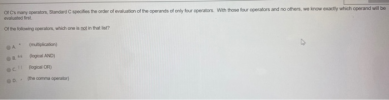
OfCs many operators, Standard C specifies the order of evaluation of the operands of only four operators. With those four operators and no others, we know exactly which operand will be evaluated first of the following operators, which one is not in that ist? A B multiplication) logical AND) logical ORI the comme operator) ocll The strncpy(char *81, const char *32, int n) function, which takes a numeric input parameter "n" that defines how many characters will...
In
C language
OfCs many operators, Standard C specifies the order of evaluation of the operands of only four operators. With those four operators and no others, we know exactly which operand will be evaluated first of the following operators, which one is not in that ist? A B multiplication) logical AND) logical ORI the comme operator) ocll The strncpy(char *81, const char *32, int n) function, which takes a numeric input parameter "n" that defines how many characters will...
 1. Simplify the Boolean expression (A+B+C)(D+E)' + (A+B+C)(D+E) and choose the best answer. 1. A+B+C 2. D+E 3. A'B'C' 4. D'E 5. None of the above
 Rank the following compounds in order of increasing heat of hydrogenation. A B D E OB<C<E<A<D OD A<E<C<B OB«E<C<A<D O E<B<C<A<D O DA<C<<
 Rank the following compounds in order of increasing heat of hydrogenation. A C D E OD<A<C<E<B B<E<C<A<D O E<B<C<A<D OD A<E<C<B OB<C<E<A<D
 In
C language
OfCs many operators, Standard C specifies the order of evaluation of the operands of only four operators. With those four operators and no others, we know exactly which operand will be evaluated first of the following operators, which one is not in that ist? A B multiplication) logical AND) logical ORI the comme operator) ocll The strncpy(char *81, const char *32, int n) function, which takes a numeric input parameter "n" that defines how many characters will...
In
C language
OfCs many operators, Standard C specifies the order of evaluation of the operands of only four operators. With those four operators and no others, we know exactly which operand will be evaluated first of the following operators, which one is not in that ist? A B multiplication) logical AND) logical ORI the comme operator) ocll The strncpy(char *81, const char *32, int n) function, which takes a numeric input parameter "n" that defines how many characters will...
Most questions answered within 3 hours.
-
Where is the error in this code sequence?
String s1 = "Hello";
String s2 = "ello";...
asked 10 months ago -
Financial data for Joel de Paris, Inc., for last year
follow:
Joel de Paris, Inc.
Balance...
asked 10 months ago -
Consider this reaction:
Al2(SO4)3 (aq)+ BaCl3
(aq) Al2Cl6 (aq)- +
3BaSO4(s) . What is the...
asked 10 months ago -
Suppose that Savneet is considering increasing her
recent random sample from 20 car rentals to 40...
asked 10 months ago -
Trucks arrive at an unloading terminal at an average rate of 120
per hour.
Trucks arrive...
asked 10 months ago -
Why are methanol and ethanol completely soluble in water while
octanol is not very little soluble....
asked 10 months ago -
A facilities manager at a university reads in a research report
that the mean amount of...
asked 10 months ago -
When the CuSO4 is rehydrated by adding water to the anhydrous
compound, is this an endothermic...
asked 10 months ago -
A ray of sunlight is passing from diamond into crown glass; the
angle of incidence is...
asked 10 months ago -
A block of mass 0.249 kg is placed on top of a light, vertical
spring of...
asked 10 months ago -
how do the kidneys compensate in the presences of acidosis
a) trigger hyperventilate
b) reserve acid...
asked 10 months ago -
Question 501 pts
The rental rate of capital to the firm increases. Which of the
following...
asked 10 months ago