
Homework Answers
Add Answer to:
Problem 3. How many lines, as a function of n (in O.) form), does the following...
Can I please get help with this question? Problem 3. How many lines, as a function...
 Can I please get help with this question?
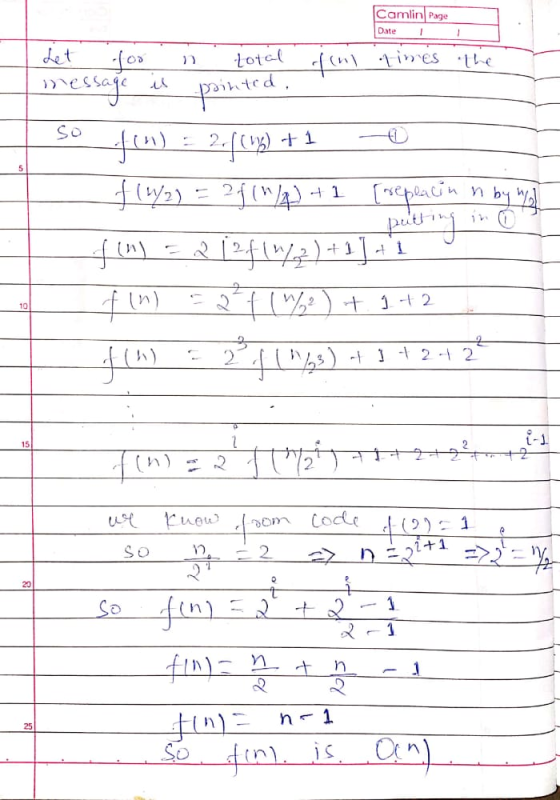
Problem 3. How many lines, as a function of n (in 0(.) form), does the following program print? Write a recurrence and solve it. You may assume n is a power of 2. function f(n) { If (n>1) { print.line ("still going");/ f(n/2); f(n/2); }
Can I please get help with this question?
Problem 3. How many lines, as a function of n (in 0(.) form), does the following program print? Write a recurrence and solve it. You may assume n is a power of 2. function f(n) { If (n>1) { print.line ("still going");/ f(n/2); f(n/2); }
How much time does the following "algorithm" require as a function Problem 4.1. of n? for...
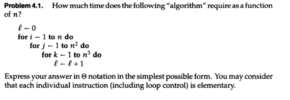 How much time does the following "algorithm" require as a function Problem 4.1. of n? for i 1 to n do for j 1 to n do for k 1 to n3 do Express your answer in 6 notation in the simplest possible form. You may consider that each individual instruction (including loop control) is elementary
Recussive
Consider the following pseudocode: f(int n, int d) { println(space(d) + "n=" + n + " begins"); if (n > 1) { f(n/2, d+1); println(space(d+1) + "hi"); f(n/2, d+1); } println(space(d) + "n=" + n + " ends"); } where println(s) prints the string s on its own line, space(d) is a string of d spaces, and the + in the println means string concatenation. For example, if n=4 and d=2, the commands println(space(d) + "n=" + n + "...
pleas answer asap 3. (20 points) Algorithm Analysis and Recurrence There is a mystery function called Mystery(n) and the pseudocode of the algorithm own as below. Assume that n 3* for some positiv...
 pleas answer asap
3. (20 points) Algorithm Analysis and Recurrence There is a mystery function called Mystery(n) and the pseudocode of the algorithm own as below. Assume that n 3* for some positive integer k21. Mystery (n) if n<4 3 for i1 to 9 5 for i-1 to n 2 return 1 Mystery (n/3) Print "hello" 6 (1) (5 points) Please analyze the worst-case asymptotic execution time of this algorithm. Express the execution time as a function of the input...
pleas answer asap
3. (20 points) Algorithm Analysis and Recurrence There is a mystery function called Mystery(n) and the pseudocode of the algorithm own as below. Assume that n 3* for some positive integer k21. Mystery (n) if n<4 3 for i1 to 9 5 for i-1 to n 2 return 1 Mystery (n/3) Print "hello" 6 (1) (5 points) Please analyze the worst-case asymptotic execution time of this algorithm. Express the execution time as a function of the input...
Solve exactly using the iteration method the following recurrence T(n) = 2T(n/2) + 6n, with T(8)...
 Solve exactly using the iteration method the following
recurrence T(n) = 2T(n/2) + 6n, with T(8) = 12. You may assume that
n is a power of two.
Please explain your answer.
(a) (20 points) Solve exactly using the iteration method the following recurrence T(n) - 2T(n/2) + 6n, with T(8)-12. You may assume that n is a power of two.
Solve exactly using the iteration method the following
recurrence T(n) = 2T(n/2) + 6n, with T(8) = 12. You may assume that
n is a power of two.
Please explain your answer.
(a) (20 points) Solve exactly using the iteration method the following recurrence T(n) - 2T(n/2) + 6n, with T(8)-12. You may assume that n is a power of two.
1Recurrences. a)Solve the following recurrence. You may assume any convenient form for n. T(1) = 0....
1Recurrences. a)Solve the following recurrence. You may assume any convenient form for n. T(1) = 0. T(n) = T(n/2)+1, n>1 b)Consider the following recurrence relation: T(1) = 4 T(n) = T(n-1) +4 Argue using mathematical induction that T(n) = 4n Note that you must induction to establish the solution.
Problem 3. (20 points) Define a relation among the functions that map from N to R+...
 Problem 3. (20 points) Define a relation among the functions that map from N to R+ as follows: f(n) g(n) iff f (n) is o(g(n)) i.e. f(n) is O(gfn) but g(n) is not O(f(n)). Order the following functions according to <assuming e is a real constant, 0<E<1. Provide justifcations for your answer. (a) n log n, ( e), and (h) (1/3)" ni+e, (e) (n Problem 4. (15 points) Solve the following recurrence equations and give the solution in θ notation;...
2. Consider the following functions. For each of them, determine how many times is ‘hey’ printed...
 2. Consider the following functions. For each of them, determine
how many times is ‘hey’ printed in terms of the input n. You should
first write down a recurrence and then solve it using the recursion
tree method. That means you should write down the first few levels
of the recursion tree, specify the pattern, and then solve. (a) def
fun(n) { if (n > 1) { print( ‘hi’ ‘hi’ ‘hi’ ) fun(n/4) fun(n/4)
fun(n/4) }}
(b) def fun(n) {...
2. Consider the following functions. For each of them, determine
how many times is ‘hey’ printed in terms of the input n. You should
first write down a recurrence and then solve it using the recursion
tree method. That means you should write down the first few levels
of the recursion tree, specify the pattern, and then solve. (a) def
fun(n) { if (n > 1) { print( ‘hi’ ‘hi’ ‘hi’ ) fun(n/4) fun(n/4)
fun(n/4) }}
(b) def fun(n) {...
How many critical numbers does the following function have? f(x) = x²e-32 1 3 N Infinitely...
 How many critical numbers does the following function have? f(x) = x²e-32 1 3 N Infinitely many 0
Consider the problem of computing the power function pow(n,x) = n^x using only multiplications. The first...
Consider the problem of computing the power function pow(n,x) = n^x using only multiplications. The first approach is to perform x multiplications ($n \cdot n \cdot n \cdot \ldots \cdot n$, x times). Find a better, recursive algorithm to solve this problem (by better, we mean one that uses fewer than $x$ multiplications). Write down the pseudocode for this new function, and then analyze the runtime of that recursive program by first writing out the recurrence relation $T(n, x)$ that...
 Can I please get help with this question?
Problem 3. How many lines, as a function of n (in 0(.) form), does the following program print? Write a recurrence and solve it. You may assume n is a power of 2. function f(n) { If (n>1) { print.line ("still going");/ f(n/2); f(n/2); }
Can I please get help with this question?
Problem 3. How many lines, as a function of n (in 0(.) form), does the following program print? Write a recurrence and solve it. You may assume n is a power of 2. function f(n) { If (n>1) { print.line ("still going");/ f(n/2); f(n/2); }
 How much time does the following "algorithm" require as a function Problem 4.1. of n? for i 1 to n do for j 1 to n do for k 1 to n3 do Express your answer in 6 notation in the simplest possible form. You may consider that each individual instruction (including loop control) is elementary
 pleas answer asap
3. (20 points) Algorithm Analysis and Recurrence There is a mystery function called Mystery(n) and the pseudocode of the algorithm own as below. Assume that n 3* for some positive integer k21. Mystery (n) if n<4 3 for i1 to 9 5 for i-1 to n 2 return 1 Mystery (n/3) Print "hello" 6 (1) (5 points) Please analyze the worst-case asymptotic execution time of this algorithm. Express the execution time as a function of the input...
pleas answer asap
3. (20 points) Algorithm Analysis and Recurrence There is a mystery function called Mystery(n) and the pseudocode of the algorithm own as below. Assume that n 3* for some positive integer k21. Mystery (n) if n<4 3 for i1 to 9 5 for i-1 to n 2 return 1 Mystery (n/3) Print "hello" 6 (1) (5 points) Please analyze the worst-case asymptotic execution time of this algorithm. Express the execution time as a function of the input...
 Solve exactly using the iteration method the following
recurrence T(n) = 2T(n/2) + 6n, with T(8) = 12. You may assume that
n is a power of two.
Please explain your answer.
(a) (20 points) Solve exactly using the iteration method the following recurrence T(n) - 2T(n/2) + 6n, with T(8)-12. You may assume that n is a power of two.
Solve exactly using the iteration method the following
recurrence T(n) = 2T(n/2) + 6n, with T(8) = 12. You may assume that
n is a power of two.
Please explain your answer.
(a) (20 points) Solve exactly using the iteration method the following recurrence T(n) - 2T(n/2) + 6n, with T(8)-12. You may assume that n is a power of two.
 Problem 3. (20 points) Define a relation among the functions that map from N to R+ as follows: f(n) g(n) iff f (n) is o(g(n)) i.e. f(n) is O(gfn) but g(n) is not O(f(n)). Order the following functions according to <assuming e is a real constant, 0<E<1. Provide justifcations for your answer. (a) n log n, ( e), and (h) (1/3)" ni+e, (e) (n Problem 4. (15 points) Solve the following recurrence equations and give the solution in θ notation;...
 2. Consider the following functions. For each of them, determine
how many times is ‘hey’ printed in terms of the input n. You should
first write down a recurrence and then solve it using the recursion
tree method. That means you should write down the first few levels
of the recursion tree, specify the pattern, and then solve. (a) def
fun(n) { if (n > 1) { print( ‘hi’ ‘hi’ ‘hi’ ) fun(n/4) fun(n/4)
fun(n/4) }}
(b) def fun(n) {...
2. Consider the following functions. For each of them, determine
how many times is ‘hey’ printed in terms of the input n. You should
first write down a recurrence and then solve it using the recursion
tree method. That means you should write down the first few levels
of the recursion tree, specify the pattern, and then solve. (a) def
fun(n) { if (n > 1) { print( ‘hi’ ‘hi’ ‘hi’ ) fun(n/4) fun(n/4)
fun(n/4) }}
(b) def fun(n) {...
 How many critical numbers does the following function have? f(x) = x²e-32 1 3 N Infinitely many 0
Most questions answered within 3 hours.
-
Where is the error in this code sequence?
String s1 = "Hello";
String s2 = "ello";...
asked 10 months ago -
Financial data for Joel de Paris, Inc., for last year
follow:
Joel de Paris, Inc.
Balance...
asked 10 months ago -
Consider this reaction:
Al2(SO4)3 (aq)+ BaCl3
(aq) Al2Cl6 (aq)- +
3BaSO4(s) . What is the...
asked 10 months ago -
Suppose that Savneet is considering increasing her
recent random sample from 20 car rentals to 40...
asked 10 months ago -
Trucks arrive at an unloading terminal at an average rate of 120
per hour.
Trucks arrive...
asked 10 months ago -
Why are methanol and ethanol completely soluble in water while
octanol is not very little soluble....
asked 10 months ago -
A facilities manager at a university reads in a research report
that the mean amount of...
asked 10 months ago -
When the CuSO4 is rehydrated by adding water to the anhydrous
compound, is this an endothermic...
asked 10 months ago -
A ray of sunlight is passing from diamond into crown glass; the
angle of incidence is...
asked 10 months ago -
A block of mass 0.249 kg is placed on top of a light, vertical
spring of...
asked 10 months ago -
how do the kidneys compensate in the presences of acidosis
a) trigger hyperventilate
b) reserve acid...
asked 10 months ago -
Question 501 pts
The rental rate of capital to the firm increases. Which of the
following...
asked 10 months ago