
Homework Answers
Add Answer to:
The curve cis defined as the conter clockwise manner a long the sides of the triangle...
Please explain clearly. Thank you. The path C is defined as the counter clockwise along the...
 Please explain clearly. Thank you.
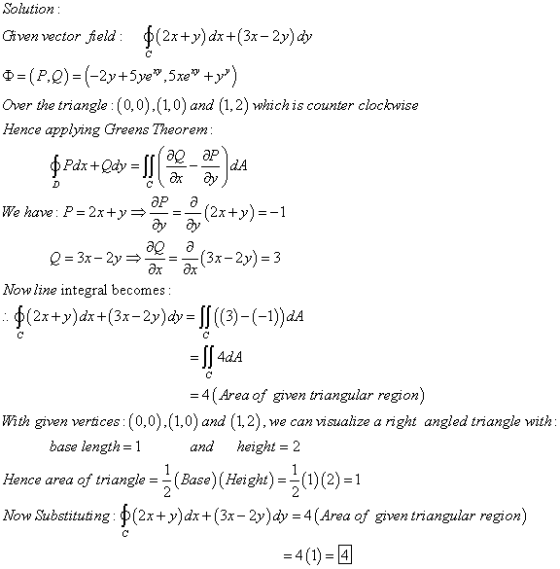
The path C is defined as the counter clockwise along the sides of the triangle with vertices at (0,0), (1,0) and (1,2). Use Green's Theorem to evaluate $c (2x+y) dx + (3x-2y) dy).
Please explain clearly. Thank you.
The path C is defined as the counter clockwise along the sides of the triangle with vertices at (0,0), (1,0) and (1,2). Use Green's Theorem to evaluate $c (2x+y) dx + (3x-2y) dy).
Let A be the inside and boundary of the triangle in R2 whose vertices are (0,0), (1,0) and (0,1). Let C be the curve obtained by proceeding around the boundary of A in an anti- clockwise direction. P...
 Let A be the inside and boundary of the triangle in R2 whose vertices are (0,0), (1,0) and (0,1). Let C be the curve obtained by proceeding around the boundary of A in an anti- clockwise direction. Prove İ}!").lx (ly İ)(2 dr dy. Pdr+Qdy That is, prove Green's Theorem for the triangle A. [Hint: the lecture notes have a proof for when A is a rectangle. So, the idea is is to give a similar proof where we have this...
Use the given transformation to evaluate the integral. -5x dx dy where R is the parallelogram bou...
 Use the given transformation to evaluate the integral. -5x dx dy where R is the parallelogram bounded by the linesy-x+1, y-x +4 y#2x+2y»2x + 5 A) -5 B) 10 C)5 D)-10 32) y+ x where R is the trapezoid with vertices at (6,0), ,0).。. 6), (0.9) 45 45 B) ÷ sin l 45 C) sin 2 45 A) sin 2
Use the given transformation to evaluate the integral. -5x dx dy where R is the parallelogram bounded by the linesy-x+1,...
Use the given transformation to evaluate the integral. -5x dx dy where R is the parallelogram bounded by the linesy-x+1, y-x +4 y#2x+2y»2x + 5 A) -5 B) 10 C)5 D)-10 32) y+ x where R is the trapezoid with vertices at (6,0), ,0).。. 6), (0.9) 45 45 B) ÷ sin l 45 C) sin 2 45 A) sin 2
Use the given transformation to evaluate the integral. -5x dx dy where R is the parallelogram bounded by the linesy-x+1,...
please solve all thank you so much :) Let C be the curve consisting of line...
 please solve all thank you so
much :)
Let C be the curve consisting of line segments from (0, 0) to (3, 3) to (0, 3) and back to (0,0). Use Green's theorem to find the value of [ xy dx + xy dx + y2 + 3 dy. Use Green's theorem to evaluate line integral fc2x e2x sin(2y) dx + 2x cos(2) dy, where is ellipse 16(x - 3)2 + 9(y – 5)2 = 144 oriented counterclockwise. Use Green's...
please solve all thank you so
much :)
Let C be the curve consisting of line segments from (0, 0) to (3, 3) to (0, 3) and back to (0,0). Use Green's theorem to find the value of [ xy dx + xy dx + y2 + 3 dy. Use Green's theorem to evaluate line integral fc2x e2x sin(2y) dx + 2x cos(2) dy, where is ellipse 16(x - 3)2 + 9(y – 5)2 = 144 oriented counterclockwise. Use Green's...
5. Evaluate SS x+2y da where R is the triangle with vertices (0,3), (4,1), and (2,6)....
 5. Evaluate SS x+2y da where R is the triangle with vertices (0,3), (4,1), and (2,6). Use the transformation x=-(u- *=£cu-v),= (3u+v+12). 6. Evaluate S 2 ydx+(1 – x)dy along the curve C given by y=1 –x" from x = -1 to x = 2.
c) fox2y2 dx - xy3 dy, where C is the triangle with vertices (0, 0), (1,...
 c) fox2y2 dx - xy3 dy, where C is the triangle with vertices (0, 0), (1, 0), (1, 1). (CE. Lect 08) Our goal is to evaluate the line integral in No. 3 (c), p. 279 of Kaplan (the last part of this question). The path involved is a triangle. To calculate such a line integral, we break up its path into pieces (hence the first three parts of this question). At the end, we add the pieces together. (a)...
All of 10 questions, please. 1. Find and classify all the critical points of the function. f(x,y) - x2(y - 2) - y2 » 2. Evaluate the integral. 3. Determine the volume of the solid that is inside the...
 All of 10 questions, please.
1. Find and classify all the critical points of the function. f(x,y) - x2(y - 2) - y2 » 2. Evaluate the integral. 3. Determine the volume of the solid that is inside the cylinder x2 + y2- 16 below z-2x2 + 2y2 and above the xy - plane. 4. Determine the surface area of the portion of 2x + 3y + 6z - 9 that is in the 1st octant. » 5. Evaluate JSxz...
All of 10 questions, please.
1. Find and classify all the critical points of the function. f(x,y) - x2(y - 2) - y2 » 2. Evaluate the integral. 3. Determine the volume of the solid that is inside the cylinder x2 + y2- 16 below z-2x2 + 2y2 and above the xy - plane. 4. Determine the surface area of the portion of 2x + 3y + 6z - 9 that is in the 1st octant. » 5. Evaluate JSxz...
Three lines are defined by the three equations: x + y = 0 x-y=0 2x+y=1 The...
 Three lines are defined by the three equations: x + y = 0 x-y=0 2x+y=1 The three lines form a triangle with vertices at: O A. (0,0),(33), 1,-1) O B. (0,0), (17 2 ) (-1,-1) o C. (1,1), (1, -1), (2, 1) O D. (1,1),(3,-3), (-2,-1) THE CORRECT ANSWER IS: A y=-x y=x -2x + 1 y=-2x +1 intersection of y=x and y=-x is (0,0) intersection of y = x and y = -2x + 1 is x = -2x...
please answer all 3 questions, I need help. thank you Use Green's Theorem to evaluate the...
 please answer all 3 questions, I need help. thank you
Use Green's Theorem to evaluate the line integral. Assume the curve is oriented counterclockwise. $(9x+ ex) dy- (4y + sinh x) dx, where C is the boundary of the square with vertices (2, 0), (5, 0), (5, 3), and (2, 3). $(9x+ ey?) ay- (4y+ + sinhx) dx = 0 (Type an exact answer.) Use Green's Theorem to evaluate the following line integral. i dy - g dx, where (19)...
please answer all 3 questions, I need help. thank you
Use Green's Theorem to evaluate the line integral. Assume the curve is oriented counterclockwise. $(9x+ ex) dy- (4y + sinh x) dx, where C is the boundary of the square with vertices (2, 0), (5, 0), (5, 3), and (2, 3). $(9x+ ey?) ay- (4y+ + sinhx) dx = 0 (Type an exact answer.) Use Green's Theorem to evaluate the following line integral. i dy - g dx, where (19)...
(d) The line integral [(x+y?)dx + (x2 + 2xy)dy, where the positively oriented curve C is...
 (d) The line integral [(x+y?)dx + (x2 + 2xy)dy, where the positively oriented curve C is the boundary of the region in the first quadrant determined by the graphs of x=0, y=x2 and y=1, can be converted to A 2xdydx 0 0 BJ 2 xdxdy 0 0 С -2x)dyda 00 D none of the above (e) Consider finding the maximum and minimum values of the function f(x, y) = x + y2 - 4x + 4y subject to the constraint...
 Please explain clearly. Thank you.
The path C is defined as the counter clockwise along the sides of the triangle with vertices at (0,0), (1,0) and (1,2). Use Green's Theorem to evaluate $c (2x+y) dx + (3x-2y) dy).
Please explain clearly. Thank you.
The path C is defined as the counter clockwise along the sides of the triangle with vertices at (0,0), (1,0) and (1,2). Use Green's Theorem to evaluate $c (2x+y) dx + (3x-2y) dy).
 Let A be the inside and boundary of the triangle in R2 whose vertices are (0,0), (1,0) and (0,1). Let C be the curve obtained by proceeding around the boundary of A in an anti- clockwise direction. Prove İ}!").lx (ly İ)(2 dr dy. Pdr+Qdy That is, prove Green's Theorem for the triangle A. [Hint: the lecture notes have a proof for when A is a rectangle. So, the idea is is to give a similar proof where we have this...
 Use the given transformation to evaluate the integral. -5x dx dy where R is the parallelogram bounded by the linesy-x+1, y-x +4 y#2x+2y»2x + 5 A) -5 B) 10 C)5 D)-10 32) y+ x where R is the trapezoid with vertices at (6,0), ,0).。. 6), (0.9) 45 45 B) ÷ sin l 45 C) sin 2 45 A) sin 2
Use the given transformation to evaluate the integral. -5x dx dy where R is the parallelogram bounded by the linesy-x+1,...
Use the given transformation to evaluate the integral. -5x dx dy where R is the parallelogram bounded by the linesy-x+1, y-x +4 y#2x+2y»2x + 5 A) -5 B) 10 C)5 D)-10 32) y+ x where R is the trapezoid with vertices at (6,0), ,0).。. 6), (0.9) 45 45 B) ÷ sin l 45 C) sin 2 45 A) sin 2
Use the given transformation to evaluate the integral. -5x dx dy where R is the parallelogram bounded by the linesy-x+1,...
 please solve all thank you so
much :)
Let C be the curve consisting of line segments from (0, 0) to (3, 3) to (0, 3) and back to (0,0). Use Green's theorem to find the value of [ xy dx + xy dx + y2 + 3 dy. Use Green's theorem to evaluate line integral fc2x e2x sin(2y) dx + 2x cos(2) dy, where is ellipse 16(x - 3)2 + 9(y – 5)2 = 144 oriented counterclockwise. Use Green's...
please solve all thank you so
much :)
Let C be the curve consisting of line segments from (0, 0) to (3, 3) to (0, 3) and back to (0,0). Use Green's theorem to find the value of [ xy dx + xy dx + y2 + 3 dy. Use Green's theorem to evaluate line integral fc2x e2x sin(2y) dx + 2x cos(2) dy, where is ellipse 16(x - 3)2 + 9(y – 5)2 = 144 oriented counterclockwise. Use Green's...
 5. Evaluate SS x+2y da where R is the triangle with vertices (0,3), (4,1), and (2,6). Use the transformation x=-(u- *=£cu-v),= (3u+v+12). 6. Evaluate S 2 ydx+(1 – x)dy along the curve C given by y=1 –x" from x = -1 to x = 2.
 c) fox2y2 dx - xy3 dy, where C is the triangle with vertices (0, 0), (1, 0), (1, 1). (CE. Lect 08) Our goal is to evaluate the line integral in No. 3 (c), p. 279 of Kaplan (the last part of this question). The path involved is a triangle. To calculate such a line integral, we break up its path into pieces (hence the first three parts of this question). At the end, we add the pieces together. (a)...
 All of 10 questions, please.
1. Find and classify all the critical points of the function. f(x,y) - x2(y - 2) - y2 » 2. Evaluate the integral. 3. Determine the volume of the solid that is inside the cylinder x2 + y2- 16 below z-2x2 + 2y2 and above the xy - plane. 4. Determine the surface area of the portion of 2x + 3y + 6z - 9 that is in the 1st octant. » 5. Evaluate JSxz...
All of 10 questions, please.
1. Find and classify all the critical points of the function. f(x,y) - x2(y - 2) - y2 » 2. Evaluate the integral. 3. Determine the volume of the solid that is inside the cylinder x2 + y2- 16 below z-2x2 + 2y2 and above the xy - plane. 4. Determine the surface area of the portion of 2x + 3y + 6z - 9 that is in the 1st octant. » 5. Evaluate JSxz...
 Three lines are defined by the three equations: x + y = 0 x-y=0 2x+y=1 The three lines form a triangle with vertices at: O A. (0,0),(33), 1,-1) O B. (0,0), (17 2 ) (-1,-1) o C. (1,1), (1, -1), (2, 1) O D. (1,1),(3,-3), (-2,-1) THE CORRECT ANSWER IS: A y=-x y=x -2x + 1 y=-2x +1 intersection of y=x and y=-x is (0,0) intersection of y = x and y = -2x + 1 is x = -2x...
 please answer all 3 questions, I need help. thank you
Use Green's Theorem to evaluate the line integral. Assume the curve is oriented counterclockwise. $(9x+ ex) dy- (4y + sinh x) dx, where C is the boundary of the square with vertices (2, 0), (5, 0), (5, 3), and (2, 3). $(9x+ ey?) ay- (4y+ + sinhx) dx = 0 (Type an exact answer.) Use Green's Theorem to evaluate the following line integral. i dy - g dx, where (19)...
please answer all 3 questions, I need help. thank you
Use Green's Theorem to evaluate the line integral. Assume the curve is oriented counterclockwise. $(9x+ ex) dy- (4y + sinh x) dx, where C is the boundary of the square with vertices (2, 0), (5, 0), (5, 3), and (2, 3). $(9x+ ey?) ay- (4y+ + sinhx) dx = 0 (Type an exact answer.) Use Green's Theorem to evaluate the following line integral. i dy - g dx, where (19)...
 (d) The line integral [(x+y?)dx + (x2 + 2xy)dy, where the positively oriented curve C is the boundary of the region in the first quadrant determined by the graphs of x=0, y=x2 and y=1, can be converted to A 2xdydx 0 0 BJ 2 xdxdy 0 0 С -2x)dyda 00 D none of the above (e) Consider finding the maximum and minimum values of the function f(x, y) = x + y2 - 4x + 4y subject to the constraint...
Most questions answered within 3 hours.
-
Where is the error in this code sequence?
String s1 = "Hello";
String s2 = "ello";...
asked 10 months ago -
Financial data for Joel de Paris, Inc., for last year
follow:
Joel de Paris, Inc.
Balance...
asked 10 months ago -
Consider this reaction:
Al2(SO4)3 (aq)+ BaCl3
(aq) Al2Cl6 (aq)- +
3BaSO4(s) . What is the...
asked 10 months ago -
Suppose that Savneet is considering increasing her
recent random sample from 20 car rentals to 40...
asked 10 months ago -
Trucks arrive at an unloading terminal at an average rate of 120
per hour.
Trucks arrive...
asked 10 months ago -
Why are methanol and ethanol completely soluble in water while
octanol is not very little soluble....
asked 10 months ago -
A facilities manager at a university reads in a research report
that the mean amount of...
asked 10 months ago -
When the CuSO4 is rehydrated by adding water to the anhydrous
compound, is this an endothermic...
asked 10 months ago -
A ray of sunlight is passing from diamond into crown glass; the
angle of incidence is...
asked 10 months ago -
A block of mass 0.249 kg is placed on top of a light, vertical
spring of...
asked 10 months ago -
how do the kidneys compensate in the presences of acidosis
a) trigger hyperventilate
b) reserve acid...
asked 10 months ago -
Question 501 pts
The rental rate of capital to the firm increases. Which of the
following...
asked 10 months ago