
Homework Answers
Add Answer to:
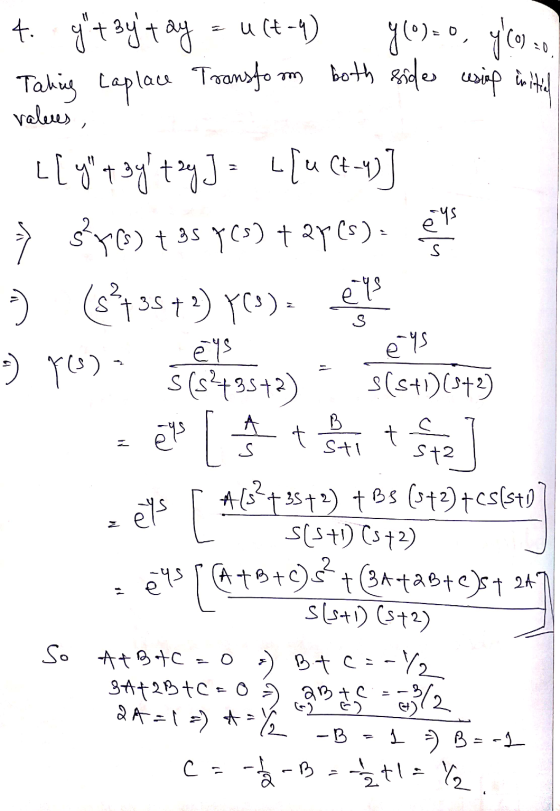
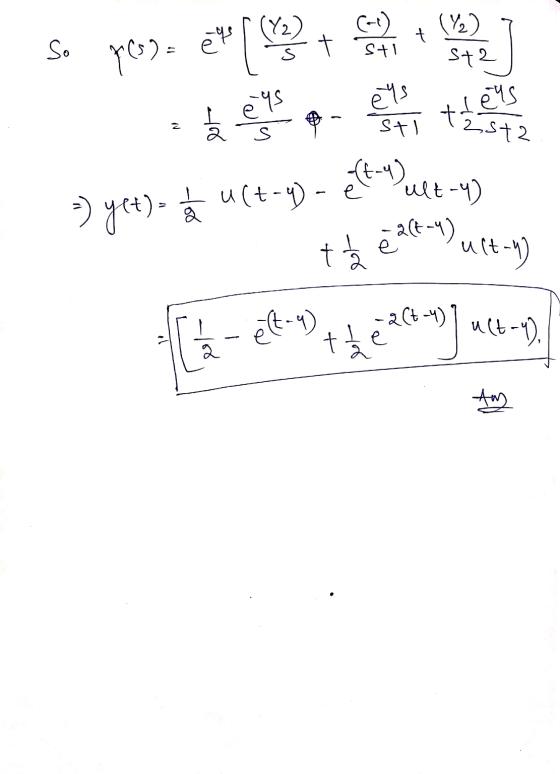
Solve the following IVPs using Laplace Transform: 4) y” + 3 y' + 2y = u(t...
III. Solve each of the following IVPs using Laplace Transforms 1, y'+2y = 4-u2(t), y(0) =...
 III. Solve each of the following IVPs using Laplace Transforms 1, y'+2y = 4-u2(t), y(0) = 1. 2、 y', _ y = 2t, y(0) = 0, y'(0) = a 3· y', _ y =-206(t-3), y(0) = 1, y'(0) = 0. 4· y', + 2y' + 2y = h(t), y(0) = 0,必))-1.
Solve the following IVPs using Laplace Transform: 5) y” + y = (t – 2) uſt...
 Solve the following IVPs using Laplace Transform: 5) y” + y = (t – 2) uſt – 2); y(0) = y'(0) = 0
Solve the following IVPs using Laplace Transform: 2) y" + 4y' + 3y = 3 ezt;...
 Solve the following IVPs using Laplace Transform: 2) y" + 4y' + 3y = 3 ezt; y(0) = y'(0) = 0
Solve the following IVPs using Laplace Transform: 1) dy dt 3y(t) = e4t; y(0) = 0
 Solve the following IVPs using Laplace Transform: 1) dy dt 3y(t) = e4t; y(0) = 0
Solve the following IVPs using Laplace Transform: 3) y" + 4y' + 4y = t4e-2t; y(0)...
 Solve the following IVPs using Laplace Transform: 3) y" + 4y' + 4y = t4e-2t; y(0) = 1, y'(0) = 2
(4 points) Use the Laplace transform to solve the following initial value problem: y" – 2y...
 (4 points) Use the Laplace transform to solve the following initial value problem: y" – 2y + 5y = 0 y(0) = 0, y'(0) = 8 First, using Y for the Laplace transform of y(t), i.e., Y = L{y(t)}| find the equation you get by taking the Laplace transform of the differential equation = 01 Now solve for Y(3) By completing the square in the denominator and inverting the transform, find g(t) =
6 (5) Solve the differential equation using a Laplace Transform: y 3y' +2y t y(0) 0,...
 6 (5) Solve the differential equation using a Laplace Transform: y 3y' +2y t y(0) 0, y'(0) 2
Solve the following initial value problem using the method of Laplace transform. y" + 2y' +10y...
 Solve the following initial value problem using the method of Laplace transform. y" + 2y' +10y = f(t); y(0)= 1, y'(0) = 0, where, f(0) = 10, Ost<10, 20, 10<t.
Page 4 IV. Use the Laplace transform to solve the IVP y' - 2y + y...
 Page 4 IV. Use the Laplace transform to solve the IVP y' - 2y + y = f(t), y(0) = 1, v/(0) = 1, where (10) 0, t <3 f(t) = t-3, 3 You may use the partial fraction decomposition 16–25+1) 5+(9–1 = (-) + ? + - , but you need to show all the steps needed to arrive to the expression - 022-28+1) in order to receive credit.
1. y(3)-2y"+Sy.-0, y(0)-O, V00)-Ly( )-i using Laplace transform, solve y(t) and y"(0) af ecOS
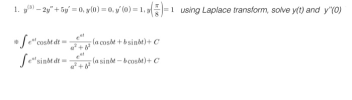 1. y(3)-2y"+Sy.-0, y(0)-O, V00)-Ly( )-i using Laplace transform, solve y(t) and y"(0) af ecOS
 III. Solve each of the following IVPs using Laplace Transforms 1, y'+2y = 4-u2(t), y(0) = 1. 2、 y', _ y = 2t, y(0) = 0, y'(0) = a 3· y', _ y =-206(t-3), y(0) = 1, y'(0) = 0. 4· y', + 2y' + 2y = h(t), y(0) = 0,必))-1.
 Solve the following IVPs using Laplace Transform: 5) y” + y = (t – 2) uſt – 2); y(0) = y'(0) = 0
 Solve the following IVPs using Laplace Transform: 2) y" + 4y' + 3y = 3 ezt; y(0) = y'(0) = 0
 Solve the following IVPs using Laplace Transform: 1) dy dt 3y(t) = e4t; y(0) = 0
 Solve the following IVPs using Laplace Transform: 3) y" + 4y' + 4y = t4e-2t; y(0) = 1, y'(0) = 2
 (4 points) Use the Laplace transform to solve the following initial value problem: y" – 2y + 5y = 0 y(0) = 0, y'(0) = 8 First, using Y for the Laplace transform of y(t), i.e., Y = L{y(t)}| find the equation you get by taking the Laplace transform of the differential equation = 01 Now solve for Y(3) By completing the square in the denominator and inverting the transform, find g(t) =
 6 (5) Solve the differential equation using a Laplace Transform: y 3y' +2y t y(0) 0, y'(0) 2
 Solve the following initial value problem using the method of Laplace transform. y" + 2y' +10y = f(t); y(0)= 1, y'(0) = 0, where, f(0) = 10, Ost<10, 20, 10<t.
 Page 4 IV. Use the Laplace transform to solve the IVP y' - 2y + y = f(t), y(0) = 1, v/(0) = 1, where (10) 0, t <3 f(t) = t-3, 3 You may use the partial fraction decomposition 16–25+1) 5+(9–1 = (-) + ? + - , but you need to show all the steps needed to arrive to the expression - 022-28+1) in order to receive credit.
 1. y(3)-2y"+Sy.-0, y(0)-O, V00)-Ly( )-i using Laplace transform, solve y(t) and y"(0) af ecOS
Most questions answered within 3 hours.
-
Where is the error in this code sequence?
String s1 = "Hello";
String s2 = "ello";...
asked 10 months ago -
Financial data for Joel de Paris, Inc., for last year
follow:
Joel de Paris, Inc.
Balance...
asked 10 months ago -
Consider this reaction:
Al2(SO4)3 (aq)+ BaCl3
(aq) Al2Cl6 (aq)- +
3BaSO4(s) . What is the...
asked 10 months ago -
Suppose that Savneet is considering increasing her
recent random sample from 20 car rentals to 40...
asked 10 months ago -
Trucks arrive at an unloading terminal at an average rate of 120
per hour.
Trucks arrive...
asked 10 months ago -
Why are methanol and ethanol completely soluble in water while
octanol is not very little soluble....
asked 10 months ago -
A facilities manager at a university reads in a research report
that the mean amount of...
asked 10 months ago -
When the CuSO4 is rehydrated by adding water to the anhydrous
compound, is this an endothermic...
asked 10 months ago -
A ray of sunlight is passing from diamond into crown glass; the
angle of incidence is...
asked 10 months ago -
A block of mass 0.249 kg is placed on top of a light, vertical
spring of...
asked 10 months ago -
how do the kidneys compensate in the presences of acidosis
a) trigger hyperventilate
b) reserve acid...
asked 10 months ago -
Question 501 pts
The rental rate of capital to the firm increases. Which of the
following...
asked 10 months ago