
Homework Answers
a. Sketch the solid S:= {[x; y; z] in |R3 | x,y,z ≥ 0, and 2x...
a. Sketch the solid S:= {[x; y; z] in |R3 | x,y,z ≥ 0, and 2x + 4 y + 2z ≤ 12}. b. Using your calculator evaluate, i) as a triple integral and ii) by the divergence theorem, the volume of S. c. Find i)the surface area of the solid S and ii)the flux thru the top of S due to the vector field F, where F(x,y,z) = ( x + yz , y + xz , z +...
help asap #13] Evaluate SSxyds where is the part of the Splane 2x-y+ Z = 4...
 help asap
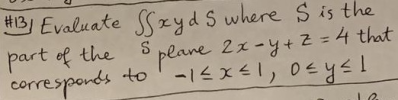
#13] Evaluate SSxyds where is the part of the Splane 2x-y+ Z = 4 that corresponds to 1= xt1, osyal
help asap
#13] Evaluate SSxyds where is the part of the Splane 2x-y+ Z = 4 that corresponds to 1= xt1, osyal
-. (15 pts.) Let S is the first-octant portion of the plane 2x + y +z...
 -. (15 pts.) Let S is the first-octant portion of the plane 2x + y +z = 4. Evaluate the surface integral SSE (2y2 + 2yz) ds.
Evaluate Z Z S curl(F) · dS where F(x, y, z) = (x^ 3 , −z...
Evaluate Z Z S curl(F) · dS where F(x, y, z) = (x^ 3 , −z ^3y ^3 , 2x − 4y) and S is the portion of the paraboloid z = x ^2 + y^ 2 − 3 below the plane z = 1 with orientation in the negative z-axis direction.
4. Evaluate Sl y(+12) ds, where S = {(1,y,z) : 2 = 4 – r?,05152,0 <ys...
 4. Evaluate Sl y(+12) ds, where S = {(1,y,z) : 2 = 4 – r?,05152,0 <ys 5).
5. Calculate the surface area of the portion of the sphere x2+y2+12-4 between the planes z-1 and z ะไ 6. Evaluate (xyz) dS, where S is the portion of the plane 2x+2y+z-2 that lies in the first oc...
 5. Calculate the surface area of the portion of the sphere x2+y2+12-4 between the planes z-1 and z ะไ 6. Evaluate (xyz) dS, where S is the portion of the plane 2x+2y+z-2 that lies in the first octant. 7. Evaluate F. ds. a) F = yli + xzj-k through the cone z = VF+ア0s z 4 with normal pointing away from the z-axis. b) F-yi+xj+ek where S is the portion of the cylinder+y9, 0szs3, 0s r and O s y...
Evaluate: vr y-x dA , y + 2x+1 where R is the parallelogram bounded by y-x-2, y-x-3, y + 2x = 0, andy+2x=4. Evalua...
 Evaluate: vr y-x dA , y + 2x+1 where R is the parallelogram bounded by y-x-2, y-x-3, y + 2x = 0, andy+2x=4.
Evaluate: vr y-x dA , y + 2x+1 where R is the parallelogram bounded by y-x-2, y-x-3, y + 2x = 0, andy+2x=4.
Evaluate: vr y-x dA , y + 2x+1 where R is the parallelogram bounded by y-x-2, y-x-3, y + 2x = 0, andy+2x=4.
Use the Divergence Theorem to evaluate ∫∫S F·dS, where F(x,y,z)=z²xi+(y³/3+sin z) j+(x² z+y²) k and S is the top half of the sphere x²+y²+z²=4
Use the Divergence Theorem to evaluate ∫∫S F·dS, where F(x,y,z)=z²xi+(y³/3+sin z) j+(x² z+y²) k and S is the top half of the sphere x²+y²+z²=4 . (Hint: Note that S is not a closed surface, First compute integrals over S₁ and S₂, where S₁ is the disk x²+y² ≤ 4, oriented downward, and S₂=S₁ ∪ S.)
Evaluate z) ds, where S is the intersection of the plane z=4-y with the solid cylinder...
 Evaluate z) ds, where S is the intersection of the plane z=4-y with the solid cylinder x2 + y2 33. 8. 127211 ob.8V21 C. None of these O d. 4√3 a e. 1231
4. Evaluate the Surface Integral [f(r,y,0)nds , where S is the part of the surface z-Vx+y* below ...
 4. Evaluate the Surface Integral [f(r,y,0)nds , where S is the part of the surface z-Vx+y* below z-1, and i is the unit outer normal to S with negative z- component.
4. Evaluate the Surface Integral [f(r,y,0)nds , where S is the part of the surface z-Vx+y* below z-1, and i is the unit outer normal to S with negative z- component.
4. Evaluate the Surface Integral [f(r,y,0)nds , where S is the part of the surface z-Vx+y* below z-1, and i is the unit outer normal to S with negative z- component.
 help asap
#13] Evaluate SSxyds where is the part of the Splane 2x-y+ Z = 4 that corresponds to 1= xt1, osyal
help asap
#13] Evaluate SSxyds where is the part of the Splane 2x-y+ Z = 4 that corresponds to 1= xt1, osyal
 -. (15 pts.) Let S is the first-octant portion of the plane 2x + y +z = 4. Evaluate the surface integral SSE (2y2 + 2yz) ds.
 4. Evaluate Sl y(+12) ds, where S = {(1,y,z) : 2 = 4 – r?,05152,0 <ys 5).
 5. Calculate the surface area of the portion of the sphere x2+y2+12-4 between the planes z-1 and z ะไ 6. Evaluate (xyz) dS, where S is the portion of the plane 2x+2y+z-2 that lies in the first octant. 7. Evaluate F. ds. a) F = yli + xzj-k through the cone z = VF+ア0s z 4 with normal pointing away from the z-axis. b) F-yi+xj+ek where S is the portion of the cylinder+y9, 0szs3, 0s r and O s y...
 Evaluate: vr y-x dA , y + 2x+1 where R is the parallelogram bounded by y-x-2, y-x-3, y + 2x = 0, andy+2x=4.
Evaluate: vr y-x dA , y + 2x+1 where R is the parallelogram bounded by y-x-2, y-x-3, y + 2x = 0, andy+2x=4.
Evaluate: vr y-x dA , y + 2x+1 where R is the parallelogram bounded by y-x-2, y-x-3, y + 2x = 0, andy+2x=4.
 Evaluate z) ds, where S is the intersection of the plane z=4-y with the solid cylinder x2 + y2 33. 8. 127211 ob.8V21 C. None of these O d. 4√3 a e. 1231
 4. Evaluate the Surface Integral [f(r,y,0)nds , where S is the part of the surface z-Vx+y* below z-1, and i is the unit outer normal to S with negative z- component.
4. Evaluate the Surface Integral [f(r,y,0)nds , where S is the part of the surface z-Vx+y* below z-1, and i is the unit outer normal to S with negative z- component.
4. Evaluate the Surface Integral [f(r,y,0)nds , where S is the part of the surface z-Vx+y* below z-1, and i is the unit outer normal to S with negative z- component.
Most questions answered within 3 hours.
-
Where is the error in this code sequence?
String s1 = "Hello";
String s2 = "ello";...
asked 10 months ago -
Financial data for Joel de Paris, Inc., for last year
follow:
Joel de Paris, Inc.
Balance...
asked 10 months ago -
Consider this reaction:
Al2(SO4)3 (aq)+ BaCl3
(aq) Al2Cl6 (aq)- +
3BaSO4(s) . What is the...
asked 10 months ago -
Suppose that Savneet is considering increasing her
recent random sample from 20 car rentals to 40...
asked 10 months ago -
Trucks arrive at an unloading terminal at an average rate of 120
per hour.
Trucks arrive...
asked 10 months ago -
Why are methanol and ethanol completely soluble in water while
octanol is not very little soluble....
asked 10 months ago -
A facilities manager at a university reads in a research report
that the mean amount of...
asked 10 months ago -
When the CuSO4 is rehydrated by adding water to the anhydrous
compound, is this an endothermic...
asked 10 months ago -
A ray of sunlight is passing from diamond into crown glass; the
angle of incidence is...
asked 10 months ago -
A block of mass 0.249 kg is placed on top of a light, vertical
spring of...
asked 10 months ago -
how do the kidneys compensate in the presences of acidosis
a) trigger hyperventilate
b) reserve acid...
asked 10 months ago -
Question 501 pts
The rental rate of capital to the firm increases. Which of the
following...
asked 10 months ago