

Homework Answers
Add Answer to:
this is a 2 part question
Suppose instead that Lysol and Clorox were competing using quantities...
Suppose instead that Lysol and Clorox were competing using quantities (Cournot Competition). Also suppose that the...
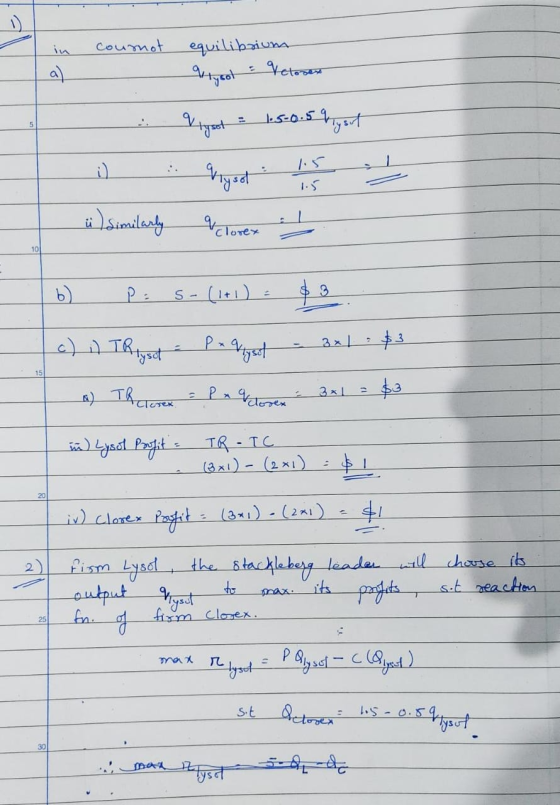
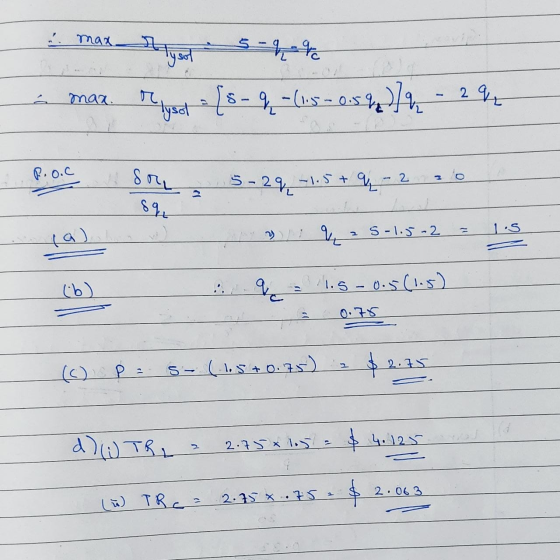
 Suppose instead that Lysol and Clorox were competing using quantities (Cournot Competition). Also suppose that the respective marginal cost for each firm is Mysor = 2 = Aysor and MC clorox = 2 = AC clorox. The inverse demand equation is still P = 5-Q with the marginal revenue being MR = 5 - 2Q. To make the following questions easier for you, the reaction curves have already been derived. For Lysol the reaction curve is nysor = 1.5-0.50 clorox...
multiple part question. please answer and cirlcle solutions! i will rate thumbs up for correct answers...
 multiple part question. please answer and cirlcle solutions! i will
rate thumbs up for correct answers
The market for disinfectant is dominated by 2 firms, Lysol and Clorox. The marginal cost (MC) for providing disinfectant is $1 (average cost is also $1), and the consumer form their demand for disinfectant via the following inverse demand equation P-5-Q:. The corresponding marginal revenue curve is: P-5-20 a. If Lysol and Clorox decide to collude, what quantities will be sold in the market...
multiple part question. please answer and cirlcle solutions! i will
rate thumbs up for correct answers
The market for disinfectant is dominated by 2 firms, Lysol and Clorox. The marginal cost (MC) for providing disinfectant is $1 (average cost is also $1), and the consumer form their demand for disinfectant via the following inverse demand equation P-5-Q:. The corresponding marginal revenue curve is: P-5-20 a. If Lysol and Clorox decide to collude, what quantities will be sold in the market...
this is a 2 part question The market for disinfectant is dominated by 2 firms, Lysol...
 this is a 2 part question
The market for disinfectant is dominated by 2 firms, Lysol and Clorox. The marginal cost (MC) for providing disinfectant is $1 (average cost is also $1), and the consumer form their demand for disinfectant via the following inverse demand equation P=5-Q:. The corresponding marginal revenue curve is: P=5- 2Q a. If Lysol and Clorox decide to collude, what quantities will be sold in the market and what price will consumers pay for this quantity...
this is a 2 part question
The market for disinfectant is dominated by 2 firms, Lysol and Clorox. The marginal cost (MC) for providing disinfectant is $1 (average cost is also $1), and the consumer form their demand for disinfectant via the following inverse demand equation P=5-Q:. The corresponding marginal revenue curve is: P=5- 2Q a. If Lysol and Clorox decide to collude, what quantities will be sold in the market and what price will consumers pay for this quantity...
The market for disinfectant is dominated by a firms, Lysol and Clorox. The marginal cost (MC)...
 The market for disinfectant is dominated by a firms, Lysol and Clorox. The marginal cost (MC) for providing disinfectant is $1 (average cost is also $1), and the consumer form their demand for disinfectant via the following inverse demand equation P-5-Q:. The corresponding marginal revenue curve is: P-5- 20 a. If Lysol and Clorox decide to collude, what quantities will be sold in the market and what price will consumers pay for this quantity? (s points) i. Quantity: il. Price:...
Suppose that instead of colluding, Lysol and Clorox are competing using prices (Bertrand competition). Also assume...
 Suppose that instead of colluding, Lysol and Clorox are competing using prices (Bertrand competition). Also assume that marginal cost for Lysol and Clorox is $1. The inverse demand equation is still P=5-Q with the marginal revenue being P=5-20 a. What will be the market price that consumers pay? b. How many units will be supplied in the market at the market price found in part (a)?
Reference the following information about the market demand function for questions 1 to 15. These questions...
Reference the following information about the market demand function for questions 1 to 15. These questions are on different types of market structures – monopoly, perfect competition, Cournot oligopoly market, and the Stackelberg oligopoly market. The market demand function is given the following equation: P = 1600 – Q where Q is the industry’s output level. Suppose initially this market is served by a single firm. Let the total cost function of this firm be given the function C(Q) =...
2) As in the above exercise 1), consider two firms with the same constant average and...
 2) As in the above exercise 1), consider two firms with the same constant average and marginal cost AC=MC =5 facing the market demand curve Q1 + Q2 53- P. Now, let's consider the Stackelberg model in order to analyze what will happen when one of the firms makes its output decision ahead of the other firm Suppose that firm 1 is the Stackelberg leader. How much will each firm produce? What is the resulting market price? How much profit...
Reference the following information about the market demand function for questions 1 to 15. These questions...
Reference the following information about the market demand function for questions 1 to 15. These questions are on different types of market structures – monopoly, perfect competition, Cournot oligopoly market, and the Stackelberg oligopoly market. The market demand function is given the following equation: P = 1600 – Q where Q is the industry’s output level. Suppose initially this market is served by a single firm. Let the total cost function of this firm be given the function C(Q) =...
JUST THE QUESTION 16 PLEASE THE FINAL PART OF C IS DEADWEIGHT LOSS AND COMPARE THEM...
 JUST THE QUESTION 16 PLEASE THE FINAL PART OF C IS DEADWEIGHT
LOSS AND COMPARE THEM WITH YOUR FINDINGS ON A
co
(b) each firm produces (c) each firm is a price taker. (d) there are few firms in the market. le) each firm observes a horizontal demand curve. Short Questions (10 pts.) 16. A monopoly faces a market demand curve given by Q = 60 - P and a marginal revenue curve given by MR-60 - 20. If MC...
JUST THE QUESTION 16 PLEASE THE FINAL PART OF C IS DEADWEIGHT
LOSS AND COMPARE THEM WITH YOUR FINDINGS ON A
co
(b) each firm produces (c) each firm is a price taker. (d) there are few firms in the market. le) each firm observes a horizontal demand curve. Short Questions (10 pts.) 16. A monopoly faces a market demand curve given by Q = 60 - P and a marginal revenue curve given by MR-60 - 20. If MC...
Assume that there are two firms competing in the market for taxi services, Company U and...
Assume that there are two firms competing in the market for taxi services, Company U and Company G. Company U has a marginal cost MCUB = $6 per trip, and a fixed cost FCUB = $2,500,000; while Company G has a marginal cost MCGC = $12 per trip, and a fixed cost FCGC = $1,500,000. The inverse demand for taxi trips in the market is given by the function: ?=60−?/10,000 In this equation, P is the price of a taxi...
 Suppose instead that Lysol and Clorox were competing using quantities (Cournot Competition). Also suppose that the respective marginal cost for each firm is Mysor = 2 = Aysor and MC clorox = 2 = AC clorox. The inverse demand equation is still P = 5-Q with the marginal revenue being MR = 5 - 2Q. To make the following questions easier for you, the reaction curves have already been derived. For Lysol the reaction curve is nysor = 1.5-0.50 clorox...
 multiple part question. please answer and cirlcle solutions! i will
rate thumbs up for correct answers
The market for disinfectant is dominated by 2 firms, Lysol and Clorox. The marginal cost (MC) for providing disinfectant is $1 (average cost is also $1), and the consumer form their demand for disinfectant via the following inverse demand equation P-5-Q:. The corresponding marginal revenue curve is: P-5-20 a. If Lysol and Clorox decide to collude, what quantities will be sold in the market...
multiple part question. please answer and cirlcle solutions! i will
rate thumbs up for correct answers
The market for disinfectant is dominated by 2 firms, Lysol and Clorox. The marginal cost (MC) for providing disinfectant is $1 (average cost is also $1), and the consumer form their demand for disinfectant via the following inverse demand equation P-5-Q:. The corresponding marginal revenue curve is: P-5-20 a. If Lysol and Clorox decide to collude, what quantities will be sold in the market...
 this is a 2 part question
The market for disinfectant is dominated by 2 firms, Lysol and Clorox. The marginal cost (MC) for providing disinfectant is $1 (average cost is also $1), and the consumer form their demand for disinfectant via the following inverse demand equation P=5-Q:. The corresponding marginal revenue curve is: P=5- 2Q a. If Lysol and Clorox decide to collude, what quantities will be sold in the market and what price will consumers pay for this quantity...
this is a 2 part question
The market for disinfectant is dominated by 2 firms, Lysol and Clorox. The marginal cost (MC) for providing disinfectant is $1 (average cost is also $1), and the consumer form their demand for disinfectant via the following inverse demand equation P=5-Q:. The corresponding marginal revenue curve is: P=5- 2Q a. If Lysol and Clorox decide to collude, what quantities will be sold in the market and what price will consumers pay for this quantity...
 The market for disinfectant is dominated by a firms, Lysol and Clorox. The marginal cost (MC) for providing disinfectant is $1 (average cost is also $1), and the consumer form their demand for disinfectant via the following inverse demand equation P-5-Q:. The corresponding marginal revenue curve is: P-5- 20 a. If Lysol and Clorox decide to collude, what quantities will be sold in the market and what price will consumers pay for this quantity? (s points) i. Quantity: il. Price:...
 Suppose that instead of colluding, Lysol and Clorox are competing using prices (Bertrand competition). Also assume that marginal cost for Lysol and Clorox is $1. The inverse demand equation is still P=5-Q with the marginal revenue being P=5-20 a. What will be the market price that consumers pay? b. How many units will be supplied in the market at the market price found in part (a)?
 2) As in the above exercise 1), consider two firms with the same constant average and marginal cost AC=MC =5 facing the market demand curve Q1 + Q2 53- P. Now, let's consider the Stackelberg model in order to analyze what will happen when one of the firms makes its output decision ahead of the other firm Suppose that firm 1 is the Stackelberg leader. How much will each firm produce? What is the resulting market price? How much profit...
 JUST THE QUESTION 16 PLEASE THE FINAL PART OF C IS DEADWEIGHT
LOSS AND COMPARE THEM WITH YOUR FINDINGS ON A
co
(b) each firm produces (c) each firm is a price taker. (d) there are few firms in the market. le) each firm observes a horizontal demand curve. Short Questions (10 pts.) 16. A monopoly faces a market demand curve given by Q = 60 - P and a marginal revenue curve given by MR-60 - 20. If MC...
JUST THE QUESTION 16 PLEASE THE FINAL PART OF C IS DEADWEIGHT
LOSS AND COMPARE THEM WITH YOUR FINDINGS ON A
co
(b) each firm produces (c) each firm is a price taker. (d) there are few firms in the market. le) each firm observes a horizontal demand curve. Short Questions (10 pts.) 16. A monopoly faces a market demand curve given by Q = 60 - P and a marginal revenue curve given by MR-60 - 20. If MC...
Most questions answered within 3 hours.
-
Where is the error in this code sequence?
String s1 = "Hello";
String s2 = "ello";...
asked 10 months ago -
Financial data for Joel de Paris, Inc., for last year
follow:
Joel de Paris, Inc.
Balance...
asked 10 months ago -
Consider this reaction:
Al2(SO4)3 (aq)+ BaCl3
(aq) Al2Cl6 (aq)- +
3BaSO4(s) . What is the...
asked 10 months ago -
Suppose that Savneet is considering increasing her
recent random sample from 20 car rentals to 40...
asked 10 months ago -
Trucks arrive at an unloading terminal at an average rate of 120
per hour.
Trucks arrive...
asked 10 months ago -
Why are methanol and ethanol completely soluble in water while
octanol is not very little soluble....
asked 10 months ago -
A facilities manager at a university reads in a research report
that the mean amount of...
asked 10 months ago -
When the CuSO4 is rehydrated by adding water to the anhydrous
compound, is this an endothermic...
asked 10 months ago -
A ray of sunlight is passing from diamond into crown glass; the
angle of incidence is...
asked 10 months ago -
A block of mass 0.249 kg is placed on top of a light, vertical
spring of...
asked 10 months ago -
how do the kidneys compensate in the presences of acidosis
a) trigger hyperventilate
b) reserve acid...
asked 10 months ago -
Question 501 pts
The rental rate of capital to the firm increases. Which of the
following...
asked 10 months ago