
Homework Answers

Add Answer to:
(15 points) Please show your work! Water (p = 1000 kg/m3) flows through the pipe below....
what is the volume flow rate through the pipe? the water density is 1000 kg/m3. The...
 what is the volume flow rate through the pipe? the water density is 1000 kg/m3. The pressure above the water in the tank is 250 kPa. The pressure of the atmosphere is 100 kPa. Air 250 kPa (sluten tank med "lock") 2.5 m 10 cm
Problem 1. Water flows from a large tank through a smooth pipe of length 80 m....
 Problem 1. Water flows from a large tank through a smooth pipe of length 80 m. Both the tank free surface and jet exit are exposed to the atmosphere. Take the density of water p = 1000 kg/m3, dynamic viscosity of water u = 0.001 kg/m.s, atmospheric pressure = 100 kPa, and gravity = 9.8 m/s2. Calculate the volumetric flow rate through the pipe. Neglect entrance losses to the pipe. Hint: Consider the inlet and outlet sections of the pipe...
Paragraph Drawing Water (p = 1000 kg/m3) is accelerated from rest in a horizontal pipe that...
 Paragraph Drawing Water (p = 1000 kg/m3) is accelerated from rest in a horizontal pipe that is 80 m long! and 30 cm in diameter. If the acceleration rate (toward the downstream end) is 5 m/s?! what is the pressure at the upstream end if the pressure at the downstream end is 90 kPa gage? What is the net force?
Problem 1. Water flows from a large tank through a smooth pipe of length 80 m....
 Problem 1. Water flows from a large tank through a smooth pipe of length 80 m. Both the tank free surface and jet exit are exposed to the atmosphere. Take the density of water p = 1000 kg/m3, dynamic viscosity of water j = 0.001 kg/m.s, atmospheric pressure = 100 kPa, and gravity = 9.8 m/s2. Calculate the volumetric flow rate through the pipe. Neglect entrance losses to the pipe. Hint: Consider the inlet and outlet sections of the pipe...
8. Water at 15°C flows out of the elbow at 0.0153 m3/s. The water is discharged...
 8. Water at 15°C flows out of the elbow at 0.0153 m3/s. The water is discharged to the atmosphere at section 2. The pipe diameter is D1 = 100 mm and D2 = 30 mm. The pressure pi = 2.3 atm (gage). Neglect the weight of the elbow and the water within it. Neglect elevation change between 1 and 2. Determine the force on the flange bolts at section 1. (40 points)
In the figure, water flows through a horizontal pipe and then out into the atmosphere at...
 In the figure, water flows through a horizontal pipe and then
out into the atmosphere at a speed v1 = 16.0
m/s. The diameters of the left and right sections of the pipe are
5.20 cm and 3.00 cm. (a) What volume of water
flows into the atmosphere during a 10 min period? In the left
section of the pipe, what are (b) the speed
v2 and (c) the gauge
pressure?
Question 1 In the figure, water flows through a...
In the figure, water flows through a horizontal pipe and then
out into the atmosphere at a speed v1 = 16.0
m/s. The diameters of the left and right sections of the pipe are
5.20 cm and 3.00 cm. (a) What volume of water
flows into the atmosphere during a 10 min period? In the left
section of the pipe, what are (b) the speed
v2 and (c) the gauge
pressure?
Question 1 In the figure, water flows through a...
lunzontal pipe and pump system in the following figure discharges 0.01583 m3/s. The gage pressure iust...
 lunzontal pipe and pump system in the following figure discharges 0.01583 m3/s. The gage pressure iust before the pressure is 400 The m/s2 losses between 20°C water at 57 m3/h 0 kPa and just after the pump the gage a. The pump inlet diameter is 9 cm and the outlet diameter is 3 em. Let g-9.81 pump is 12 o Pwater9 kg/m, Hwate0.001002 kgm-s) and Pat the two pressure points and the pump. But consider frictional losses at the 9-cm...
In the figure, water flows through a horizontal pipe and then out into the atmosphere at...
 In the figure, water flows through a horizontal pipe and then out into the atmosphere at a speed vi-14.0 m/s. The diameters of the left and right sections of the pipe are 4.80 cm and 2.70 cm. (a) What volume of water flows into the atmosphere during a 10 min period? In the left section of the pipe, what are (b) the speed v2 and (c) the gauge pressure? da
Water at 20°C flows at 0.08 m3/s through a pipe and is metered by a 12...
 Water at 20°C flows at 0.08 m3/s through a pipe and is metered by a 12 cm diameter long-radius flow nozzle (d = 12 cm). If the pressure drop across the nozzle is 25 kPa, what is the diameter of the pipe (D)? Use: Pwater = 998 kg/m3; Hwater = 0.001 kg/m-s. Express your answer in centimeters (cm). D
Question 11 Water is flowing through a 10-cm-diameter water pipe at a rate of 0.2 m3/s....
 Question 11 Water is flowing through a 10-cm-diameter water pipe at a rate of 0.2 m3/s. Now a diffuser with an outlet diameter of 20 cm is bolted to the pipe in order to slow down water that exits into atmosphere, as shown. Disregarding frictional effects, determine the force exerted on the flange due to the water flow. Density of water = 1000 kg/m3 = 10 cm D = 20 cm Diffuser 357 N 1549 N 6205 N none of...
 what is the volume flow rate through the pipe? the water density is 1000 kg/m3. The pressure above the water in the tank is 250 kPa. The pressure of the atmosphere is 100 kPa. Air 250 kPa (sluten tank med "lock") 2.5 m 10 cm
 Problem 1. Water flows from a large tank through a smooth pipe of length 80 m. Both the tank free surface and jet exit are exposed to the atmosphere. Take the density of water p = 1000 kg/m3, dynamic viscosity of water u = 0.001 kg/m.s, atmospheric pressure = 100 kPa, and gravity = 9.8 m/s2. Calculate the volumetric flow rate through the pipe. Neglect entrance losses to the pipe. Hint: Consider the inlet and outlet sections of the pipe...
 Paragraph Drawing Water (p = 1000 kg/m3) is accelerated from rest in a horizontal pipe that is 80 m long! and 30 cm in diameter. If the acceleration rate (toward the downstream end) is 5 m/s?! what is the pressure at the upstream end if the pressure at the downstream end is 90 kPa gage? What is the net force?
 Problem 1. Water flows from a large tank through a smooth pipe of length 80 m. Both the tank free surface and jet exit are exposed to the atmosphere. Take the density of water p = 1000 kg/m3, dynamic viscosity of water j = 0.001 kg/m.s, atmospheric pressure = 100 kPa, and gravity = 9.8 m/s2. Calculate the volumetric flow rate through the pipe. Neglect entrance losses to the pipe. Hint: Consider the inlet and outlet sections of the pipe...
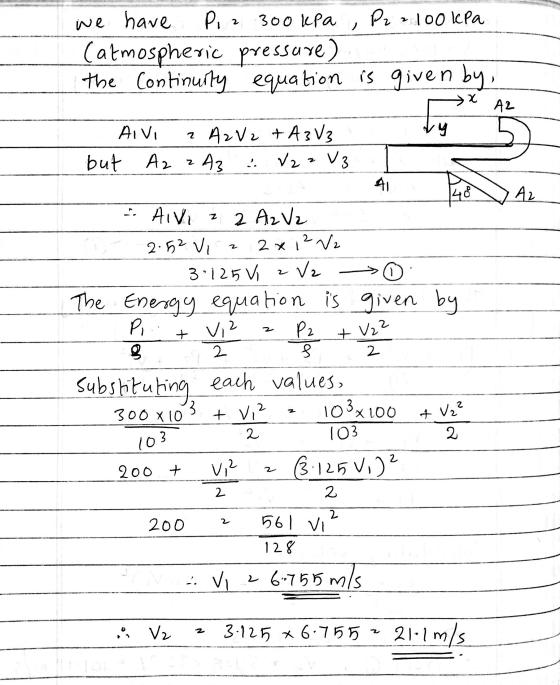
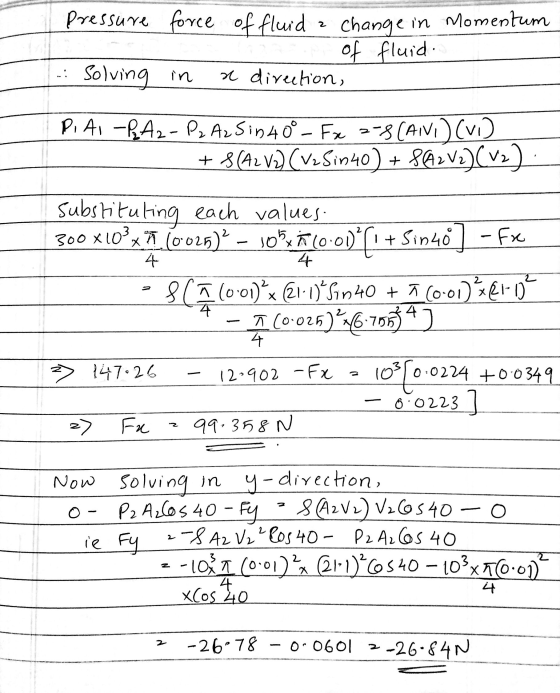
 8. Water at 15°C flows out of the elbow at 0.0153 m3/s. The water is discharged to the atmosphere at section 2. The pipe diameter is D1 = 100 mm and D2 = 30 mm. The pressure pi = 2.3 atm (gage). Neglect the weight of the elbow and the water within it. Neglect elevation change between 1 and 2. Determine the force on the flange bolts at section 1. (40 points)
 In the figure, water flows through a horizontal pipe and then
out into the atmosphere at a speed v1 = 16.0
m/s. The diameters of the left and right sections of the pipe are
5.20 cm and 3.00 cm. (a) What volume of water
flows into the atmosphere during a 10 min period? In the left
section of the pipe, what are (b) the speed
v2 and (c) the gauge
pressure?
Question 1 In the figure, water flows through a...
In the figure, water flows through a horizontal pipe and then
out into the atmosphere at a speed v1 = 16.0
m/s. The diameters of the left and right sections of the pipe are
5.20 cm and 3.00 cm. (a) What volume of water
flows into the atmosphere during a 10 min period? In the left
section of the pipe, what are (b) the speed
v2 and (c) the gauge
pressure?
Question 1 In the figure, water flows through a...
 lunzontal pipe and pump system in the following figure discharges 0.01583 m3/s. The gage pressure iust before the pressure is 400 The m/s2 losses between 20°C water at 57 m3/h 0 kPa and just after the pump the gage a. The pump inlet diameter is 9 cm and the outlet diameter is 3 em. Let g-9.81 pump is 12 o Pwater9 kg/m, Hwate0.001002 kgm-s) and Pat the two pressure points and the pump. But consider frictional losses at the 9-cm...
 In the figure, water flows through a horizontal pipe and then out into the atmosphere at a speed vi-14.0 m/s. The diameters of the left and right sections of the pipe are 4.80 cm and 2.70 cm. (a) What volume of water flows into the atmosphere during a 10 min period? In the left section of the pipe, what are (b) the speed v2 and (c) the gauge pressure? da
 Water at 20°C flows at 0.08 m3/s through a pipe and is metered by a 12 cm diameter long-radius flow nozzle (d = 12 cm). If the pressure drop across the nozzle is 25 kPa, what is the diameter of the pipe (D)? Use: Pwater = 998 kg/m3; Hwater = 0.001 kg/m-s. Express your answer in centimeters (cm). D
 Question 11 Water is flowing through a 10-cm-diameter water pipe at a rate of 0.2 m3/s. Now a diffuser with an outlet diameter of 20 cm is bolted to the pipe in order to slow down water that exits into atmosphere, as shown. Disregarding frictional effects, determine the force exerted on the flange due to the water flow. Density of water = 1000 kg/m3 = 10 cm D = 20 cm Diffuser 357 N 1549 N 6205 N none of...
Most questions answered within 3 hours.
-
Where is the error in this code sequence?
String s1 = "Hello";
String s2 = "ello";...
asked 11 months ago -
Financial data for Joel de Paris, Inc., for last year
follow:
Joel de Paris, Inc.
Balance...
asked 11 months ago -
Consider this reaction:
Al2(SO4)3 (aq)+ BaCl3
(aq) Al2Cl6 (aq)- +
3BaSO4(s) . What is the...
asked 11 months ago -
Suppose that Savneet is considering increasing her
recent random sample from 20 car rentals to 40...
asked 11 months ago -
Trucks arrive at an unloading terminal at an average rate of 120
per hour.
Trucks arrive...
asked 11 months ago -
Why are methanol and ethanol completely soluble in water while
octanol is not very little soluble....
asked 11 months ago -
A facilities manager at a university reads in a research report
that the mean amount of...
asked 11 months ago -
When the CuSO4 is rehydrated by adding water to the anhydrous
compound, is this an endothermic...
asked 11 months ago -
A ray of sunlight is passing from diamond into crown glass; the
angle of incidence is...
asked 11 months ago -
A block of mass 0.249 kg is placed on top of a light, vertical
spring of...
asked 11 months ago -
how do the kidneys compensate in the presences of acidosis
a) trigger hyperventilate
b) reserve acid...
asked 11 months ago -
Question 501 pts
The rental rate of capital to the firm increases. Which of the
following...
asked 11 months ago