Typically, who faces the larger economic incidence of a tax?
Typically, who faces the larger economic incidence of a tax?
Homework Answers
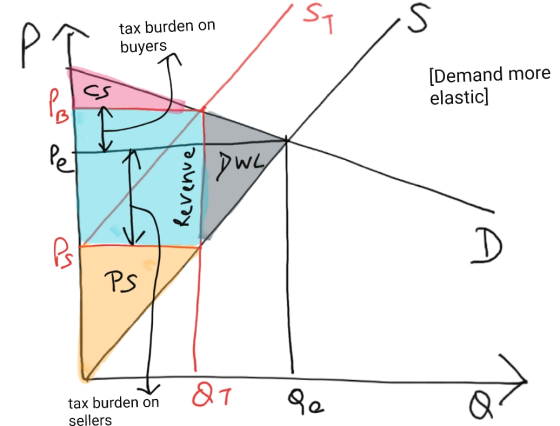
Ans) When government imposes tax, it does not really matter upon whom the tax is imposed, burden is shared by both buyers and sellers. Now who will bear greater burden of tax depends upon the elasticity of demand and supply. Accordingly, less elastic side of the market bears greater burden of tax.

Explain the relationship between the statutory incidence and the economic incidence of a unit tax levied...
Explain the relationship between the statutory incidence and the economic incidence of a unit tax levied in a market.
Tax incidence refers to who “feels” the effects of a tax, buyers or sellers. On the...
Tax incidence refers to who “feels” the effects of a tax, buyers or sellers. On the example from the previous page, the $4 tax resulted in buyers paying $3 more (since the market price was $4 without the tax, and the price buyers pay with the tax is $7) and sellers receiving $1 less (since the market price was $4 without the tax and sellers receive $3 with the tax). So, we say the incidence of the $4 tax is...
Figure: Tax Incidence Reference: Ref 7-12 (Figure: Tax Incidence) Look at the figure Tax Incidence. All...
 Figure: Tax Incidence
Reference: Ref 7-12
(Figure: Tax Incidence) Look at the figure Tax Incidence. All other
things unchanged, when a good or service is characterized by a
relatively inelastic supply, as shown in panel _____, a greater
share of the burden of an excise tax is borne by _____.
A; sellers
B; sellers
A; buyers
B; buyers
Panel A Panel B Price (per unit) Price (per unit) S2 -tax 0 YAN Q2 Q1 Quantity (per period) Q2Q1 Quantity (per...
Figure: Tax Incidence
Reference: Ref 7-12
(Figure: Tax Incidence) Look at the figure Tax Incidence. All other
things unchanged, when a good or service is characterized by a
relatively inelastic supply, as shown in panel _____, a greater
share of the burden of an excise tax is borne by _____.
A; sellers
B; sellers
A; buyers
B; buyers
Panel A Panel B Price (per unit) Price (per unit) S2 -tax 0 YAN Q2 Q1 Quantity (per period) Q2Q1 Quantity (per...
(Figure: Tax Incidence) Use Figure: Tax Incidence. Based on the figure, the deadweight loss of an excise tax is likely...
 (Figure: Tax Incidence) Use Figure: Tax Incidence. Based on the
figure, the deadweight loss of an excise tax is likely to be
greater in panel _____ than in panel _____.
C; A
C; D
B; A
D; A
Figure: Tax Incidence Pand A Price (per unit) Price (per unit) Pe Q2 Q3 Quantity (per period) Q2Q Quantity (per period) Panel Panel D Price (per unit) Price (per unit) Si QQ, Quantity (per period) 0,, Quantity (per period)
(Figure: Tax Incidence) Use Figure: Tax Incidence. Based on the
figure, the deadweight loss of an excise tax is likely to be
greater in panel _____ than in panel _____.
C; A
C; D
B; A
D; A
Figure: Tax Incidence Pand A Price (per unit) Price (per unit) Pe Q2 Q3 Quantity (per period) Q2Q Quantity (per period) Panel Panel D Price (per unit) Price (per unit) Si QQ, Quantity (per period) 0,, Quantity (per period)
(Figure: Tax Incidence) Use Figure: Tax Incidence. All other things unchanged, when a good or service...
 (Figure: Tax Incidence) Use Figure: Tax Incidence. All other
things unchanged, when a good or service is characterized by a
relatively elastic supply, as shown in panel _____, a greater share
of the burden of an excise tax is borne by _____.
A; sellers
B; buyers
A; buyers
B; sellers
Figure: Tax Incidence Pand A Price (per unit) Price (per unit) Pe Q2 Q3 Quantity (per period) Q2Q Quantity (per period) Panel Panel D Price (per unit) Price (per unit)...
(Figure: Tax Incidence) Use Figure: Tax Incidence. All other
things unchanged, when a good or service is characterized by a
relatively elastic supply, as shown in panel _____, a greater share
of the burden of an excise tax is borne by _____.
A; sellers
B; buyers
A; buyers
B; sellers
Figure: Tax Incidence Pand A Price (per unit) Price (per unit) Pe Q2 Q3 Quantity (per period) Q2Q Quantity (per period) Panel Panel D Price (per unit) Price (per unit)...
. Calculating tax incidence Suppose that the U.S. government decides to charge wine producers a tax....
 . Calculating tax incidence Suppose that the U.S. government decides to charge wine producers a tax. Before the tax, 50 million bottles of wine were sold every month at a price of $6 per bottle. After the tax, 44 million bottles of wine are sold every month; consumers pay $7 per bottle, and producers receive $3 per bottle (after paying the tax). The amount of the tax on a bottle of wine is s per bottle. Of this amount, the...
6. Calculating tax incidence Suppose that the U.S. government decides to charge cola consumers a tax....
 6. Calculating tax incidence Suppose that the U.S. government decides to charge cola consumers a tax. Before the tax, 15 million cases of cola were sold every month at a price of $6 per case. After the tax, 9 million cases of cola are sold every month; consumers pay $9 per case (including the tax), and producers receive $3 per case The amount of the tax on a case of colas S p er case of this amount, the burden...
An economist who favors larger government would recommend Multiple Choice tax cuts during recession and reductions...
 An economist who favors larger government would recommend Multiple Choice tax cuts during recession and reductions in government spending during inflation. increases in government spending during recession and tax increases during inflation. O tax increases during recession and tax cuts during inflation. tax cuts during recession and tax increases during inflation.
The amount of tax levied per unit of good or service is called the tax: incidence....
 The amount of tax levied per unit of good or service is called the tax: incidence. rate O surplus revenue.
1. Symbolic and numerical tax incidence: Consider a market described by the following equations: ?? =...
1. Symbolic and numerical tax incidence: Consider a market described by the following equations: ?? = ? + 1 − ?? ?? = ? Here A is a fixed parameter. Answer the following questions. a. Solve for the equilibrium price and quantity. P* = ________ Q* = ________ b. Now suppose a specific tax, ? > 0, is imposed on this market that has to be paid to the government by suppliers. Using ??∗ and ?, give the new price...
 Figure: Tax Incidence
Reference: Ref 7-12
(Figure: Tax Incidence) Look at the figure Tax Incidence. All other
things unchanged, when a good or service is characterized by a
relatively inelastic supply, as shown in panel _____, a greater
share of the burden of an excise tax is borne by _____.
A; sellers
B; sellers
A; buyers
B; buyers
Panel A Panel B Price (per unit) Price (per unit) S2 -tax 0 YAN Q2 Q1 Quantity (per period) Q2Q1 Quantity (per...
Figure: Tax Incidence
Reference: Ref 7-12
(Figure: Tax Incidence) Look at the figure Tax Incidence. All other
things unchanged, when a good or service is characterized by a
relatively inelastic supply, as shown in panel _____, a greater
share of the burden of an excise tax is borne by _____.
A; sellers
B; sellers
A; buyers
B; buyers
Panel A Panel B Price (per unit) Price (per unit) S2 -tax 0 YAN Q2 Q1 Quantity (per period) Q2Q1 Quantity (per...
 (Figure: Tax Incidence) Use Figure: Tax Incidence. Based on the
figure, the deadweight loss of an excise tax is likely to be
greater in panel _____ than in panel _____.
C; A
C; D
B; A
D; A
Figure: Tax Incidence Pand A Price (per unit) Price (per unit) Pe Q2 Q3 Quantity (per period) Q2Q Quantity (per period) Panel Panel D Price (per unit) Price (per unit) Si QQ, Quantity (per period) 0,, Quantity (per period)
(Figure: Tax Incidence) Use Figure: Tax Incidence. Based on the
figure, the deadweight loss of an excise tax is likely to be
greater in panel _____ than in panel _____.
C; A
C; D
B; A
D; A
Figure: Tax Incidence Pand A Price (per unit) Price (per unit) Pe Q2 Q3 Quantity (per period) Q2Q Quantity (per period) Panel Panel D Price (per unit) Price (per unit) Si QQ, Quantity (per period) 0,, Quantity (per period)
 (Figure: Tax Incidence) Use Figure: Tax Incidence. All other
things unchanged, when a good or service is characterized by a
relatively elastic supply, as shown in panel _____, a greater share
of the burden of an excise tax is borne by _____.
A; sellers
B; buyers
A; buyers
B; sellers
Figure: Tax Incidence Pand A Price (per unit) Price (per unit) Pe Q2 Q3 Quantity (per period) Q2Q Quantity (per period) Panel Panel D Price (per unit) Price (per unit)...
(Figure: Tax Incidence) Use Figure: Tax Incidence. All other
things unchanged, when a good or service is characterized by a
relatively elastic supply, as shown in panel _____, a greater share
of the burden of an excise tax is borne by _____.
A; sellers
B; buyers
A; buyers
B; sellers
Figure: Tax Incidence Pand A Price (per unit) Price (per unit) Pe Q2 Q3 Quantity (per period) Q2Q Quantity (per period) Panel Panel D Price (per unit) Price (per unit)...
 . Calculating tax incidence Suppose that the U.S. government decides to charge wine producers a tax. Before the tax, 50 million bottles of wine were sold every month at a price of $6 per bottle. After the tax, 44 million bottles of wine are sold every month; consumers pay $7 per bottle, and producers receive $3 per bottle (after paying the tax). The amount of the tax on a bottle of wine is s per bottle. Of this amount, the...
 6. Calculating tax incidence Suppose that the U.S. government decides to charge cola consumers a tax. Before the tax, 15 million cases of cola were sold every month at a price of $6 per case. After the tax, 9 million cases of cola are sold every month; consumers pay $9 per case (including the tax), and producers receive $3 per case The amount of the tax on a case of colas S p er case of this amount, the burden...
 An economist who favors larger government would recommend Multiple Choice tax cuts during recession and reductions in government spending during inflation. increases in government spending during recession and tax increases during inflation. O tax increases during recession and tax cuts during inflation. tax cuts during recession and tax increases during inflation.
 The amount of tax levied per unit of good or service is called the tax: incidence. rate O surplus revenue.
Most questions answered within 3 hours.
-
Where is the error in this code sequence?
String s1 = "Hello";
String s2 = "ello";...
asked 10 months ago -
Financial data for Joel de Paris, Inc., for last year
follow:
Joel de Paris, Inc.
Balance...
asked 10 months ago -
Consider this reaction:
Al2(SO4)3 (aq)+ BaCl3
(aq) Al2Cl6 (aq)- +
3BaSO4(s) . What is the...
asked 10 months ago -
Suppose that Savneet is considering increasing her
recent random sample from 20 car rentals to 40...
asked 10 months ago -
Trucks arrive at an unloading terminal at an average rate of 120
per hour.
Trucks arrive...
asked 10 months ago -
Why are methanol and ethanol completely soluble in water while
octanol is not very little soluble....
asked 10 months ago -
A facilities manager at a university reads in a research report
that the mean amount of...
asked 10 months ago -
When the CuSO4 is rehydrated by adding water to the anhydrous
compound, is this an endothermic...
asked 10 months ago -
A ray of sunlight is passing from diamond into crown glass; the
angle of incidence is...
asked 10 months ago -
A block of mass 0.249 kg is placed on top of a light, vertical
spring of...
asked 10 months ago -
how do the kidneys compensate in the presences of acidosis
a) trigger hyperventilate
b) reserve acid...
asked 10 months ago -
Question 501 pts
The rental rate of capital to the firm increases. Which of the
following...
asked 10 months ago