The element ACE is rigid. The three suspender bars are made of the same material
The element ACE is rigid. The three suspender bars are made of the same material (the modulus of elasticity, E, is the same for all members) and have equal cross-sectional areas, A.
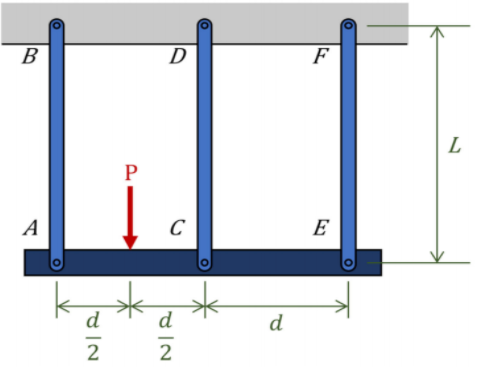
1. Superimpose a free body diagram on the provided figure.
2. Clearly draw the 'deformed position of the system. a. Label all forces, distances, and deformations/displacements.
3. Determine the average normal stress in each suspender bars (σAB, σCD, σEF) in terms of P and A.
4. Determine the vertical displacement of point A, ΔA, in terms of P, L, A and E.
Homework Answers


Add Answer to:
The element ACE is rigid. The three suspender bars are made of the same material
The rigid beam ACE is subjected to the load P and suspended at points A, C, and E
 The rigid beam ACE is subjected to the load P and suspended at points A, C, and E by three suspender bars AB, CD, and EF (see Figure 1). These three suspender bars are made of the same steel and have the same circular cross section with the same diameter of d=30 mm. The ultimate 2m stress of steel is σu=450 MPa and Young modulus is E=200 GPa. (a) Using a factor of safety FS=1.5, determine the All maximum allowable load...
The assembly has the diameters and material makeup indicated. If it fits securely between its fixed...
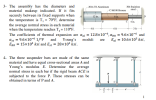 The assembly has the diameters and material makeup indicated. If it fits securely between its fixed supports when the temperature is T_1 = 70 degree F, determine the average normal stress in each material when the temperature reaches T_2 = 110 degree F. The coefficients of thermal expansion are alpha_al = 12.8 Times 10^-6, alpha_BR = 9.6 Times 10^-6 and alpha_st = 9.6 Times 10^-6 1/degree F and Young's moduli are E_al = 10.6 Times 10^3 ksi, E_BR = 15...
practice exam for mechanic of material Problem #3: The rigid be m The rigid beam ACE...
 practice exam for mechanic of material
Problem #3: The rigid be m The rigid beam ACE is u sed the suspender bars. Bars AB der hars Bars AB and EF are made of aluminum and har CD is made of steel. Each barha and bar CD is made of steel Fach har has a cross-sectional area of 900 mm, Ex - 200 GPa, E-70 GPa P-20 KN. al 2 m 5 -15 Fox 190 0 3 FAQ +15 Foc 390...
practice exam for mechanic of material
Problem #3: The rigid be m The rigid beam ACE is u sed the suspender bars. Bars AB der hars Bars AB and EF are made of aluminum and har CD is made of steel. Each barha and bar CD is made of steel Fach har has a cross-sectional area of 900 mm, Ex - 200 GPa, E-70 GPa P-20 KN. al 2 m 5 -15 Fox 190 0 3 FAQ +15 Foc 390...
The rigid beam in (Figure 1) is supported by the three suspender bars. Bars AB and EF are made of aluminum and bar CD is made of steel.
 The rigid beam in (Figure 1) is supported by the three suspender bars. Bars AB and EF are made of aluminum and bar CD is made of steel. Part A If each bar has a cross-sectional area of \(480 \mathrm{~mm}^{2}\), determine the maximum value of \(P\) if the allowable stress is \(\left(\sigma_{\text {allow }}\right)_{\text {st }}-190 \mathrm{MPa}\) far the steel and \(\left(\sigma_{\text {allow }}\right)_{\text {al }}-150 \mathrm{MPa}\) for the aluminum. \(E_{\text {st }}-200 \mathrm{GPa}, E_{\text {al }}-70 \mathrm{GPa}\).
Bars A and B in the mechanism shown are made of steel with a modulus of...
 Bars A and B in the mechanism shown are made of steel with a modulus of elasticity E = 200 GPa, a cross-sectional area of A = 100 mm?, and a length L = 2.5 m. The applied force F = 10 kN. (a) Write the equations of equilibrium for the horizontal bar. (b) Determine the forces in bars A and B. (c) Find the axial stress in bars A and B. to 2.0 m 3.0 m ** 1.5 m...
blem 5 (25 points): Consider the system of bars shown below. Bars AB, CD, and EF...
 blem 5 (25 points): Consider the system of bars shown below. Bars AB, CD, and EF are connected d link BED. Determine the horizontal displacement of point F B by a rigid . Bar AB has a cross-sectional area of 0.012 m2, a Young's modulus of 200 GPa, and a length of 0.34 m. . Bar CD has a cross-sectional area of 0.010 m2, a Young's modulus of 200 GPa, and a length of 034 m . Bar EF has...
need detailed process and pretty handwriting 3. (25%) The horizontal rigid beam ABCD is supported by...
 need detailed process and pretty handwriting
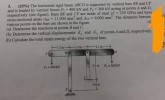
3. (25%) The horizontal rigid beam ABCD is supported by vertical bars BE and CF and is loaded by vertical forces P - 400 kN and P, -360 kN acting at points A and D respectively (see figure). Bars BE and CF are made of steel (E 25 cross-sectional areas ABE 11,000 mm and AcF 9,000 mm2. The distances betwee various points on the bars are shown in the figure. (a) Determine the reactions...
need detailed process and pretty handwriting
3. (25%) The horizontal rigid beam ABCD is supported by vertical bars BE and CF and is loaded by vertical forces P - 400 kN and P, -360 kN acting at points A and D respectively (see figure). Bars BE and CF are made of steel (E 25 cross-sectional areas ABE 11,000 mm and AcF 9,000 mm2. The distances betwee various points on the bars are shown in the figure. (a) Determine the reactions...
UIT LE 11/4., /4.127 Three rigid bars with the same length L are pinned as shown...
 UIT LE 11/4., /4.127 Three rigid bars with the same length L are pinned as shown in the figure. They are connected by linear springs with the same spring constant K. A downward force P is applied at the point F. Use the principle of virtual work to determine the vertical displacements at points A, C, and F corresponding to the equilibrium state. Assume that all displacements are small at the equilibrium state.
The below truss is made from three bars of the same steel material, all of which...
 The below truss is made from three bars of the same steel material, all of which have circular cross sections with different diameters. The Young modulus of steel is E= 200 GPa, and yield stress of steel is Gyöeld=200 MPa (in both tension and compression). The force P=7 kN is applied at point C as shown (see Figure 4). All bars are pin connected at their ends. (a) Determine the minimum diameter of the bars so that buckling will not...
Two bars BC and CD of cross sectional areas 100 mm2 and 50 mm2 respectively rigidly connected at C and also to fixed wa...
 Two bars BC and CD of cross sectional areas 100 mm2 and 50 mm2 respectively rigidly connected at C and also to fixed walls at their other ends as shown in Figure 4. Both bars are made of the same material having an elastic modulus E = 200 GPa and have the same length 0.5 m. An axial load P is applied at C (towards B) as shown in the figure. Find the maximum force P that can be safely...
 The assembly has the diameters and material makeup indicated. If it fits securely between its fixed supports when the temperature is T_1 = 70 degree F, determine the average normal stress in each material when the temperature reaches T_2 = 110 degree F. The coefficients of thermal expansion are alpha_al = 12.8 Times 10^-6, alpha_BR = 9.6 Times 10^-6 and alpha_st = 9.6 Times 10^-6 1/degree F and Young's moduli are E_al = 10.6 Times 10^3 ksi, E_BR = 15...
 practice exam for mechanic of material
Problem #3: The rigid be m The rigid beam ACE is u sed the suspender bars. Bars AB der hars Bars AB and EF are made of aluminum and har CD is made of steel. Each barha and bar CD is made of steel Fach har has a cross-sectional area of 900 mm, Ex - 200 GPa, E-70 GPa P-20 KN. al 2 m 5 -15 Fox 190 0 3 FAQ +15 Foc 390...
practice exam for mechanic of material
Problem #3: The rigid be m The rigid beam ACE is u sed the suspender bars. Bars AB der hars Bars AB and EF are made of aluminum and har CD is made of steel. Each barha and bar CD is made of steel Fach har has a cross-sectional area of 900 mm, Ex - 200 GPa, E-70 GPa P-20 KN. al 2 m 5 -15 Fox 190 0 3 FAQ +15 Foc 390...
 Bars A and B in the mechanism shown are made of steel with a modulus of elasticity E = 200 GPa, a cross-sectional area of A = 100 mm?, and a length L = 2.5 m. The applied force F = 10 kN. (a) Write the equations of equilibrium for the horizontal bar. (b) Determine the forces in bars A and B. (c) Find the axial stress in bars A and B. to 2.0 m 3.0 m ** 1.5 m...
 blem 5 (25 points): Consider the system of bars shown below. Bars AB, CD, and EF are connected d link BED. Determine the horizontal displacement of point F B by a rigid . Bar AB has a cross-sectional area of 0.012 m2, a Young's modulus of 200 GPa, and a length of 0.34 m. . Bar CD has a cross-sectional area of 0.010 m2, a Young's modulus of 200 GPa, and a length of 034 m . Bar EF has...
 need detailed process and pretty handwriting
3. (25%) The horizontal rigid beam ABCD is supported by vertical bars BE and CF and is loaded by vertical forces P - 400 kN and P, -360 kN acting at points A and D respectively (see figure). Bars BE and CF are made of steel (E 25 cross-sectional areas ABE 11,000 mm and AcF 9,000 mm2. The distances betwee various points on the bars are shown in the figure. (a) Determine the reactions...
need detailed process and pretty handwriting
3. (25%) The horizontal rigid beam ABCD is supported by vertical bars BE and CF and is loaded by vertical forces P - 400 kN and P, -360 kN acting at points A and D respectively (see figure). Bars BE and CF are made of steel (E 25 cross-sectional areas ABE 11,000 mm and AcF 9,000 mm2. The distances betwee various points on the bars are shown in the figure. (a) Determine the reactions...
 UIT LE 11/4., /4.127 Three rigid bars with the same length L are pinned as shown in the figure. They are connected by linear springs with the same spring constant K. A downward force P is applied at the point F. Use the principle of virtual work to determine the vertical displacements at points A, C, and F corresponding to the equilibrium state. Assume that all displacements are small at the equilibrium state.
 The below truss is made from three bars of the same steel material, all of which have circular cross sections with different diameters. The Young modulus of steel is E= 200 GPa, and yield stress of steel is Gyöeld=200 MPa (in both tension and compression). The force P=7 kN is applied at point C as shown (see Figure 4). All bars are pin connected at their ends. (a) Determine the minimum diameter of the bars so that buckling will not...
 Two bars BC and CD of cross sectional areas 100 mm2 and 50 mm2 respectively rigidly connected at C and also to fixed walls at their other ends as shown in Figure 4. Both bars are made of the same material having an elastic modulus E = 200 GPa and have the same length 0.5 m. An axial load P is applied at C (towards B) as shown in the figure. Find the maximum force P that can be safely...
Most questions answered within 3 hours.
-
Where is the error in this code sequence?
String s1 = "Hello";
String s2 = "ello";...
asked 10 months ago -
Financial data for Joel de Paris, Inc., for last year
follow:
Joel de Paris, Inc.
Balance...
asked 10 months ago -
Consider this reaction:
Al2(SO4)3 (aq)+ BaCl3
(aq) Al2Cl6 (aq)- +
3BaSO4(s) . What is the...
asked 10 months ago -
Suppose that Savneet is considering increasing her
recent random sample from 20 car rentals to 40...
asked 10 months ago -
Trucks arrive at an unloading terminal at an average rate of 120
per hour.
Trucks arrive...
asked 10 months ago -
Why are methanol and ethanol completely soluble in water while
octanol is not very little soluble....
asked 10 months ago -
A facilities manager at a university reads in a research report
that the mean amount of...
asked 10 months ago -
When the CuSO4 is rehydrated by adding water to the anhydrous
compound, is this an endothermic...
asked 10 months ago -
A ray of sunlight is passing from diamond into crown glass; the
angle of incidence is...
asked 10 months ago -
A block of mass 0.249 kg is placed on top of a light, vertical
spring of...
asked 10 months ago -
how do the kidneys compensate in the presences of acidosis
a) trigger hyperventilate
b) reserve acid...
asked 10 months ago -
Question 501 pts
The rental rate of capital to the firm increases. Which of the
following...
asked 10 months ago