
Homework Answers
Expression Tree
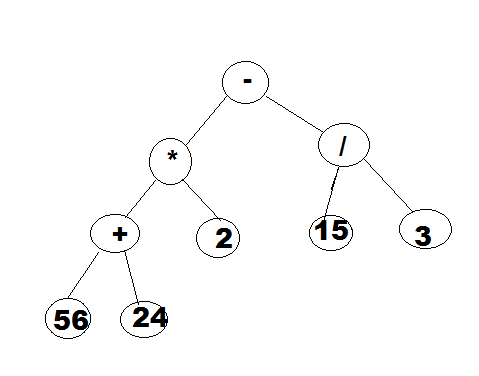
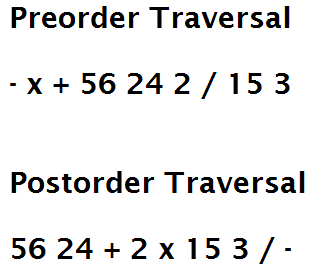
Preorder Traversal
- x + 56 24 2 / 15 3
Postorder Traversal
56 24 + 2 x 15 3 / -
Add Answer to:
For the following mathematical expression (56 + 24 ) X 2 – (15/3) a. draw the...
c++, data structures Given the following Binary Tree: tree 56 47 69 22 49 59 11...
 c++, data structures
Given the following Binary Tree: tree 56 47 69 22 49 59 11 29 62 I 23 30 61 64 1. Show the order in which the nodes in the tree are processed by inorder traversal, postorder traversal, and preorder traversal. 2. Show how the tree would look like after deletion of 29, 59 and 47 3. Show how the original tree would look after the insertion of nodes containing 63, 77,76, 48, 9, and 10 (in...
c++, data structures
Given the following Binary Tree: tree 56 47 69 22 49 59 11 29 62 I 23 30 61 64 1. Show the order in which the nodes in the tree are processed by inorder traversal, postorder traversal, and preorder traversal. 2. Show how the tree would look like after deletion of 29, 59 and 47 3. Show how the original tree would look after the insertion of nodes containing 63, 77,76, 48, 9, and 10 (in...
Answer question 3. Question 1 is for the graph Assume the following questions using the provided...
 Answer question 3.
Question 1 is for the graph
Assume the following questions using the provided tree. By postorder traversal, what is the node to visit first? By preorder traversal, what is the node to visit last? By postorder traversal, what is the node to visit after node 5? By preorder traversal, what is the node to visit after node 5? By inorder traversal, what is the node to visit after node 5?
Answer question 3.
Question 1 is for the graph
Assume the following questions using the provided tree. By postorder traversal, what is the node to visit first? By preorder traversal, what is the node to visit last? By postorder traversal, what is the node to visit after node 5? By preorder traversal, what is the node to visit after node 5? By inorder traversal, what is the node to visit after node 5?
I need the answers and solutions to questions. 9 4b 7+c 9. Consider the expression 3(a...
 I need the answers and solutions to questions. 9
4b 7+c 9. Consider the expression 3(a +6)- the co 10. Use the tree from the previous problem to generate the preorder form of the expression 11. Use the tree from the previous problem to generate the postorder form of the expression Draw the corresponding expression tree
I need the answers and solutions to questions. 9
4b 7+c 9. Consider the expression 3(a +6)- the co 10. Use the tree from the previous problem to generate the preorder form of the expression 11. Use the tree from the previous problem to generate the postorder form of the expression Draw the corresponding expression tree
(Pre-order and post-order traversal). Implement the textbook's algorithm (not the Java implementation) for pre-order and post-order...
 (Pre-order and post-order traversal). Implement the textbook's
algorithm (not the Java implementation) for
pre-order and post-order traversal. To "process" or "visit" a node
means to print the data at that node.
Pre-order traversal output: 10 6 4 8 18 15 21
Post-order traversal output: 4 8 6 15 21 18 10
Additionally, create and traverse the following trees:
Algorithm preorder(p) perform the "visit" action for position p this happens before any recursion for each child c in children(p) do recursively...
(Pre-order and post-order traversal). Implement the textbook's
algorithm (not the Java implementation) for
pre-order and post-order traversal. To "process" or "visit" a node
means to print the data at that node.
Pre-order traversal output: 10 6 4 8 18 15 21
Post-order traversal output: 4 8 6 15 21 18 10
Additionally, create and traverse the following trees:
Algorithm preorder(p) perform the "visit" action for position p this happens before any recursion for each child c in children(p) do recursively...
2. Consider following pre-order expression, draw the expression tree. *+-123-4+56
 2. Consider following pre-order expression, draw the expression tree. *+-123-4+56
TestCodeForAssigment.py def main(): # testing recursive find, pre- and post-order, and __len__ """ creating the following...
 TestCodeForAssigment.py
def main():
# testing recursive find, pre- and post-order, and __len__
""" creating the following BST:
25
15 29
12 20 27 50
17 """
t1 = BST()
t1.insert_rec(25)
t1.insert_rec(15)
t1.insert_rec(12)
t1.insert_rec(20)
t1.insert_rec(17)
t1.insert_rec(29)
t1.insert_rec(27)
t1.insert_rec(50)
print("Let's see if we can find 27 using the non-recursive find: ", t1.find(27))
print("Let's see if we can find 27 using the recursive find: ", t1.findRecursive(27))
print("The length of the BST tree is ",t1.__len__())
print("The preorder traversal of the tree:", list(t1.preOrder()))
print("The postorder...
TestCodeForAssigment.py
def main():
# testing recursive find, pre- and post-order, and __len__
""" creating the following BST:
25
15 29
12 20 27 50
17 """
t1 = BST()
t1.insert_rec(25)
t1.insert_rec(15)
t1.insert_rec(12)
t1.insert_rec(20)
t1.insert_rec(17)
t1.insert_rec(29)
t1.insert_rec(27)
t1.insert_rec(50)
print("Let's see if we can find 27 using the non-recursive find: ", t1.find(27))
print("Let's see if we can find 27 using the recursive find: ", t1.findRecursive(27))
print("The length of the BST tree is ",t1.__len__())
print("The preorder traversal of the tree:", list(t1.preOrder()))
print("The postorder...
Create a binary search tree from the following: 43, 5, 2, 54, 64, 23, 6, 48,...
Create a binary search tree from the following: 43, 5, 2, 54, 64, 23, 6, 48, 30 and write its preorder, inorder and postorder traversal. (Needs to be in C#)
a) Create a binary search tree with the 4 2 2 0 1 4 5 9...
a) Create a binary search tree with the 4 2 2 0 1 4 5 9 7 1 5 3 6 number. b) Provide the Preorder, Inorder and Postorder traversal of tree obtained in part (a). Show all the steps.
Can someone help with these two problems? The following binary tree contains the characters 'A' through...
 Can someone help with these two problems?
The following binary tree contains the characters 'A' through 'G' in its nodes. List the nodes in the order that they are visited by: A preorder traversal. An inorder traversal. A postorder traversal. The binary tree in Problem 2 is a Binary Search Tree since for every node, all elements stored in the left subtree of the node are smaller than the element in the node and all elements stored in the right...
Can someone help with these two problems?
The following binary tree contains the characters 'A' through 'G' in its nodes. List the nodes in the order that they are visited by: A preorder traversal. An inorder traversal. A postorder traversal. The binary tree in Problem 2 is a Binary Search Tree since for every node, all elements stored in the left subtree of the node are smaller than the element in the node and all elements stored in the right...
This is in Java Create a client class that does the following: Manually creates an instance...
This is in Java Create a client class that does the following: Manually creates an instance of a binary expression tree that represents the following expression: (((5+2)*(2-1)/((2+9))+((7-2)-1))*8) Do this by using methods such as addRoot, addLeft, addRight, set, and attach. The element should be of type String Note that you are manually building this specific expression tree, the pseudo code might look something like: Create a LinkedBinaryTree Add “*” as the root to the tree Add “/” as the left...
 c++, data structures
Given the following Binary Tree: tree 56 47 69 22 49 59 11 29 62 I 23 30 61 64 1. Show the order in which the nodes in the tree are processed by inorder traversal, postorder traversal, and preorder traversal. 2. Show how the tree would look like after deletion of 29, 59 and 47 3. Show how the original tree would look after the insertion of nodes containing 63, 77,76, 48, 9, and 10 (in...
c++, data structures
Given the following Binary Tree: tree 56 47 69 22 49 59 11 29 62 I 23 30 61 64 1. Show the order in which the nodes in the tree are processed by inorder traversal, postorder traversal, and preorder traversal. 2. Show how the tree would look like after deletion of 29, 59 and 47 3. Show how the original tree would look after the insertion of nodes containing 63, 77,76, 48, 9, and 10 (in...
 Answer question 3.
Question 1 is for the graph
Assume the following questions using the provided tree. By postorder traversal, what is the node to visit first? By preorder traversal, what is the node to visit last? By postorder traversal, what is the node to visit after node 5? By preorder traversal, what is the node to visit after node 5? By inorder traversal, what is the node to visit after node 5?
Answer question 3.
Question 1 is for the graph
Assume the following questions using the provided tree. By postorder traversal, what is the node to visit first? By preorder traversal, what is the node to visit last? By postorder traversal, what is the node to visit after node 5? By preorder traversal, what is the node to visit after node 5? By inorder traversal, what is the node to visit after node 5?
 I need the answers and solutions to questions. 9
4b 7+c 9. Consider the expression 3(a +6)- the co 10. Use the tree from the previous problem to generate the preorder form of the expression 11. Use the tree from the previous problem to generate the postorder form of the expression Draw the corresponding expression tree
I need the answers and solutions to questions. 9
4b 7+c 9. Consider the expression 3(a +6)- the co 10. Use the tree from the previous problem to generate the preorder form of the expression 11. Use the tree from the previous problem to generate the postorder form of the expression Draw the corresponding expression tree
 (Pre-order and post-order traversal). Implement the textbook's
algorithm (not the Java implementation) for
pre-order and post-order traversal. To "process" or "visit" a node
means to print the data at that node.
Pre-order traversal output: 10 6 4 8 18 15 21
Post-order traversal output: 4 8 6 15 21 18 10
Additionally, create and traverse the following trees:
Algorithm preorder(p) perform the "visit" action for position p this happens before any recursion for each child c in children(p) do recursively...
(Pre-order and post-order traversal). Implement the textbook's
algorithm (not the Java implementation) for
pre-order and post-order traversal. To "process" or "visit" a node
means to print the data at that node.
Pre-order traversal output: 10 6 4 8 18 15 21
Post-order traversal output: 4 8 6 15 21 18 10
Additionally, create and traverse the following trees:
Algorithm preorder(p) perform the "visit" action for position p this happens before any recursion for each child c in children(p) do recursively...
 2. Consider following pre-order expression, draw the expression tree. *+-123-4+56
 TestCodeForAssigment.py
def main():
# testing recursive find, pre- and post-order, and __len__
""" creating the following BST:
25
15 29
12 20 27 50
17 """
t1 = BST()
t1.insert_rec(25)
t1.insert_rec(15)
t1.insert_rec(12)
t1.insert_rec(20)
t1.insert_rec(17)
t1.insert_rec(29)
t1.insert_rec(27)
t1.insert_rec(50)
print("Let's see if we can find 27 using the non-recursive find: ", t1.find(27))
print("Let's see if we can find 27 using the recursive find: ", t1.findRecursive(27))
print("The length of the BST tree is ",t1.__len__())
print("The preorder traversal of the tree:", list(t1.preOrder()))
print("The postorder...
TestCodeForAssigment.py
def main():
# testing recursive find, pre- and post-order, and __len__
""" creating the following BST:
25
15 29
12 20 27 50
17 """
t1 = BST()
t1.insert_rec(25)
t1.insert_rec(15)
t1.insert_rec(12)
t1.insert_rec(20)
t1.insert_rec(17)
t1.insert_rec(29)
t1.insert_rec(27)
t1.insert_rec(50)
print("Let's see if we can find 27 using the non-recursive find: ", t1.find(27))
print("Let's see if we can find 27 using the recursive find: ", t1.findRecursive(27))
print("The length of the BST tree is ",t1.__len__())
print("The preorder traversal of the tree:", list(t1.preOrder()))
print("The postorder...
 Can someone help with these two problems?
The following binary tree contains the characters 'A' through 'G' in its nodes. List the nodes in the order that they are visited by: A preorder traversal. An inorder traversal. A postorder traversal. The binary tree in Problem 2 is a Binary Search Tree since for every node, all elements stored in the left subtree of the node are smaller than the element in the node and all elements stored in the right...
Can someone help with these two problems?
The following binary tree contains the characters 'A' through 'G' in its nodes. List the nodes in the order that they are visited by: A preorder traversal. An inorder traversal. A postorder traversal. The binary tree in Problem 2 is a Binary Search Tree since for every node, all elements stored in the left subtree of the node are smaller than the element in the node and all elements stored in the right...
Most questions answered within 3 hours.
-
Where is the error in this code sequence?
String s1 = "Hello";
String s2 = "ello";...
asked 10 months ago -
Financial data for Joel de Paris, Inc., for last year
follow:
Joel de Paris, Inc.
Balance...
asked 10 months ago -
Consider this reaction:
Al2(SO4)3 (aq)+ BaCl3
(aq) Al2Cl6 (aq)- +
3BaSO4(s) . What is the...
asked 10 months ago -
Suppose that Savneet is considering increasing her
recent random sample from 20 car rentals to 40...
asked 10 months ago -
Trucks arrive at an unloading terminal at an average rate of 120
per hour.
Trucks arrive...
asked 10 months ago -
Why are methanol and ethanol completely soluble in water while
octanol is not very little soluble....
asked 10 months ago -
A facilities manager at a university reads in a research report
that the mean amount of...
asked 10 months ago -
When the CuSO4 is rehydrated by adding water to the anhydrous
compound, is this an endothermic...
asked 10 months ago -
A ray of sunlight is passing from diamond into crown glass; the
angle of incidence is...
asked 10 months ago -
A block of mass 0.249 kg is placed on top of a light, vertical
spring of...
asked 10 months ago -
how do the kidneys compensate in the presences of acidosis
a) trigger hyperventilate
b) reserve acid...
asked 10 months ago -
Question 501 pts
The rental rate of capital to the firm increases. Which of the
following...
asked 10 months ago