
Homework Answers
If the electronegativity of the two bonded atoms are different then the bond is polar. As the difference in electronegativity of the two bonded atoms increases, the polarity of the bond increases.
If one atom is highly electronegative than the other atom in the bond, then the highly electronegative atom attracts the bonded pair of electrons more than its share. Hence, partial negative charge is developed on the highly electronegative atom and partial positive charge is developed on the less electronegative atom.
Part a
The structure of the compound is as follows:

Calculate the electronegativity difference as follows:
The electronegativity difference is low for . Hence, the least polar bond is .
Part b
The carbon atom which has the most positive character is as follows:
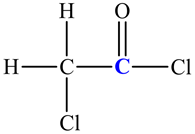
As the right carbon is attached to two highly electronegative atoms, the right C has the most partial positive character.
Ans: Part aThe least polar bond is .
Part bThe right C has the most partial positive character.
Add Answer to:
Analyze the polarity of each bond in the following organic compound. Which bond, other than the...
Analyze the polarity of each bond in the organic compound.
Analyze the polarity of each bond in the organic compound.
In a covalent bond between two atoms, the more electronegative atom will attract more electron density...
 In a covalent bond between two atoms, the more electronegative atom will attract more electron density toward itself, producing a polar bond. The more electronegative element will carry a partial negative charge, whereas the less electronegative element will carry a partial positive charge. The direction of the bond dipole is always toward the more electronegative element. This is often indicated by an arrow, as shown in the figure. The magnitude of the bond polarity can be estimated by using the...
A covalent bond is a bond in which electrons are shared between atoms of elements
 A covalent bond is a
bond in which electrons are shared between atoms of elements. A
covalent bond can be polar or nonpolar. In a nonpolar covalent
bond, the bond is between two identical atoms and the electrons are
evenly shared between the atoms.In contrast, in a
polar covalent bond, the bond is between two nonidentical atoms and
the electrons are unevenly shared between the atoms. The uneven
sharing of electrons takes place because of the difference in the
electronegativity...
A covalent bond is a
bond in which electrons are shared between atoms of elements. A
covalent bond can be polar or nonpolar. In a nonpolar covalent
bond, the bond is between two identical atoms and the electrons are
evenly shared between the atoms.In contrast, in a
polar covalent bond, the bond is between two nonidentical atoms and
the electrons are unevenly shared between the atoms. The uneven
sharing of electrons takes place because of the difference in the
electronegativity...
NAme SAnIRA ID 05100 9 Worksheet-Polarity of Bonds III. Using the table of electronegativities from your...
 NAme SAnIRA ID 05100 9 Worksheet-Polarity of Bonds III. Using the table of electronegativities from your Periodic table calculate the EN difference for the atoms that are bonded in the I. Determine the type of bond (ionic, polar covalent, or non-polar covalent) that will form between atoms of the following elements and show the polarity of the bond if it is polar covalent. following molecules. Then tell whether the bond is nonpolar covalent, polar covalent, or ionic. Tell which atom...
1.37 Consider the X-H bond, in which X is an atom other than H. The H...
 1.37 Consider the X-H bond, in which X is an atom other than H. The H in a polar bond is more acidic (more easily to moved) than the H in a nonpolar bond. Considering bond polarity, which hydrogen in acetid, CH,C-OH, do you expect to be most acidic? Write an equation for the reaction between acetic acid and sodium oxide.
PC 101 Homework 02 Given each compound or molecule, first state whether each atom is a...
PC 101 Homework 02 Given each compound or molecule, first state whether each atom is a metal or nonmetal. Then, using your electronegativity chart, provide the electronegativity (En) values for each atom and then mathematically predict whether the bond between the atoms will be an ionic bond, a polar covalent bond, or a nonpolar covalent bond. Compound/Molecule 1st Atom (metal or nonmetal) 1st atom’s En Value 2nd Atom (metal or nonmetal) 2nd Atom’s En Value En Difference Bond Type H-Cl ...
Polarity Electronegativity and Dipoles CHM113 Chapter 8 Resource Worksheets Resource 2: Polarity, Electronegativity, Dipoles 1. Label...
 Polarity Electronegativity and Dipoles
CHM113 Chapter 8 Resource Worksheets Resource 2: Polarity, Electronegativity, Dipoles 1. Label the bond in each of the following compounds as ionic, nonpolar, or polar covalent. a) F2 b) HF c) KCI d) Cus 2. For each covalent compound below. Inbel the bond as either nonpolar covalent or polar covalent. Compound Bond Type Compound Bond Type NO O; Cl2 NO; PO, ΝΗ, H0 CH SO: N, NF; CCL 3. For the following compounds identify what has...
Polarity Electronegativity and Dipoles
CHM113 Chapter 8 Resource Worksheets Resource 2: Polarity, Electronegativity, Dipoles 1. Label the bond in each of the following compounds as ionic, nonpolar, or polar covalent. a) F2 b) HF c) KCI d) Cus 2. For each covalent compound below. Inbel the bond as either nonpolar covalent or polar covalent. Compound Bond Type Compound Bond Type NO O; Cl2 NO; PO, ΝΗ, H0 CH SO: N, NF; CCL 3. For the following compounds identify what has...
Bond Polarity Order the following bonds according to their expected relative degrees of polarity, based upon...
 Bond Polarity Order the following bonds according to their expected relative degrees of polarity, based upon the electonegativities of the elements most polari 2nd most polar 3rd most polar 2nd least polar least polar CI-CI Br-F O-N H-F O-Br
Indicate the polarity of each bond with a polar arrow: 1) N – B 2) N.
Indicate the polarity of each bond with a polar arrow: 1) N – B 2) N – O 3) C – S 4) S – O 5) N – H 6) Cl – O an explanation would be helpful please
Which of the following is true about the peptide bond. Choose all true statements. The peptide...
Which of the following is true about the peptide bond. Choose all true statements. The peptide bond is polar, the N has a partial negative charge and the C has a partial positive charge. The peptide bond is uncharged. The plane of the peptide bond contains the following atoms: the alpha-carbon atom and CO groups of the first amino acid, the NH group and alpha-carbon of the second amino acid. The peptide bond has no double bond character.
 In a covalent bond between two atoms, the more electronegative atom will attract more electron density toward itself, producing a polar bond. The more electronegative element will carry a partial negative charge, whereas the less electronegative element will carry a partial positive charge. The direction of the bond dipole is always toward the more electronegative element. This is often indicated by an arrow, as shown in the figure. The magnitude of the bond polarity can be estimated by using the...
 A covalent bond is a
bond in which electrons are shared between atoms of elements. A
covalent bond can be polar or nonpolar. In a nonpolar covalent
bond, the bond is between two identical atoms and the electrons are
evenly shared between the atoms.In contrast, in a
polar covalent bond, the bond is between two nonidentical atoms and
the electrons are unevenly shared between the atoms. The uneven
sharing of electrons takes place because of the difference in the
electronegativity...
A covalent bond is a
bond in which electrons are shared between atoms of elements. A
covalent bond can be polar or nonpolar. In a nonpolar covalent
bond, the bond is between two identical atoms and the electrons are
evenly shared between the atoms.In contrast, in a
polar covalent bond, the bond is between two nonidentical atoms and
the electrons are unevenly shared between the atoms. The uneven
sharing of electrons takes place because of the difference in the
electronegativity...
 NAme SAnIRA ID 05100 9 Worksheet-Polarity of Bonds III. Using the table of electronegativities from your Periodic table calculate the EN difference for the atoms that are bonded in the I. Determine the type of bond (ionic, polar covalent, or non-polar covalent) that will form between atoms of the following elements and show the polarity of the bond if it is polar covalent. following molecules. Then tell whether the bond is nonpolar covalent, polar covalent, or ionic. Tell which atom...
 1.37 Consider the X-H bond, in which X is an atom other than H. The H in a polar bond is more acidic (more easily to moved) than the H in a nonpolar bond. Considering bond polarity, which hydrogen in acetid, CH,C-OH, do you expect to be most acidic? Write an equation for the reaction between acetic acid and sodium oxide.
 Polarity Electronegativity and Dipoles
CHM113 Chapter 8 Resource Worksheets Resource 2: Polarity, Electronegativity, Dipoles 1. Label the bond in each of the following compounds as ionic, nonpolar, or polar covalent. a) F2 b) HF c) KCI d) Cus 2. For each covalent compound below. Inbel the bond as either nonpolar covalent or polar covalent. Compound Bond Type Compound Bond Type NO O; Cl2 NO; PO, ΝΗ, H0 CH SO: N, NF; CCL 3. For the following compounds identify what has...
Polarity Electronegativity and Dipoles
CHM113 Chapter 8 Resource Worksheets Resource 2: Polarity, Electronegativity, Dipoles 1. Label the bond in each of the following compounds as ionic, nonpolar, or polar covalent. a) F2 b) HF c) KCI d) Cus 2. For each covalent compound below. Inbel the bond as either nonpolar covalent or polar covalent. Compound Bond Type Compound Bond Type NO O; Cl2 NO; PO, ΝΗ, H0 CH SO: N, NF; CCL 3. For the following compounds identify what has...
 Bond Polarity Order the following bonds according to their expected relative degrees of polarity, based upon the electonegativities of the elements most polari 2nd most polar 3rd most polar 2nd least polar least polar CI-CI Br-F O-N H-F O-Br
Most questions answered within 3 hours.
-
Where is the error in this code sequence?
String s1 = "Hello";
String s2 = "ello";...
asked 11 months ago -
Financial data for Joel de Paris, Inc., for last year
follow:
Joel de Paris, Inc.
Balance...
asked 11 months ago -
Consider this reaction:
Al2(SO4)3 (aq)+ BaCl3
(aq) Al2Cl6 (aq)- +
3BaSO4(s) . What is the...
asked 11 months ago -
Suppose that Savneet is considering increasing her
recent random sample from 20 car rentals to 40...
asked 11 months ago -
Trucks arrive at an unloading terminal at an average rate of 120
per hour.
Trucks arrive...
asked 11 months ago -
Why are methanol and ethanol completely soluble in water while
octanol is not very little soluble....
asked 11 months ago -
A facilities manager at a university reads in a research report
that the mean amount of...
asked 11 months ago -
When the CuSO4 is rehydrated by adding water to the anhydrous
compound, is this an endothermic...
asked 11 months ago -
A ray of sunlight is passing from diamond into crown glass; the
angle of incidence is...
asked 11 months ago -
A block of mass 0.249 kg is placed on top of a light, vertical
spring of...
asked 11 months ago -
how do the kidneys compensate in the presences of acidosis
a) trigger hyperventilate
b) reserve acid...
asked 11 months ago -
Question 501 pts
The rental rate of capital to the firm increases. Which of the
following...
asked 11 months ago