
Homework Answers
A precipitation reaction..
A precipitation reaction refers to formation of insoluble salt when two solutions containing two salts are combined .the insoluble salt that falls out of solution is known as the precipitation.this is the precitation
Add Answer to:
Question 17 (1 point) Knowing that chemical reactions often are classified as more than one type...
Knowing that chemical reactions often are classified as more than one type of reaction, what type...
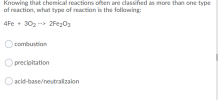 Knowing that chemical reactions often are classified as more than one type of reaction, what type of reaction is the following: 4Fe + 302 --> 2Fe2O3 combustion precipitation acid-base/neutralizaion
which one of the following precipitation reactions does not occur? Question 16 Which ONE of the...
 which one of the following precipitation reactions does not
occur?
Question 16 Which ONE of the following precipitation reactions does NOT occur? O Pb(NO3)2 + 2NaCl → 2NaNO3 + PbCl2 O Pb(NO3)2 + ZnSO4 → PbSO4 + Zn(NO3)2 KNO3 + MgSO4 Mg(NO3)2 + K2SO4 CaCl2 + Na2CO3 – CaCO3 + 2Naci O Pb(NO3)2 + ZnSO4 – PbSO4 + Zn(NO3)2
which one of the following precipitation reactions does not
occur?
Question 16 Which ONE of the following precipitation reactions does NOT occur? O Pb(NO3)2 + 2NaCl → 2NaNO3 + PbCl2 O Pb(NO3)2 + ZnSO4 → PbSO4 + Zn(NO3)2 KNO3 + MgSO4 Mg(NO3)2 + K2SO4 CaCl2 + Na2CO3 – CaCO3 + 2Naci O Pb(NO3)2 + ZnSO4 – PbSO4 + Zn(NO3)2
8. (1 point per blank) A solution of Pb(NO3)2 (aq) is mixed with a solution of...
 8. (1 point per blank) A solution of Pb(NO3)2 (aq) is mixed with a solution of KI (aq) A solid forms and its identity is The balanced net ionic equation for the solid formation reaction is: The spectator ions are This type of chemical reaction is referred to as: (choices: redox, precipitation, combustion, synthesis, acid-base neutralization)
Consider the following chemical equation: Ca(OH)2 (aq) + H2SO4 (aq) + CaSO4 (s) + H20 (1)...
 Consider the following chemical equation: Ca(OH)2 (aq) + H2SO4 (aq) + CaSO4 (s) + H20 (1) Identify the type(s) of chemical reaction that this is classified as. precipitation + acid-base precipitation + oxidation-reduction (redox) precipitation acid-base oxidation-reduction (redox)
Classify each chemical reaction: reaction HCl(aq) + NaOH(aq) NaCl(aq) + H20(1) 2Nacio, (s) → 2NaCl(s) +...
 Classify each chemical reaction: reaction HCl(aq) + NaOH(aq) NaCl(aq) + H20(1) 2Nacio, (s) → 2NaCl(s) + 30 (8) type of reaction (check all that apply) combination precipitation single replacement combustion double replacement acid-base decomposition combination precipitation single replacement combustion double replacement acid-base decomposition combination precipitation single replacement combustion double replacement acid-base decomposition combination precipitation single replacement combustion double replacement acid-base decomposition CH,CH, CH, (s) + 502 (8) – 300,(8) + 4H2O(8) NaCl(aq) + AgNO, (aq) - NaNO3(aq) + AgCl(s)
-CHM-1050-A - Basic Chemistry 1.00 mol of neon has a mass of Select one: O A....
 -CHM-1050-A - Basic Chemistry 1.00 mol of neon has a mass of Select one: O A. 20.2 g OB. 1.009 OOO O E. 14.00 In this set of chemical reactions, which is a single replacement reaction? Select one: O A. CuSO4(aq) + BaCl2(aq) → BaSO4(s) + CuCl2(aq) B. Zn(s) + H2SO4(aq) → ZnSO4(aq) + H2(g) OC. Pb(NO3)2(aq) + 2NaCl(aq) → PbCl2(s) + 2NaNO3(aq) D. AgNO3(aq) + NaCl(aq) ► AgCl(s) + NaNO3(aq) E. K2SO4(aq) + BaCl2(aq) → BaSO4(s) + 2Cl(aq) Finish...
help me to solve worksheet like an example sheet i am posting it for second time....
 help me to solve worksheet like an example sheet i am posting
it for second time. help me
CHEM 200 CHAP 7: Classifying Chemical Reactions Dr. Bancroft ZnCl2 (aq) + (NH)2SO4 (aq) → _ZnSO4 (aq) + 2NH.CI (aq) Total Ionic: Circle one: • Redox: Combination • Redox: Decomposition • Redox: Single Replacement • DD: Precipitation • DD: Acid-Base • No Reaction Occurs Net lonic: 2 H2 (g) + 2 H20 (1) Total Ionic: Circle one: • Redox: Combination • Redox:...
help me to solve worksheet like an example sheet i am posting
it for second time. help me
CHEM 200 CHAP 7: Classifying Chemical Reactions Dr. Bancroft ZnCl2 (aq) + (NH)2SO4 (aq) → _ZnSO4 (aq) + 2NH.CI (aq) Total Ionic: Circle one: • Redox: Combination • Redox: Decomposition • Redox: Single Replacement • DD: Precipitation • DD: Acid-Base • No Reaction Occurs Net lonic: 2 H2 (g) + 2 H20 (1) Total Ionic: Circle one: • Redox: Combination • Redox:...
reaction MgI,(aq) + Pb(NO3)2(aq) + Mg(NO3), (aq) + Pb17 () Na(s) + Br, (1) NaBr, (s)...
 reaction MgI,(aq) + Pb(NO3)2(aq) + Mg(NO3), (aq) + Pb17 () Na(s) + Br, (1) NaBr, (s) type of reaction (check all that apply) combination precipitation single replacement combustion double replacement acid-base decomposition combination precipitation single replacement combustion double replacement acid-base decomposition combination precipitation single replacement combustion double replacement acid-base decomposition combination precipitation single replacement combustion double replacement acid-base decomposition CH, CH, OH (1) + 30 (8) ► 2002 (8) + 3H,0 (8) H Br(aq) + NaOH(aq) NaBr(aq) + H, 0(1)
1) Complete the following reactions with the products and balance them. Also, name the type of...
 1) Complete the following reactions with the products and balance them. Also, name the type of each reaction (oxidation-reduction, precipitation, acid-base, gas formation or heat of combustion) (a) K2504(aq) + Pd(NO3)2(aq) → (b) Ba(OH)2(aq) + HCIO4(aq) → (c) Fe(s) + CuSO4(aq) → (d) C3H60(1) + O2(g) → (e) Zn(s) + H2SO4(aq) →
3 .Which one of the following reactions is a redox reaction? 1. 2Al(s) + 2KOH(aq)...
3 .Which one of the following reactions is a redox reaction? 1. 2Al(s) + 2KOH(aq) + 6H2O(l) → 2KAl(OH)4(aq) + 3H2(g) 2. Pb(NO3)2(aq) + 2HCl(aq) → PbCl2(s) + 2HNO3(aq) 3. Zn(OH)2(aq) + H2SO4(aq) → ZnSO4(aq) + 2H2O(l)
 Knowing that chemical reactions often are classified as more than one type of reaction, what type of reaction is the following: 4Fe + 302 --> 2Fe2O3 combustion precipitation acid-base/neutralizaion
 which one of the following precipitation reactions does not
occur?
Question 16 Which ONE of the following precipitation reactions does NOT occur? O Pb(NO3)2 + 2NaCl → 2NaNO3 + PbCl2 O Pb(NO3)2 + ZnSO4 → PbSO4 + Zn(NO3)2 KNO3 + MgSO4 Mg(NO3)2 + K2SO4 CaCl2 + Na2CO3 – CaCO3 + 2Naci O Pb(NO3)2 + ZnSO4 – PbSO4 + Zn(NO3)2
which one of the following precipitation reactions does not
occur?
Question 16 Which ONE of the following precipitation reactions does NOT occur? O Pb(NO3)2 + 2NaCl → 2NaNO3 + PbCl2 O Pb(NO3)2 + ZnSO4 → PbSO4 + Zn(NO3)2 KNO3 + MgSO4 Mg(NO3)2 + K2SO4 CaCl2 + Na2CO3 – CaCO3 + 2Naci O Pb(NO3)2 + ZnSO4 – PbSO4 + Zn(NO3)2
 8. (1 point per blank) A solution of Pb(NO3)2 (aq) is mixed with a solution of KI (aq) A solid forms and its identity is The balanced net ionic equation for the solid formation reaction is: The spectator ions are This type of chemical reaction is referred to as: (choices: redox, precipitation, combustion, synthesis, acid-base neutralization)
 Consider the following chemical equation: Ca(OH)2 (aq) + H2SO4 (aq) + CaSO4 (s) + H20 (1) Identify the type(s) of chemical reaction that this is classified as. precipitation + acid-base precipitation + oxidation-reduction (redox) precipitation acid-base oxidation-reduction (redox)
 Classify each chemical reaction: reaction HCl(aq) + NaOH(aq) NaCl(aq) + H20(1) 2Nacio, (s) → 2NaCl(s) + 30 (8) type of reaction (check all that apply) combination precipitation single replacement combustion double replacement acid-base decomposition combination precipitation single replacement combustion double replacement acid-base decomposition combination precipitation single replacement combustion double replacement acid-base decomposition combination precipitation single replacement combustion double replacement acid-base decomposition CH,CH, CH, (s) + 502 (8) – 300,(8) + 4H2O(8) NaCl(aq) + AgNO, (aq) - NaNO3(aq) + AgCl(s)
 -CHM-1050-A - Basic Chemistry 1.00 mol of neon has a mass of Select one: O A. 20.2 g OB. 1.009 OOO O E. 14.00 In this set of chemical reactions, which is a single replacement reaction? Select one: O A. CuSO4(aq) + BaCl2(aq) → BaSO4(s) + CuCl2(aq) B. Zn(s) + H2SO4(aq) → ZnSO4(aq) + H2(g) OC. Pb(NO3)2(aq) + 2NaCl(aq) → PbCl2(s) + 2NaNO3(aq) D. AgNO3(aq) + NaCl(aq) ► AgCl(s) + NaNO3(aq) E. K2SO4(aq) + BaCl2(aq) → BaSO4(s) + 2Cl(aq) Finish...
 help me to solve worksheet like an example sheet i am posting
it for second time. help me
CHEM 200 CHAP 7: Classifying Chemical Reactions Dr. Bancroft ZnCl2 (aq) + (NH)2SO4 (aq) → _ZnSO4 (aq) + 2NH.CI (aq) Total Ionic: Circle one: • Redox: Combination • Redox: Decomposition • Redox: Single Replacement • DD: Precipitation • DD: Acid-Base • No Reaction Occurs Net lonic: 2 H2 (g) + 2 H20 (1) Total Ionic: Circle one: • Redox: Combination • Redox:...
help me to solve worksheet like an example sheet i am posting
it for second time. help me
CHEM 200 CHAP 7: Classifying Chemical Reactions Dr. Bancroft ZnCl2 (aq) + (NH)2SO4 (aq) → _ZnSO4 (aq) + 2NH.CI (aq) Total Ionic: Circle one: • Redox: Combination • Redox: Decomposition • Redox: Single Replacement • DD: Precipitation • DD: Acid-Base • No Reaction Occurs Net lonic: 2 H2 (g) + 2 H20 (1) Total Ionic: Circle one: • Redox: Combination • Redox:...
 reaction MgI,(aq) + Pb(NO3)2(aq) + Mg(NO3), (aq) + Pb17 () Na(s) + Br, (1) NaBr, (s) type of reaction (check all that apply) combination precipitation single replacement combustion double replacement acid-base decomposition combination precipitation single replacement combustion double replacement acid-base decomposition combination precipitation single replacement combustion double replacement acid-base decomposition combination precipitation single replacement combustion double replacement acid-base decomposition CH, CH, OH (1) + 30 (8) ► 2002 (8) + 3H,0 (8) H Br(aq) + NaOH(aq) NaBr(aq) + H, 0(1)
 1) Complete the following reactions with the products and balance them. Also, name the type of each reaction (oxidation-reduction, precipitation, acid-base, gas formation or heat of combustion) (a) K2504(aq) + Pd(NO3)2(aq) → (b) Ba(OH)2(aq) + HCIO4(aq) → (c) Fe(s) + CuSO4(aq) → (d) C3H60(1) + O2(g) → (e) Zn(s) + H2SO4(aq) →
Most questions answered within 3 hours.
-
Where is the error in this code sequence?
String s1 = "Hello";
String s2 = "ello";...
asked 10 months ago -
Financial data for Joel de Paris, Inc., for last year
follow:
Joel de Paris, Inc.
Balance...
asked 10 months ago -
Consider this reaction:
Al2(SO4)3 (aq)+ BaCl3
(aq) Al2Cl6 (aq)- +
3BaSO4(s) . What is the...
asked 10 months ago -
Suppose that Savneet is considering increasing her
recent random sample from 20 car rentals to 40...
asked 10 months ago -
Trucks arrive at an unloading terminal at an average rate of 120
per hour.
Trucks arrive...
asked 10 months ago -
Why are methanol and ethanol completely soluble in water while
octanol is not very little soluble....
asked 10 months ago -
A facilities manager at a university reads in a research report
that the mean amount of...
asked 10 months ago -
When the CuSO4 is rehydrated by adding water to the anhydrous
compound, is this an endothermic...
asked 10 months ago -
A ray of sunlight is passing from diamond into crown glass; the
angle of incidence is...
asked 10 months ago -
A block of mass 0.249 kg is placed on top of a light, vertical
spring of...
asked 10 months ago -
how do the kidneys compensate in the presences of acidosis
a) trigger hyperventilate
b) reserve acid...
asked 10 months ago -
Question 501 pts
The rental rate of capital to the firm increases. Which of the
following...
asked 10 months ago