Calculate the pH of a solution containing the following compounds. (Note that these are concentrations before...
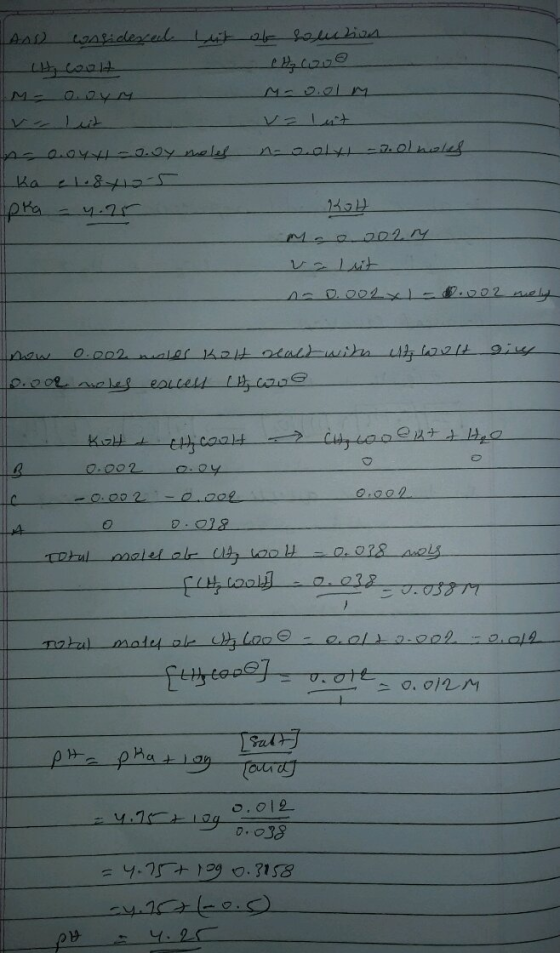
Calculate the pH of a solution containing the following compounds. (Note that these are concentrations before any reaction occurs).
| [CH3COOH] | 0.040 M |
| [CH3COO-1] | 0.010 M |
| [KOH] | 0.002 M |
Homework Answers
Add Answer to:
Calculate the pH of a solution containing the following
compounds. (Note that these are concentrations before...
Calculate the pH of a solution containing the following compounds. (Note that these are concentrations before...
Calculate the pH of a solution containing the following compounds. (Note that these are concentrations before any reaction occurs). [NaH2PO4] 0.300 M [Na2HPO4] 0.840 M [KOH] 0.054 M
2. Calculate the pH of a 0.4480 M solution of the base H2BO3-1 dissolved in water...
2. Calculate the pH of a 0.4480 M solution of the base H2BO3-1 dissolved in water if Ka = 5.4x10⁻¹⁰ for H3BO3. 3. Calculate the pH of a solution containing the following compounds. (Note that these are concentrations before any reaction occurs). [NaH2PO4] 0.300 M [Na2HPO4] 0.840 M [KOH] 0.054 M 4. For the titration of 15.00 mL of 0.100 M C6H5OH with 0.150 M NaOH, calculate the pH after the addition of 6.00 mL of NaOH.
1. Calculate the pH of a 0.0820 M solution of the acid HClO dissolved in water...
1. Calculate the pH of a 0.0820 M solution of the acid HClO dissolved in water if Ka = 2.9x10⁻⁸. 2. Calculate the pH of a 0.4480 M solution of the base H2BO3-1 dissolved in water if Ka = 5.4x10⁻¹⁰ for H3BO3. 3. Calculate the pH of a solution containing the following compounds. (Note that these are concentrations before any reaction occurs). [NaH2PO4] 0.300 M [Na2HPO4] 0.840 M [KOH] 0.054 M 4. For the titration of 15.00 mL of 0.100...
11) What would be the pH of 100.0 mL of a solution that is 0.040 M...
11) What would be the pH of 100.0 mL of a solution that is 0.040 M CH3COOH and 0.010 M CH3COO–? a. 5.36 b. 7.00 c. 4.16 d. Not enough information is given.
what concentrations of CH3COO- and CH3COOH of those below would give a buffer with a pH...
 what concentrations of CH3COO- and CH3COOH of those
below would give a buffer with a pH of 4.11 (pKa=
CH3COOH=4.84)
Br What concentrations of [CH3COO 1 and [CH1COOH1 of those below would give a buffer with a pH of 4.11? (pKa CH3COOH = 4.84). 10 a) (CH3COO]-0.15 M, [CH3COOH] = 0.10 M b) [CH3COO]-0.10 M, [CH3COOH] = 0.53 M c) [CH3COO]-0.46 M, [CH3COOH]= 0.10 M d) [CH3COO]- 0.23 M, [CH3COOH] = 0.10 M 14
what concentrations of CH3COO- and CH3COOH of those
below would give a buffer with a pH of 4.11 (pKa=
CH3COOH=4.84)
Br What concentrations of [CH3COO 1 and [CH1COOH1 of those below would give a buffer with a pH of 4.11? (pKa CH3COOH = 4.84). 10 a) (CH3COO]-0.15 M, [CH3COOH] = 0.10 M b) [CH3COO]-0.10 M, [CH3COOH] = 0.53 M c) [CH3COO]-0.46 M, [CH3COOH]= 0.10 M d) [CH3COO]- 0.23 M, [CH3COOH] = 0.10 M 14
5. Please calculate the pH of a solution containing 0.40 M CH,COOH and 0.70 M CH3COONa...
 5. Please calculate the pH of a solution containing 0.40 M CH,COOH and 0.70 M CH3COONa (K, acetic acid = 1.8 X 10"): CH3COOH + H+ + CH3COO CH3COONa → CH3COO + Nat 6. The molar solubility of tin(ll) iodide is 1.28 x 10⁻² mol/L. What is Ksp for this compound?
Calculate the pH of a solution containing a salt AcNa derived from a strong base (NaOH)...
Calculate the pH of a solution containing a salt AcNa derived from a strong base (NaOH) and a weak acid (AcH), like CH3COONa, KF, NaNO2 and so on. In this case two processes have to be considered: 1. Dissociation of the salt, within the assumption that the salt is a strong electrolyte: AcNa → Ac- + Na+, for instance: CH3COONa → CH3COO- + Na+ 2. the hydrolysis of the water Ac- + H2O ⇌ AcH + OH-, for example:...
2. Calculate the concentrations and activities of H3O+ for the following solutions (assume that the ionic strength...
 2. Calculate the concentrations and activities of H3O+ for the following solutions (assume that the ionic strength is determined by the acid/base). Calculate the pH for each solution two ways: 1) pH = -log[H3O+] and 2) pH = -log @,0+. (a) 0.010 M HNO3 (b) 0.035 M KOH (c) 0.030 M HCI (d) 3.0 M HCI
1.A 1.00 liter solution contains 0.28 M acetic acid and 0.36 M sodium acetate. If 0.180...
1.A 1.00 liter solution contains 0.28 M acetic acid and 0.36 M sodium acetate. If 0.180 moles of potassium hydroxide are added to this system, indicate whether the following statements are true or false. (Assume that the volume does not change upon the addition of potassium hydroxide.) A. The number of moles of CH3COOH will remain the same. B. The number of moles of CH3COO- will decrease. C. The equilibrium concentration of H3O+ will increase. D. The pH will increase....
1) Calculate the pH of the 1L buffer composed of 500 mL of 0.60 M acetic...
1) Calculate the pH of the 1L buffer composed of 500 mL of 0.60 M acetic acid plus 500 mL of 0.60 M sodium acetate, after 0.010 mol of HCl is added (Ka HC2H3O2 = 1.75 x 10⁻⁵). Report your answer to the hundredths place. 2) Calculate the pH of the 1L buffer composed of 500 mL 0.60 M acetic acid plus 500 mL of 0.60 M sodium acetate, after 0.010 mol of NaOH is added (Ka HC2H3O2 = 1.75...
 what concentrations of CH3COO- and CH3COOH of those
below would give a buffer with a pH of 4.11 (pKa=
CH3COOH=4.84)
Br What concentrations of [CH3COO 1 and [CH1COOH1 of those below would give a buffer with a pH of 4.11? (pKa CH3COOH = 4.84). 10 a) (CH3COO]-0.15 M, [CH3COOH] = 0.10 M b) [CH3COO]-0.10 M, [CH3COOH] = 0.53 M c) [CH3COO]-0.46 M, [CH3COOH]= 0.10 M d) [CH3COO]- 0.23 M, [CH3COOH] = 0.10 M 14
what concentrations of CH3COO- and CH3COOH of those
below would give a buffer with a pH of 4.11 (pKa=
CH3COOH=4.84)
Br What concentrations of [CH3COO 1 and [CH1COOH1 of those below would give a buffer with a pH of 4.11? (pKa CH3COOH = 4.84). 10 a) (CH3COO]-0.15 M, [CH3COOH] = 0.10 M b) [CH3COO]-0.10 M, [CH3COOH] = 0.53 M c) [CH3COO]-0.46 M, [CH3COOH]= 0.10 M d) [CH3COO]- 0.23 M, [CH3COOH] = 0.10 M 14
 5. Please calculate the pH of a solution containing 0.40 M CH,COOH and 0.70 M CH3COONa (K, acetic acid = 1.8 X 10"): CH3COOH + H+ + CH3COO CH3COONa → CH3COO + Nat 6. The molar solubility of tin(ll) iodide is 1.28 x 10⁻² mol/L. What is Ksp for this compound?
 2. Calculate the concentrations and activities of H3O+ for the following solutions (assume that the ionic strength is determined by the acid/base). Calculate the pH for each solution two ways: 1) pH = -log[H3O+] and 2) pH = -log @,0+. (a) 0.010 M HNO3 (b) 0.035 M KOH (c) 0.030 M HCI (d) 3.0 M HCI
Most questions answered within 3 hours.
-
Where is the error in this code sequence?
String s1 = "Hello";
String s2 = "ello";...
asked 10 months ago -
Financial data for Joel de Paris, Inc., for last year
follow:
Joel de Paris, Inc.
Balance...
asked 10 months ago -
Consider this reaction:
Al2(SO4)3 (aq)+ BaCl3
(aq) Al2Cl6 (aq)- +
3BaSO4(s) . What is the...
asked 10 months ago -
Suppose that Savneet is considering increasing her
recent random sample from 20 car rentals to 40...
asked 10 months ago -
Trucks arrive at an unloading terminal at an average rate of 120
per hour.
Trucks arrive...
asked 10 months ago -
Why are methanol and ethanol completely soluble in water while
octanol is not very little soluble....
asked 10 months ago -
A facilities manager at a university reads in a research report
that the mean amount of...
asked 10 months ago -
When the CuSO4 is rehydrated by adding water to the anhydrous
compound, is this an endothermic...
asked 10 months ago -
A ray of sunlight is passing from diamond into crown glass; the
angle of incidence is...
asked 10 months ago -
A block of mass 0.249 kg is placed on top of a light, vertical
spring of...
asked 10 months ago -
how do the kidneys compensate in the presences of acidosis
a) trigger hyperventilate
b) reserve acid...
asked 10 months ago -
Question 501 pts
The rental rate of capital to the firm increases. Which of the
following...
asked 10 months ago