



Homework Answers
Add Answer to:
Chem 1212 Lab Report on electrochemistry
Electrochemistry When electrons transfer between reaction components in a redox...
i need help with all of these questions Chem 103A Electrochemistry 5. A voltaic cell is...
 i need help with all of these questions
Chem 103A Electrochemistry 5. A voltaic cell is to be constructed using the Ag/Ag half cell and the Pb/Pb half-cell. Measurement shows that the silver electrode is positive. a) Write balanced half-reactions and the overall spontancous reaction, without using a table of half-cell potentials. b) Diagram the cell, labeling electrodes as anode and cathode, labeling the salt bridge, showing what ions are in solution, and showing the direction of electron flow in...
i need help with all of these questions
Chem 103A Electrochemistry 5. A voltaic cell is to be constructed using the Ag/Ag half cell and the Pb/Pb half-cell. Measurement shows that the silver electrode is positive. a) Write balanced half-reactions and the overall spontancous reaction, without using a table of half-cell potentials. b) Diagram the cell, labeling electrodes as anode and cathode, labeling the salt bridge, showing what ions are in solution, and showing the direction of electron flow in...
some questions are filled out but still need help woth the remainder of this assignment part...
 some questions are filled out but still need help woth the
remainder of this assignment
part B and below needs to be answered.
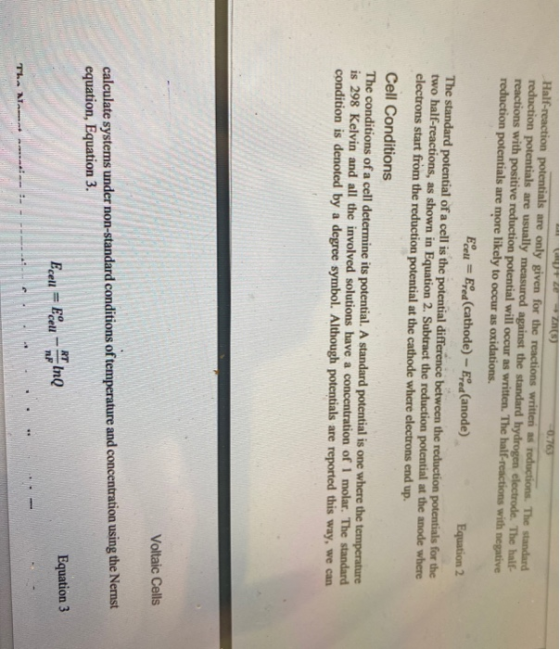
Paragraph Styles . . Electrochemical Cells Objective: Investigate electrochemical potential using electrochemical cells. Information: Electric current is the flow of negatively charged particles. An electrochemical cell is a device that creates an electric current by converting chemical energy into electric current, or vice versa. Voltaic cells are electrochemical cells that produce current spontaneously by converting chemical energy...
some questions are filled out but still need help woth the
remainder of this assignment
part B and below needs to be answered.
Paragraph Styles . . Electrochemical Cells Objective: Investigate electrochemical potential using electrochemical cells. Information: Electric current is the flow of negatively charged particles. An electrochemical cell is a device that creates an electric current by converting chemical energy into electric current, or vice versa. Voltaic cells are electrochemical cells that produce current spontaneously by converting chemical energy...
data collected Cu(NO3)2 | Zn(NO3)2 = 0.999 V Pb | 1.0 M Pb(NO3)2 || 1.0 M...
 data collected
Cu(NO3)2 | Zn(NO3)2 = 0.999 V
Pb | 1.0 M Pb(NO3)2 || 1.0 M Zn(NO3)2 | Zn = 0.396 V
PART B: REDUCTION POTENTIALS 1. Report the measured cell potential for each galvanic cell and state which electrode corresponds to the cathode and which to the anode. 2. Given E = -0.76 V for the Zn/Zn half-cell, and your measured Ecell, calculate the reduction potential at the Cu and Pb electrodes and write the redox half- 6 reactions...
data collected
Cu(NO3)2 | Zn(NO3)2 = 0.999 V
Pb | 1.0 M Pb(NO3)2 || 1.0 M Zn(NO3)2 | Zn = 0.396 V
PART B: REDUCTION POTENTIALS 1. Report the measured cell potential for each galvanic cell and state which electrode corresponds to the cathode and which to the anode. 2. Given E = -0.76 V for the Zn/Zn half-cell, and your measured Ecell, calculate the reduction potential at the Cu and Pb electrodes and write the redox half- 6 reactions...
Table provided below for context Please answer all parts that you can. 1. Which electrochemical cell...
 Table provided below for context
Please answer all parts that you can.
1. Which electrochemical cell had the greatest voltage? Identify the anode and the cathode for this pair, the measured cell potential, and the calculated Eºcell- 2. Which electrochemical cell had the smallest voltage? Identify the anode and the cathode for this pair, the measured cell potential, and the calculated Eºcell- 3. If the oxidation and reduction half-reactions are separated in a battery, this means the oxidizing agent is...
Table provided below for context
Please answer all parts that you can.
1. Which electrochemical cell had the greatest voltage? Identify the anode and the cathode for this pair, the measured cell potential, and the calculated Eºcell- 2. Which electrochemical cell had the smallest voltage? Identify the anode and the cathode for this pair, the measured cell potential, and the calculated Eºcell- 3. If the oxidation and reduction half-reactions are separated in a battery, this means the oxidizing agent is...
a) Part a. Define A, Z, and X in the following notation used to specify a...
 a) Part a. Define A, Z, and X in the following notation used to specify a nuclide: A 2X. Part b. How are A and Z related? Part c. How many protons and how many neutrons are there in the common radiotracer, Iron-59? b) For the following redox reaction at 25°C, Ecell = 2.24 V. Calculate the equilibrium constant, K. Mg(s) + Pb 2+ (aq) + Mg - (aq) + Pb(s) c) A voltaic cell is set up with one...
In a galvanic cell, a spontaneous redox reaction occurs. However the reactants are separated such that...
 In a galvanic cell, a spontaneous redox reaction occurs. However the reactants are separated such that the transfer of electrons is forced to occur across a wire. The resulting electricity is measured in volts (V) and is the sum of the potentials of the oxidation and reduction half-reactions: E^o cell = E^o red + E^o ox By reversing the reduction half-reactions, you get the corresponding oxidation half-reaction, for which E^o ox has the opposite sign of E^o red You can...
In a copper-zinc voltaic cell, one half-cell consists of a ZnZn electrode inserted in a solution...
 In a copper-zinc voltaic cell, one half-cell consists of a ZnZn
electrode inserted in a solution of zinc sulfate and the other
half-cell consists of a CuCu electrode inserted in a copper sulfate
solution. These two half-cells are separated by a salt bridge.
At the zinc electrode (anode), ZnZn metal undergoes oxidation by
losing two electrons and enters the solution as Zn2+Zn2+ ions. The
oxidation half-cell reaction that takes place at the anode is
Zn(s)→Zn2+(aq)+2e−Zn(s)→Zn2+(aq)+2e−
The CuCu ions undergo reduction...
In a copper-zinc voltaic cell, one half-cell consists of a ZnZn
electrode inserted in a solution of zinc sulfate and the other
half-cell consists of a CuCu electrode inserted in a copper sulfate
solution. These two half-cells are separated by a salt bridge.
At the zinc electrode (anode), ZnZn metal undergoes oxidation by
losing two electrons and enters the solution as Zn2+Zn2+ ions. The
oxidation half-cell reaction that takes place at the anode is
Zn(s)→Zn2+(aq)+2e−Zn(s)→Zn2+(aq)+2e−
The CuCu ions undergo reduction...
PART A: REDOX REACTIONS 1. For each of the metals, write the redox equations for reactions...
 PART A: REDOX REACTIONS 1. For each of the metals, write the redox equations for reactions you observed in a table as shown below. Write NR for “no reaction” where none was observed. 2+ (**e.g., Cu + Zn → Cu + Zn , Ecell = 1.10 V) Cu(NO3)2 Pb(NO3)2 Zn(NO3)2 16 Cu(s) NR NR Pb(s) NR Zn(s) NR 2. Calculate the Eº for every cell, whether or not a reaction was observed, using equation (5) and values for the standard...
A voltaic cell is set up with one beaker containing 1.0 M Zn(NO 3) 2 and...
A voltaic cell is set up with one beaker containing 1.0 M Zn(NO 3) 2 and a zinc electrode, and another beaker containing 1.0 M Ni(NO 3) 2 and a nickel electrode. Given the following standard reduction potentials, answer the 3 questions below: Eº Zn2+(aq) + 2e → Zn(s) -0.76 V Ni2+(aq) + 2e → Ni(s) -0.23V Part a. Write out the half-cell reaction that occurs at the anode of the voltaic cell. Part b. In which direction do...
Enter electrons as e A voltaic cell is constructed in which the anode is a Ni...
 Enter electrons as e A voltaic cell is constructed in which the anode is a Ni Ni2+ half cell and the cathode is a Hg|Hg2+ half cell. The half-cell compartments are connected by a salt bridge. (Use the lowest possible coefficients. Use the pull-down boxes to specify states such as (aq) or (s). If a box is not needed, leave it blank.) The anode reaction is: + + The cathode reaction is: + V> + The net cell reaction is:...
 i need help with all of these questions
Chem 103A Electrochemistry 5. A voltaic cell is to be constructed using the Ag/Ag half cell and the Pb/Pb half-cell. Measurement shows that the silver electrode is positive. a) Write balanced half-reactions and the overall spontancous reaction, without using a table of half-cell potentials. b) Diagram the cell, labeling electrodes as anode and cathode, labeling the salt bridge, showing what ions are in solution, and showing the direction of electron flow in...
i need help with all of these questions
Chem 103A Electrochemistry 5. A voltaic cell is to be constructed using the Ag/Ag half cell and the Pb/Pb half-cell. Measurement shows that the silver electrode is positive. a) Write balanced half-reactions and the overall spontancous reaction, without using a table of half-cell potentials. b) Diagram the cell, labeling electrodes as anode and cathode, labeling the salt bridge, showing what ions are in solution, and showing the direction of electron flow in...
 some questions are filled out but still need help woth the
remainder of this assignment
part B and below needs to be answered.
Paragraph Styles . . Electrochemical Cells Objective: Investigate electrochemical potential using electrochemical cells. Information: Electric current is the flow of negatively charged particles. An electrochemical cell is a device that creates an electric current by converting chemical energy into electric current, or vice versa. Voltaic cells are electrochemical cells that produce current spontaneously by converting chemical energy...
some questions are filled out but still need help woth the
remainder of this assignment
part B and below needs to be answered.
Paragraph Styles . . Electrochemical Cells Objective: Investigate electrochemical potential using electrochemical cells. Information: Electric current is the flow of negatively charged particles. An electrochemical cell is a device that creates an electric current by converting chemical energy into electric current, or vice versa. Voltaic cells are electrochemical cells that produce current spontaneously by converting chemical energy...
 data collected
Cu(NO3)2 | Zn(NO3)2 = 0.999 V
Pb | 1.0 M Pb(NO3)2 || 1.0 M Zn(NO3)2 | Zn = 0.396 V
PART B: REDUCTION POTENTIALS 1. Report the measured cell potential for each galvanic cell and state which electrode corresponds to the cathode and which to the anode. 2. Given E = -0.76 V for the Zn/Zn half-cell, and your measured Ecell, calculate the reduction potential at the Cu and Pb electrodes and write the redox half- 6 reactions...
data collected
Cu(NO3)2 | Zn(NO3)2 = 0.999 V
Pb | 1.0 M Pb(NO3)2 || 1.0 M Zn(NO3)2 | Zn = 0.396 V
PART B: REDUCTION POTENTIALS 1. Report the measured cell potential for each galvanic cell and state which electrode corresponds to the cathode and which to the anode. 2. Given E = -0.76 V for the Zn/Zn half-cell, and your measured Ecell, calculate the reduction potential at the Cu and Pb electrodes and write the redox half- 6 reactions...
 Table provided below for context
Please answer all parts that you can.
1. Which electrochemical cell had the greatest voltage? Identify the anode and the cathode for this pair, the measured cell potential, and the calculated Eºcell- 2. Which electrochemical cell had the smallest voltage? Identify the anode and the cathode for this pair, the measured cell potential, and the calculated Eºcell- 3. If the oxidation and reduction half-reactions are separated in a battery, this means the oxidizing agent is...
Table provided below for context
Please answer all parts that you can.
1. Which electrochemical cell had the greatest voltage? Identify the anode and the cathode for this pair, the measured cell potential, and the calculated Eºcell- 2. Which electrochemical cell had the smallest voltage? Identify the anode and the cathode for this pair, the measured cell potential, and the calculated Eºcell- 3. If the oxidation and reduction half-reactions are separated in a battery, this means the oxidizing agent is...
 a) Part a. Define A, Z, and X in the following notation used to specify a nuclide: A 2X. Part b. How are A and Z related? Part c. How many protons and how many neutrons are there in the common radiotracer, Iron-59? b) For the following redox reaction at 25°C, Ecell = 2.24 V. Calculate the equilibrium constant, K. Mg(s) + Pb 2+ (aq) + Mg - (aq) + Pb(s) c) A voltaic cell is set up with one...
 In a galvanic cell, a spontaneous redox reaction occurs. However the reactants are separated such that the transfer of electrons is forced to occur across a wire. The resulting electricity is measured in volts (V) and is the sum of the potentials of the oxidation and reduction half-reactions: E^o cell = E^o red + E^o ox By reversing the reduction half-reactions, you get the corresponding oxidation half-reaction, for which E^o ox has the opposite sign of E^o red You can...
 In a copper-zinc voltaic cell, one half-cell consists of a ZnZn
electrode inserted in a solution of zinc sulfate and the other
half-cell consists of a CuCu electrode inserted in a copper sulfate
solution. These two half-cells are separated by a salt bridge.
At the zinc electrode (anode), ZnZn metal undergoes oxidation by
losing two electrons and enters the solution as Zn2+Zn2+ ions. The
oxidation half-cell reaction that takes place at the anode is
Zn(s)→Zn2+(aq)+2e−Zn(s)→Zn2+(aq)+2e−
The CuCu ions undergo reduction...
In a copper-zinc voltaic cell, one half-cell consists of a ZnZn
electrode inserted in a solution of zinc sulfate and the other
half-cell consists of a CuCu electrode inserted in a copper sulfate
solution. These two half-cells are separated by a salt bridge.
At the zinc electrode (anode), ZnZn metal undergoes oxidation by
losing two electrons and enters the solution as Zn2+Zn2+ ions. The
oxidation half-cell reaction that takes place at the anode is
Zn(s)→Zn2+(aq)+2e−Zn(s)→Zn2+(aq)+2e−
The CuCu ions undergo reduction...
 PART A: REDOX REACTIONS 1. For each of the metals, write the redox equations for reactions you observed in a table as shown below. Write NR for “no reaction” where none was observed. 2+ (**e.g., Cu + Zn → Cu + Zn , Ecell = 1.10 V) Cu(NO3)2 Pb(NO3)2 Zn(NO3)2 16 Cu(s) NR NR Pb(s) NR Zn(s) NR 2. Calculate the Eº for every cell, whether or not a reaction was observed, using equation (5) and values for the standard...
 Enter electrons as e A voltaic cell is constructed in which the anode is a Ni Ni2+ half cell and the cathode is a Hg|Hg2+ half cell. The half-cell compartments are connected by a salt bridge. (Use the lowest possible coefficients. Use the pull-down boxes to specify states such as (aq) or (s). If a box is not needed, leave it blank.) The anode reaction is: + + The cathode reaction is: + V> + The net cell reaction is:...
Most questions answered within 3 hours.
-
Where is the error in this code sequence?
String s1 = "Hello";
String s2 = "ello";...
asked 10 months ago -
Financial data for Joel de Paris, Inc., for last year
follow:
Joel de Paris, Inc.
Balance...
asked 10 months ago -
Consider this reaction:
Al2(SO4)3 (aq)+ BaCl3
(aq) Al2Cl6 (aq)- +
3BaSO4(s) . What is the...
asked 10 months ago -
Suppose that Savneet is considering increasing her
recent random sample from 20 car rentals to 40...
asked 10 months ago -
Trucks arrive at an unloading terminal at an average rate of 120
per hour.
Trucks arrive...
asked 10 months ago -
Why are methanol and ethanol completely soluble in water while
octanol is not very little soluble....
asked 10 months ago -
A facilities manager at a university reads in a research report
that the mean amount of...
asked 10 months ago -
When the CuSO4 is rehydrated by adding water to the anhydrous
compound, is this an endothermic...
asked 10 months ago -
A ray of sunlight is passing from diamond into crown glass; the
angle of incidence is...
asked 10 months ago -
A block of mass 0.249 kg is placed on top of a light, vertical
spring of...
asked 10 months ago -
how do the kidneys compensate in the presences of acidosis
a) trigger hyperventilate
b) reserve acid...
asked 10 months ago -
Question 501 pts
The rental rate of capital to the firm increases. Which of the
following...
asked 10 months ago