
Homework Answers
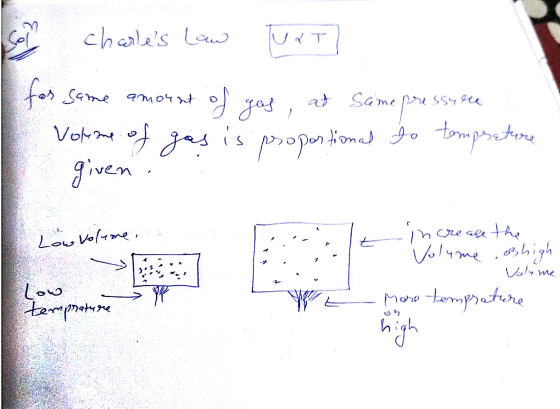
Add Answer to:
4. Diagram the particles in the boxes that would model Charles 'Law. (Include arrows.) | Label...
4. Diagram the particles in the boxes that would model Gay-Lussac's Law. (Include arrows.) Label the...
 4. Diagram the particles in the boxes that would model Gay-Lussac's Law. (Include arrows.) Label the variables below each box.
14. Diagram the particles in the boxes that would Model Boyle's Law. (Include arrows.) Label the...
 14. Diagram the particles in the boxes that would Model Boyle's Law. (Include arrows.) Label the variables below each box.
In the boxes below, draw a diagram of what you think ten gas particles would look...
 In the boxes below, draw a diagram of what you think ten gas particles would look like if you could zoom really close in to see them. Use • for particles, → to show their movement. Bigger arrows mean more velocity. The box is the container. Low temperature High temperature High volume low volume High pressure Low pressure
10) Draw a box-and-arrow (SMRF) model representing HOW expression of the sickle-cell allele results in the...
 10) Draw a box-and-arrow (SMRF) model representing HOW expression of the sickle-cell allele results in the sickle-cell disease phenotype At a minimum, use the following structures: allele, chromosome, DNA, gene, mRNA, protein, genotype, phenotype. You may include additional structures, or repeat a structure more than once, if it helps you convey the function of the model. Modify your wording to make the model specific to the case of sickle-cell anemia. Remember to label your arrows. (10 points) Remember the conventions...
On the left in the diagram below three charged particles (12 and 3) are arranged so...
 On the left in the diagram below three charged particles (12 and 3) are arranged so that each particle is at the vertex of a right triangle. One the right a fourth particle has been added along the line formed by 1 and 2. If For the arrangement on the left, draw a free-body diagram for particle 3 (only include electrostatic forces and please label the arrows), and determine the net electrostatic force that acts on particle 3. Express this...
using the boxes on the diagram below, fill in the appropriate structures in each of the...
 using the boxes on the diagram below, fill in the appropriate structures in each of the boxes for an E, reaction, taking into account the approximate energy levels of the potential products. For example, the intermediate should include a structure with a carbocation. Label the transition state(s) with a f. EIOH E1 elimination product (assume no rearrangement) reflux Energy Reaction Coordinate Full mechanism:
20. Draw a Venn diagram to compare and contrast ATP production in the mitochondria and chloroplast:...
20. Draw a Venn diagram to compare and contrast ATP production in the mitochondria and chloroplast: IN CLASS ACTIVITY: 21. Complete the following model of photosynthesis in which the two main processes are represented by boxes and arrows. : sunlight/photons : energy management molecules (ATP and electron carriers) : inputs and outputs other than energy management molecules Write out the equation for photosynthesis: Label each box and each arrow.
Label the chiral centers in the below molecule as (R) or (S) in the boxes provided...
 Label the chiral centers in the below molecule as (R) or (S) in the boxes provided and clearly indicate your priorities of groups attached to each of the chiral centers (see arrows). (8 points) CH3 CH-CH3 CSH Fhimu HO CHE
2. Charles and Guryan (2008) test 4 predictions of Becker's 1956 model of employer prejudice Expl...
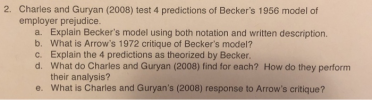 2. Charles and Guryan (2008) test 4 predictions of Becker's 1956 model of employer prejudice Explain Becker's model using both notation and written description. What is Arrow's 1972 critique of Becker's model? Explain the 4 predictions as theorized by Becker What do Charles and Guryan (2008) find for each? How do they perform their analysis? What is Charles and Guryan's (2008) response to Arrow's critique? a. b. c. d. e.
2. Charles and Guryan (2008) test 4 predictions of Becker's...
2. Charles and Guryan (2008) test 4 predictions of Becker's 1956 model of employer prejudice Explain Becker's model using both notation and written description. What is Arrow's 1972 critique of Becker's model? Explain the 4 predictions as theorized by Becker What do Charles and Guryan (2008) find for each? How do they perform their analysis? What is Charles and Guryan's (2008) response to Arrow's critique? a. b. c. d. e.
2. Charles and Guryan (2008) test 4 predictions of Becker's...
4. Label each band diagram below with an appropriate label.(4) Draw the band diagram for a...
 4. Label each band diagram below with an appropriate label.(4) Draw the band diagram for a p-type and n-type semiconductor(4). Briefly describe an experiment that you could perform to distinguish between a conductor and a semiconductor (they both look shiny and hard at room temperature).(2) (10 points) (d (rt o :ODH Energy
 4. Diagram the particles in the boxes that would model Gay-Lussac's Law. (Include arrows.) Label the variables below each box.
 14. Diagram the particles in the boxes that would Model Boyle's Law. (Include arrows.) Label the variables below each box.
 In the boxes below, draw a diagram of what you think ten gas particles would look like if you could zoom really close in to see them. Use • for particles, → to show their movement. Bigger arrows mean more velocity. The box is the container. Low temperature High temperature High volume low volume High pressure Low pressure
 10) Draw a box-and-arrow (SMRF) model representing HOW expression of the sickle-cell allele results in the sickle-cell disease phenotype At a minimum, use the following structures: allele, chromosome, DNA, gene, mRNA, protein, genotype, phenotype. You may include additional structures, or repeat a structure more than once, if it helps you convey the function of the model. Modify your wording to make the model specific to the case of sickle-cell anemia. Remember to label your arrows. (10 points) Remember the conventions...
 On the left in the diagram below three charged particles (12 and 3) are arranged so that each particle is at the vertex of a right triangle. One the right a fourth particle has been added along the line formed by 1 and 2. If For the arrangement on the left, draw a free-body diagram for particle 3 (only include electrostatic forces and please label the arrows), and determine the net electrostatic force that acts on particle 3. Express this...
 using the boxes on the diagram below, fill in the appropriate structures in each of the boxes for an E, reaction, taking into account the approximate energy levels of the potential products. For example, the intermediate should include a structure with a carbocation. Label the transition state(s) with a f. EIOH E1 elimination product (assume no rearrangement) reflux Energy Reaction Coordinate Full mechanism:
 Label the chiral centers in the below molecule as (R) or (S) in the boxes provided and clearly indicate your priorities of groups attached to each of the chiral centers (see arrows). (8 points) CH3 CH-CH3 CSH Fhimu HO CHE
 2. Charles and Guryan (2008) test 4 predictions of Becker's 1956 model of employer prejudice Explain Becker's model using both notation and written description. What is Arrow's 1972 critique of Becker's model? Explain the 4 predictions as theorized by Becker What do Charles and Guryan (2008) find for each? How do they perform their analysis? What is Charles and Guryan's (2008) response to Arrow's critique? a. b. c. d. e.
2. Charles and Guryan (2008) test 4 predictions of Becker's...
2. Charles and Guryan (2008) test 4 predictions of Becker's 1956 model of employer prejudice Explain Becker's model using both notation and written description. What is Arrow's 1972 critique of Becker's model? Explain the 4 predictions as theorized by Becker What do Charles and Guryan (2008) find for each? How do they perform their analysis? What is Charles and Guryan's (2008) response to Arrow's critique? a. b. c. d. e.
2. Charles and Guryan (2008) test 4 predictions of Becker's...
 4. Label each band diagram below with an appropriate label.(4) Draw the band diagram for a p-type and n-type semiconductor(4). Briefly describe an experiment that you could perform to distinguish between a conductor and a semiconductor (they both look shiny and hard at room temperature).(2) (10 points) (d (rt o :ODH Energy
Most questions answered within 3 hours.
-
Where is the error in this code sequence?
String s1 = "Hello";
String s2 = "ello";...
asked 10 months ago -
Financial data for Joel de Paris, Inc., for last year
follow:
Joel de Paris, Inc.
Balance...
asked 10 months ago -
Consider this reaction:
Al2(SO4)3 (aq)+ BaCl3
(aq) Al2Cl6 (aq)- +
3BaSO4(s) . What is the...
asked 10 months ago -
Suppose that Savneet is considering increasing her
recent random sample from 20 car rentals to 40...
asked 10 months ago -
Trucks arrive at an unloading terminal at an average rate of 120
per hour.
Trucks arrive...
asked 10 months ago -
Why are methanol and ethanol completely soluble in water while
octanol is not very little soluble....
asked 10 months ago -
A facilities manager at a university reads in a research report
that the mean amount of...
asked 10 months ago -
When the CuSO4 is rehydrated by adding water to the anhydrous
compound, is this an endothermic...
asked 10 months ago -
A ray of sunlight is passing from diamond into crown glass; the
angle of incidence is...
asked 10 months ago -
A block of mass 0.249 kg is placed on top of a light, vertical
spring of...
asked 10 months ago -
how do the kidneys compensate in the presences of acidosis
a) trigger hyperventilate
b) reserve acid...
asked 10 months ago -
Question 501 pts
The rental rate of capital to the firm increases. Which of the
following...
asked 10 months ago