


Homework Answers
Add Answer to:
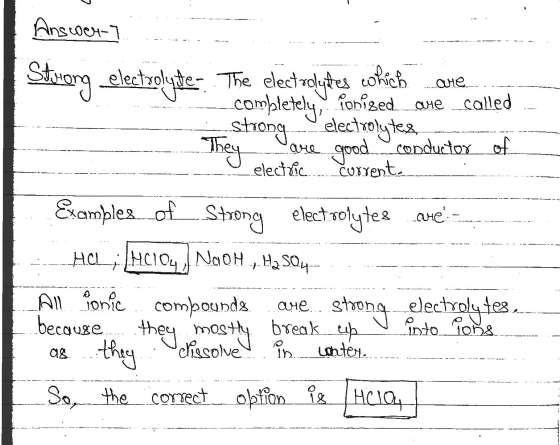
Question 7 (4 points) An example of a strong electrolyte is: HClO4 NH3 H20 CO He...
6. [4 points] Circle the species in each of the following pairs of atoms that has...
 6. [4 points] Circle the species in each of the following pairs of atoms that has the higher first ionization energy (a) Cs or Rb (b) O or Te (c) Cl or Mg (d) Li or Ne 7. [5 points] Write the condensed electron configurations for the following ions (a) Mg Answer: (b) O Answer (c) Fe (d) Mn (e) Ni Answer Answer Answer 8. [4 points] Circle the solid in each of the following sets of ionic compounds that...
Question 12 (4 points) Which of the following substance is a strong electrolyte? PC13 O2 NF3...
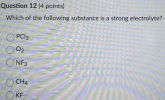 Question 12 (4 points) Which of the following substance is a strong electrolyte? PC13 O2 NF3 CH4 KF
1) A hydrogen bond is A) an attraction between a hydrogen atom attached to N, O, or F and an N, O, or Fatom on anot...
 1) A hydrogen bond is A) an attraction between a hydrogen atom attached to N, O, or F and an N, O, or Fatom on anothe molecule. B) a covalent bond between H and O. c) an ionic bond between H and another atom. D) a bond that is stronger than a covalent bond. E) the polar O-H bond in water. 2) Which of the following molecules can form hydrogen bonds? A) CH4 B) NaH C) NH3 D) BH3 E)...
Question 14 (4 points) Which of the following properties increase(s) as we move left to right...
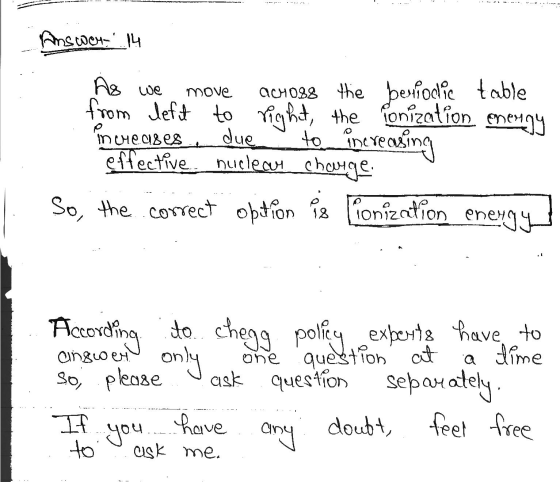
 Question 14 (4 points) Which of the following properties increase(s) as we move left to right across the periodic table? ionization energy O atomic size Metallic Character two of the above all of the above Question 13 (4 points) Which one of the following sets of quantum numbers (n, l, m,ms) is NOT correctly written? (3, 3, 1, -1/2) O (4,0, 0, +1/2) (3, 1,-1, +1/2) O (2, 1, 0, -1/2) (3, 2, 1, +1/2) Question 10 (4 points) Hydrogen...
Worksheet Chapter 6.1 Periodic Trends 1. Select the element with the highest ionization energy Name Date...
 Worksheet Chapter 6.1 Periodic Trends 1. Select the element with the highest ionization energy Name Date a F b. Ne d. Ar e. He 2. Which alkali metal is expected to have the smallest ionization energy? c. CI a. Li b. Na d. Cs e. Fr 3. Which of the following would be expected to have the smallest atomic size? c. Rb a. K c. Rb d. Sr e. Cs 4. Which of the following would be expected to have...
which elements have a partially filled p sub level in in their electron configurations please help with these q...
 which elements have a partially filled p sub level in in their
electron configurations
please help with these questions from the pictures. Thanks !
MODE ctaionont 16. In which of the following bonds does sulfur have a partial negative charge (8-)? oecies E) S-C D) Si-S C) S-CI A) O-S B) F-S 17. Arrange the following bonds in order of increasing polarity: O-H, C-H, F-H, H-H A) O-H<C-H < F-H < H-H B) C-H<O-H < F-H< H-H C) H-H <C-H...
which elements have a partially filled p sub level in in their
electron configurations
please help with these questions from the pictures. Thanks !
MODE ctaionont 16. In which of the following bonds does sulfur have a partial negative charge (8-)? oecies E) S-C D) Si-S C) S-CI A) O-S B) F-S 17. Arrange the following bonds in order of increasing polarity: O-H, C-H, F-H, H-H A) O-H<C-H < F-H < H-H B) C-H<O-H < F-H< H-H C) H-H <C-H...
Explain the answer please. ) 1 on electronegativity differences, which of the following is most likely...
 Explain the answer please.
) 1 on electronegativity differences, which of the following is most likely to be ionie? BaF2 b) Bra c) PH d) NO e CL 6. How many electrons can be contained in all of the orbitals with n-4? c) 10 d) 18 32 Which of the following molecules has no dipole moment? mause it is a Hencar wno 7. NH c) H20 d) all e) none 8. How many electrons can be described by the quantum...
Explain the answer please.
) 1 on electronegativity differences, which of the following is most likely to be ionie? BaF2 b) Bra c) PH d) NO e CL 6. How many electrons can be contained in all of the orbitals with n-4? c) 10 d) 18 32 Which of the following molecules has no dipole moment? mause it is a Hencar wno 7. NH c) H20 d) all e) none 8. How many electrons can be described by the quantum...
Question 1 (1 point) Using the solubility curve, at which temperature do KCl and KCIO, have...
 Question 1 (1 point) Using the solubility curve, at which temperature do KCl and KCIO, have the same solubility? Solubility Curve Grams of solute/100g H30 to .- 30. 0 10 70 80 90 100 20 30 40 50 60 Temperature (°C) O 93°C 56°C O 85°C 0750 Previous Page Next Page Page 2 of 24 Question 2 (1 point) Saline (salt) solution is 0.9% by mass which is similar to tears, blood, and other body fluids. Which of the following...
please help me answer question 1 to 3, thank you Chapter 9, Solutions, Review & Extra Credit. 2 Points for each XC c...
 please help me answer question 1 to 3,
thank you
Chapter 9, Solutions, Review & Extra Credit. 2 Points for each XC correct answer; 6 points total, max. Partial Credit given. Suggestions...work in teams [it will improve the learning experience] 1. Solutions-A solution forms when a solute (the smaller quantity) dissolves in a solvent (the larger quantity). In a solution, the particles of solute are evenly distributed in the solvent. A solute may be a gas, liquid or solid. A...
please help me answer question 1 to 3,
thank you
Chapter 9, Solutions, Review & Extra Credit. 2 Points for each XC correct answer; 6 points total, max. Partial Credit given. Suggestions...work in teams [it will improve the learning experience] 1. Solutions-A solution forms when a solute (the smaller quantity) dissolves in a solvent (the larger quantity). In a solution, the particles of solute are evenly distributed in the solvent. A solute may be a gas, liquid or solid. A...
e. 18 Test Your Knowledge MULTIPLE CHOICE: Choose the one best answer. 1. Each element has...
 e. 18 Test Your Knowledge MULTIPLE CHOICE: Choose the one best answer. 1. Each element has its own characteristic atom in which a. the atomic mass is constant. b. the atomic number is constant. c. the mass number is constant. d. Two of the above are correct. e. All of the above are correct. 2. Which of the following is not a trace element in the human body? a. iodine b. zinc c. iron d. calcium e. fluorine 3. A...
 6. [4 points] Circle the species in each of the following pairs of atoms that has the higher first ionization energy (a) Cs or Rb (b) O or Te (c) Cl or Mg (d) Li or Ne 7. [5 points] Write the condensed electron configurations for the following ions (a) Mg Answer: (b) O Answer (c) Fe (d) Mn (e) Ni Answer Answer Answer 8. [4 points] Circle the solid in each of the following sets of ionic compounds that...
 Question 12 (4 points) Which of the following substance is a strong electrolyte? PC13 O2 NF3 CH4 KF
 1) A hydrogen bond is A) an attraction between a hydrogen atom attached to N, O, or F and an N, O, or Fatom on anothe molecule. B) a covalent bond between H and O. c) an ionic bond between H and another atom. D) a bond that is stronger than a covalent bond. E) the polar O-H bond in water. 2) Which of the following molecules can form hydrogen bonds? A) CH4 B) NaH C) NH3 D) BH3 E)...
 Question 14 (4 points) Which of the following properties increase(s) as we move left to right across the periodic table? ionization energy O atomic size Metallic Character two of the above all of the above Question 13 (4 points) Which one of the following sets of quantum numbers (n, l, m,ms) is NOT correctly written? (3, 3, 1, -1/2) O (4,0, 0, +1/2) (3, 1,-1, +1/2) O (2, 1, 0, -1/2) (3, 2, 1, +1/2) Question 10 (4 points) Hydrogen...
 Worksheet Chapter 6.1 Periodic Trends 1. Select the element with the highest ionization energy Name Date a F b. Ne d. Ar e. He 2. Which alkali metal is expected to have the smallest ionization energy? c. CI a. Li b. Na d. Cs e. Fr 3. Which of the following would be expected to have the smallest atomic size? c. Rb a. K c. Rb d. Sr e. Cs 4. Which of the following would be expected to have...
 which elements have a partially filled p sub level in in their
electron configurations
please help with these questions from the pictures. Thanks !
MODE ctaionont 16. In which of the following bonds does sulfur have a partial negative charge (8-)? oecies E) S-C D) Si-S C) S-CI A) O-S B) F-S 17. Arrange the following bonds in order of increasing polarity: O-H, C-H, F-H, H-H A) O-H<C-H < F-H < H-H B) C-H<O-H < F-H< H-H C) H-H <C-H...
which elements have a partially filled p sub level in in their
electron configurations
please help with these questions from the pictures. Thanks !
MODE ctaionont 16. In which of the following bonds does sulfur have a partial negative charge (8-)? oecies E) S-C D) Si-S C) S-CI A) O-S B) F-S 17. Arrange the following bonds in order of increasing polarity: O-H, C-H, F-H, H-H A) O-H<C-H < F-H < H-H B) C-H<O-H < F-H< H-H C) H-H <C-H...
 Explain the answer please.
) 1 on electronegativity differences, which of the following is most likely to be ionie? BaF2 b) Bra c) PH d) NO e CL 6. How many electrons can be contained in all of the orbitals with n-4? c) 10 d) 18 32 Which of the following molecules has no dipole moment? mause it is a Hencar wno 7. NH c) H20 d) all e) none 8. How many electrons can be described by the quantum...
Explain the answer please.
) 1 on electronegativity differences, which of the following is most likely to be ionie? BaF2 b) Bra c) PH d) NO e CL 6. How many electrons can be contained in all of the orbitals with n-4? c) 10 d) 18 32 Which of the following molecules has no dipole moment? mause it is a Hencar wno 7. NH c) H20 d) all e) none 8. How many electrons can be described by the quantum...
 Question 1 (1 point) Using the solubility curve, at which temperature do KCl and KCIO, have the same solubility? Solubility Curve Grams of solute/100g H30 to .- 30. 0 10 70 80 90 100 20 30 40 50 60 Temperature (°C) O 93°C 56°C O 85°C 0750 Previous Page Next Page Page 2 of 24 Question 2 (1 point) Saline (salt) solution is 0.9% by mass which is similar to tears, blood, and other body fluids. Which of the following...
 please help me answer question 1 to 3,
thank you
Chapter 9, Solutions, Review & Extra Credit. 2 Points for each XC correct answer; 6 points total, max. Partial Credit given. Suggestions...work in teams [it will improve the learning experience] 1. Solutions-A solution forms when a solute (the smaller quantity) dissolves in a solvent (the larger quantity). In a solution, the particles of solute are evenly distributed in the solvent. A solute may be a gas, liquid or solid. A...
please help me answer question 1 to 3,
thank you
Chapter 9, Solutions, Review & Extra Credit. 2 Points for each XC correct answer; 6 points total, max. Partial Credit given. Suggestions...work in teams [it will improve the learning experience] 1. Solutions-A solution forms when a solute (the smaller quantity) dissolves in a solvent (the larger quantity). In a solution, the particles of solute are evenly distributed in the solvent. A solute may be a gas, liquid or solid. A...
 e. 18 Test Your Knowledge MULTIPLE CHOICE: Choose the one best answer. 1. Each element has its own characteristic atom in which a. the atomic mass is constant. b. the atomic number is constant. c. the mass number is constant. d. Two of the above are correct. e. All of the above are correct. 2. Which of the following is not a trace element in the human body? a. iodine b. zinc c. iron d. calcium e. fluorine 3. A...
Most questions answered within 3 hours.
-
Where is the error in this code sequence?
String s1 = "Hello";
String s2 = "ello";...
asked 10 months ago -
Financial data for Joel de Paris, Inc., for last year
follow:
Joel de Paris, Inc.
Balance...
asked 10 months ago -
Consider this reaction:
Al2(SO4)3 (aq)+ BaCl3
(aq) Al2Cl6 (aq)- +
3BaSO4(s) . What is the...
asked 10 months ago -
Suppose that Savneet is considering increasing her
recent random sample from 20 car rentals to 40...
asked 10 months ago -
Trucks arrive at an unloading terminal at an average rate of 120
per hour.
Trucks arrive...
asked 10 months ago -
Why are methanol and ethanol completely soluble in water while
octanol is not very little soluble....
asked 10 months ago -
A facilities manager at a university reads in a research report
that the mean amount of...
asked 10 months ago -
When the CuSO4 is rehydrated by adding water to the anhydrous
compound, is this an endothermic...
asked 10 months ago -
A ray of sunlight is passing from diamond into crown glass; the
angle of incidence is...
asked 10 months ago -
A block of mass 0.249 kg is placed on top of a light, vertical
spring of...
asked 10 months ago -
how do the kidneys compensate in the presences of acidosis
a) trigger hyperventilate
b) reserve acid...
asked 10 months ago -
Question 501 pts
The rental rate of capital to the firm increases. Which of the
following...
asked 10 months ago