
Homework Answers
Answer:
When a few drops of NaOH solution are added to the buffer, the equilibrium shifts right and [CH3COO-] increases.
Hence, Option C. shifts right and [CH3COO-] increases, is the correct answer.
Explanation:
The following reaction is,
CH3COOH + H2O
 CH3COO- + H3O+
If a buffer solution is prepared by adding NaCH3COO(s) to CH3COOH(aq). Then this solution contains equimolar in acid, CH3COOH and base, NaCH3COO.
If we add few drops of NaOH solution to the buffer then the reaction is,
CH3COOH(aq) +
OH- CH3COO-(aq) + H2O(l)
So, from the above reaction we can tell that the concentration of [CH3COO-] increases, hence the equilibrium position shifts to the right side.
Add Answer to:
25 (1 Point) Consider the following: CH,COOH + H20 ~ CH,COO + H20+ A buffer solution...
Consider the following reaction: CH COOH(aOH (aq) > CH COo (aq)+H2O(I) 1st attempt m# See Periodic...
 Consider the following reaction: CH COOH(aOH (aq) > CH COo (aq)+H2O(I) 1st attempt m# See Periodic Table See Hint How much 6.01 M NaOH must be added to 410.0 mL of a buffer that is 0.0205 M acetic acid and O.0230 M sodium acetate to raise the pH to 5.75? mL
Solubility Product A student determines that the concentration of OH" ions in a saturated solution of...
 Solubility Product A student determines that the concentration of OH" ions in a saturated solution of calcium hydroxide, Ca(OH)2 is 0.054 M. What is Ksp for Ca(OH)2? Ca 7.9 x 10⁻⁵ Ob.5.4 x 10-3 Oc. 1.6 x 10⁻⁷ Od. 2.9x 10⁻³ Freezing Point Depression Which colligative property of solutions listed below is correctly stated. 1. The freezing point of a solution decreases as more solute is added. II. The boiling point of a solution increases as more solute is added....
F. pH of Buffer after the addition of the Strong Base 1. Calculate the expected pH...
 F. pH of Buffer after the addition of the Strong Base 1. Calculate the expected pH of this solution. 50.0 mL buffer + 2.0mLION NAOH pH 2. Measured pH of this solution. pH 4.59 3. What is the percent error between the calculated and measured value? What are some of the possible sources of this error? % error pH of Buffer after the addition of the Strong Base: ix. Measure out 50.0 ml the buffer in part D and 2.0...
19 * (1 Point) Which of the following represents a buffer equilibrium? A. HI + H20...
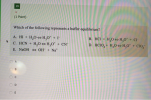 19 * (1 Point) Which of the following represents a buffer equilibrium? A. HI + H20 H,0* + I C. HCN + HOe H,O + CNC E. NaOH OH- + Nat B. HCl + H2OH,0* + CH D. HCIO4 + H2OH,0* + CIO, A B ОС О О О OD Ο Ε
Equilibrium Consider the following equilibrium: CH 3COOH(aq) + H 20(1) = CH 3COO "(aq) + H...
 Equilibrium Consider the following equilibrium: CH 3COOH(aq) + H 20(1) = CH 3COO "(aq) + H 30 +(aq) What would be the effect of adding sodium acetate (CH 3COONa) a strong electrolyte to the reaction and what would happen to the pH of the solution? a. the equilbrium will shift to the right and the pH will decrease O b. the equilibrium will shift to the left and there will be no change in pH O c. the equilbrium will...
1. Which of the following compounds should be soluble in CC14? a) Naci b ) H20...
 1. Which of the following compounds should be soluble in CC14? a) Naci b ) H20 c) NaOH d) C3H18 e) None of these 2. with increasing CO2 pressure and_ with The solubility of carbon dioxide gas in water increasing temperature. a) increases, increases b) increases, decreases c) decreases, increases d) decreases, decreases e) remains constant, decreases 3. Pressure . Based on the Raoult's Law plot for a mixture of liquids A and B shown on the right, which of...
please show all work neatly 5. (2 pts) Consider the following acids and their dissociation constants HPO4-2(aq) + H2O.. H3O"(aq) + PO4-3(aq) Ka-2.2x 10.13 HCOOH(aq) H20 H3O (a) HCOO (aq) Ka =...
 please show all work neatly
5. (2 pts) Consider the following acids and their dissociation constants HPO4-2(aq) + H2O.. H3O"(aq) + PO4-3(aq) Ka-2.2x 10.13 HCOOH(aq) H20 H3O (a) HCOO (aq) Ka = 1.8x10⁻⁴ a. Which is the weaker acid, HPO42 or HCOOH? b. What is the conjugate base of, HPO42 or c. Which acid has the weaker conjugate base? d. Which acid produces more ions? 6. (2 pts) Write a balanced equation for the neutralization of H3PO4(aq) and NaOH(aq) (3...
please show all work neatly
5. (2 pts) Consider the following acids and their dissociation constants HPO4-2(aq) + H2O.. H3O"(aq) + PO4-3(aq) Ka-2.2x 10.13 HCOOH(aq) H20 H3O (a) HCOO (aq) Ka = 1.8x10⁻⁴ a. Which is the weaker acid, HPO42 or HCOOH? b. What is the conjugate base of, HPO42 or c. Which acid has the weaker conjugate base? d. Which acid produces more ions? 6. (2 pts) Write a balanced equation for the neutralization of H3PO4(aq) and NaOH(aq) (3...
1. Which of the following make a buffer solution? (circle all the correct answers) a. 0.1...
 1. Which of the following make a buffer solution? (circle all the correct answers) a. 0.1 M HCl and 0.1 M NaCl b. 0.1 M HF and 0.075 M KF C. 0.15 M Pentanoic acid and 0.15 M sodium pentanoate d. 0.1 M NaOH and 0.1 M HCI e. 0.1 M acetic acid and 0.00001 sodium acetate 2. Which of the following could make buffer systems when mixed together? (circle the correct answers) a. 0.10 M acetic acid and 0.05...
1) What is the effect on equilibrium when sodium acetate is added to a solution of...
1) What is the effect on equilibrium when sodium acetate is added to a solution of acetic acid? CH3COOH(aq) H+(aq) + CH3COO– (aq) A. There is no change in the equilibrium. B. The equilibrium shifts to the right. C. More information is needed to answer the question. D. The equilibrium shifts to the left. E. The pH decreases. 29) What is the concentration of Pb2+ ions in a solution prepared by adding 5.00 g of lead(II) iodide to 500. mL...
estion 10 of 65 > Consider the reaction. HF(aq) + KOH(aq) — KF(aq) + H20(1) What...
 estion 10 of 65 > Consider the reaction. HF(aq) + KOH(aq) — KF(aq) + H20(1) What is the net ionic equation for the chemical reaction? HF(aq) + K+(aq) + OH(aq) — K+(aq) + F (aq) + H2O(1) O HF(aq) + K+(aq) + OH-(aq) — K+(aq) + F (aq) + H+(1) + OH-(1) O HF(aq) + OH-(aq) —> F-(aq) + H2O(1) HF(aq) + K+(aq) F (aq) + H+(1) HF(aq) + K+(aq) K+(aq) + H2O(1) - 11 of 65 > Calculate either...
 Consider the following reaction: CH COOH(aOH (aq) > CH COo (aq)+H2O(I) 1st attempt m# See Periodic Table See Hint How much 6.01 M NaOH must be added to 410.0 mL of a buffer that is 0.0205 M acetic acid and O.0230 M sodium acetate to raise the pH to 5.75? mL
 Solubility Product A student determines that the concentration of OH" ions in a saturated solution of calcium hydroxide, Ca(OH)2 is 0.054 M. What is Ksp for Ca(OH)2? Ca 7.9 x 10⁻⁵ Ob.5.4 x 10-3 Oc. 1.6 x 10⁻⁷ Od. 2.9x 10⁻³ Freezing Point Depression Which colligative property of solutions listed below is correctly stated. 1. The freezing point of a solution decreases as more solute is added. II. The boiling point of a solution increases as more solute is added....
 F. pH of Buffer after the addition of the Strong Base 1. Calculate the expected pH of this solution. 50.0 mL buffer + 2.0mLION NAOH pH 2. Measured pH of this solution. pH 4.59 3. What is the percent error between the calculated and measured value? What are some of the possible sources of this error? % error pH of Buffer after the addition of the Strong Base: ix. Measure out 50.0 ml the buffer in part D and 2.0...
 19 * (1 Point) Which of the following represents a buffer equilibrium? A. HI + H20 H,0* + I C. HCN + HOe H,O + CNC E. NaOH OH- + Nat B. HCl + H2OH,0* + CH D. HCIO4 + H2OH,0* + CIO, A B ОС О О О OD Ο Ε
 Equilibrium Consider the following equilibrium: CH 3COOH(aq) + H 20(1) = CH 3COO "(aq) + H 30 +(aq) What would be the effect of adding sodium acetate (CH 3COONa) a strong electrolyte to the reaction and what would happen to the pH of the solution? a. the equilbrium will shift to the right and the pH will decrease O b. the equilibrium will shift to the left and there will be no change in pH O c. the equilbrium will...
 1. Which of the following compounds should be soluble in CC14? a) Naci b ) H20 c) NaOH d) C3H18 e) None of these 2. with increasing CO2 pressure and_ with The solubility of carbon dioxide gas in water increasing temperature. a) increases, increases b) increases, decreases c) decreases, increases d) decreases, decreases e) remains constant, decreases 3. Pressure . Based on the Raoult's Law plot for a mixture of liquids A and B shown on the right, which of...
 please show all work neatly
5. (2 pts) Consider the following acids and their dissociation constants HPO4-2(aq) + H2O.. H3O"(aq) + PO4-3(aq) Ka-2.2x 10.13 HCOOH(aq) H20 H3O (a) HCOO (aq) Ka = 1.8x10⁻⁴ a. Which is the weaker acid, HPO42 or HCOOH? b. What is the conjugate base of, HPO42 or c. Which acid has the weaker conjugate base? d. Which acid produces more ions? 6. (2 pts) Write a balanced equation for the neutralization of H3PO4(aq) and NaOH(aq) (3...
please show all work neatly
5. (2 pts) Consider the following acids and their dissociation constants HPO4-2(aq) + H2O.. H3O"(aq) + PO4-3(aq) Ka-2.2x 10.13 HCOOH(aq) H20 H3O (a) HCOO (aq) Ka = 1.8x10⁻⁴ a. Which is the weaker acid, HPO42 or HCOOH? b. What is the conjugate base of, HPO42 or c. Which acid has the weaker conjugate base? d. Which acid produces more ions? 6. (2 pts) Write a balanced equation for the neutralization of H3PO4(aq) and NaOH(aq) (3...
 1. Which of the following make a buffer solution? (circle all the correct answers) a. 0.1 M HCl and 0.1 M NaCl b. 0.1 M HF and 0.075 M KF C. 0.15 M Pentanoic acid and 0.15 M sodium pentanoate d. 0.1 M NaOH and 0.1 M HCI e. 0.1 M acetic acid and 0.00001 sodium acetate 2. Which of the following could make buffer systems when mixed together? (circle the correct answers) a. 0.10 M acetic acid and 0.05...
 estion 10 of 65 > Consider the reaction. HF(aq) + KOH(aq) — KF(aq) + H20(1) What is the net ionic equation for the chemical reaction? HF(aq) + K+(aq) + OH(aq) — K+(aq) + F (aq) + H2O(1) O HF(aq) + K+(aq) + OH-(aq) — K+(aq) + F (aq) + H+(1) + OH-(1) O HF(aq) + OH-(aq) —> F-(aq) + H2O(1) HF(aq) + K+(aq) F (aq) + H+(1) HF(aq) + K+(aq) K+(aq) + H2O(1) - 11 of 65 > Calculate either...
Most questions answered within 3 hours.
-
Where is the error in this code sequence?
String s1 = "Hello";
String s2 = "ello";...
asked 10 months ago -
Financial data for Joel de Paris, Inc., for last year
follow:
Joel de Paris, Inc.
Balance...
asked 10 months ago -
Consider this reaction:
Al2(SO4)3 (aq)+ BaCl3
(aq) Al2Cl6 (aq)- +
3BaSO4(s) . What is the...
asked 10 months ago -
Suppose that Savneet is considering increasing her
recent random sample from 20 car rentals to 40...
asked 10 months ago -
Trucks arrive at an unloading terminal at an average rate of 120
per hour.
Trucks arrive...
asked 10 months ago -
Why are methanol and ethanol completely soluble in water while
octanol is not very little soluble....
asked 10 months ago -
A facilities manager at a university reads in a research report
that the mean amount of...
asked 10 months ago -
When the CuSO4 is rehydrated by adding water to the anhydrous
compound, is this an endothermic...
asked 10 months ago -
A ray of sunlight is passing from diamond into crown glass; the
angle of incidence is...
asked 10 months ago -
A block of mass 0.249 kg is placed on top of a light, vertical
spring of...
asked 10 months ago -
how do the kidneys compensate in the presences of acidosis
a) trigger hyperventilate
b) reserve acid...
asked 10 months ago -
Question 501 pts
The rental rate of capital to the firm increases. Which of the
following...
asked 10 months ago