
Homework Answers

![d) Let Pnti CRI Pn (R) Define D C Pex)) = pica) DoT (ou DCTC b()) D ((x+1) Þ(x+3)] d! [ +1) P(249)] (2+1) plcx+3) + P(x+1) da](http://img.homeworklib.com/questions/74b14270-ea1c-11ea-bdd9-c1316e406032.png?x-oss-process=image/resize,w_560)
1. Let T : Pn(R) + Pn+1(R) be defined: T(P(x)) = (x + 1)p(x + 2)...
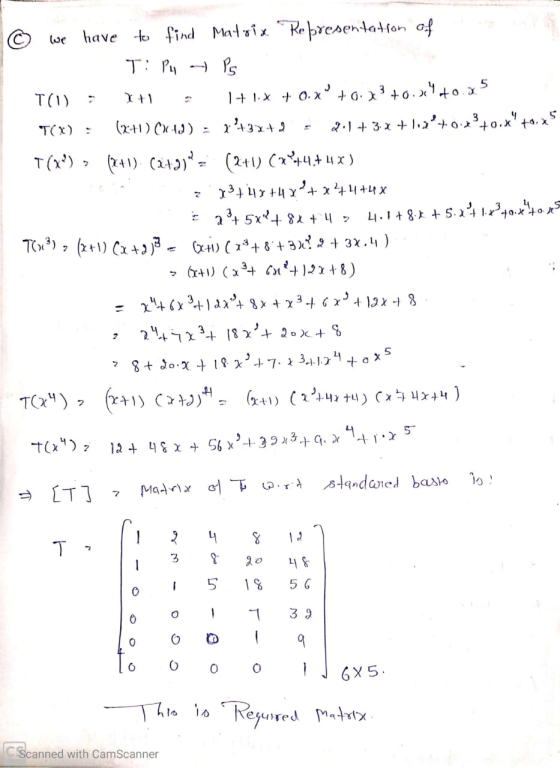
 1. Let T : Pn(R) + Pn+1(R) be defined: T(P(x)) = (x + 1)p(x + 2) bases {1, X, ..., (a) (2 marks) Show that T is a linear transformation. (b) (3 marks) Is T one-to-one? Describe ker(T). What is the rank of T? (c) (8 marks) Find a matrix representation for T with respect to the standard xn} for Pn and {1, 2, ..., xn+1} for Pn+1 if n = 4. (d) (5 marks) Let D : Pn+1(R) +...
1. Let T: Pn(R) + Pn+1(R) be defined: T(P(x)) = (x + 1)p(x + 2) (c)...
 1. Let T: Pn(R) + Pn+1(R) be defined: T(P(x)) = (x + 1)p(x + 2) (c) (8 marks) Find a matrix representation for T with respect to the standard bases {1, 2, ...,2"} for Pn and {1, 2, ...,xN+1} for Pn+1 if n = 4. (d) (5 marks) Let D : Pn+1(R) + Pn(R) be the derivative operator. What is the rank of DoT? Justify your answer. Describe ker(DoT). Is DoT one-to-one? (e) (5 marks) What is the rank of...
What's the solution of d and e 1. Let T : Pn(R) + Pn+1(R) be defined:...
 What's the solution of d and e
1. Let T : Pn(R) + Pn+1(R) be defined: T(P(x)) = (x + 1)p(x + 2) bases {1, X, ..., (a) (2 marks) Show that T is a linear transformation. (b) (3 marks) Is T one-to-one? Describe ker(T). What is the rank of T? (c) (8 marks) Find a matrix representation for T with respect to the standard xn} for Pn and {1, 2, ..., xn+1} for Pn+1 if n = 4. (d)...
What's the solution of d and e
1. Let T : Pn(R) + Pn+1(R) be defined: T(P(x)) = (x + 1)p(x + 2) bases {1, X, ..., (a) (2 marks) Show that T is a linear transformation. (b) (3 marks) Is T one-to-one? Describe ker(T). What is the rank of T? (c) (8 marks) Find a matrix representation for T with respect to the standard xn} for Pn and {1, 2, ..., xn+1} for Pn+1 if n = 4. (d)...
Can someone help in part D AND E PLEASE? solve it in general do not use...
 Can someone help in part D AND E PLEASE?
solve it in general do not use numbers please
1. Let T: Pn(R) + Pn+1(R) be defined: T(P(x)) = (x + 1)p(x + 2) (a) (2 marks) Show that T is a linear transformation. (b) (3 marks) Is T one-to-one? Describe ker(T). What is the rank of T? (c) (8 marks) Find a matrix representation for T with respect to the standard bases {1, X, ..., x" } for Pn and...
Can someone help in part D AND E PLEASE?
solve it in general do not use numbers please
1. Let T: Pn(R) + Pn+1(R) be defined: T(P(x)) = (x + 1)p(x + 2) (a) (2 marks) Show that T is a linear transformation. (b) (3 marks) Is T one-to-one? Describe ker(T). What is the rank of T? (c) (8 marks) Find a matrix representation for T with respect to the standard bases {1, X, ..., x" } for Pn and...
let T: P2 --> R be the linear transformation defined by T(p(x))=p(2) a) What is the...
let T: P2 --> R be the linear transformation defined by T(p(x))=p(2) a) What is the rank of T? b)what is the nullity of T? c)find a basis for Ker(T)
5. For t ER, define the evaluation map evt : Pn(R) + R given by evt(p(x))...
 5. For t ER, define the evaluation map evt : Pn(R) + R given by evt(p(x)) = p(t). Here we consider R as the vector space R1. (a) Prove evt is a linear map. (b) For part (b), let n= 4. Write down a polynomial p e ker(ev3). (c) For any t, the set of polynomials Ut = {p E Pn(R) : p(t) = 0} is a subspace. What is the dimension of Ut (in terms of n)? Justify your...
2. Let T: P(R) + P(R) be such that Tp(x) = P(1)x2 +p(1)+ p0). a) Show...
 2. Let T: P(R) + P(R) be such that Tp(x) = P(1)x2 +p(1)+ p0). a) Show that T is a linear operator. b) Find a basis for Ker(T) and a basis for Range(T). c) Is T invertible? Why? d) If possible find a basis for P(R) such that [T], is a diagonal matrix. e) Find the eigenvalues and eigenvectors of S=T* - 31.
Recall that if T: R" R" is a linear transforrmation T(x) = [Tx, where [T is the transformation matrix, then 1....
 Recall that if T: R" R" is a linear transforrmation T(x) = [Tx, where [T is the transformation matrix, then 1. ker(T) null([T] (ker(T) is the kernel of T) 2. T is one-to-one exactly when ker(T) = {0 3. range of T subspace spanned by the columns of [T] col([T) 4. T is onto exactly when T(x) = [Tx = b is consistent for all b in R". 5. Also, T is onto exactly when range of T col([T]) =...
Problem 1: Let W = {p(t) € Pz : p'le) = 0}. We know from Problem...
 Problem 1: Let W = {p(t) € Pz : p'le) = 0}. We know from Problem 1, Section 4.3 and Problem 1, Section 4.6 that W is a subspace of P3. Let T:W+Pbe given by T(p(t)) = p' (t). It is easy to check that T is a linear transformation. (a) Find a basis for and the dimension of Range T. (b) Find Ker T, a basis for Ker T and dim KerT. (c) Is T one-to-one? Explain. (d) Is...
could u help me for this question?thanku!! 21. Let T be a linear transformation from P2 into P3 over R defined by T(p(x)) xp(x). (a) Find [T]B.A the matrix of T relative to the bases A = {1-x, l-x...
 could u help me for this question?thanku!!
21. Let T be a linear transformation from P2 into P3 over R defined by T(p(x)) xp(x). (a) Find [T]B.A the matrix of T relative to the bases A = {1-x, l-x2,x) and B={1,1+x, 1 +x+12, 1-x3}. (b) Use [TlB. A to find a basis for the range of T. (c) Use TB.A to find a basis for the kernel of T. (d) State the rank and nullity of T.
21. Let T...
could u help me for this question?thanku!!
21. Let T be a linear transformation from P2 into P3 over R defined by T(p(x)) xp(x). (a) Find [T]B.A the matrix of T relative to the bases A = {1-x, l-x2,x) and B={1,1+x, 1 +x+12, 1-x3}. (b) Use [TlB. A to find a basis for the range of T. (c) Use TB.A to find a basis for the kernel of T. (d) State the rank and nullity of T.
21. Let T...
 1. Let T : Pn(R) + Pn+1(R) be defined: T(P(x)) = (x + 1)p(x + 2) bases {1, X, ..., (a) (2 marks) Show that T is a linear transformation. (b) (3 marks) Is T one-to-one? Describe ker(T). What is the rank of T? (c) (8 marks) Find a matrix representation for T with respect to the standard xn} for Pn and {1, 2, ..., xn+1} for Pn+1 if n = 4. (d) (5 marks) Let D : Pn+1(R) +...
 1. Let T: Pn(R) + Pn+1(R) be defined: T(P(x)) = (x + 1)p(x + 2) (c) (8 marks) Find a matrix representation for T with respect to the standard bases {1, 2, ...,2"} for Pn and {1, 2, ...,xN+1} for Pn+1 if n = 4. (d) (5 marks) Let D : Pn+1(R) + Pn(R) be the derivative operator. What is the rank of DoT? Justify your answer. Describe ker(DoT). Is DoT one-to-one? (e) (5 marks) What is the rank of...
 What's the solution of d and e
1. Let T : Pn(R) + Pn+1(R) be defined: T(P(x)) = (x + 1)p(x + 2) bases {1, X, ..., (a) (2 marks) Show that T is a linear transformation. (b) (3 marks) Is T one-to-one? Describe ker(T). What is the rank of T? (c) (8 marks) Find a matrix representation for T with respect to the standard xn} for Pn and {1, 2, ..., xn+1} for Pn+1 if n = 4. (d)...
What's the solution of d and e
1. Let T : Pn(R) + Pn+1(R) be defined: T(P(x)) = (x + 1)p(x + 2) bases {1, X, ..., (a) (2 marks) Show that T is a linear transformation. (b) (3 marks) Is T one-to-one? Describe ker(T). What is the rank of T? (c) (8 marks) Find a matrix representation for T with respect to the standard xn} for Pn and {1, 2, ..., xn+1} for Pn+1 if n = 4. (d)...
 Can someone help in part D AND E PLEASE?
solve it in general do not use numbers please
1. Let T: Pn(R) + Pn+1(R) be defined: T(P(x)) = (x + 1)p(x + 2) (a) (2 marks) Show that T is a linear transformation. (b) (3 marks) Is T one-to-one? Describe ker(T). What is the rank of T? (c) (8 marks) Find a matrix representation for T with respect to the standard bases {1, X, ..., x" } for Pn and...
Can someone help in part D AND E PLEASE?
solve it in general do not use numbers please
1. Let T: Pn(R) + Pn+1(R) be defined: T(P(x)) = (x + 1)p(x + 2) (a) (2 marks) Show that T is a linear transformation. (b) (3 marks) Is T one-to-one? Describe ker(T). What is the rank of T? (c) (8 marks) Find a matrix representation for T with respect to the standard bases {1, X, ..., x" } for Pn and...
 5. For t ER, define the evaluation map evt : Pn(R) + R given by evt(p(x)) = p(t). Here we consider R as the vector space R1. (a) Prove evt is a linear map. (b) For part (b), let n= 4. Write down a polynomial p e ker(ev3). (c) For any t, the set of polynomials Ut = {p E Pn(R) : p(t) = 0} is a subspace. What is the dimension of Ut (in terms of n)? Justify your...
 2. Let T: P(R) + P(R) be such that Tp(x) = P(1)x2 +p(1)+ p0). a) Show that T is a linear operator. b) Find a basis for Ker(T) and a basis for Range(T). c) Is T invertible? Why? d) If possible find a basis for P(R) such that [T], is a diagonal matrix. e) Find the eigenvalues and eigenvectors of S=T* - 31.
 Recall that if T: R" R" is a linear transforrmation T(x) = [Tx, where [T is the transformation matrix, then 1. ker(T) null([T] (ker(T) is the kernel of T) 2. T is one-to-one exactly when ker(T) = {0 3. range of T subspace spanned by the columns of [T] col([T) 4. T is onto exactly when T(x) = [Tx = b is consistent for all b in R". 5. Also, T is onto exactly when range of T col([T]) =...
 Problem 1: Let W = {p(t) € Pz : p'le) = 0}. We know from Problem 1, Section 4.3 and Problem 1, Section 4.6 that W is a subspace of P3. Let T:W+Pbe given by T(p(t)) = p' (t). It is easy to check that T is a linear transformation. (a) Find a basis for and the dimension of Range T. (b) Find Ker T, a basis for Ker T and dim KerT. (c) Is T one-to-one? Explain. (d) Is...
 could u help me for this question?thanku!!
21. Let T be a linear transformation from P2 into P3 over R defined by T(p(x)) xp(x). (a) Find [T]B.A the matrix of T relative to the bases A = {1-x, l-x2,x) and B={1,1+x, 1 +x+12, 1-x3}. (b) Use [TlB. A to find a basis for the range of T. (c) Use TB.A to find a basis for the kernel of T. (d) State the rank and nullity of T.
21. Let T...
could u help me for this question?thanku!!
21. Let T be a linear transformation from P2 into P3 over R defined by T(p(x)) xp(x). (a) Find [T]B.A the matrix of T relative to the bases A = {1-x, l-x2,x) and B={1,1+x, 1 +x+12, 1-x3}. (b) Use [TlB. A to find a basis for the range of T. (c) Use TB.A to find a basis for the kernel of T. (d) State the rank and nullity of T.
21. Let T...
Most questions answered within 3 hours.
-
Where is the error in this code sequence?
String s1 = "Hello";
String s2 = "ello";...
asked 10 months ago -
Financial data for Joel de Paris, Inc., for last year
follow:
Joel de Paris, Inc.
Balance...
asked 10 months ago -
Consider this reaction:
Al2(SO4)3 (aq)+ BaCl3
(aq) Al2Cl6 (aq)- +
3BaSO4(s) . What is the...
asked 10 months ago -
Suppose that Savneet is considering increasing her
recent random sample from 20 car rentals to 40...
asked 10 months ago -
Trucks arrive at an unloading terminal at an average rate of 120
per hour.
Trucks arrive...
asked 10 months ago -
Why are methanol and ethanol completely soluble in water while
octanol is not very little soluble....
asked 10 months ago -
A facilities manager at a university reads in a research report
that the mean amount of...
asked 10 months ago -
When the CuSO4 is rehydrated by adding water to the anhydrous
compound, is this an endothermic...
asked 10 months ago -
A ray of sunlight is passing from diamond into crown glass; the
angle of incidence is...
asked 10 months ago -
A block of mass 0.249 kg is placed on top of a light, vertical
spring of...
asked 10 months ago -
how do the kidneys compensate in the presences of acidosis
a) trigger hyperventilate
b) reserve acid...
asked 10 months ago -
Question 501 pts
The rental rate of capital to the firm increases. Which of the
following...
asked 10 months ago