
Homework Answers
Add Answer to:
FEA
( finite element analysis )
c) In terms of performing a finite element analysis, describe...
FEA ( finite element analysis ) d) Describe the difference between geometric nonlinearities and material nonlinearities....
 FEA ( finite element analysis )
d) Describe the difference between geometric nonlinearities and material nonlinearities. besede large do lacement Targe decoration Grobnion) Straw & plastic دل به جریان when there is inelastic bohano e) Describe how to include the self-weight of a structure when performing a finite element analysis. need
FEA ( finite element analysis )
d) Describe the difference between geometric nonlinearities and material nonlinearities. besede large do lacement Targe decoration Grobnion) Straw & plastic دل به جریان when there is inelastic bohano e) Describe how to include the self-weight of a structure when performing a finite element analysis. need
FEA ( finite element analysis ) c) Describe the boundary conditions needed to impose a symmetry...
 FEA
( finite element analysis )
c) Describe the boundary conditions needed to impose a symmetry plane when using beam elements. d) How do you know when to turn on "Large Deflection? e) Describe the difference between mesh convergence and force convergence. force converge
FEA
( finite element analysis )
c) Describe the boundary conditions needed to impose a symmetry plane when using beam elements. d) How do you know when to turn on "Large Deflection? e) Describe the difference between mesh convergence and force convergence. force converge
FEA ( finite element analysis ) b) Describe an example of a harmonic response finite element...
 FEA ( finite element analysis )
b) Describe an example of a harmonic response finite element analysis c) Describe the difference between solid elements and shell elements. DO
FEA ( finite element analysis )
b) Describe an example of a harmonic response finite element analysis c) Describe the difference between solid elements and shell elements. DO
FEA 1. Answer True or False below. (2 points each) When performing a nonlinear FE analysis,...
 FEA
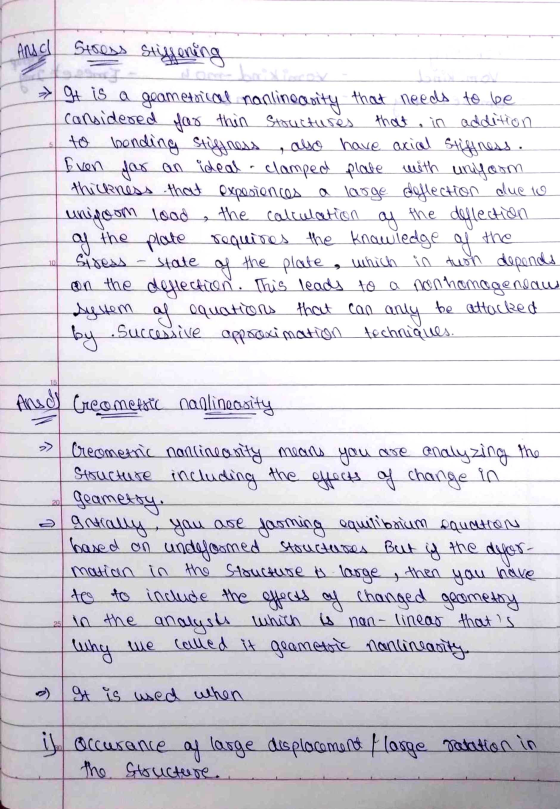
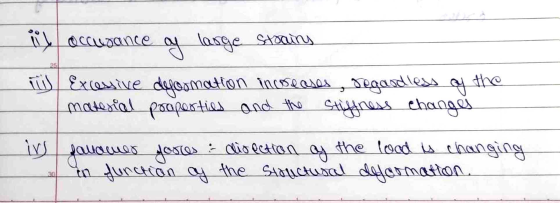
1. Answer True or False below. (2 points each) When performing a nonlinear FE analysis, pressure is considered a “follower force.” Once an element aspect ratio exceeds 1, the larger the aspect ratio, the better the element performs. Eigenvalue buckling provides a good estimate of the Euler critical buckling load. It is important to include the Bauschinger effect in your FE model when simulating problems that experience large strain. Buckling can be considered as the inverse of stress stiffening....
FEA
1. Answer True or False below. (2 points each) When performing a nonlinear FE analysis, pressure is considered a “follower force.” Once an element aspect ratio exceeds 1, the larger the aspect ratio, the better the element performs. Eigenvalue buckling provides a good estimate of the Euler critical buckling load. It is important to include the Bauschinger effect in your FE model when simulating problems that experience large strain. Buckling can be considered as the inverse of stress stiffening....
Finite Element Analysis CVE705 Stiffness Matrix Problem: An eight-node element assemblage shown is used in a...
 Finite Element Analysis
CVE705
Stiffness Matrix
Problem:
An eight-node element assemblage shown is used in a finite
element analysis.
Calculate the diagonal element of the stiffness matrix
corresponding to the degree of freedom U100
shown.
Use a plane stress case
E = 10,000
v = 0.3
t = 1.0
U100
Finite Element Analysis
CVE705
Stiffness Matrix
Problem:
An eight-node element assemblage shown is used in a finite
element analysis.
Calculate the diagonal element of the stiffness matrix
corresponding to the degree of freedom U100
shown.
Use a plane stress case
E = 10,000
v = 0.3
t = 1.0
U100
1. Answer True or False below. (2 points each) When performing a nonlinear FE analysis, pressure...
 1. Answer True or False below. (2 points each) When performing a nonlinear FE analysis, pressure is considered a "follower force." Once an element aspect ratio exceeds 1, the larger the aspect ratio, the better the element performs. Eigenvalue buckling provides a good estimate of the Euler critical buckling load. It is important to include the Bauschinger effect in your FE model when simulating problems that experience large strain. Buckling can be considered as the inverse of stress stiffening. Most...
Section 4.4 Finite Element Formulation of Frames 235 256 of 929 where the transformation matrix is...
 Section 4.4 Finite Element Formulation of Frames 235 256 of 929 where the transformation matrix is sine cose 0 0 0 0 0 sine 0 0 0 -sine cose 0 0 In the previous section, we developed the stines matributed to bending for a beancement. This matracounts for lateral deplacements and rotaties teach mode andis TO 0 0 0 60-126 0 0 0 0 0 LO 621041 To represent the contribution of each term to nodal degrees of freedom, the...
Finite Element Method 5.17 Displacements of the three-member truss shown are confined to the plane of...
 Finite Element Method
5.17 Displacements of the three-member truss shown are confined to the plane of the figure, and points 1, 2 and 3 are fixed to the stationary rim. All members have the same A, E, and L a) Obtain the 2x2 stiffness matrix that operates on the horizontal and vertical degrees of freedom of the central node. b) Obtain the corresponding global force vector c) Solve for the displacements and for axial stress in member (2-4), when the...
Finite Element Method
5.17 Displacements of the three-member truss shown are confined to the plane of the figure, and points 1, 2 and 3 are fixed to the stationary rim. All members have the same A, E, and L a) Obtain the 2x2 stiffness matrix that operates on the horizontal and vertical degrees of freedom of the central node. b) Obtain the corresponding global force vector c) Solve for the displacements and for axial stress in member (2-4), when the...
Problem 1: Finite element analysis project (part 2) Consider the beam that was modeled using Soli...
 Problem 1: Finite element analysis project (part 2) Consider the beam that was modeled using SolidWorks in Part 1 5mm- 80mm 100mm 10m Let the beam be made out of A36 structural steel. Determine and plot: (1a) e deflection of the beam h(x) Note: do not forget to convert pressure to force/length (1b) the normal stress in the beam ơxx(x, y, z) For the plots, let y - 0,z - 48mm) No partial answer is provided here you should check...
2D truss elements (a) have rotational degrees of freedom. (b) can transmit axial forces. (c) cannot...
2D truss elements (a) have rotational degrees of freedom. (b) can transmit axial forces. (c) cannot resist bending. (d) always have nonlinear material properties. 3. Modal analysis is (a) an example of a Finite Element steady-state analysis. (b) an example of a Finite Element transient analysis. (c) an example of a Finite Element eigenvalue analysis. (d) None of the above. 4. In a static stress analysis using truss elements, the elements of the stiffness matrix will always depend on: (a)...
 FEA ( finite element analysis )
d) Describe the difference between geometric nonlinearities and material nonlinearities. besede large do lacement Targe decoration Grobnion) Straw & plastic دل به جریان when there is inelastic bohano e) Describe how to include the self-weight of a structure when performing a finite element analysis. need
FEA ( finite element analysis )
d) Describe the difference between geometric nonlinearities and material nonlinearities. besede large do lacement Targe decoration Grobnion) Straw & plastic دل به جریان when there is inelastic bohano e) Describe how to include the self-weight of a structure when performing a finite element analysis. need
 FEA
( finite element analysis )
c) Describe the boundary conditions needed to impose a symmetry plane when using beam elements. d) How do you know when to turn on "Large Deflection? e) Describe the difference between mesh convergence and force convergence. force converge
FEA
( finite element analysis )
c) Describe the boundary conditions needed to impose a symmetry plane when using beam elements. d) How do you know when to turn on "Large Deflection? e) Describe the difference between mesh convergence and force convergence. force converge
 FEA ( finite element analysis )
b) Describe an example of a harmonic response finite element analysis c) Describe the difference between solid elements and shell elements. DO
FEA ( finite element analysis )
b) Describe an example of a harmonic response finite element analysis c) Describe the difference between solid elements and shell elements. DO
 FEA
1. Answer True or False below. (2 points each) When performing a nonlinear FE analysis, pressure is considered a “follower force.” Once an element aspect ratio exceeds 1, the larger the aspect ratio, the better the element performs. Eigenvalue buckling provides a good estimate of the Euler critical buckling load. It is important to include the Bauschinger effect in your FE model when simulating problems that experience large strain. Buckling can be considered as the inverse of stress stiffening....
FEA
1. Answer True or False below. (2 points each) When performing a nonlinear FE analysis, pressure is considered a “follower force.” Once an element aspect ratio exceeds 1, the larger the aspect ratio, the better the element performs. Eigenvalue buckling provides a good estimate of the Euler critical buckling load. It is important to include the Bauschinger effect in your FE model when simulating problems that experience large strain. Buckling can be considered as the inverse of stress stiffening....
 Finite Element Analysis
CVE705
Stiffness Matrix
Problem:
An eight-node element assemblage shown is used in a finite
element analysis.
Calculate the diagonal element of the stiffness matrix
corresponding to the degree of freedom U100
shown.
Use a plane stress case
E = 10,000
v = 0.3
t = 1.0
U100
Finite Element Analysis
CVE705
Stiffness Matrix
Problem:
An eight-node element assemblage shown is used in a finite
element analysis.
Calculate the diagonal element of the stiffness matrix
corresponding to the degree of freedom U100
shown.
Use a plane stress case
E = 10,000
v = 0.3
t = 1.0
U100
 1. Answer True or False below. (2 points each) When performing a nonlinear FE analysis, pressure is considered a "follower force." Once an element aspect ratio exceeds 1, the larger the aspect ratio, the better the element performs. Eigenvalue buckling provides a good estimate of the Euler critical buckling load. It is important to include the Bauschinger effect in your FE model when simulating problems that experience large strain. Buckling can be considered as the inverse of stress stiffening. Most...
 Section 4.4 Finite Element Formulation of Frames 235 256 of 929 where the transformation matrix is sine cose 0 0 0 0 0 sine 0 0 0 -sine cose 0 0 In the previous section, we developed the stines matributed to bending for a beancement. This matracounts for lateral deplacements and rotaties teach mode andis TO 0 0 0 60-126 0 0 0 0 0 LO 621041 To represent the contribution of each term to nodal degrees of freedom, the...
 Finite Element Method
5.17 Displacements of the three-member truss shown are confined to the plane of the figure, and points 1, 2 and 3 are fixed to the stationary rim. All members have the same A, E, and L a) Obtain the 2x2 stiffness matrix that operates on the horizontal and vertical degrees of freedom of the central node. b) Obtain the corresponding global force vector c) Solve for the displacements and for axial stress in member (2-4), when the...
Finite Element Method
5.17 Displacements of the three-member truss shown are confined to the plane of the figure, and points 1, 2 and 3 are fixed to the stationary rim. All members have the same A, E, and L a) Obtain the 2x2 stiffness matrix that operates on the horizontal and vertical degrees of freedom of the central node. b) Obtain the corresponding global force vector c) Solve for the displacements and for axial stress in member (2-4), when the...
 Problem 1: Finite element analysis project (part 2) Consider the beam that was modeled using SolidWorks in Part 1 5mm- 80mm 100mm 10m Let the beam be made out of A36 structural steel. Determine and plot: (1a) e deflection of the beam h(x) Note: do not forget to convert pressure to force/length (1b) the normal stress in the beam ơxx(x, y, z) For the plots, let y - 0,z - 48mm) No partial answer is provided here you should check...
Most questions answered within 3 hours.
-
Where is the error in this code sequence?
String s1 = "Hello";
String s2 = "ello";...
asked 10 months ago -
Financial data for Joel de Paris, Inc., for last year
follow:
Joel de Paris, Inc.
Balance...
asked 10 months ago -
Consider this reaction:
Al2(SO4)3 (aq)+ BaCl3
(aq) Al2Cl6 (aq)- +
3BaSO4(s) . What is the...
asked 10 months ago -
Suppose that Savneet is considering increasing her
recent random sample from 20 car rentals to 40...
asked 10 months ago -
Trucks arrive at an unloading terminal at an average rate of 120
per hour.
Trucks arrive...
asked 10 months ago -
Why are methanol and ethanol completely soluble in water while
octanol is not very little soluble....
asked 10 months ago -
A facilities manager at a university reads in a research report
that the mean amount of...
asked 10 months ago -
When the CuSO4 is rehydrated by adding water to the anhydrous
compound, is this an endothermic...
asked 10 months ago -
A ray of sunlight is passing from diamond into crown glass; the
angle of incidence is...
asked 10 months ago -
A block of mass 0.249 kg is placed on top of a light, vertical
spring of...
asked 10 months ago -
how do the kidneys compensate in the presences of acidosis
a) trigger hyperventilate
b) reserve acid...
asked 10 months ago -
Question 501 pts
The rental rate of capital to the firm increases. Which of the
following...
asked 10 months ago