


Homework Answers
1. Aromatic compounds do not have enough reactivity towards radical halogenation as compared to aliphatic compounds. This is so because aromatic compounds are much stable than the aliphatic compounds. Thus, this is true statement.
Double bonds in aromatic compounds are shorter than single bonds. False.
Aromatic compounds release less energy on combustion. False.
The aromatic compounds are thermodynamically more stable than simple alkenes , they release less energy per pi bond upon saturation. Thus False.
Option-1 is the correct answer.
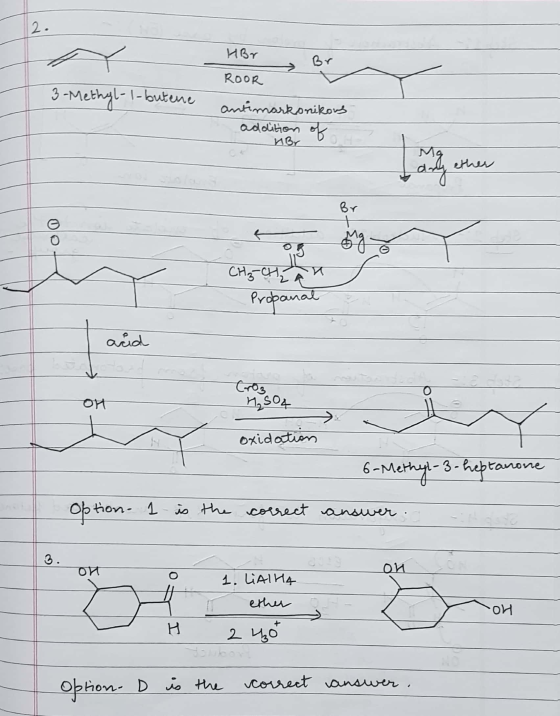
2. Correct synthesis is Option-1.
3. LiAlH4 is a reducing agent which reduces aldehydes to alcohols. Option-4 is the correct answer.
Add Answer to:
Which of the following statements is true? Aromatic compounds do not react in radical halogenation as...
Which is the correct synthesis of 6-methyl-3-heptanone from 3-methyl-1-butene? Acid and water, then Cr03/H2SO4, then CH3CH2CH2...
 Which is the correct synthesis of 6-methyl-3-heptanone from 3-methyl-1-butene? Acid and water, then Cr03/H2SO4, then CH3CH2CH2 MgBr, then acid, then CrOz/H2SO4 Acid and water, then C+03/H2S04, then CH3CH2CH2MgBr, then acid HB:/ROOR, then Mg/ether, then propanal, then acid, then CrO3/H2SO4 HBr, then Mg/ether, then propanal, then acid, then CrOz/H2SO4 Question 21 (4 points) Which of the following statements is true? Aromatic compounds release more energy per pi bond upon saturation than simple alkenes. Aromatic compounds have longer C-C bonds than alkanes....
Which of the following statements is true? Aromatic compounds release more energy per pi bond upon...
 Which of the following statements is true? Aromatic compounds release more energy per pi bond upon saturation than simple alkenes. Aromatic compounds release more energy on combustion than aliphatic compounds do. Aromatic compounds have shorter C-C bonds than CH2=CH2 Aromatic compounds do not react in radical halogenation as compared to aliphatic compounds
Question 1 (4 points) Which of the following statements is true? Aromatic compounds release more energy...
 Question 1 (4 points) Which of the following statements is true? Aromatic compounds release more energy per pi bond upon saturation than simple alkenes. Aromatic compounds react faster than aliphatic compounds in radical halogenation. Aromatic compounds release more energy on combustion than aliphatic compounds do. Aromatic compounds have shorter C-C bonds than alkanes.
Question 1 (4 points) Which of the following statements is true? Aromatic compounds release more energy...
 Question 1 (4 points) Which of the following statements is true? Aromatic compounds release more energy per pi bond upon saturation than simple alkenes. Aromatic compounds react faster than aliphatic compounds in radical halogenation. Aromatic compounds release more energy on combustion than aliphatic compounds do. Aromatic compounds have shorter C-C bonds than alkanes.
Question 13 (4 points) Which of the following statements is true? Aromatic compounds have shorter C-C...
 Question 13 (4 points) Which of the following statements is true? Aromatic compounds have shorter C-C bonds than alkanes. Aromatic compounds release more energy per pi bond upon saturation than simple alkenes. Aromatic compounds react faster than aliphatic compounds in radical halogenation. Aromatic compounds release more energy on combustion than aliphatic compounds do.
please help in all sections asap!! Predict the product for the following reaction sequence: MgBr PCO...
 please help in all sections asap!!
Predict the product for the following reaction sequence: MgBr PCO CHCE etler Predict the product for the following reaction, Predict the product for the following reaction. excess CH3OH H2SO4 H3CO OCHз Но осна ОСН3 Which one of the following compounds will yield 1-hexanol when treated with butylmagnesium bromide followed by acid workup? 1-hexanol formaldehyde acetaldehyde odrane hexanal Provide the reagents necessary to carry out the following conversion. 1. H20/ H2SO4 2. PCC/CH2Cl2 PCC/ CH2Cl2...
please help in all sections asap!!
Predict the product for the following reaction sequence: MgBr PCO CHCE etler Predict the product for the following reaction, Predict the product for the following reaction. excess CH3OH H2SO4 H3CO OCHз Но осна ОСН3 Which one of the following compounds will yield 1-hexanol when treated with butylmagnesium bromide followed by acid workup? 1-hexanol formaldehyde acetaldehyde odrane hexanal Provide the reagents necessary to carry out the following conversion. 1. H20/ H2SO4 2. PCC/CH2Cl2 PCC/ CH2Cl2...
all of them please QUESTION 1 1 points Save Answer Which of the following can have...
 all of them please
QUESTION 1 1 points Save Answer Which of the following can have cis/trans isomers? Draw their isomers. CH3CH2CH=CH2 (CH3CH2)2CCHCH3 CH3CH2CH=CHCH3 CH2=CH2 QUESTION 2 1 points Save Answer Name the following compounds, with cis/trans nomenclature. trans-4-methyl-2-hexene trans-4-thyl-2-pentane O cis-4-thyl-2-pentane O cis-4-methyl-2-hexene QUESTION 3 1 points Save Answer Name the following compounds, with cis/trans nomenclature Br Br Otrsans-2,5-dibromo-3-hexene trans-1,4-dibromo-2-butane O cis-1,4-dibromo-2-butane cis 2,5-dibromo-3-hexene Click Save and Submit to see and submit Click Save All Answers to save all...
all of them please
QUESTION 1 1 points Save Answer Which of the following can have cis/trans isomers? Draw their isomers. CH3CH2CH=CH2 (CH3CH2)2CCHCH3 CH3CH2CH=CHCH3 CH2=CH2 QUESTION 2 1 points Save Answer Name the following compounds, with cis/trans nomenclature. trans-4-methyl-2-hexene trans-4-thyl-2-pentane O cis-4-thyl-2-pentane O cis-4-methyl-2-hexene QUESTION 3 1 points Save Answer Name the following compounds, with cis/trans nomenclature Br Br Otrsans-2,5-dibromo-3-hexene trans-1,4-dibromo-2-butane O cis-1,4-dibromo-2-butane cis 2,5-dibromo-3-hexene Click Save and Submit to see and submit Click Save All Answers to save all...
____ 1. The diagram below represents serine, a polar, uncharged amino acid. Which functional group gives...
 ____ 1. The diagram below represents serine, a polar, uncharged
amino acid. Which functional group gives serine its
distinct property?
a. H3
b. CH2OH
c. –H
d. COO–
____ 2. The monomers shown below are monomers for which of the
following natural polymers?
a. polysaccharides
b. plastics
c. DNA
d. proteins
____ 3. Which of the following processes illustrates the production
of a protein?
a. specific code for amino acids --> amino acid chain -->
gene --> DNA --> specific...
____ 1. The diagram below represents serine, a polar, uncharged
amino acid. Which functional group gives serine its
distinct property?
a. H3
b. CH2OH
c. –H
d. COO–
____ 2. The monomers shown below are monomers for which of the
following natural polymers?
a. polysaccharides
b. plastics
c. DNA
d. proteins
____ 3. Which of the following processes illustrates the production
of a protein?
a. specific code for amino acids --> amino acid chain -->
gene --> DNA --> specific...
 Which is the correct synthesis of 6-methyl-3-heptanone from 3-methyl-1-butene? Acid and water, then Cr03/H2SO4, then CH3CH2CH2 MgBr, then acid, then CrOz/H2SO4 Acid and water, then C+03/H2S04, then CH3CH2CH2MgBr, then acid HB:/ROOR, then Mg/ether, then propanal, then acid, then CrO3/H2SO4 HBr, then Mg/ether, then propanal, then acid, then CrOz/H2SO4 Question 21 (4 points) Which of the following statements is true? Aromatic compounds release more energy per pi bond upon saturation than simple alkenes. Aromatic compounds have longer C-C bonds than alkanes....
 Which of the following statements is true? Aromatic compounds release more energy per pi bond upon saturation than simple alkenes. Aromatic compounds release more energy on combustion than aliphatic compounds do. Aromatic compounds have shorter C-C bonds than CH2=CH2 Aromatic compounds do not react in radical halogenation as compared to aliphatic compounds
 Question 1 (4 points) Which of the following statements is true? Aromatic compounds release more energy per pi bond upon saturation than simple alkenes. Aromatic compounds react faster than aliphatic compounds in radical halogenation. Aromatic compounds release more energy on combustion than aliphatic compounds do. Aromatic compounds have shorter C-C bonds than alkanes.
 Question 1 (4 points) Which of the following statements is true? Aromatic compounds release more energy per pi bond upon saturation than simple alkenes. Aromatic compounds react faster than aliphatic compounds in radical halogenation. Aromatic compounds release more energy on combustion than aliphatic compounds do. Aromatic compounds have shorter C-C bonds than alkanes.
 Question 13 (4 points) Which of the following statements is true? Aromatic compounds have shorter C-C bonds than alkanes. Aromatic compounds release more energy per pi bond upon saturation than simple alkenes. Aromatic compounds react faster than aliphatic compounds in radical halogenation. Aromatic compounds release more energy on combustion than aliphatic compounds do.
 please help in all sections asap!!
Predict the product for the following reaction sequence: MgBr PCO CHCE etler Predict the product for the following reaction, Predict the product for the following reaction. excess CH3OH H2SO4 H3CO OCHз Но осна ОСН3 Which one of the following compounds will yield 1-hexanol when treated with butylmagnesium bromide followed by acid workup? 1-hexanol formaldehyde acetaldehyde odrane hexanal Provide the reagents necessary to carry out the following conversion. 1. H20/ H2SO4 2. PCC/CH2Cl2 PCC/ CH2Cl2...
please help in all sections asap!!
Predict the product for the following reaction sequence: MgBr PCO CHCE etler Predict the product for the following reaction, Predict the product for the following reaction. excess CH3OH H2SO4 H3CO OCHз Но осна ОСН3 Which one of the following compounds will yield 1-hexanol when treated with butylmagnesium bromide followed by acid workup? 1-hexanol formaldehyde acetaldehyde odrane hexanal Provide the reagents necessary to carry out the following conversion. 1. H20/ H2SO4 2. PCC/CH2Cl2 PCC/ CH2Cl2...
 all of them please
QUESTION 1 1 points Save Answer Which of the following can have cis/trans isomers? Draw their isomers. CH3CH2CH=CH2 (CH3CH2)2CCHCH3 CH3CH2CH=CHCH3 CH2=CH2 QUESTION 2 1 points Save Answer Name the following compounds, with cis/trans nomenclature. trans-4-methyl-2-hexene trans-4-thyl-2-pentane O cis-4-thyl-2-pentane O cis-4-methyl-2-hexene QUESTION 3 1 points Save Answer Name the following compounds, with cis/trans nomenclature Br Br Otrsans-2,5-dibromo-3-hexene trans-1,4-dibromo-2-butane O cis-1,4-dibromo-2-butane cis 2,5-dibromo-3-hexene Click Save and Submit to see and submit Click Save All Answers to save all...
all of them please
QUESTION 1 1 points Save Answer Which of the following can have cis/trans isomers? Draw their isomers. CH3CH2CH=CH2 (CH3CH2)2CCHCH3 CH3CH2CH=CHCH3 CH2=CH2 QUESTION 2 1 points Save Answer Name the following compounds, with cis/trans nomenclature. trans-4-methyl-2-hexene trans-4-thyl-2-pentane O cis-4-thyl-2-pentane O cis-4-methyl-2-hexene QUESTION 3 1 points Save Answer Name the following compounds, with cis/trans nomenclature Br Br Otrsans-2,5-dibromo-3-hexene trans-1,4-dibromo-2-butane O cis-1,4-dibromo-2-butane cis 2,5-dibromo-3-hexene Click Save and Submit to see and submit Click Save All Answers to save all...
 ____ 1. The diagram below represents serine, a polar, uncharged
amino acid. Which functional group gives serine its
distinct property?
a. H3
b. CH2OH
c. –H
d. COO–
____ 2. The monomers shown below are monomers for which of the
following natural polymers?
a. polysaccharides
b. plastics
c. DNA
d. proteins
____ 3. Which of the following processes illustrates the production
of a protein?
a. specific code for amino acids --> amino acid chain -->
gene --> DNA --> specific...
____ 1. The diagram below represents serine, a polar, uncharged
amino acid. Which functional group gives serine its
distinct property?
a. H3
b. CH2OH
c. –H
d. COO–
____ 2. The monomers shown below are monomers for which of the
following natural polymers?
a. polysaccharides
b. plastics
c. DNA
d. proteins
____ 3. Which of the following processes illustrates the production
of a protein?
a. specific code for amino acids --> amino acid chain -->
gene --> DNA --> specific...
Most questions answered within 3 hours.
-
Where is the error in this code sequence?
String s1 = "Hello";
String s2 = "ello";...
asked 11 months ago -
Financial data for Joel de Paris, Inc., for last year
follow:
Joel de Paris, Inc.
Balance...
asked 11 months ago -
Consider this reaction:
Al2(SO4)3 (aq)+ BaCl3
(aq) Al2Cl6 (aq)- +
3BaSO4(s) . What is the...
asked 11 months ago -
Suppose that Savneet is considering increasing her
recent random sample from 20 car rentals to 40...
asked 11 months ago -
Trucks arrive at an unloading terminal at an average rate of 120
per hour.
Trucks arrive...
asked 11 months ago -
Why are methanol and ethanol completely soluble in water while
octanol is not very little soluble....
asked 11 months ago -
A facilities manager at a university reads in a research report
that the mean amount of...
asked 11 months ago -
When the CuSO4 is rehydrated by adding water to the anhydrous
compound, is this an endothermic...
asked 11 months ago -
A ray of sunlight is passing from diamond into crown glass; the
angle of incidence is...
asked 11 months ago -
A block of mass 0.249 kg is placed on top of a light, vertical
spring of...
asked 11 months ago -
how do the kidneys compensate in the presences of acidosis
a) trigger hyperventilate
b) reserve acid...
asked 11 months ago -
Question 501 pts
The rental rate of capital to the firm increases. Which of the
following...
asked 11 months ago