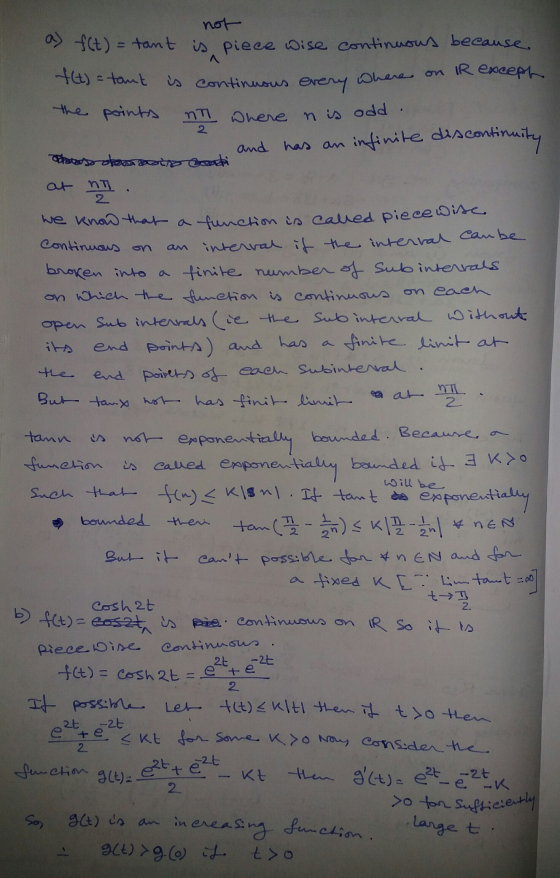
Q. Determine whether the given functions are exponentially bounded and piecewise continuous on 0 ≤ t < ∞.
(a) f(t) = tant
(b) f(t) = cosh2t
(c) f(t) =  , where
denotes the greatest integer less than or equal to t.
, where
denotes the greatest integer less than or equal to t.
Homework Answers
![ie, at -2t e+ e 2 - Kt > 1. [96) = 1] . - cosh (2)> kt+1 Thus we see that for Sufficiently har large tyo Cosh (at) & a kt for](http://img.homeworklib.com/questions/65536280-ea51-11ea-8cee-77bf9d8e58e1.png?x-oss-process=image/resize,w_560)
Add Answer to:
Q. Determine whether the given functions are exponentially
bounded and piecewise continuous on 0 ≤ t...
consider the variation of constants formula where P(t)= a) show that solves the initial value problem x'+p(t)=(t) x()= when p and q are continuous functions of t on an interval I and tg p(s)d...
consider the variation of constants formula where P(t)= a) show that solves the initial value problem x'+p(t)=(t) x()= when p and q are continuous functions of t on an interval I and tg p(s)ds We were unable to transcribe this imageWe were unable to transcribe this imageWe were unable to transcribe this imageWe were unable to transcribe this imageWe were unable to transcribe this image tg p(s)ds
Let T : C([0, 1]) → R be a (not necessarily bounded) linear functional. Show that...
 Let T : C([0, 1]) → R be a (not necessarily bounded) linear
functional.
Show that T is positive if and only if
=
(here 1 denotes the constant function [0, 1] → R, x → 1).
We were unable to transcribe this imageWe were unable to transcribe this image
Let T : C([0, 1]) → R be a (not necessarily bounded) linear
functional.
Show that T is positive if and only if
=
(here 1 denotes the constant function [0, 1] → R, x → 1).
We were unable to transcribe this imageWe were unable to transcribe this image
a) By direct substitution determine which of the following functions satisfy the wave equation. 1. g(x,...
a) By direct substitution determine which of the following functions satisfy the wave equation. 1. g(x, t) = Acos(kx − t) where A, k, are positive constants. 2. h(x, t) = Ae where A, k, are positive constants. 3. p(x, t) = Asinh(kx − t) where A, k, are positive constants. 4. q(x, t) = Ae where A, a, are positive constants. 5. An arbitrary function: f(x, t) = f(kx−t) where k and are positive constants. (Hint: Be careful with...
find the solution of the inhomogeneous system for y" +p(t)y' +q(t)y = f(t), a second order...
find the solution of the inhomogeneous system for y" +p(t)y' +q(t)y = f(t), a second order scalar equation with p, q, f continuous on interval I, for which (to ) = 0, to on I We were unable to transcribe this imageWe were unable to transcribe this imageWe were unable to transcribe this image
A metric space (X, d) is totally bounded if, given ε>0, there exists a finite subset...
 A metric space (X, d) is totally bounded if, given
ε>0, there exists a finite subset =
of X, called an ε-net, such that for each x∈X there
exists
∈
such that d(x,)
< ε. Prove that if Y is a subset of a totally bounded space X
then, given ε>0, the subset Y has an ε-net and
therefore Y is also totally bounded.
We were unable to transcribe this imageWe were unable to transcribe this imageWe were unable to...
A metric space (X, d) is totally bounded if, given
ε>0, there exists a finite subset =
of X, called an ε-net, such that for each x∈X there
exists
∈
such that d(x,)
< ε. Prove that if Y is a subset of a totally bounded space X
then, given ε>0, the subset Y has an ε-net and
therefore Y is also totally bounded.
We were unable to transcribe this imageWe were unable to transcribe this imageWe were unable to...
TIMER Chapter 6, Section 6.1, Question 01 Determine whether f is continuous, piecewise continuous, or neither...
 TIMER Chapter 6, Section 6.1, Question 01 Determine whether f is continuous, piecewise continuous, or neither on the interval Osts 3. (2+² Ostsi f(t) = 5+t, 1<ts2 9-t, 2 <ts 3 piecewise continuous neither continuous
The Laplace transform of the piecewise continuous function $4, 0<t<3 f(t) is given by 2, t>...
 The Laplace transform of the piecewise continuous function $4, 0<t<3 f(t) is given by 2, t> 3 1 L{f} (1 – 2e-st), 8 >0. S None of them L{f} = (1 – 3e®), s>0. 2 L{f} (3 - e-), 8 >0. S 2 L{f} (2-est), s >0. S
The Laplace transform of the piecewise continuous function $4, 0<t<3 f(t) is given by 2, t>...
 The Laplace transform of the piecewise continuous function $4, 0<t<3 f(t) is given by 2, t> 3 1 L{f} (1 – 2e-st), 8 >0. S None of them L{f} = (1 – 3e®), s>0. 2 L{f} (3 - e-), 8 >0. S 2 L{f} (2-est), s >0. S
Where Let n(t) be a fixed strictly positive continuous function on (a, b). define H, =...
 Where
Let n(t) be a fixed strictly positive continuous function on (a, b). define H, = L([a,b], 7) to be the space of all measurable functions f on (a, b) such that \n(t)dt <0. Define the inner product on H, by (5,9)n = [ f(0)9€)n(t)dt (a) Show that H, is a Hilbert space, and that the mapping U:f →nif gives a unitary correspondence between H, and the usual space L-([a, b]). We were unable to transcribe this image
Where
Let n(t) be a fixed strictly positive continuous function on (a, b). define H, = L([a,b], 7) to be the space of all measurable functions f on (a, b) such that \n(t)dt <0. Define the inner product on H, by (5,9)n = [ f(0)9€)n(t)dt (a) Show that H, is a Hilbert space, and that the mapping U:f →nif gives a unitary correspondence between H, and the usual space L-([a, b]). We were unable to transcribe this image
A current passing through a resistor (R = 16 Ω) decreases exponentially with time as I(t)...
 A current passing through a resistor (R = 16
Ω) decreases exponentially with time as I(t) =
I0e-αt where I0
= 7.5 A and α = 0.25 s-1.
Calculate the total
energy dissipated by the resistor in joules as time goes to
infinity.
E(t→∞) =
Calculate the energy
dissipated by the resistor in joules during the first 5
seconds.
E =
We were unable to transcribe this imageWe were unable to transcribe this image
A current passing through a resistor (R = 16
Ω) decreases exponentially with time as I(t) =
I0e-αt where I0
= 7.5 A and α = 0.25 s-1.
Calculate the total
energy dissipated by the resistor in joules as time goes to
infinity.
E(t→∞) =
Calculate the energy
dissipated by the resistor in joules during the first 5
seconds.
E =
We were unable to transcribe this imageWe were unable to transcribe this image
 Let T : C([0, 1]) → R be a (not necessarily bounded) linear
functional.
Show that T is positive if and only if
=
(here 1 denotes the constant function [0, 1] → R, x → 1).
We were unable to transcribe this imageWe were unable to transcribe this image
Let T : C([0, 1]) → R be a (not necessarily bounded) linear
functional.
Show that T is positive if and only if
=
(here 1 denotes the constant function [0, 1] → R, x → 1).
We were unable to transcribe this imageWe were unable to transcribe this image
 A metric space (X, d) is totally bounded if, given
ε>0, there exists a finite subset =
of X, called an ε-net, such that for each x∈X there
exists
∈
such that d(x,)
< ε. Prove that if Y is a subset of a totally bounded space X
then, given ε>0, the subset Y has an ε-net and
therefore Y is also totally bounded.
We were unable to transcribe this imageWe were unable to transcribe this imageWe were unable to...
A metric space (X, d) is totally bounded if, given
ε>0, there exists a finite subset =
of X, called an ε-net, such that for each x∈X there
exists
∈
such that d(x,)
< ε. Prove that if Y is a subset of a totally bounded space X
then, given ε>0, the subset Y has an ε-net and
therefore Y is also totally bounded.
We were unable to transcribe this imageWe were unable to transcribe this imageWe were unable to...
 TIMER Chapter 6, Section 6.1, Question 01 Determine whether f is continuous, piecewise continuous, or neither on the interval Osts 3. (2+² Ostsi f(t) = 5+t, 1<ts2 9-t, 2 <ts 3 piecewise continuous neither continuous
 The Laplace transform of the piecewise continuous function $4, 0<t<3 f(t) is given by 2, t> 3 1 L{f} (1 – 2e-st), 8 >0. S None of them L{f} = (1 – 3e®), s>0. 2 L{f} (3 - e-), 8 >0. S 2 L{f} (2-est), s >0. S
 The Laplace transform of the piecewise continuous function $4, 0<t<3 f(t) is given by 2, t> 3 1 L{f} (1 – 2e-st), 8 >0. S None of them L{f} = (1 – 3e®), s>0. 2 L{f} (3 - e-), 8 >0. S 2 L{f} (2-est), s >0. S
 Where
Let n(t) be a fixed strictly positive continuous function on (a, b). define H, = L([a,b], 7) to be the space of all measurable functions f on (a, b) such that \n(t)dt <0. Define the inner product on H, by (5,9)n = [ f(0)9€)n(t)dt (a) Show that H, is a Hilbert space, and that the mapping U:f →nif gives a unitary correspondence between H, and the usual space L-([a, b]). We were unable to transcribe this image
Where
Let n(t) be a fixed strictly positive continuous function on (a, b). define H, = L([a,b], 7) to be the space of all measurable functions f on (a, b) such that \n(t)dt <0. Define the inner product on H, by (5,9)n = [ f(0)9€)n(t)dt (a) Show that H, is a Hilbert space, and that the mapping U:f →nif gives a unitary correspondence between H, and the usual space L-([a, b]). We were unable to transcribe this image
 A current passing through a resistor (R = 16
Ω) decreases exponentially with time as I(t) =
I0e-αt where I0
= 7.5 A and α = 0.25 s-1.
Calculate the total
energy dissipated by the resistor in joules as time goes to
infinity.
E(t→∞) =
Calculate the energy
dissipated by the resistor in joules during the first 5
seconds.
E =
We were unable to transcribe this imageWe were unable to transcribe this image
A current passing through a resistor (R = 16
Ω) decreases exponentially with time as I(t) =
I0e-αt where I0
= 7.5 A and α = 0.25 s-1.
Calculate the total
energy dissipated by the resistor in joules as time goes to
infinity.
E(t→∞) =
Calculate the energy
dissipated by the resistor in joules during the first 5
seconds.
E =
We were unable to transcribe this imageWe were unable to transcribe this image
Most questions answered within 3 hours.
-
Where is the error in this code sequence?
String s1 = "Hello";
String s2 = "ello";...
asked 10 months ago -
Financial data for Joel de Paris, Inc., for last year
follow:
Joel de Paris, Inc.
Balance...
asked 10 months ago -
Consider this reaction:
Al2(SO4)3 (aq)+ BaCl3
(aq) Al2Cl6 (aq)- +
3BaSO4(s) . What is the...
asked 10 months ago -
Suppose that Savneet is considering increasing her
recent random sample from 20 car rentals to 40...
asked 10 months ago -
Trucks arrive at an unloading terminal at an average rate of 120
per hour.
Trucks arrive...
asked 10 months ago -
Why are methanol and ethanol completely soluble in water while
octanol is not very little soluble....
asked 10 months ago -
A facilities manager at a university reads in a research report
that the mean amount of...
asked 10 months ago -
When the CuSO4 is rehydrated by adding water to the anhydrous
compound, is this an endothermic...
asked 10 months ago -
A ray of sunlight is passing from diamond into crown glass; the
angle of incidence is...
asked 10 months ago -
A block of mass 0.249 kg is placed on top of a light, vertical
spring of...
asked 10 months ago -
how do the kidneys compensate in the presences of acidosis
a) trigger hyperventilate
b) reserve acid...
asked 10 months ago -
Question 501 pts
The rental rate of capital to the firm increases. Which of the
following...
asked 10 months ago