
Homework Answers
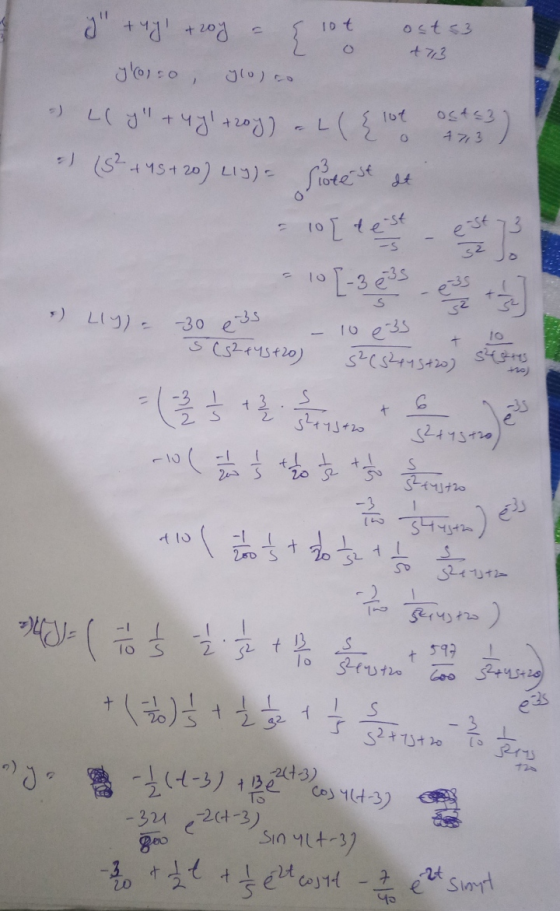
I use laplas transformation to solve this problem
Add Answer to:
WERE 700 5 9 8 45 Predict the motion for the spring frass using the values...
I want matlab code. 585 i1 FIGURE P22.15 22.15 The motion of a damped spring-mass system (Fig. P22.15) is de...
 I want matlab code.
585 i1 FIGURE P22.15 22.15 The motion of a damped spring-mass system (Fig. P22.15) is described by the following ordinary differ- ential equation: dx dx in dt2 dt where x displacement from equilibrium position (m), t time (s), m 20-kg mass, and c the damping coefficient (N s/m). The damping coefficient c takes on three values of 5 (underdamped), 40 (critically damped), and 200 (over- damped). The spring constant k-20 N/m. The initial ve- locity is...
I want matlab code.
585 i1 FIGURE P22.15 22.15 The motion of a damped spring-mass system (Fig. P22.15) is described by the following ordinary differ- ential equation: dx dx in dt2 dt where x displacement from equilibrium position (m), t time (s), m 20-kg mass, and c the damping coefficient (N s/m). The damping coefficient c takes on three values of 5 (underdamped), 40 (critically damped), and 200 (over- damped). The spring constant k-20 N/m. The initial ve- locity is...
A 189-kg mass, when attached to the end of a spring hanging vertically, stretches the spring...
 A 189-kg mass, when attached to the end of a spring hanging vertically, stretches the spring 9 m. The mass is in a medium that exerts a viscous resistance of 3024 N when the mass has a velocity of 4 m/sec. Assume the mass is given an initial velocity of 14 m/s from the equilibrium position. a) Determine the spring constant k. Use g = 10 m/sec. k b) Determine the damping coeffient 7. 7 c) If the initial value...
A 288-kg mass, when attached to the end of a spring hanging vertically, stretches the spring...
 A 288-kg mass, when attached to the end of a spring hanging vertically, stretches the spring 8 m. The mass is in a medium that exerts a viscous resistance of 576 N when the mass has a velocity of 4 m/sec. Assume the mass is given an initial velocity of 18 m/s from the equilibrium position. a) Determine the spring constant k. Use g = 10 m/sec. k b) Determine the damping coeffient 7. 7= c) If the initial value...
help please .. Simple Harmonic Motion 8. What is the value of your y-intercept? 9. Find...
 help please .. Simple Harmonic Motion
8. What is the value of your y-intercept? 9. Find the value of the spring constant (k). 10. Find the value of f (fraction of spring's mass)? 11. If the theoretical value of the spring constant is about 9 N/m, What is the percent error of k [experimental value of k is given in question 9]? Dart II Unokole Low Mothed) Period per 20 T/ad- Mass Ika 0,15 10.25 10.35 Times cycles 122.56 124.41...
help please .. Simple Harmonic Motion
8. What is the value of your y-intercept? 9. Find the value of the spring constant (k). 10. Find the value of f (fraction of spring's mass)? 11. If the theoretical value of the spring constant is about 9 N/m, What is the percent error of k [experimental value of k is given in question 9]? Dart II Unokole Low Mothed) Period per 20 T/ad- Mass Ika 0,15 10.25 10.35 Times cycles 122.56 124.41...
A mass of m kilograams (kg) is mounted on top of a vertical spring. The spring is L metres long when disengaged and the end not attached to the mass is fixced to the ground. The mass moves vertic...
 A mass of m kilograams (kg) is mounted on top of a vertical spring. The spring is L metres long when disengaged and the end not attached to the mass is fixced to the ground. The mass moves vertically up and down, acted on by gravity, the restoring force T of the spring and the damping force R due to friction: see the diagram below The gravitational force is mg dowswards, where g- 9.8m is acceleration due to gravity, measured...
A spring is suspended vertically from a fixed support. the spring has spring constant k = 8nm^-1 (5 points) A spri...
 A spring is suspended vertically from a fixed support. the
spring has spring constant k = 8nm^-1
(5 points) A spring is suspended vertically from a fixed support. The spring has spring constant k 8N m-1. An object of mass m kg is attached to the bottom of the spring. The subject is subject to damping with damping constant β N m-1 s. Let y(t) be the displacement in metres at the end of the spring below its equilibrium position,...
A spring is suspended vertically from a fixed support. the
spring has spring constant k = 8nm^-1
(5 points) A spring is suspended vertically from a fixed support. The spring has spring constant k 8N m-1. An object of mass m kg is attached to the bottom of the spring. The subject is subject to damping with damping constant β N m-1 s. Let y(t) be the displacement in metres at the end of the spring below its equilibrium position,...
A spring-mass-dashpot system for the motion of a block of mass m kg is shown in...
 A spring-mass-dashpot system for the motion of a block of mass m kg is shown in Fig. II-2. The block is moved to the right of the equilibrium position and is released from rest (time t = 0) when its displacement, x = XO. Using the notations given in Fig. II-2,4 (1) Draw the free body diagram of the block - (2) Write the equation of motion of the block- If the initial displacement of the block to the right...
A spring-mass-dashpot system for the motion of a block of mass m kg is shown in...
 A spring-mass-dashpot system for the motion of a block of mass m kg is shown in Fig. II-2. The block is moved to the right of the equilibrium position and is released from rest (time t = 0) when its displacement, x = XO. Using the notations given in Fig. II-2,4 (1) Draw the free body diagram of the block - (2) Write the equation of motion of the block- If the initial displacement of the block to the right...
5 points) A spring is suspended vertically from a fixed support. The spring has spring constant k=28 N m−1k=28 N m−1. An...
 5 points) A spring is suspended vertically from a fixed support.
The spring has spring constant k=28 N m−1k=28 N m−1. An object of
mass m=14 kgm=14 kg is attached to the bottom of the spring. The
subject is subject to damping with damping constant β N m−1 sβ N
m−1 s. Let y(t)y(t) be the displacement in metres at the end of the
spring below its equilibrium position, at time tt seconds.
(5 poins) A spring is suspended vertically...
5 points) A spring is suspended vertically from a fixed support.
The spring has spring constant k=28 N m−1k=28 N m−1. An object of
mass m=14 kgm=14 kg is attached to the bottom of the spring. The
subject is subject to damping with damping constant β N m−1 sβ N
m−1 s. Let y(t)y(t) be the displacement in metres at the end of the
spring below its equilibrium position, at time tt seconds.
(5 poins) A spring is suspended vertically...
5. For the previous problem write an equation of its oscillatory motion using a sine or...
 5. For the previous problem write an equation of its oscillatory motion using a sine or cosine function and assuming that the object starts as indicated above. Find the position and velocity of the object at time = 0.26 sec. (You have to determine to use a cosine of sine function and the initial angle based on the initial conditions given in the previous problem). 4. A mass of 1.80 kg is attached to a horizontal spring with a spring...
 I want matlab code.
585 i1 FIGURE P22.15 22.15 The motion of a damped spring-mass system (Fig. P22.15) is described by the following ordinary differ- ential equation: dx dx in dt2 dt where x displacement from equilibrium position (m), t time (s), m 20-kg mass, and c the damping coefficient (N s/m). The damping coefficient c takes on three values of 5 (underdamped), 40 (critically damped), and 200 (over- damped). The spring constant k-20 N/m. The initial ve- locity is...
I want matlab code.
585 i1 FIGURE P22.15 22.15 The motion of a damped spring-mass system (Fig. P22.15) is described by the following ordinary differ- ential equation: dx dx in dt2 dt where x displacement from equilibrium position (m), t time (s), m 20-kg mass, and c the damping coefficient (N s/m). The damping coefficient c takes on three values of 5 (underdamped), 40 (critically damped), and 200 (over- damped). The spring constant k-20 N/m. The initial ve- locity is...
 A 189-kg mass, when attached to the end of a spring hanging vertically, stretches the spring 9 m. The mass is in a medium that exerts a viscous resistance of 3024 N when the mass has a velocity of 4 m/sec. Assume the mass is given an initial velocity of 14 m/s from the equilibrium position. a) Determine the spring constant k. Use g = 10 m/sec. k b) Determine the damping coeffient 7. 7 c) If the initial value...
 A 288-kg mass, when attached to the end of a spring hanging vertically, stretches the spring 8 m. The mass is in a medium that exerts a viscous resistance of 576 N when the mass has a velocity of 4 m/sec. Assume the mass is given an initial velocity of 18 m/s from the equilibrium position. a) Determine the spring constant k. Use g = 10 m/sec. k b) Determine the damping coeffient 7. 7= c) If the initial value...
 help please .. Simple Harmonic Motion
8. What is the value of your y-intercept? 9. Find the value of the spring constant (k). 10. Find the value of f (fraction of spring's mass)? 11. If the theoretical value of the spring constant is about 9 N/m, What is the percent error of k [experimental value of k is given in question 9]? Dart II Unokole Low Mothed) Period per 20 T/ad- Mass Ika 0,15 10.25 10.35 Times cycles 122.56 124.41...
help please .. Simple Harmonic Motion
8. What is the value of your y-intercept? 9. Find the value of the spring constant (k). 10. Find the value of f (fraction of spring's mass)? 11. If the theoretical value of the spring constant is about 9 N/m, What is the percent error of k [experimental value of k is given in question 9]? Dart II Unokole Low Mothed) Period per 20 T/ad- Mass Ika 0,15 10.25 10.35 Times cycles 122.56 124.41...
 A mass of m kilograams (kg) is mounted on top of a vertical spring. The spring is L metres long when disengaged and the end not attached to the mass is fixced to the ground. The mass moves vertically up and down, acted on by gravity, the restoring force T of the spring and the damping force R due to friction: see the diagram below The gravitational force is mg dowswards, where g- 9.8m is acceleration due to gravity, measured...
 A spring is suspended vertically from a fixed support. the
spring has spring constant k = 8nm^-1
(5 points) A spring is suspended vertically from a fixed support. The spring has spring constant k 8N m-1. An object of mass m kg is attached to the bottom of the spring. The subject is subject to damping with damping constant β N m-1 s. Let y(t) be the displacement in metres at the end of the spring below its equilibrium position,...
A spring is suspended vertically from a fixed support. the
spring has spring constant k = 8nm^-1
(5 points) A spring is suspended vertically from a fixed support. The spring has spring constant k 8N m-1. An object of mass m kg is attached to the bottom of the spring. The subject is subject to damping with damping constant β N m-1 s. Let y(t) be the displacement in metres at the end of the spring below its equilibrium position,...
 A spring-mass-dashpot system for the motion of a block of mass m kg is shown in Fig. II-2. The block is moved to the right of the equilibrium position and is released from rest (time t = 0) when its displacement, x = XO. Using the notations given in Fig. II-2,4 (1) Draw the free body diagram of the block - (2) Write the equation of motion of the block- If the initial displacement of the block to the right...
 A spring-mass-dashpot system for the motion of a block of mass m kg is shown in Fig. II-2. The block is moved to the right of the equilibrium position and is released from rest (time t = 0) when its displacement, x = XO. Using the notations given in Fig. II-2,4 (1) Draw the free body diagram of the block - (2) Write the equation of motion of the block- If the initial displacement of the block to the right...
 5 points) A spring is suspended vertically from a fixed support.
The spring has spring constant k=28 N m−1k=28 N m−1. An object of
mass m=14 kgm=14 kg is attached to the bottom of the spring. The
subject is subject to damping with damping constant β N m−1 sβ N
m−1 s. Let y(t)y(t) be the displacement in metres at the end of the
spring below its equilibrium position, at time tt seconds.
(5 poins) A spring is suspended vertically...
5 points) A spring is suspended vertically from a fixed support.
The spring has spring constant k=28 N m−1k=28 N m−1. An object of
mass m=14 kgm=14 kg is attached to the bottom of the spring. The
subject is subject to damping with damping constant β N m−1 sβ N
m−1 s. Let y(t)y(t) be the displacement in metres at the end of the
spring below its equilibrium position, at time tt seconds.
(5 poins) A spring is suspended vertically...
 5. For the previous problem write an equation of its oscillatory motion using a sine or cosine function and assuming that the object starts as indicated above. Find the position and velocity of the object at time = 0.26 sec. (You have to determine to use a cosine of sine function and the initial angle based on the initial conditions given in the previous problem). 4. A mass of 1.80 kg is attached to a horizontal spring with a spring...
Most questions answered within 3 hours.
-
Where is the error in this code sequence?
String s1 = "Hello";
String s2 = "ello";...
asked 11 months ago -
Financial data for Joel de Paris, Inc., for last year
follow:
Joel de Paris, Inc.
Balance...
asked 11 months ago -
Consider this reaction:
Al2(SO4)3 (aq)+ BaCl3
(aq) Al2Cl6 (aq)- +
3BaSO4(s) . What is the...
asked 11 months ago -
Suppose that Savneet is considering increasing her
recent random sample from 20 car rentals to 40...
asked 11 months ago -
Trucks arrive at an unloading terminal at an average rate of 120
per hour.
Trucks arrive...
asked 11 months ago -
Why are methanol and ethanol completely soluble in water while
octanol is not very little soluble....
asked 11 months ago -
A facilities manager at a university reads in a research report
that the mean amount of...
asked 11 months ago -
When the CuSO4 is rehydrated by adding water to the anhydrous
compound, is this an endothermic...
asked 11 months ago -
A ray of sunlight is passing from diamond into crown glass; the
angle of incidence is...
asked 11 months ago -
A block of mass 0.249 kg is placed on top of a light, vertical
spring of...
asked 11 months ago -
how do the kidneys compensate in the presences of acidosis
a) trigger hyperventilate
b) reserve acid...
asked 11 months ago -
Question 501 pts
The rental rate of capital to the firm increases. Which of the
following...
asked 11 months ago