
Homework Answers
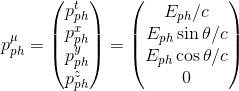
The 4 momentum components of the photon are

In cloumn vector notation
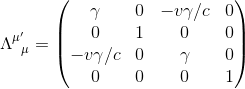
b) The Lorentz transformation matrix for transformation along Y axis
c) Therefore the momentum in S' frame is

Add Answer to:
a) A photon with energy Eph in a reference frame S moves at an angle 0...
2) Lorentz transformations a) A photon with energy Eph in a reference frame S moves at...
 2) Lorentz transformations a) A photon with energy Eph in a reference frame S moves at an angle 8 with respect to the y axis, in the x-y plane (i.e., its propagation vector is k = (sin 0, cos 6,0)). Write out the photon's momentum four-vector pph in frame S. b) Write out the 4x4 matrix that describes a Lorentz boost into a frame (S') that moves with velocity v (corresponding to Lorentz factory in the y direction of frame...
Lorentz transformations a) A photon with energy Eph in a reference frame S moves at an...
Lorentz transformations a) A photon with energy Eph in a reference frame S moves at an angle θ with respect to the y axis, in the x-y plane (i.e., its propagation vector is ˆk = (sin θ, cos θ, 0)). Write out the photon’s momentum four-vector p μ ph in frame S.
1. (a) In Bob 's reference frame, a particle has a momentum p= pd along the...
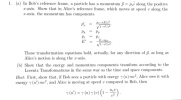 1. (a) In Bob 's reference frame, a particle has a momentum p= pd along the positive r-axis. Show that in Alice's reference frame, which moves at speed v along the r-axis, the momentum has components ру P: P These transformation equations hold, actually, for any direction of p, as long as Alice's motion is along the r-axis. (b) Show that the energy and momentum components transform according to the Lorentz Transformations in the same way as the time and...
Question 5 [12 10 22 marks] (a) In a given inertial reference frame, S', consider a...
 Question 5 [12 10 22 marks] (a) In a given inertial reference frame, S', consider a region of space where there is a uniform and constant electric field, E', and zero magnetic field, i.e. B' = 0. The frame S' moves with respect to an observer, in another frame S, with velocity v. Write an expression for the electric field, E, observed in S? Clearly explain any notation (i) and new quantities introduced Write an expression for the magnetic field,...
just 18.3 In other words, the center of mass moves as a free particle (no external...
 just 18.3
In other words, the center of mass moves as a free particle (no external force) of mass m. The solution for R corre- sponds to uniform straight-line motion, and eliminates three of the six independent variables in the original equations of motion (three components each of, and r. Let us take, as the remaining three independent variables, the three components of r -. To ma- nipulate the original dynamical equations into a single vector equation for r. divide...
just 18.3
In other words, the center of mass moves as a free particle (no external force) of mass m. The solution for R corre- sponds to uniform straight-line motion, and eliminates three of the six independent variables in the original equations of motion (three components each of, and r. Let us take, as the remaining three independent variables, the three components of r -. To ma- nipulate the original dynamical equations into a single vector equation for r. divide...
 2) Lorentz transformations a) A photon with energy Eph in a reference frame S moves at an angle 8 with respect to the y axis, in the x-y plane (i.e., its propagation vector is k = (sin 0, cos 6,0)). Write out the photon's momentum four-vector pph in frame S. b) Write out the 4x4 matrix that describes a Lorentz boost into a frame (S') that moves with velocity v (corresponding to Lorentz factory in the y direction of frame...
 1. (a) In Bob 's reference frame, a particle has a momentum p= pd along the positive r-axis. Show that in Alice's reference frame, which moves at speed v along the r-axis, the momentum has components ру P: P These transformation equations hold, actually, for any direction of p, as long as Alice's motion is along the r-axis. (b) Show that the energy and momentum components transform according to the Lorentz Transformations in the same way as the time and...
 Question 5 [12 10 22 marks] (a) In a given inertial reference frame, S', consider a region of space where there is a uniform and constant electric field, E', and zero magnetic field, i.e. B' = 0. The frame S' moves with respect to an observer, in another frame S, with velocity v. Write an expression for the electric field, E, observed in S? Clearly explain any notation (i) and new quantities introduced Write an expression for the magnetic field,...
 just 18.3
In other words, the center of mass moves as a free particle (no external force) of mass m. The solution for R corre- sponds to uniform straight-line motion, and eliminates three of the six independent variables in the original equations of motion (three components each of, and r. Let us take, as the remaining three independent variables, the three components of r -. To ma- nipulate the original dynamical equations into a single vector equation for r. divide...
just 18.3
In other words, the center of mass moves as a free particle (no external force) of mass m. The solution for R corre- sponds to uniform straight-line motion, and eliminates three of the six independent variables in the original equations of motion (three components each of, and r. Let us take, as the remaining three independent variables, the three components of r -. To ma- nipulate the original dynamical equations into a single vector equation for r. divide...
Most questions answered within 3 hours.
-
Where is the error in this code sequence?
String s1 = "Hello";
String s2 = "ello";...
asked 10 months ago -
Financial data for Joel de Paris, Inc., for last year
follow:
Joel de Paris, Inc.
Balance...
asked 10 months ago -
Consider this reaction:
Al2(SO4)3 (aq)+ BaCl3
(aq) Al2Cl6 (aq)- +
3BaSO4(s) . What is the...
asked 10 months ago -
Suppose that Savneet is considering increasing her
recent random sample from 20 car rentals to 40...
asked 10 months ago -
Trucks arrive at an unloading terminal at an average rate of 120
per hour.
Trucks arrive...
asked 10 months ago -
Why are methanol and ethanol completely soluble in water while
octanol is not very little soluble....
asked 10 months ago -
A facilities manager at a university reads in a research report
that the mean amount of...
asked 10 months ago -
When the CuSO4 is rehydrated by adding water to the anhydrous
compound, is this an endothermic...
asked 10 months ago -
A ray of sunlight is passing from diamond into crown glass; the
angle of incidence is...
asked 10 months ago -
A block of mass 0.249 kg is placed on top of a light, vertical
spring of...
asked 10 months ago -
how do the kidneys compensate in the presences of acidosis
a) trigger hyperventilate
b) reserve acid...
asked 10 months ago -
Question 501 pts
The rental rate of capital to the firm increases. Which of the
following...
asked 10 months ago