Problem 1: Air at 20°C and 1 atm flows over a spherical object at 1 m/s....
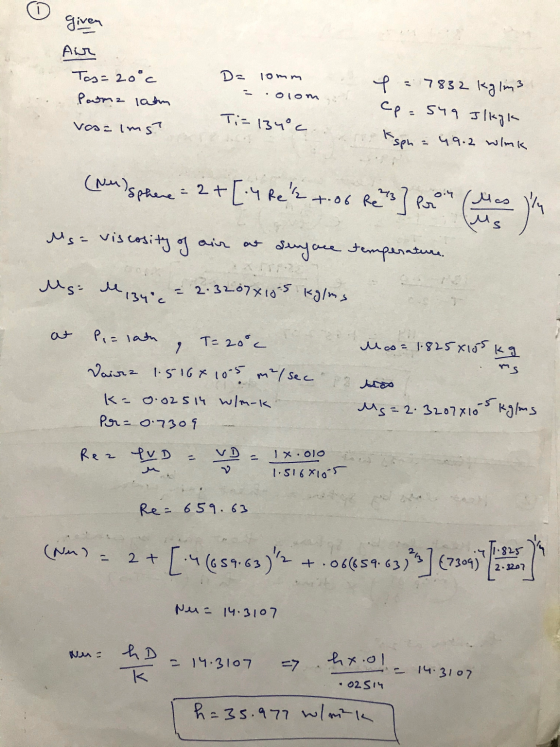
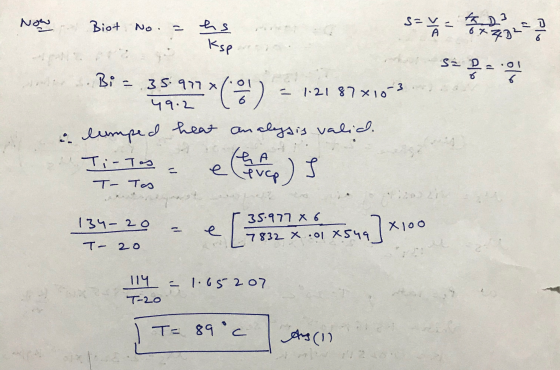
Problem 1: Air at 20°C and 1 atm flows over a spherical object at 1 m/s. The sphere has a diameter of 10mm and its initial temperature is 134°C. If the density, specific heat, and conductivity of the sphere are 7832 kg/m , 549 J/kg.K, and 49.2 W/m.K, respectively, calculate the temperature at the center of the sphere after 100 seconds.
Problem 3: Consider the sphere that was described in problem 1. If we place that hot sphere in a bucket of water, which is at 20°C, how long will it take for the surface temperature of the sphere to reach 50°C?
Homework Answers
 te
te the convective heat tranfer
coefficient calculated above are calculated by using the free
convection concept byusing grashof number and rayleigh number
the convective heat tranfer
coefficient calculated above are calculated by using the free
convection concept byusing grashof number and rayleigh number
Add Answer to:
Problem 1: Air at 20°C and 1 atm flows over a spherical object
at 1 m/s....
Air at 20°C and 1 atm flows over a long cylinder at 1 m/s. The cylinder...
Air at 20°C and 1 atm flows over a long cylinder at 1 m/s. The cylinder has a diameter of 10mm and its initial temperature is 134°C. If the density, specific heat, and 3 conductivity of the cylinder are 7832 kg/m , 549 J/kg.K, and 49.2 W/m.K, respectively, calculate the temperature on surface of the cylinder after 100 seconds.
Problem 4: Consider the heat exchanger design illustrated. Hot air flows at speed of r0.6 m/s thr...
 Problem 4: Consider the heat exchanger design illustrated. Hot air flows at speed of r0.6 m/s through the center pipe. The center pipe has an outer diameter of D=7 cm and length 4-2 m Cold water flows at 20-25 cm3/s through a smaller helical pipe having an outer diameter d = 1 cm and wall thickness of mm. The helical pipe is wrapped around the center pipe to form a heat exchanger. The center pipe has a thermal conductivity of...
Problem 7.054 Air at 25°C flows over a 9-mm-diameter sphere with a velocity of 20 m/s,...
 Problem 7.054 Air at 25°C flows over a 9-mm-diameter sphere with a velocity of 20 m/s, while the surface of the sphere is maintained at 75°C. What is the rate of heat transfer from the sphere? tPatheaticalsnctions
Problem 2. (20 pts) As shown in the figure, uniform generation occurs inside the spherical core...
 Problem 2. (20 pts) As shown in the figure, uniform generation occurs inside the spherical core with a radius n due to reactive heating at a rate of q 10 W/m3. The thermal conductivity of the reactive material is 20 Wm. K. The spherical shell 1Sr is made of stainless steel (s.s.) with a thermal conductivity k2 -15 W/m K. Given 0.5 m and k2 72=0.6 m, water flows outside to cool the s.s. shell at To-25°C and h =...
Air at 20 °C and 1 atm. flow over a flat plate with 35 m/s. The...
Air at 20 °C and 1 atm. flow over a flat plate with 35 m/s. The size of the plate is 75 cm by 75 cm and is maintained at 60 °C. Calculate: a) The heat transfer rate 40 cm from the leading edge of the plate. (5 points) b) The heat transfer rate at the end of the plate (at x = L). (5 points) c) The heat transfer rate from the entire plate. (10 points) d) The heat...
Exercise 2 Air at 20 °C and 1 atm flows over a flat plate at 50...
 Exercise 2 Air at 20 °C and 1 atm flows over a flat plate at 50 m/s. The plate is 300 cm long and is maintained at 60C. The width of the plate is 2 m. The critical Rec = 5 x 10⁵ The properties are Conductivity k = 0.0263 W/mK, kinematic viscosity nu = v = 15.89 x 10⁻⁶ m²/s, Prandtl number is Pr=0.707 Density rho = p = 1.128 kg/m3 1. Determine the critical length Xc 2. Determine...
[10] Design Problem As shown in the figure below, a double-pipe parallel-flow heat exchanger is used...
 [10] Design Problem As shown in the figure below, a double-pipe parallel-flow heat exchanger is used to heat cold fluid which is water (Cp = 4180 J/(kg.K), p = 1000 kg/m) from 20°C to 80°C at a rate of 0.15 kg/s. The heating is to be accomplished by hot fluid, which is geothermal water (Cp = 4310 J/(kg.K), p = 1050 kg/m²) available at 130°C at a mass flow rate of 0.25 kg/s. The inner tube has an inner diameter...
Air at 20 °C and 1 atm. flow over a flat plate with 35 m/s. The...
Air at 20 °C and 1 atm. flow over a flat plate with 35 m/s. The size of the plate is 75 cm by 75 cm and is maintained at 60 °C. Calculate: a) The heat transfer rate 40 cm from the leading edge of the plate. b) The heat transfer rate at the end of the plate (at x = L). c) The heat transfer rate from the entire plate. d) The heat transfer rate at the...
The boiling temperature of nitrogen at atmospheric pressure at sea level (1 atm pressure) is -196°C. Therefore, nitroge...
 The boiling temperature of nitrogen at atmospheric pressure at sea level (1 atm pressure) is -196°C. Therefore, nitrogen is commonly used in low-temperature scientific studies since the temperature of liquid nitrogen in a tank open to the atmosphere will remain constant at -196°C until it is depleted. Any heat transfer to the tank will result in the evaporation of some liquid nitrogen, which has a heat of vaporization of 198 kJ/kg and a density of 810 kg/m3 at 1 atm....
Problem 2: A hot metal ball 0.00245 W/m°C; α-0151* 10-s m2/s; d 18 cm) initially at...
 Problem 2: A hot metal ball 0.00245 W/m°C; α-0151* 10-s m2/s; d 18 cm) initially at a unifom temperature of 310°C is cooled by placing it in air at 29 C is flowing at a constant 4 m/s. In order to continue on in the manufacturing process, the temperature at the center of the ball must be 70°C. (μ. = 1.872*10-5 kg m-s). The air You mav assume that the properties of air may bem odeled as V = 1.608...
 Problem 4: Consider the heat exchanger design illustrated. Hot air flows at speed of r0.6 m/s through the center pipe. The center pipe has an outer diameter of D=7 cm and length 4-2 m Cold water flows at 20-25 cm3/s through a smaller helical pipe having an outer diameter d = 1 cm and wall thickness of mm. The helical pipe is wrapped around the center pipe to form a heat exchanger. The center pipe has a thermal conductivity of...
 Problem 7.054 Air at 25°C flows over a 9-mm-diameter sphere with a velocity of 20 m/s, while the surface of the sphere is maintained at 75°C. What is the rate of heat transfer from the sphere? tPatheaticalsnctions
 Problem 2. (20 pts) As shown in the figure, uniform generation occurs inside the spherical core with a radius n due to reactive heating at a rate of q 10 W/m3. The thermal conductivity of the reactive material is 20 Wm. K. The spherical shell 1Sr is made of stainless steel (s.s.) with a thermal conductivity k2 -15 W/m K. Given 0.5 m and k2 72=0.6 m, water flows outside to cool the s.s. shell at To-25°C and h =...
 Exercise 2 Air at 20 °C and 1 atm flows over a flat plate at 50 m/s. The plate is 300 cm long and is maintained at 60C. The width of the plate is 2 m. The critical Rec = 5 x 10⁵ The properties are Conductivity k = 0.0263 W/mK, kinematic viscosity nu = v = 15.89 x 10⁻⁶ m²/s, Prandtl number is Pr=0.707 Density rho = p = 1.128 kg/m3 1. Determine the critical length Xc 2. Determine...
 [10] Design Problem As shown in the figure below, a double-pipe parallel-flow heat exchanger is used to heat cold fluid which is water (Cp = 4180 J/(kg.K), p = 1000 kg/m) from 20°C to 80°C at a rate of 0.15 kg/s. The heating is to be accomplished by hot fluid, which is geothermal water (Cp = 4310 J/(kg.K), p = 1050 kg/m²) available at 130°C at a mass flow rate of 0.25 kg/s. The inner tube has an inner diameter...
 The boiling temperature of nitrogen at atmospheric pressure at sea level (1 atm pressure) is -196°C. Therefore, nitrogen is commonly used in low-temperature scientific studies since the temperature of liquid nitrogen in a tank open to the atmosphere will remain constant at -196°C until it is depleted. Any heat transfer to the tank will result in the evaporation of some liquid nitrogen, which has a heat of vaporization of 198 kJ/kg and a density of 810 kg/m3 at 1 atm....
 Problem 2: A hot metal ball 0.00245 W/m°C; α-0151* 10-s m2/s; d 18 cm) initially at a unifom temperature of 310°C is cooled by placing it in air at 29 C is flowing at a constant 4 m/s. In order to continue on in the manufacturing process, the temperature at the center of the ball must be 70°C. (μ. = 1.872*10-5 kg m-s). The air You mav assume that the properties of air may bem odeled as V = 1.608...
Most questions answered within 3 hours.
-
Where is the error in this code sequence?
String s1 = "Hello";
String s2 = "ello";...
asked 10 months ago -
Financial data for Joel de Paris, Inc., for last year
follow:
Joel de Paris, Inc.
Balance...
asked 10 months ago -
Consider this reaction:
Al2(SO4)3 (aq)+ BaCl3
(aq) Al2Cl6 (aq)- +
3BaSO4(s) . What is the...
asked 10 months ago -
Suppose that Savneet is considering increasing her
recent random sample from 20 car rentals to 40...
asked 10 months ago -
Trucks arrive at an unloading terminal at an average rate of 120
per hour.
Trucks arrive...
asked 10 months ago -
Why are methanol and ethanol completely soluble in water while
octanol is not very little soluble....
asked 10 months ago -
A facilities manager at a university reads in a research report
that the mean amount of...
asked 10 months ago -
When the CuSO4 is rehydrated by adding water to the anhydrous
compound, is this an endothermic...
asked 10 months ago -
A ray of sunlight is passing from diamond into crown glass; the
angle of incidence is...
asked 10 months ago -
A block of mass 0.249 kg is placed on top of a light, vertical
spring of...
asked 10 months ago -
how do the kidneys compensate in the presences of acidosis
a) trigger hyperventilate
b) reserve acid...
asked 10 months ago -
Question 501 pts
The rental rate of capital to the firm increases. Which of the
following...
asked 10 months ago