
Homework Answers
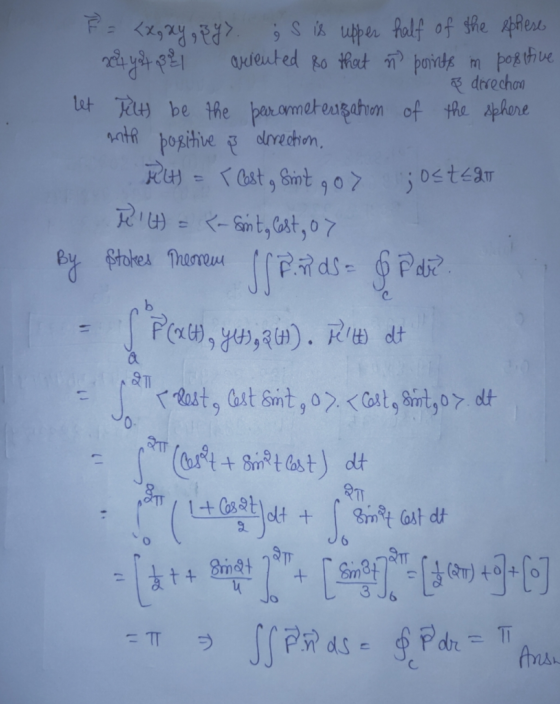
Use Stokes' Theorem to evaluate. 8. Use Stokes, Theorem to evaluate J, ▽ x ที่ do, where F(x, y, z)-(z2yz,yz2,23ezy and s is part of the sphere x2 + y2 + z-5 that lies above the plane z-1. Also, s...
 Use Stokes' Theorem to evaluate.
8. Use Stokes, Theorem to evaluate J, ▽ x ที่ do, where F(x, y, z)-(z2yz,yz2,23ezy and s is part of the sphere x2 + y2 + z-5 that lies above the plane z-1. Also, s is oriented upward.
8. Use Stokes, Theorem to evaluate J, ▽ x ที่ do, where F(x, y, z)-(z2yz,yz2,23ezy and s is part of the sphere x2 + y2 + z-5 that lies above the plane z-1. Also, s is oriented...
Use Stokes' Theorem to evaluate.
8. Use Stokes, Theorem to evaluate J, ▽ x ที่ do, where F(x, y, z)-(z2yz,yz2,23ezy and s is part of the sphere x2 + y2 + z-5 that lies above the plane z-1. Also, s is oriented upward.
8. Use Stokes, Theorem to evaluate J, ▽ x ที่ do, where F(x, y, z)-(z2yz,yz2,23ezy and s is part of the sphere x2 + y2 + z-5 that lies above the plane z-1. Also, s is oriented...
1. Suppose F = (-y,x,z) and S is the part of the sphere x2 + y2...
 1. Suppose F = (-y,x,z) and S is the part of the sphere x2 + y2 + z = 25 below the plane z = 4, oriented with the outward-pointing normal (so that the normal at (5,0,0) is 1). Compute the flux integral curl F.ds using Stoke's theorem.
Question 4 Let S be the upper half of the unit sphere 2? + y2 +...
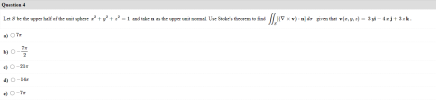 Question 4 Let S be the upper half of the unit sphere 2? + y2 + x2 = 1 and take n as the upper unit normal. Use Stoke's theorem to find xv). n do given that v(x, y, z) = 3 yi - 43j+3zk. a) O 77 b) O 77 2 c) O-217 d) O-141 e) -77
Use the Divergence Theorem to evaluate ∬SF⋅dS∬SF⋅dS where F=〈z2x,y33+3tan(z),x2z−1〉F=〈z2x,y33+3tan(z),x2z−1〉 and SS is the top half of...
 Use the Divergence Theorem to evaluate ∬SF⋅dS∬SF⋅dS where
F=〈z2x,y33+3tan(z),x2z−1〉F=〈z2x,y33+3tan(z),x2z−1〉
and SS is the top half of the sphere x2+y2+z2=9x2+y2+z2=9.
(1 point) Use the Divergence Theorem to evaluate FdS where F2x +3 tan2).^z-1 and S is the top half of the sphere x2 +y2 + z2 -9 Hint: S is not a closed surface. First compute integrals overs, and S2 , where S, is the disk x2 + y2 < 9, z = 0 oriented downward and S2 = S U...
Use the Divergence Theorem to evaluate ∬SF⋅dS∬SF⋅dS where
F=〈z2x,y33+3tan(z),x2z−1〉F=〈z2x,y33+3tan(z),x2z−1〉
and SS is the top half of the sphere x2+y2+z2=9x2+y2+z2=9.
(1 point) Use the Divergence Theorem to evaluate FdS where F2x +3 tan2).^z-1 and S is the top half of the sphere x2 +y2 + z2 -9 Hint: S is not a closed surface. First compute integrals overs, and S2 , where S, is the disk x2 + y2 < 9, z = 0 oriented downward and S2 = S U...
Consider the vector field F(x, y, z) = (z arctan(y2), 22 In(22 +1), 32) Let the...
 Consider the vector field F(x, y, z) = (z arctan(y2), 22 In(22 +1), 32) Let the surface S be the part of the sphere x2 + y2 + x2 = 4 that lies above the plane 2=1 and be oriented downwards. (a) Find the divergence of F. (b) Compute the flux integral SS. F . ñ ds.
3. Verify Stokes' Theorem for the vector field F(x, y, z)= (x2)ĩ+(y2)]+(-xy)k where S is the...
 3. Verify Stokes' Theorem for the vector field F(x, y, z)= (x2)ĩ+(y2)]+(-xy)k where S is the surface of the cone +y parametrized by (u,v)-(ucos v, u sin v, hu) x2+y2 a at height h above the xy-plane Z = a V 0<vsa, OSvs 2n, and as is the curve parametrized by ē(f) =(acost,asint, h), 0sis27 as x2+ a
3. Verify Stokes' Theorem for the vector field F(x, y, z)= (x2)ĩ+(y2)]+(-xy)k where S is the surface of the cone +y parametrized...
3. Verify Stokes' Theorem for the vector field F(x, y, z)= (x2)ĩ+(y2)]+(-xy)k where S is the surface of the cone +y parametrized by (u,v)-(ucos v, u sin v, hu) x2+y2 a at height h above the xy-plane Z = a V 0<vsa, OSvs 2n, and as is the curve parametrized by ē(f) =(acost,asint, h), 0sis27 as x2+ a
3. Verify Stokes' Theorem for the vector field F(x, y, z)= (x2)ĩ+(y2)]+(-xy)k where S is the surface of the cone +y parametrized...
2. Compute the integral of f over S where (a) f(ayz)xy+z.S is the region in the first octant with...
 solve parts b,d and f
2. Compute the integral of f over S where (a) f(ayz)xy+z.S is the region in the first octant with xy+ (b) f(xy.z)xxyz, S is the region defined in 2(a) (c) f(x,y.z) x + y2-xz, s is the region bounded by the x'y plane, the plane z (d) f(x,y,z) 2, and the cylinderx2 y z, s is the region in the first octant bounded by r2 + y2 + 2 4 (e) f(xy,z-2, s is the...
solve parts b,d and f
2. Compute the integral of f over S where (a) f(ayz)xy+z.S is the region in the first octant with xy+ (b) f(xy.z)xxyz, S is the region defined in 2(a) (c) f(x,y.z) x + y2-xz, s is the region bounded by the x'y plane, the plane z (d) f(x,y,z) 2, and the cylinderx2 y z, s is the region in the first octant bounded by r2 + y2 + 2 4 (e) f(xy,z-2, s is the...
(1 point) Let F(x, y, z) = 1z- xi + (x2 + tan(z)j + (1x²z +...
 (1 point) Let F(x, y, z) = 1z- xi + (x2 + tan(z)j + (1x²z + 3y2)k. Use the Divergence Theorem to evaluate /s F. ds where S is the top half of the sphere x2 + y2 + z2 = 1 oriented upwards. SSsF. dS =
7. Use Green's Theorem to find Jc F.nds, where C is the boundary of the region bounded by y = 4-x2 and y = 0, oriented counter-clockwise and F(x,y) = (y,-3z). what about if F(r, y) (2,3)? x2...
 7. Use Green's Theorem to find Jc F.nds, where C is the boundary of the region bounded by y = 4-x2 and y = 0, oriented counter-clockwise and F(x,y) = (y,-3z). what about if F(r, y) (2,3)? x2 + y2 that lies inside x2 + y2-1. Find the surface area of this 8. Consider the part of z surface. 9. Use Green's Theorem to find Find J F Tds, where F(x, y) (ry,e"), and C consists of the line segment...
(23 pts) Let F(x, y, z) = ?x + y, x + y, x2 + y2?,...
 (23 pts) Let F(x, y, z) = ?x + y, x + y, x2 + y2?, S be the top
hemisphere of the unit sphere oriented upward, and C the unit
circle in the xy-plane with positive orientation.
(a) Compute div(F) and curl(F).
(b) Is F conservative? Briefly explain.
(c) Use Stokes’ Theorem to compute ? F · dr by converting it to
a surface integral. (The integral is easy if C
you set it up correctly)
4. (23 pts)...
(23 pts) Let F(x, y, z) = ?x + y, x + y, x2 + y2?, S be the top
hemisphere of the unit sphere oriented upward, and C the unit
circle in the xy-plane with positive orientation.
(a) Compute div(F) and curl(F).
(b) Is F conservative? Briefly explain.
(c) Use Stokes’ Theorem to compute ? F · dr by converting it to
a surface integral. (The integral is easy if C
you set it up correctly)
4. (23 pts)...
 Use Stokes' Theorem to evaluate.
8. Use Stokes, Theorem to evaluate J, ▽ x ที่ do, where F(x, y, z)-(z2yz,yz2,23ezy and s is part of the sphere x2 + y2 + z-5 that lies above the plane z-1. Also, s is oriented upward.
8. Use Stokes, Theorem to evaluate J, ▽ x ที่ do, where F(x, y, z)-(z2yz,yz2,23ezy and s is part of the sphere x2 + y2 + z-5 that lies above the plane z-1. Also, s is oriented...
Use Stokes' Theorem to evaluate.
8. Use Stokes, Theorem to evaluate J, ▽ x ที่ do, where F(x, y, z)-(z2yz,yz2,23ezy and s is part of the sphere x2 + y2 + z-5 that lies above the plane z-1. Also, s is oriented upward.
8. Use Stokes, Theorem to evaluate J, ▽ x ที่ do, where F(x, y, z)-(z2yz,yz2,23ezy and s is part of the sphere x2 + y2 + z-5 that lies above the plane z-1. Also, s is oriented...
 1. Suppose F = (-y,x,z) and S is the part of the sphere x2 + y2 + z = 25 below the plane z = 4, oriented with the outward-pointing normal (so that the normal at (5,0,0) is 1). Compute the flux integral curl F.ds using Stoke's theorem.
 Question 4 Let S be the upper half of the unit sphere 2? + y2 + x2 = 1 and take n as the upper unit normal. Use Stoke's theorem to find xv). n do given that v(x, y, z) = 3 yi - 43j+3zk. a) O 77 b) O 77 2 c) O-217 d) O-141 e) -77
 Use the Divergence Theorem to evaluate ∬SF⋅dS∬SF⋅dS where
F=〈z2x,y33+3tan(z),x2z−1〉F=〈z2x,y33+3tan(z),x2z−1〉
and SS is the top half of the sphere x2+y2+z2=9x2+y2+z2=9.
(1 point) Use the Divergence Theorem to evaluate FdS where F2x +3 tan2).^z-1 and S is the top half of the sphere x2 +y2 + z2 -9 Hint: S is not a closed surface. First compute integrals overs, and S2 , where S, is the disk x2 + y2 < 9, z = 0 oriented downward and S2 = S U...
Use the Divergence Theorem to evaluate ∬SF⋅dS∬SF⋅dS where
F=〈z2x,y33+3tan(z),x2z−1〉F=〈z2x,y33+3tan(z),x2z−1〉
and SS is the top half of the sphere x2+y2+z2=9x2+y2+z2=9.
(1 point) Use the Divergence Theorem to evaluate FdS where F2x +3 tan2).^z-1 and S is the top half of the sphere x2 +y2 + z2 -9 Hint: S is not a closed surface. First compute integrals overs, and S2 , where S, is the disk x2 + y2 < 9, z = 0 oriented downward and S2 = S U...
 Consider the vector field F(x, y, z) = (z arctan(y2), 22 In(22 +1), 32) Let the surface S be the part of the sphere x2 + y2 + x2 = 4 that lies above the plane 2=1 and be oriented downwards. (a) Find the divergence of F. (b) Compute the flux integral SS. F . ñ ds.
 3. Verify Stokes' Theorem for the vector field F(x, y, z)= (x2)ĩ+(y2)]+(-xy)k where S is the surface of the cone +y parametrized by (u,v)-(ucos v, u sin v, hu) x2+y2 a at height h above the xy-plane Z = a V 0<vsa, OSvs 2n, and as is the curve parametrized by ē(f) =(acost,asint, h), 0sis27 as x2+ a
3. Verify Stokes' Theorem for the vector field F(x, y, z)= (x2)ĩ+(y2)]+(-xy)k where S is the surface of the cone +y parametrized...
3. Verify Stokes' Theorem for the vector field F(x, y, z)= (x2)ĩ+(y2)]+(-xy)k where S is the surface of the cone +y parametrized by (u,v)-(ucos v, u sin v, hu) x2+y2 a at height h above the xy-plane Z = a V 0<vsa, OSvs 2n, and as is the curve parametrized by ē(f) =(acost,asint, h), 0sis27 as x2+ a
3. Verify Stokes' Theorem for the vector field F(x, y, z)= (x2)ĩ+(y2)]+(-xy)k where S is the surface of the cone +y parametrized...
 solve parts b,d and f
2. Compute the integral of f over S where (a) f(ayz)xy+z.S is the region in the first octant with xy+ (b) f(xy.z)xxyz, S is the region defined in 2(a) (c) f(x,y.z) x + y2-xz, s is the region bounded by the x'y plane, the plane z (d) f(x,y,z) 2, and the cylinderx2 y z, s is the region in the first octant bounded by r2 + y2 + 2 4 (e) f(xy,z-2, s is the...
solve parts b,d and f
2. Compute the integral of f over S where (a) f(ayz)xy+z.S is the region in the first octant with xy+ (b) f(xy.z)xxyz, S is the region defined in 2(a) (c) f(x,y.z) x + y2-xz, s is the region bounded by the x'y plane, the plane z (d) f(x,y,z) 2, and the cylinderx2 y z, s is the region in the first octant bounded by r2 + y2 + 2 4 (e) f(xy,z-2, s is the...
 (1 point) Let F(x, y, z) = 1z- xi + (x2 + tan(z)j + (1x²z + 3y2)k. Use the Divergence Theorem to evaluate /s F. ds where S is the top half of the sphere x2 + y2 + z2 = 1 oriented upwards. SSsF. dS =
 7. Use Green's Theorem to find Jc F.nds, where C is the boundary of the region bounded by y = 4-x2 and y = 0, oriented counter-clockwise and F(x,y) = (y,-3z). what about if F(r, y) (2,3)? x2 + y2 that lies inside x2 + y2-1. Find the surface area of this 8. Consider the part of z surface. 9. Use Green's Theorem to find Find J F Tds, where F(x, y) (ry,e"), and C consists of the line segment...
 (23 pts) Let F(x, y, z) = ?x + y, x + y, x2 + y2?, S be the top
hemisphere of the unit sphere oriented upward, and C the unit
circle in the xy-plane with positive orientation.
(a) Compute div(F) and curl(F).
(b) Is F conservative? Briefly explain.
(c) Use Stokes’ Theorem to compute ? F · dr by converting it to
a surface integral. (The integral is easy if C
you set it up correctly)
4. (23 pts)...
(23 pts) Let F(x, y, z) = ?x + y, x + y, x2 + y2?, S be the top
hemisphere of the unit sphere oriented upward, and C the unit
circle in the xy-plane with positive orientation.
(a) Compute div(F) and curl(F).
(b) Is F conservative? Briefly explain.
(c) Use Stokes’ Theorem to compute ? F · dr by converting it to
a surface integral. (The integral is easy if C
you set it up correctly)
4. (23 pts)...
Most questions answered within 3 hours.
-
Where is the error in this code sequence?
String s1 = "Hello";
String s2 = "ello";...
asked 11 months ago -
Financial data for Joel de Paris, Inc., for last year
follow:
Joel de Paris, Inc.
Balance...
asked 11 months ago -
Consider this reaction:
Al2(SO4)3 (aq)+ BaCl3
(aq) Al2Cl6 (aq)- +
3BaSO4(s) . What is the...
asked 11 months ago -
Suppose that Savneet is considering increasing her
recent random sample from 20 car rentals to 40...
asked 11 months ago -
Trucks arrive at an unloading terminal at an average rate of 120
per hour.
Trucks arrive...
asked 11 months ago -
Why are methanol and ethanol completely soluble in water while
octanol is not very little soluble....
asked 11 months ago -
A facilities manager at a university reads in a research report
that the mean amount of...
asked 11 months ago -
When the CuSO4 is rehydrated by adding water to the anhydrous
compound, is this an endothermic...
asked 11 months ago -
A ray of sunlight is passing from diamond into crown glass; the
angle of incidence is...
asked 11 months ago -
A block of mass 0.249 kg is placed on top of a light, vertical
spring of...
asked 11 months ago -
how do the kidneys compensate in the presences of acidosis
a) trigger hyperventilate
b) reserve acid...
asked 11 months ago -
Question 501 pts
The rental rate of capital to the firm increases. Which of the
following...
asked 11 months ago