
Homework Answers
a) The currency swap should have the following arrangements,
1. Firm A should borrow $60 million in USA at 7% for 3 years
2. Firm B Should borrow 40 million Euros in Eurozone at 5% for 3 years.
3. Firm A and B enter into a Swap where Firm A receives 7% on $60 milllion every year from B and Pays 5% on 40 million Euros to B every year. At the end of 3 years, Firm A receives $60 million from B and pays 40 million Euros to B to close the swap.
In this way, Firm A and B both can achieve a synthetic loan in the currency they want and also have equal cost savings of 1% each (as compared to if they directly take loan)
b) The basic motivations to do a swap deal is to fulfill the strategic objectives of converting the nature of liabilities or assets from fixed rate to floating rate or from one currency to other. This swap deals help companies take advantage of each others competitive position and achieve the objective in a better way.
c) The interest rate dealer suffers from the currency risk. The dealer makes two way bids and has exposure in both the floating and fixed rate markets. These risks may not cancel each other out and the dealer's profits may be eroded.
Similarly, a currency swap dealer has exposure in different currencies and the relative movement between these currencies' exchange rate creates an exchange rate risk to the swap dealer.
Add Answer to:
Firm A is a U.S. MNC and wants to borrow €40 million for 3 years. Firm...
Consider the situation of firm A and firm B. The current exchange rate is $1.50/€. Firm...
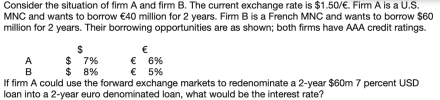 Consider the situation of firm A and firm B. The current exchange rate is $1.50/€. Firm A is a U.S. MNC and wants to borrow €40 million for 2 years. Firm B is a French MNC and wants to borrow $60 million for 2 years. Their borrowing opportunities are as shown; both firms have AAA credit ratings. $ A $ 7% € 6% B $ 8% € 5% If firm A could use the forward exchange markets to redenominate a...
Grant, Inc., is a well-known U.S. firm that needs to borrow 10 million British pounds to support a new business in the U...
Grant, Inc., is a well-known U.S. firm that needs to borrow 10 million British pounds to support a new business in the United Kingdom. However, it cannot obtain financing from British banks because it is not yet established within the United Kingdom. It decides to issue dollar-denominated debt (at par value) in the U.S., for which it will pay an annual coupon rate of 10%. It then will convert the dollar proceeds from the debt issue into British pounds at...
Multiple Choice: Problems (252-50) Firm MMA has EBIT (operating income) of $3 million, depreciation of $1...
 Multiple Choice: Problems (252-50) Firm MMA has EBIT (operating income) of $3 million, depreciation of $1 million. Pirm a s expenditures on fixed anneta - $1 million. Its net operating working capital - $0.6 million.Calculate for free cash flow. Imagine that the tax rate 40t. a. 91.2 b. $1.3 c. $1.4 Firm AAA's sales - $150,000, operating costs (no depreciation) - $75.500. Depreciation - $10,200, Tax rate 35. Pirm M b ond value is $16,500 and the interest rate of...
Case assignments must be completed with a written 2-page study on the assigned case questions in...
Case assignments must be completed with a written 2-page study on the assigned case questions in the textbook. The format requested for these assignments is based on elaborating and including two basic parts in the essay: 1) in a bullet presentation style (one phrase each bullet), list a summary of the key issues, situations, problems, opportunities and threats you may identify as relevant; 2) answer all the questions listed in each case in two or three sound paragraphs. Use the...
Dropdown options: 1-risk/return 2-equal to/greater or less than 3-self contained/stand-alone 4-variance/standard deviation 5-variance/beta coefficient 6-diversifiable/non-diversiable 7-is/...
 Dropdown options:
1-risk/return
2-equal to/greater or less than
3-self contained/stand-alone
4-variance/standard deviation
5-variance/beta coefficient
6-diversifiable/non-diversiable
7-is/ is not
8-diversifiable/non-diversifiable
9-random/non random
10-decreasing/increasing
11-2000+/500
12-reduces/increases
13-systematic of market/unsystematic or company-specific
14-diversifiable/non diversifiable
1. Basic concepts - Risk and return Professor Isadore (Izzy) Invest-a-Lot retired two years ago from Exceptional College, a small liberal arts college in North Carolina after teaching corporate finance and investment theory for 35 years. Yesterday, Izzy appear on EC LIVE, a television show produced for the students,...
Dropdown options:
1-risk/return
2-equal to/greater or less than
3-self contained/stand-alone
4-variance/standard deviation
5-variance/beta coefficient
6-diversifiable/non-diversiable
7-is/ is not
8-diversifiable/non-diversifiable
9-random/non random
10-decreasing/increasing
11-2000+/500
12-reduces/increases
13-systematic of market/unsystematic or company-specific
14-diversifiable/non diversifiable
1. Basic concepts - Risk and return Professor Isadore (Izzy) Invest-a-Lot retired two years ago from Exceptional College, a small liberal arts college in North Carolina after teaching corporate finance and investment theory for 35 years. Yesterday, Izzy appear on EC LIVE, a television show produced for the students,...
CASE 1-5 Financial Statement Ratio Computation Refer to Campbell Soup Company's financial Campbell Soup statements in...
 CASE 1-5 Financial Statement Ratio Computation Refer to Campbell Soup Company's financial Campbell Soup statements in Appendix A. Required: Compute the following ratios for Year 11. Liquidity ratios: Asset utilization ratios:* a. Current ratio n. Cash turnover b. Acid-test ratio 0. Accounts receivable turnover c. Days to sell inventory p. Inventory turnover d. Collection period 4. Working capital turnover Capital structure and solvency ratios: 1. Fixed assets turnover e. Total debt to total equity s. Total assets turnover f. Long-term...
 Consider the situation of firm A and firm B. The current exchange rate is $1.50/€. Firm A is a U.S. MNC and wants to borrow €40 million for 2 years. Firm B is a French MNC and wants to borrow $60 million for 2 years. Their borrowing opportunities are as shown; both firms have AAA credit ratings. $ A $ 7% € 6% B $ 8% € 5% If firm A could use the forward exchange markets to redenominate a...
 Multiple Choice: Problems (252-50) Firm MMA has EBIT (operating income) of $3 million, depreciation of $1 million. Pirm a s expenditures on fixed anneta - $1 million. Its net operating working capital - $0.6 million.Calculate for free cash flow. Imagine that the tax rate 40t. a. 91.2 b. $1.3 c. $1.4 Firm AAA's sales - $150,000, operating costs (no depreciation) - $75.500. Depreciation - $10,200, Tax rate 35. Pirm M b ond value is $16,500 and the interest rate of...
 Dropdown options:
1-risk/return
2-equal to/greater or less than
3-self contained/stand-alone
4-variance/standard deviation
5-variance/beta coefficient
6-diversifiable/non-diversiable
7-is/ is not
8-diversifiable/non-diversifiable
9-random/non random
10-decreasing/increasing
11-2000+/500
12-reduces/increases
13-systematic of market/unsystematic or company-specific
14-diversifiable/non diversifiable
1. Basic concepts - Risk and return Professor Isadore (Izzy) Invest-a-Lot retired two years ago from Exceptional College, a small liberal arts college in North Carolina after teaching corporate finance and investment theory for 35 years. Yesterday, Izzy appear on EC LIVE, a television show produced for the students,...
Dropdown options:
1-risk/return
2-equal to/greater or less than
3-self contained/stand-alone
4-variance/standard deviation
5-variance/beta coefficient
6-diversifiable/non-diversiable
7-is/ is not
8-diversifiable/non-diversifiable
9-random/non random
10-decreasing/increasing
11-2000+/500
12-reduces/increases
13-systematic of market/unsystematic or company-specific
14-diversifiable/non diversifiable
1. Basic concepts - Risk and return Professor Isadore (Izzy) Invest-a-Lot retired two years ago from Exceptional College, a small liberal arts college in North Carolina after teaching corporate finance and investment theory for 35 years. Yesterday, Izzy appear on EC LIVE, a television show produced for the students,...
 CASE 1-5 Financial Statement Ratio Computation Refer to Campbell Soup Company's financial Campbell Soup statements in Appendix A. Required: Compute the following ratios for Year 11. Liquidity ratios: Asset utilization ratios:* a. Current ratio n. Cash turnover b. Acid-test ratio 0. Accounts receivable turnover c. Days to sell inventory p. Inventory turnover d. Collection period 4. Working capital turnover Capital structure and solvency ratios: 1. Fixed assets turnover e. Total debt to total equity s. Total assets turnover f. Long-term...
Most questions answered within 3 hours.
-
Where is the error in this code sequence?
String s1 = "Hello";
String s2 = "ello";...
asked 11 months ago -
Financial data for Joel de Paris, Inc., for last year
follow:
Joel de Paris, Inc.
Balance...
asked 11 months ago -
Consider this reaction:
Al2(SO4)3 (aq)+ BaCl3
(aq) Al2Cl6 (aq)- +
3BaSO4(s) . What is the...
asked 11 months ago -
Suppose that Savneet is considering increasing her
recent random sample from 20 car rentals to 40...
asked 11 months ago -
Trucks arrive at an unloading terminal at an average rate of 120
per hour.
Trucks arrive...
asked 11 months ago -
Why are methanol and ethanol completely soluble in water while
octanol is not very little soluble....
asked 11 months ago -
A facilities manager at a university reads in a research report
that the mean amount of...
asked 11 months ago -
When the CuSO4 is rehydrated by adding water to the anhydrous
compound, is this an endothermic...
asked 11 months ago -
A ray of sunlight is passing from diamond into crown glass; the
angle of incidence is...
asked 11 months ago -
A block of mass 0.249 kg is placed on top of a light, vertical
spring of...
asked 11 months ago -
how do the kidneys compensate in the presences of acidosis
a) trigger hyperventilate
b) reserve acid...
asked 11 months ago -
Question 501 pts
The rental rate of capital to the firm increases. Which of the
following...
asked 11 months ago