
Homework Answers
Ans>option 1.
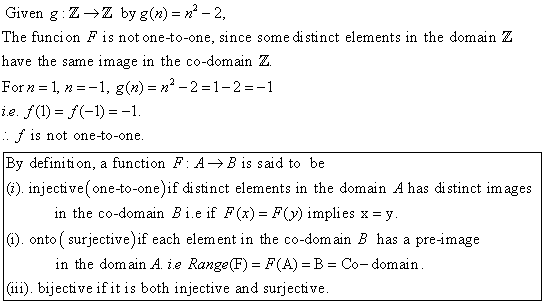
QUESTION 14 Define g:Z → Z by the rule g(n)= n2 - 2, for all integers...
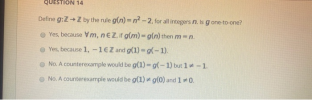 QUESTION 14 Define g:Z → Z by the rule g(n)= n2 - 2, for all integers n. Is gone-to-one? Yes, because Vm, nez, if g(m) = g(n) then m=n. Yes, because 1, -1€ Z and g(1)-(-1). No. A counterexample would be g(1)-(-1) but 1-1. No. A counterexample would be g(1) g(0) and 1=0.
4) Let D be the set of all finite subsets of positive integers. Define a function...
 4) Let D be the set of all finite subsets of positive integers. Define a function (:2 - D as follows: For each positive integer n, f(n) =the set of positive divisors of n. Find the following f (1), f(17) and f(18). Is f one-to-one? Prove or give a counterexample.
descrite math Define q, r, and s, all functions on the integers, by q(n) = n2...
 descrite math
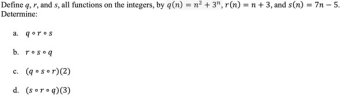
Define q, r, and s, all functions on the integers, by q(n) = n2 + 3", r(n) = n +3, and s(n) = 7n -5. Determine: a. qºros b. rosoa c. (qºsor (2) d. (soroq)(3)
descrite math
Define q, r, and s, all functions on the integers, by q(n) = n2 + 3", r(n) = n +3, and s(n) = 7n -5. Determine: a. qºros b. rosoa c. (qºsor (2) d. (soroq)(3)
Problem 4. Show that for all integers n, n2 mod 3- 1 n2 mod 3- 0...
 Problem 4. Show that for all integers n, n2 mod 3- 1 n2 mod 3- 0 or (i.e. there exists an integer k such that n2 3k or n2 3k +1). mp
Let X0,X1,... be a Markov chain whose state space is Z (the integers). Recall the Markov property: P(Xn = in | X0 = i0,X1 = i1,...,Xn−1 = in−1) = P(Xn = in | Xn−1 = in−1), ∀n, ∀it. Does the following...
 Let X0,X1,... be a Markov chain whose state space is Z (the
integers).
Recall the Markov property: P(Xn = in | X0 = i0,X1 = i1,...,Xn−1
= in−1) = P(Xn = in | Xn−1 = in−1), ∀n, ∀it. Does the following
always hold: P(Xn ≥0|X0 ≥0,X1 ≥0,...,Xn−1 ≥0)=P(Xn ≥0|Xn−1 ≥0)
?
(Prove if “yes”, provide a counterexample if “no”)
Let Xo,Xi, be a Markov chain whose state space is Z (the integers). Recall the Markov property: P(X,-'n l Xo-io, Xi...
Let X0,X1,... be a Markov chain whose state space is Z (the
integers).
Recall the Markov property: P(Xn = in | X0 = i0,X1 = i1,...,Xn−1
= in−1) = P(Xn = in | Xn−1 = in−1), ∀n, ∀it. Does the following
always hold: P(Xn ≥0|X0 ≥0,X1 ≥0,...,Xn−1 ≥0)=P(Xn ≥0|Xn−1 ≥0)
?
(Prove if “yes”, provide a counterexample if “no”)
Let Xo,Xi, be a Markov chain whose state space is Z (the integers). Recall the Markov property: P(X,-'n l Xo-io, Xi...
5. Let Zli_ {a + bi l a,b E Z. i2--1} be the Gaussian integers. Define a function for all a bi E Zi]. We call N the norm (a) Prove that N is multiplicative. This is, prove that for all a bi, c+di E Z...
 5. Let Zli_ {a + bi l a,b E Z. i2--1} be the Gaussian integers. Define a function for all a bi E Zi]. We call N the norm (a) Prove that N is multiplicative. This is, prove that for all a bi, c+di E Z[i] (b) Prove that if a + r є z[i] is a unit of Zli], then Ma + bi)-1. (c) Find all of the units in Zli
5. Let Zli_ {a + bi l a,b...
5. Let Zli_ {a + bi l a,b E Z. i2--1} be the Gaussian integers. Define a function for all a bi E Zi]. We call N the norm (a) Prove that N is multiplicative. This is, prove that for all a bi, c+di E Z[i] (b) Prove that if a + r є z[i] is a unit of Zli], then Ma + bi)-1. (c) Find all of the units in Zli
5. Let Zli_ {a + bi l a,b...
(A and C) Exercise 1.14. If n and k are integers, define the binomial coeffi- cient...
 (A and C)
Exercise 1.14. If n and k are integers, define the binomial coeffi- cient (m), read n choose k, by n! if 0 <k <n, = 0 otherwise. k!(n - k)! (a) Prove that ("#") = (m) + (-2) for all integers n and k. (b) By definition, () = 1 if k = 0 and 0 otherwise. The recursion relation in (a) gives a computational procedure, Pascal's triangle, for calculating binomial coefficients for small n. Start with...
(A and C)
Exercise 1.14. If n and k are integers, define the binomial coeffi- cient (m), read n choose k, by n! if 0 <k <n, = 0 otherwise. k!(n - k)! (a) Prove that ("#") = (m) + (-2) for all integers n and k. (b) By definition, () = 1 if k = 0 and 0 otherwise. The recursion relation in (a) gives a computational procedure, Pascal's triangle, for calculating binomial coefficients for small n. Start with...
2. (a) Prove the product rule for complex functions. More specifically, if f(z) and g(z) f(z)g(z) is also analytic, and...
 2. (a) Prove the product rule for complex functions. More specifically, if f(z) and g(z) f(z)g(z) is also analytic, and that analytic prove are that h(z) h'(z)f(z)9() f(z)g'(z) (You may use results from the multivariable part of the course without proof.) = nz"- for n e N = {1,2,3,...}. Your textbook establishes that S z"= dz (b) Let Sn be the statement is true. With the help of (a), show that if Sn is true, then Sn+1 is true. Why...
Please answer all!! 3. Show that if n e Z so that n is odd then...
 Please answer all!!
3. Show that if n e Z so that n is odd then 8|n2 + (n + 6)2 +6. 4. (a) Let a, b, and n be integers so that n > 2. Define: а is congruent to b mod n. The notation here is a = b (modn). (b) Is 12 = 4 (mod 2)? Explain. (c) Is 25 = 3 (mod 2)? Explain. (d) Is 27 = 13 (mod8)? Explain. (e) Find 6 integers x...
Please answer all!!
3. Show that if n e Z so that n is odd then 8|n2 + (n + 6)2 +6. 4. (a) Let a, b, and n be integers so that n > 2. Define: а is congruent to b mod n. The notation here is a = b (modn). (b) Is 12 = 4 (mod 2)? Explain. (c) Is 25 = 3 (mod 2)? Explain. (d) Is 27 = 13 (mod8)? Explain. (e) Find 6 integers x...
8. Define (n) to be the number of positive integers less than n and n. That...
 8. Define (n) to be the number of positive integers less than n and n. That is, (n) = {x e Z; 1 < x< n and gcd(x, n) = 1}|. Notice that U (n) |= ¢(n). For example U( 10) = {1, 3,7, 9} and therefore (10)= 4. It is well known that (n) is multiplicative. That is, if m, n are (mn) (m)¢(n). In general, (p") p" -p Also it's well known that there are relatively prime, then...
 QUESTION 14 Define g:Z → Z by the rule g(n)= n2 - 2, for all integers n. Is gone-to-one? Yes, because Vm, nez, if g(m) = g(n) then m=n. Yes, because 1, -1€ Z and g(1)-(-1). No. A counterexample would be g(1)-(-1) but 1-1. No. A counterexample would be g(1) g(0) and 1=0.
 4) Let D be the set of all finite subsets of positive integers. Define a function (:2 - D as follows: For each positive integer n, f(n) =the set of positive divisors of n. Find the following f (1), f(17) and f(18). Is f one-to-one? Prove or give a counterexample.
 descrite math
Define q, r, and s, all functions on the integers, by q(n) = n2 + 3", r(n) = n +3, and s(n) = 7n -5. Determine: a. qºros b. rosoa c. (qºsor (2) d. (soroq)(3)
descrite math
Define q, r, and s, all functions on the integers, by q(n) = n2 + 3", r(n) = n +3, and s(n) = 7n -5. Determine: a. qºros b. rosoa c. (qºsor (2) d. (soroq)(3)
 Problem 4. Show that for all integers n, n2 mod 3- 1 n2 mod 3- 0 or (i.e. there exists an integer k such that n2 3k or n2 3k +1). mp
 Let X0,X1,... be a Markov chain whose state space is Z (the
integers).
Recall the Markov property: P(Xn = in | X0 = i0,X1 = i1,...,Xn−1
= in−1) = P(Xn = in | Xn−1 = in−1), ∀n, ∀it. Does the following
always hold: P(Xn ≥0|X0 ≥0,X1 ≥0,...,Xn−1 ≥0)=P(Xn ≥0|Xn−1 ≥0)
?
(Prove if “yes”, provide a counterexample if “no”)
Let Xo,Xi, be a Markov chain whose state space is Z (the integers). Recall the Markov property: P(X,-'n l Xo-io, Xi...
Let X0,X1,... be a Markov chain whose state space is Z (the
integers).
Recall the Markov property: P(Xn = in | X0 = i0,X1 = i1,...,Xn−1
= in−1) = P(Xn = in | Xn−1 = in−1), ∀n, ∀it. Does the following
always hold: P(Xn ≥0|X0 ≥0,X1 ≥0,...,Xn−1 ≥0)=P(Xn ≥0|Xn−1 ≥0)
?
(Prove if “yes”, provide a counterexample if “no”)
Let Xo,Xi, be a Markov chain whose state space is Z (the integers). Recall the Markov property: P(X,-'n l Xo-io, Xi...
 5. Let Zli_ {a + bi l a,b E Z. i2--1} be the Gaussian integers. Define a function for all a bi E Zi]. We call N the norm (a) Prove that N is multiplicative. This is, prove that for all a bi, c+di E Z[i] (b) Prove that if a + r є z[i] is a unit of Zli], then Ma + bi)-1. (c) Find all of the units in Zli
5. Let Zli_ {a + bi l a,b...
5. Let Zli_ {a + bi l a,b E Z. i2--1} be the Gaussian integers. Define a function for all a bi E Zi]. We call N the norm (a) Prove that N is multiplicative. This is, prove that for all a bi, c+di E Z[i] (b) Prove that if a + r є z[i] is a unit of Zli], then Ma + bi)-1. (c) Find all of the units in Zli
5. Let Zli_ {a + bi l a,b...
 (A and C)
Exercise 1.14. If n and k are integers, define the binomial coeffi- cient (m), read n choose k, by n! if 0 <k <n, = 0 otherwise. k!(n - k)! (a) Prove that ("#") = (m) + (-2) for all integers n and k. (b) By definition, () = 1 if k = 0 and 0 otherwise. The recursion relation in (a) gives a computational procedure, Pascal's triangle, for calculating binomial coefficients for small n. Start with...
(A and C)
Exercise 1.14. If n and k are integers, define the binomial coeffi- cient (m), read n choose k, by n! if 0 <k <n, = 0 otherwise. k!(n - k)! (a) Prove that ("#") = (m) + (-2) for all integers n and k. (b) By definition, () = 1 if k = 0 and 0 otherwise. The recursion relation in (a) gives a computational procedure, Pascal's triangle, for calculating binomial coefficients for small n. Start with...
 2. (a) Prove the product rule for complex functions. More specifically, if f(z) and g(z) f(z)g(z) is also analytic, and that analytic prove are that h(z) h'(z)f(z)9() f(z)g'(z) (You may use results from the multivariable part of the course without proof.) = nz"- for n e N = {1,2,3,...}. Your textbook establishes that S z"= dz (b) Let Sn be the statement is true. With the help of (a), show that if Sn is true, then Sn+1 is true. Why...
 Please answer all!!
3. Show that if n e Z so that n is odd then 8|n2 + (n + 6)2 +6. 4. (a) Let a, b, and n be integers so that n > 2. Define: а is congruent to b mod n. The notation here is a = b (modn). (b) Is 12 = 4 (mod 2)? Explain. (c) Is 25 = 3 (mod 2)? Explain. (d) Is 27 = 13 (mod8)? Explain. (e) Find 6 integers x...
Please answer all!!
3. Show that if n e Z so that n is odd then 8|n2 + (n + 6)2 +6. 4. (a) Let a, b, and n be integers so that n > 2. Define: а is congruent to b mod n. The notation here is a = b (modn). (b) Is 12 = 4 (mod 2)? Explain. (c) Is 25 = 3 (mod 2)? Explain. (d) Is 27 = 13 (mod8)? Explain. (e) Find 6 integers x...
 8. Define (n) to be the number of positive integers less than n and n. That is, (n) = {x e Z; 1 < x< n and gcd(x, n) = 1}|. Notice that U (n) |= ¢(n). For example U( 10) = {1, 3,7, 9} and therefore (10)= 4. It is well known that (n) is multiplicative. That is, if m, n are (mn) (m)¢(n). In general, (p") p" -p Also it's well known that there are relatively prime, then...
Most questions answered within 3 hours.
-
Where is the error in this code sequence?
String s1 = "Hello";
String s2 = "ello";...
asked 11 months ago -
Financial data for Joel de Paris, Inc., for last year
follow:
Joel de Paris, Inc.
Balance...
asked 11 months ago -
Consider this reaction:
Al2(SO4)3 (aq)+ BaCl3
(aq) Al2Cl6 (aq)- +
3BaSO4(s) . What is the...
asked 11 months ago -
Suppose that Savneet is considering increasing her
recent random sample from 20 car rentals to 40...
asked 11 months ago -
Trucks arrive at an unloading terminal at an average rate of 120
per hour.
Trucks arrive...
asked 11 months ago -
Why are methanol and ethanol completely soluble in water while
octanol is not very little soluble....
asked 11 months ago -
A facilities manager at a university reads in a research report
that the mean amount of...
asked 11 months ago -
When the CuSO4 is rehydrated by adding water to the anhydrous
compound, is this an endothermic...
asked 11 months ago -
A ray of sunlight is passing from diamond into crown glass; the
angle of incidence is...
asked 11 months ago -
A block of mass 0.249 kg is placed on top of a light, vertical
spring of...
asked 11 months ago -
how do the kidneys compensate in the presences of acidosis
a) trigger hyperventilate
b) reserve acid...
asked 11 months ago -
Question 501 pts
The rental rate of capital to the firm increases. Which of the
following...
asked 11 months ago