
Homework Answers
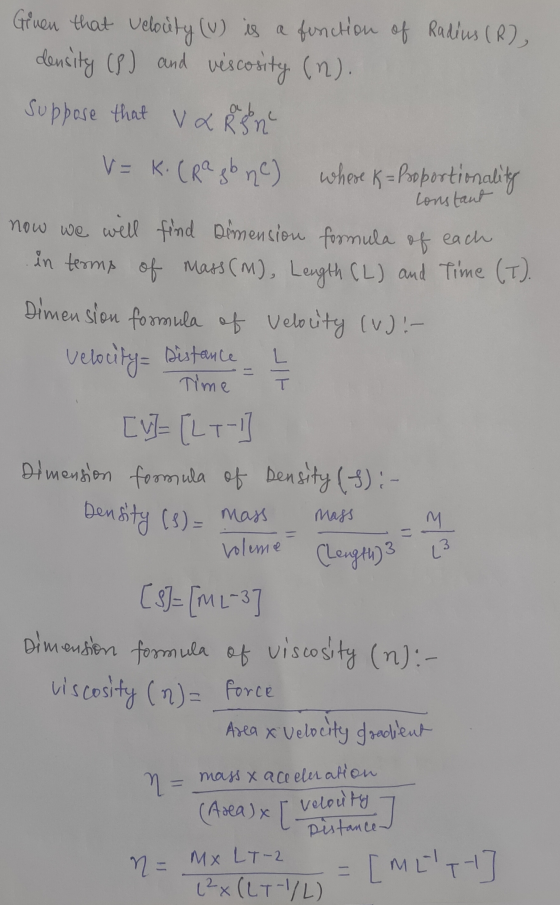
![now of both sides. - V = ko [Rasb nc substituting dimension formulas [LT-1] = ki :[279 [ML-37b [MLYTJ [MLT-1] = k [mbte]. [](http://img.homeworklib.com/questions/279b7a00-ebc4-11ea-9e44-85de4e1f1bb5.png?x-oss-process=image/resize,w_560)
Plzz give Positive Rating.. Thanks
Add Answer to:
Q1. The velocity v of a fluid beyond which streamline flows, ceases and turbulence begins depending...
Q1. The velocity v of a fluid beyond which streamline flows, ceases and turbulence begins depending...
 Q1. The velocity v of a fluid beyond which streamline flows, ceases and turbulence begins depending on the radius r of the tube, density p and viscosity n of the fluid. Using dimensions (dimensional analysis), obtain an expression which relates v. r, p and n. Hint: v « rpn => y = krapne mass volume distance force Velocity density viscosity time (area) [velocity gradient] velocity gradient velocity Using dimensional analysis, find the values of a, b and c. length
Q1. The velocity v of a fluid beyond which streamline flows, ceases and turbulence begins depending...
 Q1. The velocity v of a fluid beyond which streamline flows, ceases and turbulence begins depending on the radius r of the tube, density p and viscosity n of the fluid. Using dimensions (dimensional analysis), obtain an expression which relates v, r, p and n. Hint: v o rpn => y = krºp nc distance mass volume 2 time Velocity density = force viscosity [area][velocity gradient]' velocity gradient = velocity Using dimensional analysis, find the values length of a, b...
please sir, write clearly by hand Q1. The velocity v of a fluid beyond which streamline...
 please sir, write clearly by hand
Q1. The velocity v of a fluid beyond which streamline flows, ceases and turbulence begins depending on the radius r of the tube, density p and viscosity n of the fluid. Using dimensions (dimensional analysis), obtain an expression which relates v. 1, p and n. Hint: v arpn => y = krapon distance Velocity density mass viscosity volume force [area][velocity gradient time velocity gradient = velocity length Using dimensional analysis, find the values of...
please sir, write clearly by hand
Q1. The velocity v of a fluid beyond which streamline flows, ceases and turbulence begins depending on the radius r of the tube, density p and viscosity n of the fluid. Using dimensions (dimensional analysis), obtain an expression which relates v. 1, p and n. Hint: v arpn => y = krapon distance Velocity density mass viscosity volume force [area][velocity gradient time velocity gradient = velocity length Using dimensional analysis, find the values of...
2. a) List the characteristics of turbulent flows and state why they are challenging to compute. [12 Marks b) The N...
 2. a) List the characteristics of turbulent flows and state why they are challenging to compute. [12 Marks b) The Navier-Stokes equations in two-dimensions for an incompressible fluid are given in part b) of Q1 above. When studying turbulent flows it is usual to time average these equations. Explain the process of time averaging and show which additional terms result from the time averaging process in two-dimensions for an incompressible fluid. 12 Marks c) When modelling turbulent flows the Navier-Stokes...
Poiseuille Flow: Consider a pressure-driven (gradient DeltaP/L = (P_in -P_out)/L) flow of a fluid of viscosity...
 Poiseuille Flow: Consider a pressure-driven (gradient DeltaP/L = (P_in -P_out)/L) flow of a fluid of viscosity mu in a tube of circular cross-section with radius R and length L. Starting from the NSE, show for fully-developed, steady flow, that the volumetric flow rate is:[10] Show that the magnitude of the shear stress T_rz at the wall is: Using your answer from parts (a) and (b), obtain an expression for the friction factor f in terms of the Reynolds number Re...
The drag force Fp on a smooth sphere falling in water depends on the sphere speed...
 The drag force Fp on a smooth sphere falling in water depends on
the sphere speed V, the sphere density P. the density p and dynamic
viscosity of water, the sphere diameter Dand the gravitational
acceleration g. Using dimensional analysis with p. V and D as
repeating variables, determine suitable dimensionless groups to
obtain a reneral relationship between the drag force and the other
variables. If the same sphere were to fall through air, determine
the ratio of the drag...
The drag force Fp on a smooth sphere falling in water depends on
the sphere speed V, the sphere density P. the density p and dynamic
viscosity of water, the sphere diameter Dand the gravitational
acceleration g. Using dimensional analysis with p. V and D as
repeating variables, determine suitable dimensionless groups to
obtain a reneral relationship between the drag force and the other
variables. If the same sphere were to fall through air, determine
the ratio of the drag...
Water flows through a pipe as shown below. A1 and A2 have equal radii of r1=r2=.05...
 Water flows through a pipe as shown below. A1 and A2
have equal radii of r1=r2=.05 m. A3 has a radius r3=.15 m. The
section of the pipe between A1 and A2 is made that it has an
unknown cross sectional area. The initial velocity of the fluid and
pressure of the fluid and pressure at location 1 is 10 m/s and
6.01x10^5 N/m^2 respectively. (Water has a density of 1000 kg/m^3
also treat the water as ideal i.e. negligible...
Water flows through a pipe as shown below. A1 and A2
have equal radii of r1=r2=.05 m. A3 has a radius r3=.15 m. The
section of the pipe between A1 and A2 is made that it has an
unknown cross sectional area. The initial velocity of the fluid and
pressure of the fluid and pressure at location 1 is 10 m/s and
6.01x10^5 N/m^2 respectively. (Water has a density of 1000 kg/m^3
also treat the water as ideal i.e. negligible...
Please Show work Assume that the wall shear stress, Tw, created when a fluid flows through...
 Please Show work
Assume that the wall shear stress, Tw, created when a fluid flows through a pipe (see Figure a) depends on the pipe diameter, D, the flowrate, Q, the fluid density, p, and the kinematic viscosity, U. Some model tests run in a laboratory using water in a 0.2-ft-diameter pipe yield the vs. Q data shown in Figure b. Perform a dimensional analysis and use model data to predict the wall shear stress in a 0.5-ft-diameter pipe through...
Please Show work
Assume that the wall shear stress, Tw, created when a fluid flows through a pipe (see Figure a) depends on the pipe diameter, D, the flowrate, Q, the fluid density, p, and the kinematic viscosity, U. Some model tests run in a laboratory using water in a 0.2-ft-diameter pipe yield the vs. Q data shown in Figure b. Perform a dimensional analysis and use model data to predict the wall shear stress in a 0.5-ft-diameter pipe through...
Question 3 [20 marks] Water (density p1000 kg/m2; dynamic viscosity 0.001 Pa-s) flows steadily through a horizontal, st...
 Question 3 [20 marks] Water (density p1000 kg/m2; dynamic viscosity 0.001 Pa-s) flows steadily through a horizontal, straight pipe with circular cross section of diameter D=0.2 m. The volumetric flow rate is 0.01 m°/s. Argue that this is turbulent flow. [4 marksl а. Pressure drop in the pipe is due to friction. The pressure drop per unit length can be written as Др 4f L with U the average velocity in the pipe and fthe friction factor. Given the pipe...
Water can be considered as a non-viscous incompressible fluid of density p. A laboratory set-up is...
 Water can be considered as a non-viscous incompressible fluid of density p. A laboratory set-up is such that water flows through a pipe, exhibiting a laminar and steady-state flow. At the top end of the pipe, the flow tube has a cross-sectional area A and point 1 (located on the central streamline) is exposed to the ambient environment. The pipe drops through a A vertical distance h7 while its area decreases to when it reaches point 2 (also on the...
 Q1. The velocity v of a fluid beyond which streamline flows, ceases and turbulence begins depending on the radius r of the tube, density p and viscosity n of the fluid. Using dimensions (dimensional analysis), obtain an expression which relates v. r, p and n. Hint: v « rpn => y = krapne mass volume distance force Velocity density viscosity time (area) [velocity gradient] velocity gradient velocity Using dimensional analysis, find the values of a, b and c. length
 Q1. The velocity v of a fluid beyond which streamline flows, ceases and turbulence begins depending on the radius r of the tube, density p and viscosity n of the fluid. Using dimensions (dimensional analysis), obtain an expression which relates v, r, p and n. Hint: v o rpn => y = krºp nc distance mass volume 2 time Velocity density = force viscosity [area][velocity gradient]' velocity gradient = velocity Using dimensional analysis, find the values length of a, b...
 please sir, write clearly by hand
Q1. The velocity v of a fluid beyond which streamline flows, ceases and turbulence begins depending on the radius r of the tube, density p and viscosity n of the fluid. Using dimensions (dimensional analysis), obtain an expression which relates v. 1, p and n. Hint: v arpn => y = krapon distance Velocity density mass viscosity volume force [area][velocity gradient time velocity gradient = velocity length Using dimensional analysis, find the values of...
please sir, write clearly by hand
Q1. The velocity v of a fluid beyond which streamline flows, ceases and turbulence begins depending on the radius r of the tube, density p and viscosity n of the fluid. Using dimensions (dimensional analysis), obtain an expression which relates v. 1, p and n. Hint: v arpn => y = krapon distance Velocity density mass viscosity volume force [area][velocity gradient time velocity gradient = velocity length Using dimensional analysis, find the values of...
 2. a) List the characteristics of turbulent flows and state why they are challenging to compute. [12 Marks b) The Navier-Stokes equations in two-dimensions for an incompressible fluid are given in part b) of Q1 above. When studying turbulent flows it is usual to time average these equations. Explain the process of time averaging and show which additional terms result from the time averaging process in two-dimensions for an incompressible fluid. 12 Marks c) When modelling turbulent flows the Navier-Stokes...
 Poiseuille Flow: Consider a pressure-driven (gradient DeltaP/L = (P_in -P_out)/L) flow of a fluid of viscosity mu in a tube of circular cross-section with radius R and length L. Starting from the NSE, show for fully-developed, steady flow, that the volumetric flow rate is:[10] Show that the magnitude of the shear stress T_rz at the wall is: Using your answer from parts (a) and (b), obtain an expression for the friction factor f in terms of the Reynolds number Re...
 The drag force Fp on a smooth sphere falling in water depends on
the sphere speed V, the sphere density P. the density p and dynamic
viscosity of water, the sphere diameter Dand the gravitational
acceleration g. Using dimensional analysis with p. V and D as
repeating variables, determine suitable dimensionless groups to
obtain a reneral relationship between the drag force and the other
variables. If the same sphere were to fall through air, determine
the ratio of the drag...
The drag force Fp on a smooth sphere falling in water depends on
the sphere speed V, the sphere density P. the density p and dynamic
viscosity of water, the sphere diameter Dand the gravitational
acceleration g. Using dimensional analysis with p. V and D as
repeating variables, determine suitable dimensionless groups to
obtain a reneral relationship between the drag force and the other
variables. If the same sphere were to fall through air, determine
the ratio of the drag...
 Water flows through a pipe as shown below. A1 and A2
have equal radii of r1=r2=.05 m. A3 has a radius r3=.15 m. The
section of the pipe between A1 and A2 is made that it has an
unknown cross sectional area. The initial velocity of the fluid and
pressure of the fluid and pressure at location 1 is 10 m/s and
6.01x10^5 N/m^2 respectively. (Water has a density of 1000 kg/m^3
also treat the water as ideal i.e. negligible...
Water flows through a pipe as shown below. A1 and A2
have equal radii of r1=r2=.05 m. A3 has a radius r3=.15 m. The
section of the pipe between A1 and A2 is made that it has an
unknown cross sectional area. The initial velocity of the fluid and
pressure of the fluid and pressure at location 1 is 10 m/s and
6.01x10^5 N/m^2 respectively. (Water has a density of 1000 kg/m^3
also treat the water as ideal i.e. negligible...
 Please Show work
Assume that the wall shear stress, Tw, created when a fluid flows through a pipe (see Figure a) depends on the pipe diameter, D, the flowrate, Q, the fluid density, p, and the kinematic viscosity, U. Some model tests run in a laboratory using water in a 0.2-ft-diameter pipe yield the vs. Q data shown in Figure b. Perform a dimensional analysis and use model data to predict the wall shear stress in a 0.5-ft-diameter pipe through...
Please Show work
Assume that the wall shear stress, Tw, created when a fluid flows through a pipe (see Figure a) depends on the pipe diameter, D, the flowrate, Q, the fluid density, p, and the kinematic viscosity, U. Some model tests run in a laboratory using water in a 0.2-ft-diameter pipe yield the vs. Q data shown in Figure b. Perform a dimensional analysis and use model data to predict the wall shear stress in a 0.5-ft-diameter pipe through...
 Question 3 [20 marks] Water (density p1000 kg/m2; dynamic viscosity 0.001 Pa-s) flows steadily through a horizontal, straight pipe with circular cross section of diameter D=0.2 m. The volumetric flow rate is 0.01 m°/s. Argue that this is turbulent flow. [4 marksl а. Pressure drop in the pipe is due to friction. The pressure drop per unit length can be written as Др 4f L with U the average velocity in the pipe and fthe friction factor. Given the pipe...
 Water can be considered as a non-viscous incompressible fluid of density p. A laboratory set-up is such that water flows through a pipe, exhibiting a laminar and steady-state flow. At the top end of the pipe, the flow tube has a cross-sectional area A and point 1 (located on the central streamline) is exposed to the ambient environment. The pipe drops through a A vertical distance h7 while its area decreases to when it reaches point 2 (also on the...
Most questions answered within 3 hours.
-
Where is the error in this code sequence?
String s1 = "Hello";
String s2 = "ello";...
asked 11 months ago -
Financial data for Joel de Paris, Inc., for last year
follow:
Joel de Paris, Inc.
Balance...
asked 11 months ago -
Consider this reaction:
Al2(SO4)3 (aq)+ BaCl3
(aq) Al2Cl6 (aq)- +
3BaSO4(s) . What is the...
asked 11 months ago -
Suppose that Savneet is considering increasing her
recent random sample from 20 car rentals to 40...
asked 11 months ago -
Trucks arrive at an unloading terminal at an average rate of 120
per hour.
Trucks arrive...
asked 11 months ago -
Why are methanol and ethanol completely soluble in water while
octanol is not very little soluble....
asked 11 months ago -
A facilities manager at a university reads in a research report
that the mean amount of...
asked 11 months ago -
When the CuSO4 is rehydrated by adding water to the anhydrous
compound, is this an endothermic...
asked 11 months ago -
A ray of sunlight is passing from diamond into crown glass; the
angle of incidence is...
asked 11 months ago -
A block of mass 0.249 kg is placed on top of a light, vertical
spring of...
asked 11 months ago -
how do the kidneys compensate in the presences of acidosis
a) trigger hyperventilate
b) reserve acid...
asked 11 months ago -
Question 501 pts
The rental rate of capital to the firm increases. Which of the
following...
asked 11 months ago