
Homework Answers
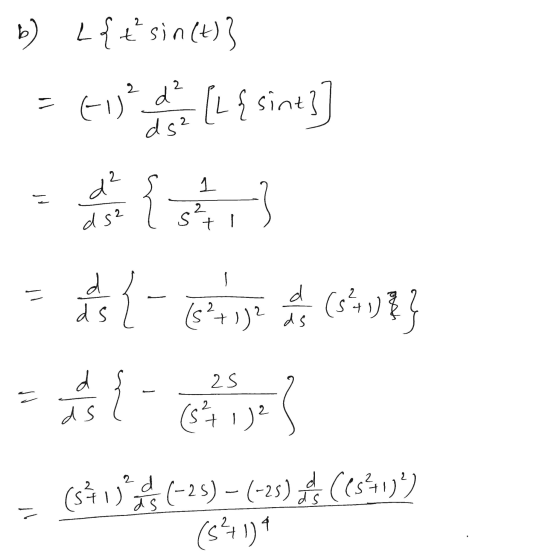
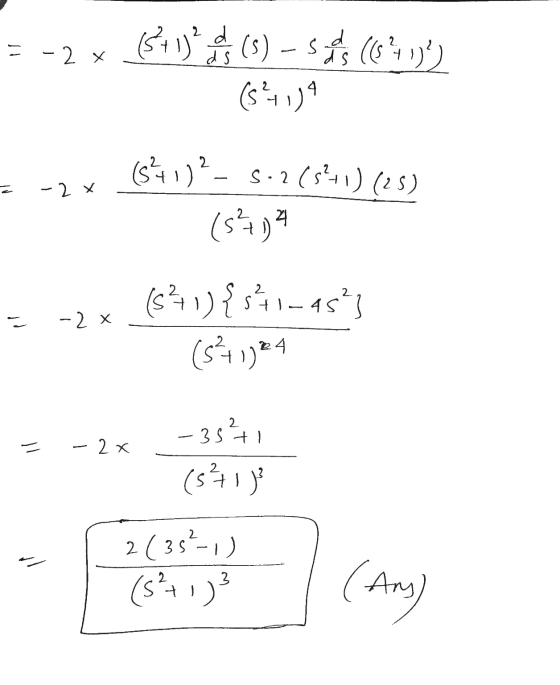
![6 6) a) L{ t cus2t} 1 L { ť cos (26)] (-) d ds [L{cos (2+)} d ds ( s²+2² (sa) () sd (sta) (544)2 - 8²4 4 - 25² (574) 2 2 S](http://img.homeworklib.com/questions/7b08dc80-ebce-11ea-90db-c980009c6819.png?x-oss-process=image/resize,w_560)
Add Answer to:
dn 6. Use the theorem, L {t" f(t)} = (-1)" den! F(s), to find each of...
Use Theorem 7.1.1 to find L{f(t)}. (Write your answer as a function of s.) f(t) =...
 Use Theorem 7.1.1 to find L{f(t)}. (Write your answer as a function of s.) f(t) = (2t - 1)3 %3D L{f(t)} =
Use Theorem 7.4.1. THEOREM 7.4.1 Derivatives of Transforms If F(s) = ℒ{f(t)} and n = 1,...
Use Theorem 7.4.1. THEOREM 7.4.1 Derivatives of Transforms If F(s) = ℒ{f(t)} and n = 1, 2, 3, . . ., then ℒ{tnf(t)} = (−1)n dn dsn F(s). Evaluate the given Laplace transform. (Write your answer as a function of s.) ℒ{3t2 cos(t)}
Use Theorem 7.4.1. THEOREM 7.4.1 Derivatives of Transforms If F(s) = ℒ{f(t)} and n = 1, 2,...
Use Theorem 7.4.1. THEOREM 7.4.1 Derivatives of Transforms If F(s) = ℒ{f(t)} and n = 1, 2, 3, . . . , thenℒ{tnf(t)} = (−1)n dn dsn F(s). Evaluate the given Laplace transform. (Write your answer as a function of s.) ℒ{t cos(7t)}
use Theorem 7.2 to find L{f(t)} (i have pictured the table of 7.2) ** just solve...
 use
Theorem 7.2 to find L{f(t)} (i have pictured the table of 7.2)
** just solve #26 & #30 please!! NOT 28**
thank you!!
26. f(t) = (2t - 1) 28. f(t) = t - e-9 + 5 30. f(t) = (e' - e-)2 THEOREM 7.2 Transforms of Some Basic Functions (a) L{1} = 1 (b) L{t"} = 1 n = 1, 2, 3,... (C) L{e} = 1 (e) L{cos kt} = 2 * 2 (() {{sinh k} = 1...
use
Theorem 7.2 to find L{f(t)} (i have pictured the table of 7.2)
** just solve #26 & #30 please!! NOT 28**
thank you!!
26. f(t) = (2t - 1) 28. f(t) = t - e-9 + 5 30. f(t) = (e' - e-)2 THEOREM 7.2 Transforms of Some Basic Functions (a) L{1} = 1 (b) L{t"} = 1 n = 1, 2, 3,... (C) L{e} = 1 (e) L{cos kt} = 2 * 2 (() {{sinh k} = 1...
Use Theorem 7.4.1. THEOREM 7.4.1 Derivatives of Transforms If F(s) = L{f(t)} and n = 1,...
 Use Theorem 7.4.1. THEOREM 7.4.1 Derivatives of Transforms If F(s) = L{f(t)} and n = 1, 2, 3, ..., then L{"f(t)} = (-1)". F(s). Evaluate the given Laplace transform. (Write your answer as a function of s.) L{t cos(7t)} Find the general solution of the given differential equation. +3y= -* YOU) - Give the largest interval over which the general solution is defined. (Think about the implications of any singular points. Enter your answer using interval notation.) Determine whether there...
L{t"f(t)} = (-114 d Fis). Use Theorem 7.4.1. THEOREM 7.4.1 Derivatives of Transforms If F(s) =...
 L{t"f(t)} = (-114 d Fis). Use Theorem 7.4.1. THEOREM 7.4.1 Derivatives of Transforms If F(s) = L{f(t)} and n = 1, 2, 3, .., then ds" Evaluate the given Laplace transform. (Write your answer as a function of s.) L{t cos(50)}
Use Theorem 7.1.1 to find L{f(t)}. (Write your answer as a function of s.) f(t) =...
 Use Theorem 7.1.1 to find L{f(t)}. (Write your answer as a function of s.) f(t) = 282 - 4 sin(56) L{f(t)}
Use Theorem 7.1.1 to find L{f(t)}. (Write your answer as a function of s.) f(t) =...
 Use Theorem 7.1.1 to find L{f(t)}. (Write your answer as a function of s.) f(t) = 5t? – 2 sin(3t) gif(t)} =
dn (a) Show that L[i" f(t)] = (-1)" (t) for any positive integer n 2 1 dsn a d K(s, t)f(t) dt / ) est = tne-8t...
 dn (a) Show that L[i" f(t)] = (-1)" (t) for any positive integer n 2 1 dsn a d K(s, t)f(t) dt / ) est = tne-8t and assume that K(s, t)f(t) dt. Hint: (-1)" as ds (b) Use the above formula to compute L[t? cost].
dn (a) Show that L[i" f(t)] = (-1)" (t) for any positive integer n 2 1 dsn a d K(s, t)f(t) dt / ) est = tne-8t and assume that K(s, t)f(t) dt. Hint:...
dn (a) Show that L[i" f(t)] = (-1)" (t) for any positive integer n 2 1 dsn a d K(s, t)f(t) dt / ) est = tne-8t and assume that K(s, t)f(t) dt. Hint: (-1)" as ds (b) Use the above formula to compute L[t? cost].
dn (a) Show that L[i" f(t)] = (-1)" (t) for any positive integer n 2 1 dsn a d K(s, t)f(t) dt / ) est = tne-8t and assume that K(s, t)f(t) dt. Hint:...
Use the important property L{f + g}=L{f(t)}.L{g(t)} of convolutions to compute the Laplace transform of sø...
 Use the important property L{f + g}=L{f(t)}.L{g(t)} of convolutions to compute the Laplace transform of sø (t - 1)? cos(2t) dt. a. 1 s'(s2 + 4) 1 b. s (s2 + 4) 2 s3 (32 + 4) 2 d. 5° (s2 + 4)
 Use Theorem 7.1.1 to find L{f(t)}. (Write your answer as a function of s.) f(t) = (2t - 1)3 %3D L{f(t)} =
 use
Theorem 7.2 to find L{f(t)} (i have pictured the table of 7.2)
** just solve #26 & #30 please!! NOT 28**
thank you!!
26. f(t) = (2t - 1) 28. f(t) = t - e-9 + 5 30. f(t) = (e' - e-)2 THEOREM 7.2 Transforms of Some Basic Functions (a) L{1} = 1 (b) L{t"} = 1 n = 1, 2, 3,... (C) L{e} = 1 (e) L{cos kt} = 2 * 2 (() {{sinh k} = 1...
use
Theorem 7.2 to find L{f(t)} (i have pictured the table of 7.2)
** just solve #26 & #30 please!! NOT 28**
thank you!!
26. f(t) = (2t - 1) 28. f(t) = t - e-9 + 5 30. f(t) = (e' - e-)2 THEOREM 7.2 Transforms of Some Basic Functions (a) L{1} = 1 (b) L{t"} = 1 n = 1, 2, 3,... (C) L{e} = 1 (e) L{cos kt} = 2 * 2 (() {{sinh k} = 1...
 Use Theorem 7.4.1. THEOREM 7.4.1 Derivatives of Transforms If F(s) = L{f(t)} and n = 1, 2, 3, ..., then L{"f(t)} = (-1)". F(s). Evaluate the given Laplace transform. (Write your answer as a function of s.) L{t cos(7t)} Find the general solution of the given differential equation. +3y= -* YOU) - Give the largest interval over which the general solution is defined. (Think about the implications of any singular points. Enter your answer using interval notation.) Determine whether there...
 L{t"f(t)} = (-114 d Fis). Use Theorem 7.4.1. THEOREM 7.4.1 Derivatives of Transforms If F(s) = L{f(t)} and n = 1, 2, 3, .., then ds" Evaluate the given Laplace transform. (Write your answer as a function of s.) L{t cos(50)}
 Use Theorem 7.1.1 to find L{f(t)}. (Write your answer as a function of s.) f(t) = 282 - 4 sin(56) L{f(t)}
 Use Theorem 7.1.1 to find L{f(t)}. (Write your answer as a function of s.) f(t) = 5t? – 2 sin(3t) gif(t)} =
 dn (a) Show that L[i" f(t)] = (-1)" (t) for any positive integer n 2 1 dsn a d K(s, t)f(t) dt / ) est = tne-8t and assume that K(s, t)f(t) dt. Hint: (-1)" as ds (b) Use the above formula to compute L[t? cost].
dn (a) Show that L[i" f(t)] = (-1)" (t) for any positive integer n 2 1 dsn a d K(s, t)f(t) dt / ) est = tne-8t and assume that K(s, t)f(t) dt. Hint:...
dn (a) Show that L[i" f(t)] = (-1)" (t) for any positive integer n 2 1 dsn a d K(s, t)f(t) dt / ) est = tne-8t and assume that K(s, t)f(t) dt. Hint: (-1)" as ds (b) Use the above formula to compute L[t? cost].
dn (a) Show that L[i" f(t)] = (-1)" (t) for any positive integer n 2 1 dsn a d K(s, t)f(t) dt / ) est = tne-8t and assume that K(s, t)f(t) dt. Hint:...
 Use the important property L{f + g}=L{f(t)}.L{g(t)} of convolutions to compute the Laplace transform of sø (t - 1)? cos(2t) dt. a. 1 s'(s2 + 4) 1 b. s (s2 + 4) 2 s3 (32 + 4) 2 d. 5° (s2 + 4)
Most questions answered within 3 hours.
-
Where is the error in this code sequence?
String s1 = "Hello";
String s2 = "ello";...
asked 11 months ago -
Financial data for Joel de Paris, Inc., for last year
follow:
Joel de Paris, Inc.
Balance...
asked 11 months ago -
Consider this reaction:
Al2(SO4)3 (aq)+ BaCl3
(aq) Al2Cl6 (aq)- +
3BaSO4(s) . What is the...
asked 11 months ago -
Suppose that Savneet is considering increasing her
recent random sample from 20 car rentals to 40...
asked 11 months ago -
Trucks arrive at an unloading terminal at an average rate of 120
per hour.
Trucks arrive...
asked 11 months ago -
Why are methanol and ethanol completely soluble in water while
octanol is not very little soluble....
asked 11 months ago -
A facilities manager at a university reads in a research report
that the mean amount of...
asked 11 months ago -
When the CuSO4 is rehydrated by adding water to the anhydrous
compound, is this an endothermic...
asked 11 months ago -
A ray of sunlight is passing from diamond into crown glass; the
angle of incidence is...
asked 11 months ago -
A block of mass 0.249 kg is placed on top of a light, vertical
spring of...
asked 11 months ago -
how do the kidneys compensate in the presences of acidosis
a) trigger hyperventilate
b) reserve acid...
asked 11 months ago -
Question 501 pts
The rental rate of capital to the firm increases. Which of the
following...
asked 11 months ago