
Homework Answers


Add Answer to:
Answer given is No=-3500rpm
Figure 4.8(C) shows the top half of a compound epicydic gearset. If...
The top half of a compound epicyclic gear set is as shown in Figure Q2. If...
 The top half of a compound epicyclic gear set is as shown in Figure Q2. If the input shaft I rotate at dockwise direction at a speed of 1,200 rpm and gear Al is set as the output, determine the following. (a) The output speed Nal when gear X rotates counter-clockwise direction at the speed of 3,000 rpm. (b) The magnitude and direction of the torque required to lock gear X if 300 Nm torque is applied on input shaft...
Answer given is 524 rpm Question 2 A compound epicydic gear is as shown in Figure...
 Answer given is 524 rpm
Question 2 A compound epicydic gear is as shown in Figure Q2. Sun wheels S1 and 52 are integral with the input shaft X and the Annulus wheel A1 is fixed. The Planet wheel P1 rotates about a pin carried by the Annulus Az and the Planet wheel P2 rotates about a pin attached to the arm keyed to the shaft Y. The numbers of teeth are : Si=30, Pu=20, P2=18, Sz=32. Find the speed...
Answer given is 524 rpm
Question 2 A compound epicydic gear is as shown in Figure Q2. Sun wheels S1 and 52 are integral with the input shaft X and the Annulus wheel A1 is fixed. The Planet wheel P1 rotates about a pin carried by the Annulus Az and the Planet wheel P2 rotates about a pin attached to the arm keyed to the shaft Y. The numbers of teeth are : Si=30, Pu=20, P2=18, Sz=32. Find the speed...
Answer given is 325 rpm O2 P2 Figure 4.12 shows the arrangement of part of a...
 Answer given is 325 rpm
O2 P2 Figure 4.12 shows the arrangement of part of a pre- selective compound gearbox. Input shaft I is rotating at 700 rpm while gear N is rotating at 600 rpm. The number of teeth are as follow : Ai(internal)=75; Al(external)=90 ; Si=25 ; Sz=35; Az=105 and N=30. With this condition, calculate the velocity of shaft 01, gear Ai and Az if the overall efficiency is 90%. [325 rpm] Si S2 Figure 4.12
Answer given is 325 rpm
O2 P2 Figure 4.12 shows the arrangement of part of a pre- selective compound gearbox. Input shaft I is rotating at 700 rpm while gear N is rotating at 600 rpm. The number of teeth are as follow : Ai(internal)=75; Al(external)=90 ; Si=25 ; Sz=35; Az=105 and N=30. With this condition, calculate the velocity of shaft 01, gear Ai and Az if the overall efficiency is 90%. [325 rpm] Si S2 Figure 4.12
Answer given is No=-143rpm (in opposite direction to A) A compound epicyclic gear is as shown...
 Answer given is No=-143rpm (in opposite direction to A)
A compound epicyclic gear is as shown in Figure 4.9. Ai and S2 form a compound wheel, which rotates freely on shaft O. The Planet wheels P1 and P2 rotate on pins fixed in arms attached to shaft O. and A2 have internal teeth: the others have external teeth, with the following numbers, tsi=40; tp1=30 ; tpz=20; ts2=50. If Si rotates at 500 rpm and wheel Az is fixed, find the...
Answer given is No=-143rpm (in opposite direction to A)
A compound epicyclic gear is as shown in Figure 4.9. Ai and S2 form a compound wheel, which rotates freely on shaft O. The Planet wheels P1 and P2 rotate on pins fixed in arms attached to shaft O. and A2 have internal teeth: the others have external teeth, with the following numbers, tsi=40; tp1=30 ; tpz=20; ts2=50. If Si rotates at 500 rpm and wheel Az is fixed, find the...
A compound epicyclic gear train is shown in the Figure. The shaft P is driven at...
 A compound epicyclic gear train is shown in the Figure. The
shaft P is driven at 2500 rpm in the clockwise direction by a motor
of power rating 8 kW. The sun S2 is fixed. The number of teeth in
the gears are S1, 34; S2, 21; A1, 86 and A2, 73. Determine
The magnitude and direction of the angular velocity of the
shaft Q and
The torque required to fix the sun, S2
A, Q P S, 5,
A compound epicyclic gear train is shown in the Figure. The
shaft P is driven at 2500 rpm in the clockwise direction by a motor
of power rating 8 kW. The sun S2 is fixed. The number of teeth in
the gears are S1, 34; S2, 21; A1, 86 and A2, 73. Determine
The magnitude and direction of the angular velocity of the
shaft Q and
The torque required to fix the sun, S2
A, Q P S, 5,
Question 1 In the epicyclic gear shown in Figure Q1 the Annulus A1 and the Sun...
 Question 1 In the epicyclic gear shown in Figure Q1 the Annulus A1 and the Sun wheel S2 are compound, the Sun wheel Si rotates with the input shaft and both Planet cages rotate with the output shaft. The numbers of teeth on the o wheels are Si=24, A1=72, Sz=40 and A2=80. (1) Find the gear ratio of the system when the Annulus A1 is held fixed. S Find the gear ratio of the system when the Figure Q1 Annulus...
A compound epicyclic gear train is shown in the Figure. The shaft P is driven a...
 A compound epicyclic gear train is shown in the Figure. The
shaft P is driven a 4000 rpm in the clockwise direction by a motor
of power rating of 10W . The annulus A2 is fixed. The
number of teeth in the gears are , S1,28;
S2,21; A1,72 and A2,99 .
Determine:
The magnitude and direction of the angular velocity of the
shaft Q
The torque required to fix the annulus, A2
A, A₂ P, P2 P P. z S
A compound epicyclic gear train is shown in the Figure. The
shaft P is driven a 4000 rpm in the clockwise direction by a motor
of power rating of 10W . The annulus A2 is fixed. The
number of teeth in the gears are , S1,28;
S2,21; A1,72 and A2,99 .
Determine:
The magnitude and direction of the angular velocity of the
shaft Q
The torque required to fix the annulus, A2
A, A₂ P, P2 P P. z S
please solve and show work HH 2. Given a compound gear box in figure 1, where;...
 please solve and show work
HH 2. Given a compound gear box in figure 1, where; a. Gear A = 40 Teeth, input rpm is 1250 rpm. b. Gear B = 160 Teeth, C. Gear C = 30 Teeth d. Gear D = 90 Teeth. Input Torque is 50 N.m., Efficiency is 75% Find the output speed, direction relative to input, power, & Holding Torque. HI B D
please solve and show work
HH 2. Given a compound gear box in figure 1, where; a. Gear A = 40 Teeth, input rpm is 1250 rpm. b. Gear B = 160 Teeth, C. Gear C = 30 Teeth d. Gear D = 90 Teeth. Input Torque is 50 N.m., Efficiency is 75% Find the output speed, direction relative to input, power, & Holding Torque. HI B D
Figure Q1 shows a gear train consists of four spur gears A, B, C and D to be designed for a specific mechanism. The power transmitted by gear A is 5 kW at rotational speed of 720 rpm counterclockwise direction. Number of teeth (N) for gears A,B,C and D ar
 Figure Q1 shows a gear train consists of four spur gears A, B, C and D to be designed for a specific
mechanism. The power transmitted by gear A is 5 kW at rotational speed of 720 rpm
counterclockwise direction. Number of teeth (N) for gears A,B,C and D are respectively 20, 50,
30 and 60. The module and pressure angle of the gears are respectively 4 mm and 20o
. Determine
followings:
(a) Tangential and radial forces between gears...
Figure Q1 shows a gear train consists of four spur gears A, B, C and D to be designed for a specific
mechanism. The power transmitted by gear A is 5 kW at rotational speed of 720 rpm
counterclockwise direction. Number of teeth (N) for gears A,B,C and D are respectively 20, 50,
30 and 60. The module and pressure angle of the gears are respectively 4 mm and 20o
. Determine
followings:
(a) Tangential and radial forces between gears...
MECHANICS OF MACHINES AND VIBRLTIONS 3I PART B (Answer ALL Question)w JAWA OKL QUESTION3 Figure Q3 shows a shaft ca...
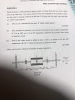 MECHANICS OF MACHINES AND VIBRLTIONS 3I PART B (Answer ALL Question)w JAWA OKL QUESTION3 Figure Q3 shows a shaft carrying an electric motor C of mass 40 kg and two rotors A and B with 10 kg mass each. The motor, shaft and rotor are supported by two bearings L and R; and the motor is rotating constantly at 600 rpm. It is found that the shaft, motor and rotor are initially totally balance. What do you understand by the...
 The top half of a compound epicyclic gear set is as shown in Figure Q2. If the input shaft I rotate at dockwise direction at a speed of 1,200 rpm and gear Al is set as the output, determine the following. (a) The output speed Nal when gear X rotates counter-clockwise direction at the speed of 3,000 rpm. (b) The magnitude and direction of the torque required to lock gear X if 300 Nm torque is applied on input shaft...
 Answer given is 524 rpm
Question 2 A compound epicydic gear is as shown in Figure Q2. Sun wheels S1 and 52 are integral with the input shaft X and the Annulus wheel A1 is fixed. The Planet wheel P1 rotates about a pin carried by the Annulus Az and the Planet wheel P2 rotates about a pin attached to the arm keyed to the shaft Y. The numbers of teeth are : Si=30, Pu=20, P2=18, Sz=32. Find the speed...
Answer given is 524 rpm
Question 2 A compound epicydic gear is as shown in Figure Q2. Sun wheels S1 and 52 are integral with the input shaft X and the Annulus wheel A1 is fixed. The Planet wheel P1 rotates about a pin carried by the Annulus Az and the Planet wheel P2 rotates about a pin attached to the arm keyed to the shaft Y. The numbers of teeth are : Si=30, Pu=20, P2=18, Sz=32. Find the speed...
 Answer given is 325 rpm
O2 P2 Figure 4.12 shows the arrangement of part of a pre- selective compound gearbox. Input shaft I is rotating at 700 rpm while gear N is rotating at 600 rpm. The number of teeth are as follow : Ai(internal)=75; Al(external)=90 ; Si=25 ; Sz=35; Az=105 and N=30. With this condition, calculate the velocity of shaft 01, gear Ai and Az if the overall efficiency is 90%. [325 rpm] Si S2 Figure 4.12
Answer given is 325 rpm
O2 P2 Figure 4.12 shows the arrangement of part of a pre- selective compound gearbox. Input shaft I is rotating at 700 rpm while gear N is rotating at 600 rpm. The number of teeth are as follow : Ai(internal)=75; Al(external)=90 ; Si=25 ; Sz=35; Az=105 and N=30. With this condition, calculate the velocity of shaft 01, gear Ai and Az if the overall efficiency is 90%. [325 rpm] Si S2 Figure 4.12
 Answer given is No=-143rpm (in opposite direction to A)
A compound epicyclic gear is as shown in Figure 4.9. Ai and S2 form a compound wheel, which rotates freely on shaft O. The Planet wheels P1 and P2 rotate on pins fixed in arms attached to shaft O. and A2 have internal teeth: the others have external teeth, with the following numbers, tsi=40; tp1=30 ; tpz=20; ts2=50. If Si rotates at 500 rpm and wheel Az is fixed, find the...
Answer given is No=-143rpm (in opposite direction to A)
A compound epicyclic gear is as shown in Figure 4.9. Ai and S2 form a compound wheel, which rotates freely on shaft O. The Planet wheels P1 and P2 rotate on pins fixed in arms attached to shaft O. and A2 have internal teeth: the others have external teeth, with the following numbers, tsi=40; tp1=30 ; tpz=20; ts2=50. If Si rotates at 500 rpm and wheel Az is fixed, find the...
 A compound epicyclic gear train is shown in the Figure. The
shaft P is driven at 2500 rpm in the clockwise direction by a motor
of power rating 8 kW. The sun S2 is fixed. The number of teeth in
the gears are S1, 34; S2, 21; A1, 86 and A2, 73. Determine
The magnitude and direction of the angular velocity of the
shaft Q and
The torque required to fix the sun, S2
A, Q P S, 5,
A compound epicyclic gear train is shown in the Figure. The
shaft P is driven at 2500 rpm in the clockwise direction by a motor
of power rating 8 kW. The sun S2 is fixed. The number of teeth in
the gears are S1, 34; S2, 21; A1, 86 and A2, 73. Determine
The magnitude and direction of the angular velocity of the
shaft Q and
The torque required to fix the sun, S2
A, Q P S, 5,
 Question 1 In the epicyclic gear shown in Figure Q1 the Annulus A1 and the Sun wheel S2 are compound, the Sun wheel Si rotates with the input shaft and both Planet cages rotate with the output shaft. The numbers of teeth on the o wheels are Si=24, A1=72, Sz=40 and A2=80. (1) Find the gear ratio of the system when the Annulus A1 is held fixed. S Find the gear ratio of the system when the Figure Q1 Annulus...
 A compound epicyclic gear train is shown in the Figure. The
shaft P is driven a 4000 rpm in the clockwise direction by a motor
of power rating of 10W . The annulus A2 is fixed. The
number of teeth in the gears are , S1,28;
S2,21; A1,72 and A2,99 .
Determine:
The magnitude and direction of the angular velocity of the
shaft Q
The torque required to fix the annulus, A2
A, A₂ P, P2 P P. z S
A compound epicyclic gear train is shown in the Figure. The
shaft P is driven a 4000 rpm in the clockwise direction by a motor
of power rating of 10W . The annulus A2 is fixed. The
number of teeth in the gears are , S1,28;
S2,21; A1,72 and A2,99 .
Determine:
The magnitude and direction of the angular velocity of the
shaft Q
The torque required to fix the annulus, A2
A, A₂ P, P2 P P. z S
 please solve and show work
HH 2. Given a compound gear box in figure 1, where; a. Gear A = 40 Teeth, input rpm is 1250 rpm. b. Gear B = 160 Teeth, C. Gear C = 30 Teeth d. Gear D = 90 Teeth. Input Torque is 50 N.m., Efficiency is 75% Find the output speed, direction relative to input, power, & Holding Torque. HI B D
please solve and show work
HH 2. Given a compound gear box in figure 1, where; a. Gear A = 40 Teeth, input rpm is 1250 rpm. b. Gear B = 160 Teeth, C. Gear C = 30 Teeth d. Gear D = 90 Teeth. Input Torque is 50 N.m., Efficiency is 75% Find the output speed, direction relative to input, power, & Holding Torque. HI B D
 MECHANICS OF MACHINES AND VIBRLTIONS 3I PART B (Answer ALL Question)w JAWA OKL QUESTION3 Figure Q3 shows a shaft carrying an electric motor C of mass 40 kg and two rotors A and B with 10 kg mass each. The motor, shaft and rotor are supported by two bearings L and R; and the motor is rotating constantly at 600 rpm. It is found that the shaft, motor and rotor are initially totally balance. What do you understand by the...
Most questions answered within 3 hours.
-
Where is the error in this code sequence?
String s1 = "Hello";
String s2 = "ello";...
asked 10 months ago -
Financial data for Joel de Paris, Inc., for last year
follow:
Joel de Paris, Inc.
Balance...
asked 10 months ago -
Consider this reaction:
Al2(SO4)3 (aq)+ BaCl3
(aq) Al2Cl6 (aq)- +
3BaSO4(s) . What is the...
asked 10 months ago -
Suppose that Savneet is considering increasing her
recent random sample from 20 car rentals to 40...
asked 10 months ago -
Trucks arrive at an unloading terminal at an average rate of 120
per hour.
Trucks arrive...
asked 10 months ago -
Why are methanol and ethanol completely soluble in water while
octanol is not very little soluble....
asked 10 months ago -
A facilities manager at a university reads in a research report
that the mean amount of...
asked 10 months ago -
When the CuSO4 is rehydrated by adding water to the anhydrous
compound, is this an endothermic...
asked 10 months ago -
A ray of sunlight is passing from diamond into crown glass; the
angle of incidence is...
asked 10 months ago -
A block of mass 0.249 kg is placed on top of a light, vertical
spring of...
asked 10 months ago -
how do the kidneys compensate in the presences of acidosis
a) trigger hyperventilate
b) reserve acid...
asked 10 months ago -
Question 501 pts
The rental rate of capital to the firm increases. Which of the
following...
asked 10 months ago