
Homework Answers
ANSWER :
1)Sound pathway :
Sound waves from outside -----> ear pinna -----> external acoustic meatus ------> vibrates tympanic membrane/ ear drum -----------> enter middle ear ------> vibrations are transmitted through 3 ossicles malleus, incus and stapes ---------> oval window -------> cochlea of the inner ear ------> hair cells of organ of corti in cochlea gets stimulated--------------> stimulates cochlear branch of vestibulocochlear nerve
2)Auditory pathway :
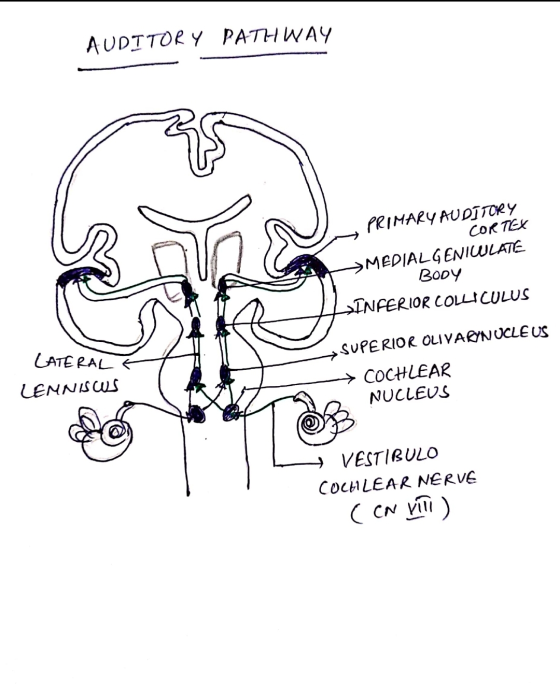
Vestibulocochlear nerve enters cranium through internal acoustic meatus ------> enters brainstem at cerebellopontine angle ------> cochlear nucleus ------> superior olivary nucleus ------> fibres from both lateral lemniscus , cochlear nucleus and superior olivary nucleus ----------> reaches inferior colliculs ------> medial geniculate body in thalamus -------> superior temporal gyrus(primary auditory cortex) , right under the lateral fissure.
Add Answer to:
Question 48 1. Trace the path of sound from the outside of the ear to stimulating...
1. Describe the process of audition, following a sound wave from the outer ear through the...
1. Describe the process of audition, following a sound wave from the outer ear through the middle ear and into the inner ear. How are auditory neurons ultimately activated? 2.Describe the pathway of auditory nerve signals from the auditory nerve to primary auditory cortex. 3. Describe both conductive and sensorineural hearing loss and why they occur. Can they be treated?
Question 47 Describe a visual pathway from the retina to the visual cortex of the occipital...
 Question 47 Describe a visual pathway from the retina to the visual cortex of the occipital lobe. Include the terms in the textbox photoreceptors Irods optic tract Icones retina thalamus ganglion cells optic disc visual cortex of occipital lobe optic nerve optic chiasm 1.! HTML Editor BIA-N-I E *** 12pt - 2 ce to search
Ear, Hearing and Equilibrium Review Questions 1. What are the three general areas or regions of...
 Ear, Hearing and Equilibrium
Review Questions 1. What are the three general areas or regions of the ear? – 2. The pinna of the ear consists of what two main parts? 3. To what sensory modality (or modalities) does the ear respond? 4. The ear performs two major sensory functions. What are they?. 5. What structure separates the outer ear from the middle ear? 6. Trace the pathway of sound waves (pressure waves) from the outer ear to the inner...
Ear, Hearing and Equilibrium
Review Questions 1. What are the three general areas or regions of the ear? – 2. The pinna of the ear consists of what two main parts? 3. To what sensory modality (or modalities) does the ear respond? 4. The ear performs two major sensory functions. What are they?. 5. What structure separates the outer ear from the middle ear? 6. Trace the pathway of sound waves (pressure waves) from the outer ear to the inner...
Jestion Completion Status: QUESTION 1 Information from the left visual field travels through the eye, to...
 Jestion Completion Status: QUESTION 1 Information from the left visual field travels through the eye, to the left nasal retina, via the left optic nerve through the optic chiasma, to the right lateral geniculate nucleus of the to the primary visual cortex of the right occipital lobe. QUESTION 2 The process in which visual information from the primary visual cortex combines with other information in additional repons of the brain refers to what step of nervous system processing? O a....
please answer - What is the purpose of an EEG? What sends the signal! Wildt Which...
 please answer
- What is the purpose of an EEG? What sends the signal! Wildt Which parts of the brain are involved in movement? Practice Questions uestions. These questions are for practice. All possible content may not be represented in this subset of question Dita 1. Jn which area of the cerebrum is the visual cortex located? 2. The is thought to be the involved in learning and memory. 3. The specialization of each cerebral hemisphere for certain functions is...
please answer
- What is the purpose of an EEG? What sends the signal! Wildt Which parts of the brain are involved in movement? Practice Questions uestions. These questions are for practice. All possible content may not be represented in this subset of question Dita 1. Jn which area of the cerebrum is the visual cortex located? 2. The is thought to be the involved in learning and memory. 3. The specialization of each cerebral hemisphere for certain functions is...
change pas channels in the volta t ive protein to change shape. This A of the...
 change pas channels in the volta t ive protein to change shape. This A of the S l e terminal siste oplasmic reticum calcio p r eneule warcoplasm reticulum sodium ions m o nster transverse tubules sarcolemma: calcium ions Saroplasmic reticum: triadsarcolemma: calcium ions sons bind to This causes a change in shape and exposing C D E Calcium vesicle tylcholine action potential Sodium sarcolemma calcium on myosin heads Sodium sacoplasmic reticulum calcium ions actin 15. An attaches to exposed...
1. According to the paper, what does lactate dehydrogenase (LDH) do and what does it allow...
 1. According to the paper, what does lactate dehydrogenase
(LDH) do and what does it allow to happen within the myofiber? (5
points)
2. According to the paper, what is the major disadvantage of
relying on glycolysis during high-intensity exercise? (5
points)
3. Using Figure 1 in the paper, briefly describe the different
sources of ATP production at 50% versus 90% AND explain whether you
believe this depiction of ATP production applies to a Type IIX
myofiber in a human....
1. According to the paper, what does lactate dehydrogenase
(LDH) do and what does it allow to happen within the myofiber? (5
points)
2. According to the paper, what is the major disadvantage of
relying on glycolysis during high-intensity exercise? (5
points)
3. Using Figure 1 in the paper, briefly describe the different
sources of ATP production at 50% versus 90% AND explain whether you
believe this depiction of ATP production applies to a Type IIX
myofiber in a human....
 Question 47 Describe a visual pathway from the retina to the visual cortex of the occipital lobe. Include the terms in the textbox photoreceptors Irods optic tract Icones retina thalamus ganglion cells optic disc visual cortex of occipital lobe optic nerve optic chiasm 1.! HTML Editor BIA-N-I E *** 12pt - 2 ce to search
 Ear, Hearing and Equilibrium
Review Questions 1. What are the three general areas or regions of the ear? – 2. The pinna of the ear consists of what two main parts? 3. To what sensory modality (or modalities) does the ear respond? 4. The ear performs two major sensory functions. What are they?. 5. What structure separates the outer ear from the middle ear? 6. Trace the pathway of sound waves (pressure waves) from the outer ear to the inner...
Ear, Hearing and Equilibrium
Review Questions 1. What are the three general areas or regions of the ear? – 2. The pinna of the ear consists of what two main parts? 3. To what sensory modality (or modalities) does the ear respond? 4. The ear performs two major sensory functions. What are they?. 5. What structure separates the outer ear from the middle ear? 6. Trace the pathway of sound waves (pressure waves) from the outer ear to the inner...
 Jestion Completion Status: QUESTION 1 Information from the left visual field travels through the eye, to the left nasal retina, via the left optic nerve through the optic chiasma, to the right lateral geniculate nucleus of the to the primary visual cortex of the right occipital lobe. QUESTION 2 The process in which visual information from the primary visual cortex combines with other information in additional repons of the brain refers to what step of nervous system processing? O a....
 please answer
- What is the purpose of an EEG? What sends the signal! Wildt Which parts of the brain are involved in movement? Practice Questions uestions. These questions are for practice. All possible content may not be represented in this subset of question Dita 1. Jn which area of the cerebrum is the visual cortex located? 2. The is thought to be the involved in learning and memory. 3. The specialization of each cerebral hemisphere for certain functions is...
please answer
- What is the purpose of an EEG? What sends the signal! Wildt Which parts of the brain are involved in movement? Practice Questions uestions. These questions are for practice. All possible content may not be represented in this subset of question Dita 1. Jn which area of the cerebrum is the visual cortex located? 2. The is thought to be the involved in learning and memory. 3. The specialization of each cerebral hemisphere for certain functions is...
 change pas channels in the volta t ive protein to change shape. This A of the S l e terminal siste oplasmic reticum calcio p r eneule warcoplasm reticulum sodium ions m o nster transverse tubules sarcolemma: calcium ions Saroplasmic reticum: triadsarcolemma: calcium ions sons bind to This causes a change in shape and exposing C D E Calcium vesicle tylcholine action potential Sodium sarcolemma calcium on myosin heads Sodium sacoplasmic reticulum calcium ions actin 15. An attaches to exposed...
 1. According to the paper, what does lactate dehydrogenase
(LDH) do and what does it allow to happen within the myofiber? (5
points)
2. According to the paper, what is the major disadvantage of
relying on glycolysis during high-intensity exercise? (5
points)
3. Using Figure 1 in the paper, briefly describe the different
sources of ATP production at 50% versus 90% AND explain whether you
believe this depiction of ATP production applies to a Type IIX
myofiber in a human....
1. According to the paper, what does lactate dehydrogenase
(LDH) do and what does it allow to happen within the myofiber? (5
points)
2. According to the paper, what is the major disadvantage of
relying on glycolysis during high-intensity exercise? (5
points)
3. Using Figure 1 in the paper, briefly describe the different
sources of ATP production at 50% versus 90% AND explain whether you
believe this depiction of ATP production applies to a Type IIX
myofiber in a human....
Most questions answered within 3 hours.
-
Where is the error in this code sequence?
String s1 = "Hello";
String s2 = "ello";...
asked 11 months ago -
Financial data for Joel de Paris, Inc., for last year
follow:
Joel de Paris, Inc.
Balance...
asked 11 months ago -
Consider this reaction:
Al2(SO4)3 (aq)+ BaCl3
(aq) Al2Cl6 (aq)- +
3BaSO4(s) . What is the...
asked 11 months ago -
Suppose that Savneet is considering increasing her
recent random sample from 20 car rentals to 40...
asked 11 months ago -
Trucks arrive at an unloading terminal at an average rate of 120
per hour.
Trucks arrive...
asked 11 months ago -
Why are methanol and ethanol completely soluble in water while
octanol is not very little soluble....
asked 11 months ago -
A facilities manager at a university reads in a research report
that the mean amount of...
asked 11 months ago -
When the CuSO4 is rehydrated by adding water to the anhydrous
compound, is this an endothermic...
asked 11 months ago -
A ray of sunlight is passing from diamond into crown glass; the
angle of incidence is...
asked 11 months ago -
A block of mass 0.249 kg is placed on top of a light, vertical
spring of...
asked 11 months ago -
how do the kidneys compensate in the presences of acidosis
a) trigger hyperventilate
b) reserve acid...
asked 11 months ago -
Question 501 pts
The rental rate of capital to the firm increases. Which of the
following...
asked 11 months ago