
Homework Answers
Add Answer to:
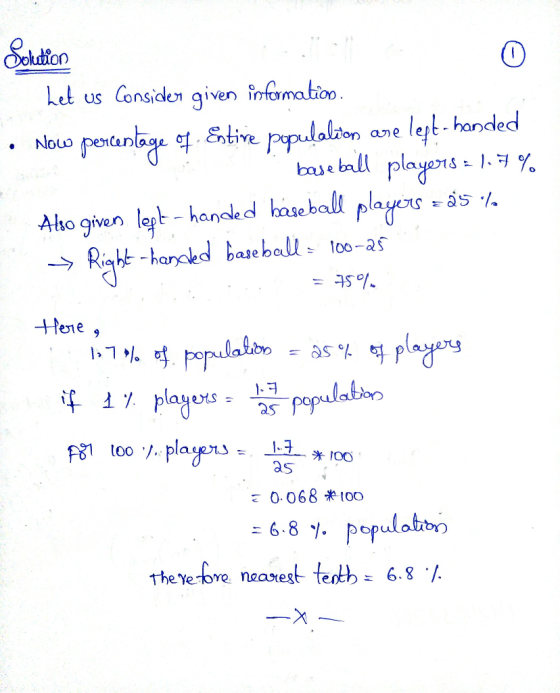
Suppose that in a particular country, 1.7% of the entire population are left-handed baseball players and...
suppose that 16% of the population of the US is left-handed. If a random sample of...
suppose that 16% of the population of the US is left-handed. If a random sample of 240 people from the US is chosen, approximate The probability that more than 39 or left-handed. Use the normal approximation to the by no meal with the correction for continually. Round your answer to that lease three decimal places do not round any intermediate step
Suppose that 12% of the population of the U.S. is left-handed. If a random sample of...
 Suppose that 12% of the population of the U.S. is left-handed. If a random sample of 130 people from the U.S. is chosen, approximate the probability that at most 14 are left-handed. Use the normal approximation to the binomial with a correction for continuity. Round your answer to at least three decimal places. Do not round any intermediate steps. (If necessary, consult a list of formulas.) x 5 ?
1 2 Suppose that 10% of the population of the U.S. is left-handed. If a random...
 1 2 Suppose that 10% of the population of the U.S. is left-handed. If a random sample of 155 people from the U.S. is chosen, approximate the probability that at least 16 are left-handed. Use the normal approximation to the binomial with a correction for continuity. Round your answer to at least three decimal places. Do not round any intermediate steps. (If necessary, consult a list of formulas) Х $ 2 e
Suppose that about 9.2% of the population is left-handed. A 200-seat school auditorium has been built...
Suppose that about 9.2% of the population is left-handed. A 200-seat school auditorium has been built with 15 “lefty seats,” seats that have the built-in desk on the left rather than the right arm of the chair. In a class of 120 students, what is the probability that there will not be enough seats for the left-handed students? Explain how you arrived at your answer.
We will be using Excel to simulate the number of left-handed people in a particular sample....
We will be using Excel to simulate the number of left-handed people in a particular sample. Left-handed people make up about 10% of the population. We will randomly pick numbers between 1 and 10, where 1 represents a left-handed person and 2 - 10 represents a right-handed person. This should result in about 10% of our sample being left-handed. Please note there are five parts to this question. 1. Create a pie graph in Excel to show the proportion of...
The proportion of left-handed people in the general population is about 0.10.1. Suppose a random sample...
 The proportion of left-handed people in the general population
is about 0.10.1. Suppose a random sample of 225225 people is
observed.
Curve 2 . -10 - Curve 3 - Curve 4 Curve 5 20 Find the probability using the normal table. (Opens in new window) P(P >0.13) = P(z > 1.5) = (Click to view hint) Check Your Turn np = 22.5 The proportion of left handed people in the general population is about 0.1. Suppose a random sample of...
The proportion of left-handed people in the general population
is about 0.10.1. Suppose a random sample of 225225 people is
observed.
Curve 2 . -10 - Curve 3 - Curve 4 Curve 5 20 Find the probability using the normal table. (Opens in new window) P(P >0.13) = P(z > 1.5) = (Click to view hint) Check Your Turn np = 22.5 The proportion of left handed people in the general population is about 0.1. Suppose a random sample of...
OD Suppose that 12% of the population of the U.S. is left-handed. If a random sample of 130 people from the U.S. is...
 OD Suppose that 12% of the population of the U.S. is left-handed. If a random sample of 130 people from the U.S. is chosen, approximate the probability that at most 14 are left-handed. Use the normal approximation to the binomial with a correction for continuity. Round your answer to at least three decimal places. Do not round any intermediate steps. (If necessary, consult a list of formulas.)
The proportion of left-handed people in the general population is about 0.1. Suppose a random sample...
 The proportion of left-handed
people in the general population is about 0.1. Suppose a random
sample of 225 people is observed.
The proportion of left-handed people in the general population is about 0.1. Suppose a random sample of 225 people is observed. Using our 'rule of thumb; can we use normal approximation values for this sampling distribution? Yes + np = 22.5 and ng= (Click to view hint) What is the mean of the sample proportion? др (Click to hide...
The proportion of left-handed
people in the general population is about 0.1. Suppose a random
sample of 225 people is observed.
The proportion of left-handed people in the general population is about 0.1. Suppose a random sample of 225 people is observed. Using our 'rule of thumb; can we use normal approximation values for this sampling distribution? Yes + np = 22.5 and ng= (Click to view hint) What is the mean of the sample proportion? др (Click to hide...
show your work 1, if right-handed 0, if left-handed. 10. Suppose the probability for a person...
 show your work
1, if right-handed 0, if left-handed. 10. Suppose the probability for a person to be right-handed is p. Let X = (a) What distribution does X follow? (b) A scientist selected a random sample of 1000 people. Let Y be the number of people who are right-handed, what distribution does Y follow? (c) This scientist found out that among the 1000 people, 100 are right-handed. He then estimated p to be 0.1. What theorem justifies his conclusion....
show your work
1, if right-handed 0, if left-handed. 10. Suppose the probability for a person to be right-handed is p. Let X = (a) What distribution does X follow? (b) A scientist selected a random sample of 1000 people. Let Y be the number of people who are right-handed, what distribution does Y follow? (c) This scientist found out that among the 1000 people, 100 are right-handed. He then estimated p to be 0.1. What theorem justifies his conclusion....
Suppose that the distance of fly balls hit to the outfield (in baseball) is normally distributed...
 Suppose that the distance of fly balls hit to the outfield (in baseball) is normally distributed with a mean of 256 feet and a standard deviation of 45 feet. Use your graphing calculator to answer the following questions. Write your answers in percent form. Round your answers to the nearest tenth of a percent. b) If one fly ball is randomly chosen from this distribution, what is the probability that this ball traveled more than 210 feet?P (more than 210...
 Suppose that 12% of the population of the U.S. is left-handed. If a random sample of 130 people from the U.S. is chosen, approximate the probability that at most 14 are left-handed. Use the normal approximation to the binomial with a correction for continuity. Round your answer to at least three decimal places. Do not round any intermediate steps. (If necessary, consult a list of formulas.) x 5 ?
 1 2 Suppose that 10% of the population of the U.S. is left-handed. If a random sample of 155 people from the U.S. is chosen, approximate the probability that at least 16 are left-handed. Use the normal approximation to the binomial with a correction for continuity. Round your answer to at least three decimal places. Do not round any intermediate steps. (If necessary, consult a list of formulas) Х $ 2 e
 The proportion of left-handed people in the general population
is about 0.10.1. Suppose a random sample of 225225 people is
observed.
Curve 2 . -10 - Curve 3 - Curve 4 Curve 5 20 Find the probability using the normal table. (Opens in new window) P(P >0.13) = P(z > 1.5) = (Click to view hint) Check Your Turn np = 22.5 The proportion of left handed people in the general population is about 0.1. Suppose a random sample of...
The proportion of left-handed people in the general population
is about 0.10.1. Suppose a random sample of 225225 people is
observed.
Curve 2 . -10 - Curve 3 - Curve 4 Curve 5 20 Find the probability using the normal table. (Opens in new window) P(P >0.13) = P(z > 1.5) = (Click to view hint) Check Your Turn np = 22.5 The proportion of left handed people in the general population is about 0.1. Suppose a random sample of...
 OD Suppose that 12% of the population of the U.S. is left-handed. If a random sample of 130 people from the U.S. is chosen, approximate the probability that at most 14 are left-handed. Use the normal approximation to the binomial with a correction for continuity. Round your answer to at least three decimal places. Do not round any intermediate steps. (If necessary, consult a list of formulas.)
 The proportion of left-handed
people in the general population is about 0.1. Suppose a random
sample of 225 people is observed.
The proportion of left-handed people in the general population is about 0.1. Suppose a random sample of 225 people is observed. Using our 'rule of thumb; can we use normal approximation values for this sampling distribution? Yes + np = 22.5 and ng= (Click to view hint) What is the mean of the sample proportion? др (Click to hide...
The proportion of left-handed
people in the general population is about 0.1. Suppose a random
sample of 225 people is observed.
The proportion of left-handed people in the general population is about 0.1. Suppose a random sample of 225 people is observed. Using our 'rule of thumb; can we use normal approximation values for this sampling distribution? Yes + np = 22.5 and ng= (Click to view hint) What is the mean of the sample proportion? др (Click to hide...
 show your work
1, if right-handed 0, if left-handed. 10. Suppose the probability for a person to be right-handed is p. Let X = (a) What distribution does X follow? (b) A scientist selected a random sample of 1000 people. Let Y be the number of people who are right-handed, what distribution does Y follow? (c) This scientist found out that among the 1000 people, 100 are right-handed. He then estimated p to be 0.1. What theorem justifies his conclusion....
show your work
1, if right-handed 0, if left-handed. 10. Suppose the probability for a person to be right-handed is p. Let X = (a) What distribution does X follow? (b) A scientist selected a random sample of 1000 people. Let Y be the number of people who are right-handed, what distribution does Y follow? (c) This scientist found out that among the 1000 people, 100 are right-handed. He then estimated p to be 0.1. What theorem justifies his conclusion....
 Suppose that the distance of fly balls hit to the outfield (in baseball) is normally distributed with a mean of 256 feet and a standard deviation of 45 feet. Use your graphing calculator to answer the following questions. Write your answers in percent form. Round your answers to the nearest tenth of a percent. b) If one fly ball is randomly chosen from this distribution, what is the probability that this ball traveled more than 210 feet?P (more than 210...
Most questions answered within 3 hours.
-
Where is the error in this code sequence?
String s1 = "Hello";
String s2 = "ello";...
asked 11 months ago -
Financial data for Joel de Paris, Inc., for last year
follow:
Joel de Paris, Inc.
Balance...
asked 11 months ago -
Consider this reaction:
Al2(SO4)3 (aq)+ BaCl3
(aq) Al2Cl6 (aq)- +
3BaSO4(s) . What is the...
asked 11 months ago -
Suppose that Savneet is considering increasing her
recent random sample from 20 car rentals to 40...
asked 11 months ago -
Trucks arrive at an unloading terminal at an average rate of 120
per hour.
Trucks arrive...
asked 11 months ago -
Why are methanol and ethanol completely soluble in water while
octanol is not very little soluble....
asked 11 months ago -
A facilities manager at a university reads in a research report
that the mean amount of...
asked 11 months ago -
When the CuSO4 is rehydrated by adding water to the anhydrous
compound, is this an endothermic...
asked 11 months ago -
A ray of sunlight is passing from diamond into crown glass; the
angle of incidence is...
asked 11 months ago -
A block of mass 0.249 kg is placed on top of a light, vertical
spring of...
asked 11 months ago -
how do the kidneys compensate in the presences of acidosis
a) trigger hyperventilate
b) reserve acid...
asked 11 months ago -
Question 501 pts
The rental rate of capital to the firm increases. Which of the
following...
asked 11 months ago