The carboxylic acid shown below may be prepared easily from all
but one of the substrates. Which compound would not provide easy
synthesis of the acid?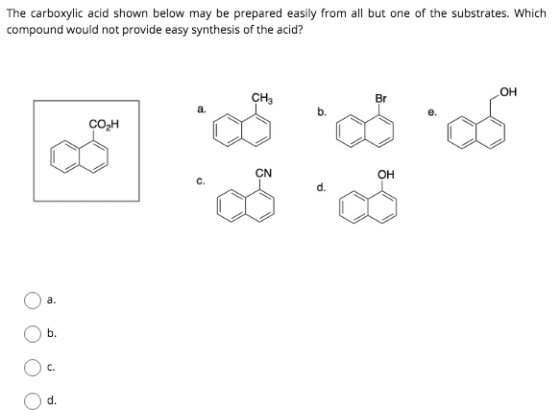
Homework Answers
Request Answer!
We need at least 10 more requests to produce the answer.
0 / 10 have requested this problem solution
The more requests, the faster the answer.
Add Answer to:
The carboxylic acid shown below may be prepared easily from all
but one of the substrates....
The carboxylic acid shown below may be prepared easily from all but one of the substrates....
 The carboxylic acid shown below may be prepared easily from all but one of the substrates. Which compound would not provide easy synthesis of the acid? OH сна Br a. b. COH CN OH O a. O b. O C. O d. Oe.
The carboxylic acid shown below may be prepared easily from all but one of the substrates....
 The carboxylic acid shown below may be prepared easily from all but one of the substrates. Which compound would not provide easy synthesis of the acid? CH Br OH b. COH CN OH d O a. Ob. Ос. Od O
Which molecule shown below cannot be hydrolyzed to a carboxylic acid? all of these can be...
 Which molecule shown below cannot be hydrolyzed to a carboxylic acid? all of these can be hydrolyzed to give a carboxylic acid Ph CI Ph CN a b с d A B C D E
1. Naming and Drawing Carboxylic Acids: 1.A. Using IUPAC guidelines, enter the name for the carboxylic...
 1. Naming and Drawing Carboxylic Acids:
1.A. Using IUPAC guidelines, enter the name for the carboxylic
acid shown below. Enter the name using IUPAC guidelines, including
numbers and punctuation (e.g., 3,4-dichlorobenzoic acid).
1.B. Draw 3-methylbenzoic acid. (Draw the molecule on the canvas
by choosing buttons from the Tools (for bonds), Atoms, and Advanced
Template toolbars. The single bond is active by default. Include
all hydrogen atoms).
2. Naming Carboxylic Acid Derivatives:
2.A. Give the IUPAC name of the ester shown....
1. Naming and Drawing Carboxylic Acids:
1.A. Using IUPAC guidelines, enter the name for the carboxylic
acid shown below. Enter the name using IUPAC guidelines, including
numbers and punctuation (e.g., 3,4-dichlorobenzoic acid).
1.B. Draw 3-methylbenzoic acid. (Draw the molecule on the canvas
by choosing buttons from the Tools (for bonds), Atoms, and Advanced
Template toolbars. The single bond is active by default. Include
all hydrogen atoms).
2. Naming Carboxylic Acid Derivatives:
2.A. Give the IUPAC name of the ester shown....
Amides are prepared from carboxylic acid derivatives. In the reaction shown below, what is the correct...
 Amides are prepared from carboxylic acid derivatives. In the reaction shown below, what is the correct structure for the missing reactant? Cheryl CH3CH2C-CI + 2(?) - CH₃CHY & N-CH3 + by-product CH3CH2C-N-CH3 CH2CH3 main product H H-N-CH2CH3 (A) CH2CH3 H-N-CH3 (B) CH2CH3 H-N-CH2CH3 (C) CH3 H-N-CH3 (D) Select one: O (A) (B) (C) (D) None of these
Carboxylic Acid Derivatives (21) 1. Nomenclatures For each of the compounds shown below, provide an acceptable...
 Carboxylic Acid Derivatives (21) 1. Nomenclatures For each of the compounds shown below, provide an acceptable IUPAC name. b. CH B d j h. OCH Carboxylic Acid Derivatives — Synthesis For each of the reactions below, predict the major organic product. OH 8 CHA CH,CH OH H a. OH PBT СО NH/CHỊCH b. cool LO COOH SOCI OH SOCI i j. d. CH CH NHẠCH CH,COOH CH,CH; k. e. CH; CH H H CHAN CH31 СО OH -COO 1. f.
1. Provide a multiple step synthesis for the transformation shown below. 2. Identify the carboxylic acid...
 1. Provide a multiple step synthesis for the transformation
shown below.
2. Identify the carboxylic acid and alcohol needed to make the
ester shown below.
3. Propose a mechanism for the reaction shown below.
4. Show all the important resonance structures for the anion
shown below. Include arrows that show how to reach each form.
Indicate which resonance structure makes the greatest
contribution to the resonance hybrid and which resonance structure
makes the least contribution to the resonance
hybrid.
1....
1. Provide a multiple step synthesis for the transformation
shown below.
2. Identify the carboxylic acid and alcohol needed to make the
ester shown below.
3. Propose a mechanism for the reaction shown below.
4. Show all the important resonance structures for the anion
shown below. Include arrows that show how to reach each form.
Indicate which resonance structure makes the greatest
contribution to the resonance hybrid and which resonance structure
makes the least contribution to the resonance
hybrid.
1....
1. Acid chiorides have the general structure shown below They are prepared from carboxylic acids using....
 1. Acid chiorides have the general structure shown below They are prepared from carboxylic acids using. eg. thiony chloride (SOC) SOC2 Acid chlorides are very reactive and an effective way to transfer an acyl group (R-CO)H to make esters or amides. a. Acyl groups are named after the corresponding carboxylic acid parent: Carboxylic Acid Acyl Chloride ethanoic acid ethanoyl chloride propanoic acid propanoyl chloride benzoic acid benzoyl chloride Name the acyl chlorides below: Acyl chlorides are very reactive molecules, reacting...
an acid chloride is prepared from the related carboxylic acid by reaction of which of the...
an acid chloride is prepared from the related carboxylic acid by reaction of which of the following? a. hcl b. cl2 c. socl2 d. hocl e. alcl3 Please explain reasoning for why
30. Select the product for the reaction shown below: но KOH O Da, ? D. A....
 30. Select the product for the reaction shown below: но KOH O Da, ? D. A. 0 B. C. 31. Provide the final product that results upon completion of the multi-step synthesis shown: NaoMe MeOH NaOME HO / dil PhyP-CH, OMo ? HCI Br NaoMe OH OH **Ph A. Br Br C. B. COH D
 The carboxylic acid shown below may be prepared easily from all but one of the substrates. Which compound would not provide easy synthesis of the acid? OH сна Br a. b. COH CN OH O a. O b. O C. O d. Oe.
 The carboxylic acid shown below may be prepared easily from all but one of the substrates. Which compound would not provide easy synthesis of the acid? CH Br OH b. COH CN OH d O a. Ob. Ос. Od O
 Which molecule shown below cannot be hydrolyzed to a carboxylic acid? all of these can be hydrolyzed to give a carboxylic acid Ph CI Ph CN a b с d A B C D E
 1. Naming and Drawing Carboxylic Acids:
1.A. Using IUPAC guidelines, enter the name for the carboxylic
acid shown below. Enter the name using IUPAC guidelines, including
numbers and punctuation (e.g., 3,4-dichlorobenzoic acid).
1.B. Draw 3-methylbenzoic acid. (Draw the molecule on the canvas
by choosing buttons from the Tools (for bonds), Atoms, and Advanced
Template toolbars. The single bond is active by default. Include
all hydrogen atoms).
2. Naming Carboxylic Acid Derivatives:
2.A. Give the IUPAC name of the ester shown....
1. Naming and Drawing Carboxylic Acids:
1.A. Using IUPAC guidelines, enter the name for the carboxylic
acid shown below. Enter the name using IUPAC guidelines, including
numbers and punctuation (e.g., 3,4-dichlorobenzoic acid).
1.B. Draw 3-methylbenzoic acid. (Draw the molecule on the canvas
by choosing buttons from the Tools (for bonds), Atoms, and Advanced
Template toolbars. The single bond is active by default. Include
all hydrogen atoms).
2. Naming Carboxylic Acid Derivatives:
2.A. Give the IUPAC name of the ester shown....
 Amides are prepared from carboxylic acid derivatives. In the reaction shown below, what is the correct structure for the missing reactant? Cheryl CH3CH2C-CI + 2(?) - CH₃CHY & N-CH3 + by-product CH3CH2C-N-CH3 CH2CH3 main product H H-N-CH2CH3 (A) CH2CH3 H-N-CH3 (B) CH2CH3 H-N-CH2CH3 (C) CH3 H-N-CH3 (D) Select one: O (A) (B) (C) (D) None of these
 Carboxylic Acid Derivatives (21) 1. Nomenclatures For each of the compounds shown below, provide an acceptable IUPAC name. b. CH B d j h. OCH Carboxylic Acid Derivatives — Synthesis For each of the reactions below, predict the major organic product. OH 8 CHA CH,CH OH H a. OH PBT СО NH/CHỊCH b. cool LO COOH SOCI OH SOCI i j. d. CH CH NHẠCH CH,COOH CH,CH; k. e. CH; CH H H CHAN CH31 СО OH -COO 1. f.
 1. Provide a multiple step synthesis for the transformation
shown below.
2. Identify the carboxylic acid and alcohol needed to make the
ester shown below.
3. Propose a mechanism for the reaction shown below.
4. Show all the important resonance structures for the anion
shown below. Include arrows that show how to reach each form.
Indicate which resonance structure makes the greatest
contribution to the resonance hybrid and which resonance structure
makes the least contribution to the resonance
hybrid.
1....
1. Provide a multiple step synthesis for the transformation
shown below.
2. Identify the carboxylic acid and alcohol needed to make the
ester shown below.
3. Propose a mechanism for the reaction shown below.
4. Show all the important resonance structures for the anion
shown below. Include arrows that show how to reach each form.
Indicate which resonance structure makes the greatest
contribution to the resonance hybrid and which resonance structure
makes the least contribution to the resonance
hybrid.
1....
 1. Acid chiorides have the general structure shown below They are prepared from carboxylic acids using. eg. thiony chloride (SOC) SOC2 Acid chlorides are very reactive and an effective way to transfer an acyl group (R-CO)H to make esters or amides. a. Acyl groups are named after the corresponding carboxylic acid parent: Carboxylic Acid Acyl Chloride ethanoic acid ethanoyl chloride propanoic acid propanoyl chloride benzoic acid benzoyl chloride Name the acyl chlorides below: Acyl chlorides are very reactive molecules, reacting...
 30. Select the product for the reaction shown below: но KOH O Da, ? D. A. 0 B. C. 31. Provide the final product that results upon completion of the multi-step synthesis shown: NaoMe MeOH NaOME HO / dil PhyP-CH, OMo ? HCI Br NaoMe OH OH **Ph A. Br Br C. B. COH D
Most questions answered within 3 hours.
-
Where is the error in this code sequence?
String s1 = "Hello";
String s2 = "ello";...
asked 10 months ago -
Financial data for Joel de Paris, Inc., for last year
follow:
Joel de Paris, Inc.
Balance...
asked 10 months ago -
Consider this reaction:
Al2(SO4)3 (aq)+ BaCl3
(aq) Al2Cl6 (aq)- +
3BaSO4(s) . What is the...
asked 10 months ago -
Suppose that Savneet is considering increasing her
recent random sample from 20 car rentals to 40...
asked 10 months ago -
Trucks arrive at an unloading terminal at an average rate of 120
per hour.
Trucks arrive...
asked 10 months ago -
Why are methanol and ethanol completely soluble in water while
octanol is not very little soluble....
asked 10 months ago -
A facilities manager at a university reads in a research report
that the mean amount of...
asked 10 months ago -
When the CuSO4 is rehydrated by adding water to the anhydrous
compound, is this an endothermic...
asked 10 months ago -
A ray of sunlight is passing from diamond into crown glass; the
angle of incidence is...
asked 10 months ago -
A block of mass 0.249 kg is placed on top of a light, vertical
spring of...
asked 10 months ago -
how do the kidneys compensate in the presences of acidosis
a) trigger hyperventilate
b) reserve acid...
asked 10 months ago -
Question 501 pts
The rental rate of capital to the firm increases. Which of the
following...
asked 10 months ago