

Homework Answers
Ans-3
Option c is correct answer.
Because change in A will reflect in B only after a clock cycle . Similarly change in B will reflect at S only after a clock cycle. But to ensure that setup violation is not met data must reach little early before the next clock cycle.
This is best described in last waveform because change in B is reflected at next clock cycle after change in A but little early to ensure system does not meet setup violation.
Similarly change in S is reflected a clock cycle after B but little early to ensure system does not meet setup violation.
Ans -4
Option a is correct.
Because when system sees setup or hold violation the circuit will miss change in its input, that is circuits output will not change to reflect change in A.
So to not miss correct output we sould take care that there are not any setup or hold violations in circuit.
Add Answer to:
QUESTION 3 The following synchronizer circuit is composed of flip-flops with a setup time of 2...
The answer is not the third option for Q3 and not the first option for Q4....
 The answer is not the third option for Q3 and not the first
option for Q4.
QUESTION 3 The following synchronizer circuit is composed of flip-flops with a setup time of 2 ns, a hold time of ons, and a clock- to-Q delay of Ons B D-FF D-FF A Q D S D Q CLK Given the delays above, analyze the circuit above, and fill out the timing diagram below. clk A B S clk А B. S clk o...
The answer is not the third option for Q3 and not the first
option for Q4.
QUESTION 3 The following synchronizer circuit is composed of flip-flops with a setup time of 2 ns, a hold time of ons, and a clock- to-Q delay of Ons B D-FF D-FF A Q D S D Q CLK Given the delays above, analyze the circuit above, and fill out the timing diagram below. clk A B S clk А B. S clk o...
Initial value of Q was not given but we can probably take to be 0. QUESTION...
 Initial value of Q was not given but we can probably take to be
0.
QUESTION 4 Suppose that, instead of adding a single FF, you were to add a two-flip-flop synchronizer, as below: D-FF D D-FF D-FF a D Q D Q D Q QO 1 ns Imagine that the following timing diagram depicts the actual values of b after a setup time violation. Assuming that each flip-flop still has a setup time of 1 ns, a hold time...
Initial value of Q was not given but we can probably take to be
0.
QUESTION 4 Suppose that, instead of adding a single FF, you were to add a two-flip-flop synchronizer, as below: D-FF D D-FF D-FF a D Q D Q D Q QO 1 ns Imagine that the following timing diagram depicts the actual values of b after a setup time violation. Assuming that each flip-flop still has a setup time of 1 ns, a hold time...
(20 pts.) For the following circuit, the timing characteristics of the components are summarized below. .Flip-flop:...
 (20 pts.) For the following circuit, the timing characteristics of the components are summarized below. .Flip-flop: clock-to-Q maximum delay tpcq 40ps, clock-to-Q minimum delay tec 30ps, setup time tsetup 50ps, hold time thold 60ps Logic gate (each AND, OR, Inverter): propagation delay tpd 35ps, contamination delay ted25ps. FFl Fr3 CLK OUT FF2 CLK Suppose that there is no clock skew. What is the maximum clock frequency of this a. circuit? b. How much clock skew can the circuit tolerate before...
All flip flops are positive-edge triggered. Assume each flip flop starts at 0.
 All flip flops are
positive-edge triggered. Assume each flip flop starts at 0.
Problem 11: (8 pts) For the following circuit, complete the timing diagram for the state of each flip flop and the output, where shown. All flip flops are positive-edge triggered. Assume each flip flop starts at 0. J-K FF TFF CLK PRE CLR PRE CLR CLR回 Clock CLR
Problem 11: (8 pts) For the following circuit, complete the timing diagram for the state of each flip flop...
All flip flops are
positive-edge triggered. Assume each flip flop starts at 0.
Problem 11: (8 pts) For the following circuit, complete the timing diagram for the state of each flip flop and the output, where shown. All flip flops are positive-edge triggered. Assume each flip flop starts at 0. J-K FF TFF CLK PRE CLR PRE CLR CLR回 Clock CLR
Problem 11: (8 pts) For the following circuit, complete the timing diagram for the state of each flip flop...
TIMING Consider the following ciru. The clock connections to the flip-flops are not shown (both flip-flops...
 TIMING Consider the following ciru. The clock connections to the flip-flops are not shown (both flip-flops are clocked by the same clock). Y1 D a Assume the following Delay of each AND gate: 1 ns Delay of each inverter 04 ns Set up time of each flip-flop: 0.1 ns Hold time of each flip-flop: 0 ns Clk-to-Q delay of each fip-flop: 0.3 ns a) What is the maximum frequency of the clock in this cicuit (in MHz)? b) Suppose the...
3. (16 pts.) A sequential circuit design is shown in the following diagram CLK CLK Frt Trl Frl FF1 D-FF clk-to-q propagation delay tpcq 15 ps D-FF clk-to-q contamination delay tccq-10 ps D-FF dat...
 3. (16 pts.) A sequential circuit design is shown in the following diagram CLK CLK Frt Trl Frl FF1 D-FF clk-to-q propagation delay tpcq 15 ps D-FF clk-to-q contamination delay tccq-10 ps D-FF data setup time ts-15 ps D-FF data hold time th = 10 ps Gate 2-input NAND 2-input NOR 2-input XOIR NOT Tpd(ps) Tea(ps) 15 25 35 10 10 15 25 (8 pts.) Calculate the maximum clock frequency for reliable operation assuming there is no clock skew (8...
Please show all the work. Thanks QUESTION 1 Consider the following circuit. Given that XOR and...
 Please show all the work.
Thanks
QUESTION 1 Consider the following circuit. Given that XOR and AND gates have an input to output delay of 10 ns, the D Flip-Flops have a delay of 20 ns from clock to Q-output, and the minimum setup time of the D Flip-Flops is 8 ns, hold time of the D-FF is 5 ns. (a) what is the maximum frequency (in MHz) that this counter can be clocked before it fails? (b) Does the...
Please show all the work.
Thanks
QUESTION 1 Consider the following circuit. Given that XOR and AND gates have an input to output delay of 10 ns, the D Flip-Flops have a delay of 20 ns from clock to Q-output, and the minimum setup time of the D Flip-Flops is 8 ns, hold time of the D-FF is 5 ns. (a) what is the maximum frequency (in MHz) that this counter can be clocked before it fails? (b) Does the...
(b) Using a timing diagram showing the clk, Q1 and D2 signals, explain the following timing const...
 (b) Using a timing diagram showing the clk, Q1 and D2 signals, explain the following timing constraints for the circuit shown in Figure 2.1 cqtcd 2 old where tod is the contamination delay of the combinational logic 7 marks reg2 reg1 Combinational D2 logic clk. clk Figure 2.1 (c) In the circuit shown in Figure 2.2, the flip-flops have a clock-to-Q contamination delay of 30 ps and a propagation delay of 80 ps. They have a setup time of 50...
1. a) Complete the waveform templates for the Master –Slave D-flip-flop below with given D, CLK,...
 1.
a) Complete the waveform templates for the Master –Slave
D-flip-flop below with given D, CLK, CLEAR, and PRESET signals.
Neglect the propagation delays.
b) Does it have positive or negative edge triggering with
respect to CLK?
c) Are the asynchronous PRESET and CLEAR active-high or
active-low?
2. Enabling of data load in the D-flip-flop was implemented with
a 2-to-1 multiplexer as show below. The D-flip-flop has the
positive edge triggering and the active-low asynchronous clear.
a) Is the Enable...
1.
a) Complete the waveform templates for the Master –Slave
D-flip-flop below with given D, CLK, CLEAR, and PRESET signals.
Neglect the propagation delays.
b) Does it have positive or negative edge triggering with
respect to CLK?
c) Are the asynchronous PRESET and CLEAR active-high or
active-low?
2. Enabling of data load in the D-flip-flop was implemented with
a 2-to-1 multiplexer as show below. The D-flip-flop has the
positive edge triggering and the active-low asynchronous clear.
a) Is the Enable...
Q2) Time diagram analysis: for the following circuit with the time domain signals draw the output...
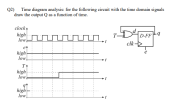 Q2) Time diagram analysis: for the following circuit with the time domain signals draw the output Q as a function of time clock high low D-FF q t clk et high low Tt high low t high low
 The answer is not the third option for Q3 and not the first
option for Q4.
QUESTION 3 The following synchronizer circuit is composed of flip-flops with a setup time of 2 ns, a hold time of ons, and a clock- to-Q delay of Ons B D-FF D-FF A Q D S D Q CLK Given the delays above, analyze the circuit above, and fill out the timing diagram below. clk A B S clk А B. S clk o...
The answer is not the third option for Q3 and not the first
option for Q4.
QUESTION 3 The following synchronizer circuit is composed of flip-flops with a setup time of 2 ns, a hold time of ons, and a clock- to-Q delay of Ons B D-FF D-FF A Q D S D Q CLK Given the delays above, analyze the circuit above, and fill out the timing diagram below. clk A B S clk А B. S clk o...
 Initial value of Q was not given but we can probably take to be
0.
QUESTION 4 Suppose that, instead of adding a single FF, you were to add a two-flip-flop synchronizer, as below: D-FF D D-FF D-FF a D Q D Q D Q QO 1 ns Imagine that the following timing diagram depicts the actual values of b after a setup time violation. Assuming that each flip-flop still has a setup time of 1 ns, a hold time...
Initial value of Q was not given but we can probably take to be
0.
QUESTION 4 Suppose that, instead of adding a single FF, you were to add a two-flip-flop synchronizer, as below: D-FF D D-FF D-FF a D Q D Q D Q QO 1 ns Imagine that the following timing diagram depicts the actual values of b after a setup time violation. Assuming that each flip-flop still has a setup time of 1 ns, a hold time...
 (20 pts.) For the following circuit, the timing characteristics of the components are summarized below. .Flip-flop: clock-to-Q maximum delay tpcq 40ps, clock-to-Q minimum delay tec 30ps, setup time tsetup 50ps, hold time thold 60ps Logic gate (each AND, OR, Inverter): propagation delay tpd 35ps, contamination delay ted25ps. FFl Fr3 CLK OUT FF2 CLK Suppose that there is no clock skew. What is the maximum clock frequency of this a. circuit? b. How much clock skew can the circuit tolerate before...
 All flip flops are
positive-edge triggered. Assume each flip flop starts at 0.
Problem 11: (8 pts) For the following circuit, complete the timing diagram for the state of each flip flop and the output, where shown. All flip flops are positive-edge triggered. Assume each flip flop starts at 0. J-K FF TFF CLK PRE CLR PRE CLR CLR回 Clock CLR
Problem 11: (8 pts) For the following circuit, complete the timing diagram for the state of each flip flop...
All flip flops are
positive-edge triggered. Assume each flip flop starts at 0.
Problem 11: (8 pts) For the following circuit, complete the timing diagram for the state of each flip flop and the output, where shown. All flip flops are positive-edge triggered. Assume each flip flop starts at 0. J-K FF TFF CLK PRE CLR PRE CLR CLR回 Clock CLR
Problem 11: (8 pts) For the following circuit, complete the timing diagram for the state of each flip flop...
 TIMING Consider the following ciru. The clock connections to the flip-flops are not shown (both flip-flops are clocked by the same clock). Y1 D a Assume the following Delay of each AND gate: 1 ns Delay of each inverter 04 ns Set up time of each flip-flop: 0.1 ns Hold time of each flip-flop: 0 ns Clk-to-Q delay of each fip-flop: 0.3 ns a) What is the maximum frequency of the clock in this cicuit (in MHz)? b) Suppose the...
 3. (16 pts.) A sequential circuit design is shown in the following diagram CLK CLK Frt Trl Frl FF1 D-FF clk-to-q propagation delay tpcq 15 ps D-FF clk-to-q contamination delay tccq-10 ps D-FF data setup time ts-15 ps D-FF data hold time th = 10 ps Gate 2-input NAND 2-input NOR 2-input XOIR NOT Tpd(ps) Tea(ps) 15 25 35 10 10 15 25 (8 pts.) Calculate the maximum clock frequency for reliable operation assuming there is no clock skew (8...
 Please show all the work.
Thanks
QUESTION 1 Consider the following circuit. Given that XOR and AND gates have an input to output delay of 10 ns, the D Flip-Flops have a delay of 20 ns from clock to Q-output, and the minimum setup time of the D Flip-Flops is 8 ns, hold time of the D-FF is 5 ns. (a) what is the maximum frequency (in MHz) that this counter can be clocked before it fails? (b) Does the...
Please show all the work.
Thanks
QUESTION 1 Consider the following circuit. Given that XOR and AND gates have an input to output delay of 10 ns, the D Flip-Flops have a delay of 20 ns from clock to Q-output, and the minimum setup time of the D Flip-Flops is 8 ns, hold time of the D-FF is 5 ns. (a) what is the maximum frequency (in MHz) that this counter can be clocked before it fails? (b) Does the...
 (b) Using a timing diagram showing the clk, Q1 and D2 signals, explain the following timing constraints for the circuit shown in Figure 2.1 cqtcd 2 old where tod is the contamination delay of the combinational logic 7 marks reg2 reg1 Combinational D2 logic clk. clk Figure 2.1 (c) In the circuit shown in Figure 2.2, the flip-flops have a clock-to-Q contamination delay of 30 ps and a propagation delay of 80 ps. They have a setup time of 50...
 1.
a) Complete the waveform templates for the Master –Slave
D-flip-flop below with given D, CLK, CLEAR, and PRESET signals.
Neglect the propagation delays.
b) Does it have positive or negative edge triggering with
respect to CLK?
c) Are the asynchronous PRESET and CLEAR active-high or
active-low?
2. Enabling of data load in the D-flip-flop was implemented with
a 2-to-1 multiplexer as show below. The D-flip-flop has the
positive edge triggering and the active-low asynchronous clear.
a) Is the Enable...
1.
a) Complete the waveform templates for the Master –Slave
D-flip-flop below with given D, CLK, CLEAR, and PRESET signals.
Neglect the propagation delays.
b) Does it have positive or negative edge triggering with
respect to CLK?
c) Are the asynchronous PRESET and CLEAR active-high or
active-low?
2. Enabling of data load in the D-flip-flop was implemented with
a 2-to-1 multiplexer as show below. The D-flip-flop has the
positive edge triggering and the active-low asynchronous clear.
a) Is the Enable...
 Q2) Time diagram analysis: for the following circuit with the time domain signals draw the output Q as a function of time clock high low D-FF q t clk et high low Tt high low t high low
Most questions answered within 3 hours.
-
Where is the error in this code sequence?
String s1 = "Hello";
String s2 = "ello";...
asked 10 months ago -
Financial data for Joel de Paris, Inc., for last year
follow:
Joel de Paris, Inc.
Balance...
asked 10 months ago -
Consider this reaction:
Al2(SO4)3 (aq)+ BaCl3
(aq) Al2Cl6 (aq)- +
3BaSO4(s) . What is the...
asked 10 months ago -
Suppose that Savneet is considering increasing her
recent random sample from 20 car rentals to 40...
asked 10 months ago -
Trucks arrive at an unloading terminal at an average rate of 120
per hour.
Trucks arrive...
asked 10 months ago -
Why are methanol and ethanol completely soluble in water while
octanol is not very little soluble....
asked 10 months ago -
A facilities manager at a university reads in a research report
that the mean amount of...
asked 10 months ago -
When the CuSO4 is rehydrated by adding water to the anhydrous
compound, is this an endothermic...
asked 10 months ago -
A ray of sunlight is passing from diamond into crown glass; the
angle of incidence is...
asked 10 months ago -
A block of mass 0.249 kg is placed on top of a light, vertical
spring of...
asked 10 months ago -
how do the kidneys compensate in the presences of acidosis
a) trigger hyperventilate
b) reserve acid...
asked 10 months ago -
Question 501 pts
The rental rate of capital to the firm increases. Which of the
following...
asked 10 months ago