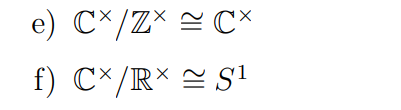
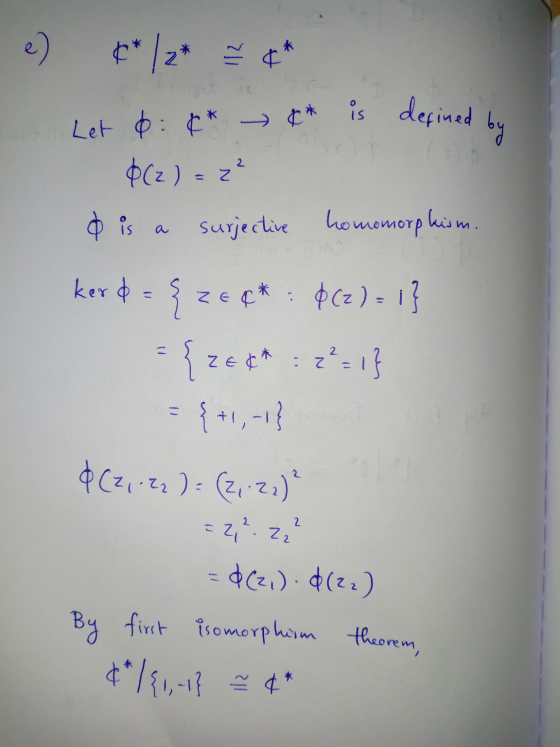
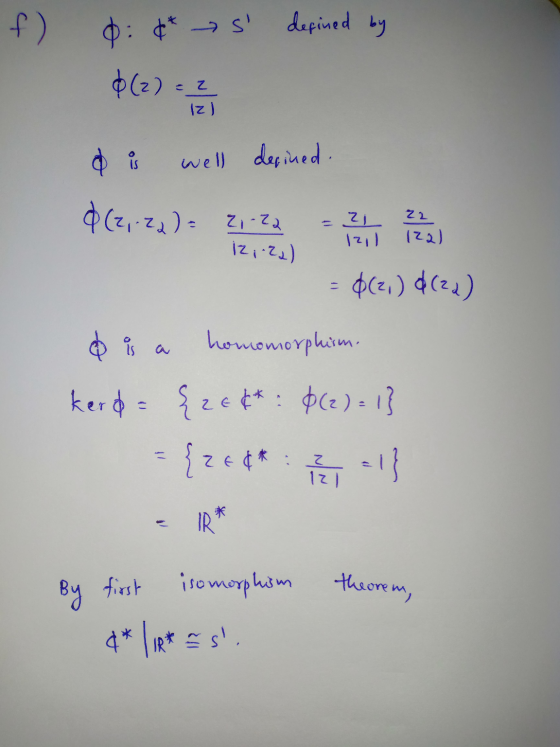
You have to establish the following isomoorphism by showing that the mapping/function its a homomorphism and then use the first isomoorphism theorem.
Note that for part e) Z* is {1, -1}, or u2, as G* is set of elements with a multiplicative inverse in G under multiplication so Z* is {1, -1} and for C* it is all complex numbers in C except zero under multiplication, and for R* it is everything in R under multiplication except zero.
S1 in part f is the unit circle in the complex plane under multiplication.
Any help would be appreciated!
Homework Answers
Add Answer to:
You have to establish the following isomoorphism by showing that
the mapping/function its a homomorphism and...
You have to establish the following isomoorphism by showing that the mapping/function its a homomorphism and...
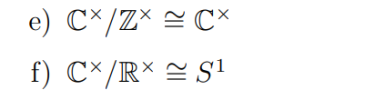 You have to establish the following isomoorphism by showing that
the mapping/function its a homomorphism and then use the first
isomoorphism theorem.
Note that for part e) Z* is {1, -1}, or u2, as G* is set of
elements with a multiplicative inverse in G under multiplication so
Z* is {1, -1} and for C* it is all complex numbers in C except zero
under multiplication, and for R* it is everything in R under
multiplication except zero.
S1 in...
You have to establish the following isomoorphism by showing that
the mapping/function its a homomorphism and then use the first
isomoorphism theorem.
Note that for part e) Z* is {1, -1}, or u2, as G* is set of
elements with a multiplicative inverse in G under multiplication so
Z* is {1, -1} and for C* it is all complex numbers in C except zero
under multiplication, and for R* it is everything in R under
multiplication except zero.
S1 in...
1- (2,5+2,5 mark) Consider in GL(2, Q), the subset (a=1 or a=-1),bez Prove that H, with multiplication, is a subgroup of GL(2,Q) a) Is the function b) an homomorphism of groups? Justify your answ...
 1- (2,5+2,5 mark) Consider in GL(2, Q), the subset (a=1 or a=-1),bez Prove that H, with multiplication, is a subgroup of GL(2,Q) a) Is the function b) an homomorphism of groups? Justify your answer 2 (3 marks) Let G be a group and a E G an element of order 12. Find the orders of each of the elements of (a) 3- (1+1,5 marks) Let G be a group such that any non-identity element has order 2. Prove that a)...
Only need answer from (IV) to (VI) Only need answer from (IV) to (VI) Math 3140...
 Only need answer from (IV) to (VI)
Math 3140 page 1 of 7 1. (30) Let R be the group of real numbers under addition, and let U = {e® : 0 E R} be the group of all complex numbers on the unit circle under multiplication. Let o: R U be the map given by = e is a homomorphism of groups. (i) Prove that (i) Find the kernel of . (Don't...
Only need answer from (IV) to (VI)
Only need answer from (IV) to (VI)
Math 3140 page 1 of 7 1. (30) Let R be the group of real numbers under addition, and let U = {e® : 0 E R} be the group of all complex numbers on the unit circle under multiplication. Let o: R U be the map given by = e is a homomorphism of groups. (i) Prove that (i) Find the kernel of . (Don't...
1. Let Q be the set of polynomials with rational coefficients. You may assume that this...
 1. Let Q be the set of polynomials with rational coefficients. You may assume that this is an abelian group under addition. Consider the function Ql] Q[x] given by p(px)) = p'(x), where we are taking the derivative. Show that is a group homomorphism. Determine the kernel of 2. Let G and H be groups. Show that (G x H)/G is isomorphic to H. Hint: consider defining a surjective homomorphism p : Gx HH with kernel G. Then apply the...
ei0 : 0 E R} be the group of all complex numbers on the unit circle...
 ei0 : 0 E R} be the group of all complex numbers on the unit circle under multiplication. Let ø : R -> U 1. (30) Let R be the group of real numbers under addition, and let U be the map given by e2Tir (r) (i) Prove that d is a homomorphism of groups (ii) Find the kernel of ø. (Don't just write down the definition. You need to describe explicit subset of R.) an real number r for...
8. (30) This problem has several parts spread over several pages. Note that you can use the conclusion of a previ...
 8. (30) This problem has several parts spread over several pages. Note that you can use the conclusion of a previous part even if you were unable to work that part. Assume throughout that f in analytic and non-zero in BR(20) for some R> 0 so that f has an isolated singularity at zo (a) Show that f has a pole at zo if and only if if zメzo, and g(z) = is analytic at zo. ) show that if...
Please answer all parts. Thank you! 20. Let R be a commutative ring with identity. We define a multiplicative subset of R to be a subset S such that 1 S and ab S if a, b E S. Define a relation ~ on R...
 Please answer all parts. Thank you!
20. Let R be a commutative ring with identity. We define a multiplicative subset of R to be a subset S such that 1 S and ab S if a, b E S. Define a relation ~ on R × S by (a, s) ~ (a, s') if there exists an s"e S such that s* (s,a-sa,) a. 0. Show that ~ is an equivalence relation on b. Let a/s denote the equivalence class...
Please answer all parts. Thank you!
20. Let R be a commutative ring with identity. We define a multiplicative subset of R to be a subset S such that 1 S and ab S if a, b E S. Define a relation ~ on R × S by (a, s) ~ (a, s') if there exists an s"e S such that s* (s,a-sa,) a. 0. Show that ~ is an equivalence relation on b. Let a/s denote the equivalence class...
Could someone pls explain question 9 (e)? 9. Consider the set of matrices F = a)...
 Could someone pls explain question 9 (e)?
9. Consider the set of matrices F = a) Show that AB BA for all A, B E F b) Show that every A E F\ {0} is invertible and compute A-. c) Show that F is a field d) Show that F can be identified with C e) What form of matrix in F corresponds to the modđulus-argument form of a complex number Comment on the geometric significance. Solution a) Let A...
Could someone pls explain question 9 (e)?
9. Consider the set of matrices F = a) Show that AB BA for all A, B E F b) Show that every A E F\ {0} is invertible and compute A-. c) Show that F is a field d) Show that F can be identified with C e) What form of matrix in F corresponds to the modđulus-argument form of a complex number Comment on the geometric significance. Solution a) Let A...
finition of the natural logarithm function and its properties) Define for 0 the function Inx h)...
 finition of the natural logarithm function and its properties) Define for 0 the function Inx h) Because In is increasing on (0,o), it is one-to-one on (0,). Let exp denote its inverse. Show that exp is differentiable on R, and Da(exp(x)) -exp(x). 1) Denote exp(1) by e. Show that 2.5<e<3. (Hint: Refine the procedure used in part (d).) 0) Show that lim(1+1/n) e.Hint: Use part (g) and Theorem 3.4.13.) (k) Show that for any rational r, exp(r)e.(Hint: Use part (c).)...
Q9 6. Define Euclidean domain. 7. Let FCK be fields. Let a € K be a...
 Q9
6. Define Euclidean domain. 7. Let FCK be fields. Let a € K be a root of an irreducible polynomial pa) EFE. Define the near 8. Let p() be an irreducible polynomial with coefficients in the field F. Describe how to construct a field K containing a root of p(x) and what that root is. 9. State the Fundamental Theorem of Algebra. 10. Let G be a group and HCG. State what is required in order that H be...
Q9
6. Define Euclidean domain. 7. Let FCK be fields. Let a € K be a root of an irreducible polynomial pa) EFE. Define the near 8. Let p() be an irreducible polynomial with coefficients in the field F. Describe how to construct a field K containing a root of p(x) and what that root is. 9. State the Fundamental Theorem of Algebra. 10. Let G be a group and HCG. State what is required in order that H be...
 You have to establish the following isomoorphism by showing that
the mapping/function its a homomorphism and then use the first
isomoorphism theorem.
Note that for part e) Z* is {1, -1}, or u2, as G* is set of
elements with a multiplicative inverse in G under multiplication so
Z* is {1, -1} and for C* it is all complex numbers in C except zero
under multiplication, and for R* it is everything in R under
multiplication except zero.
S1 in...
You have to establish the following isomoorphism by showing that
the mapping/function its a homomorphism and then use the first
isomoorphism theorem.
Note that for part e) Z* is {1, -1}, or u2, as G* is set of
elements with a multiplicative inverse in G under multiplication so
Z* is {1, -1} and for C* it is all complex numbers in C except zero
under multiplication, and for R* it is everything in R under
multiplication except zero.
S1 in...
 1- (2,5+2,5 mark) Consider in GL(2, Q), the subset (a=1 or a=-1),bez Prove that H, with multiplication, is a subgroup of GL(2,Q) a) Is the function b) an homomorphism of groups? Justify your answer 2 (3 marks) Let G be a group and a E G an element of order 12. Find the orders of each of the elements of (a) 3- (1+1,5 marks) Let G be a group such that any non-identity element has order 2. Prove that a)...
 Only need answer from (IV) to (VI)
Math 3140 page 1 of 7 1. (30) Let R be the group of real numbers under addition, and let U = {e® : 0 E R} be the group of all complex numbers on the unit circle under multiplication. Let o: R U be the map given by = e is a homomorphism of groups. (i) Prove that (i) Find the kernel of . (Don't...
Only need answer from (IV) to (VI)
Only need answer from (IV) to (VI)
Math 3140 page 1 of 7 1. (30) Let R be the group of real numbers under addition, and let U = {e® : 0 E R} be the group of all complex numbers on the unit circle under multiplication. Let o: R U be the map given by = e is a homomorphism of groups. (i) Prove that (i) Find the kernel of . (Don't...
 1. Let Q be the set of polynomials with rational coefficients. You may assume that this is an abelian group under addition. Consider the function Ql] Q[x] given by p(px)) = p'(x), where we are taking the derivative. Show that is a group homomorphism. Determine the kernel of 2. Let G and H be groups. Show that (G x H)/G is isomorphic to H. Hint: consider defining a surjective homomorphism p : Gx HH with kernel G. Then apply the...
 ei0 : 0 E R} be the group of all complex numbers on the unit circle under multiplication. Let ø : R -> U 1. (30) Let R be the group of real numbers under addition, and let U be the map given by e2Tir (r) (i) Prove that d is a homomorphism of groups (ii) Find the kernel of ø. (Don't just write down the definition. You need to describe explicit subset of R.) an real number r for...
 8. (30) This problem has several parts spread over several pages. Note that you can use the conclusion of a previous part even if you were unable to work that part. Assume throughout that f in analytic and non-zero in BR(20) for some R> 0 so that f has an isolated singularity at zo (a) Show that f has a pole at zo if and only if if zメzo, and g(z) = is analytic at zo. ) show that if...
 Please answer all parts. Thank you!
20. Let R be a commutative ring with identity. We define a multiplicative subset of R to be a subset S such that 1 S and ab S if a, b E S. Define a relation ~ on R × S by (a, s) ~ (a, s') if there exists an s"e S such that s* (s,a-sa,) a. 0. Show that ~ is an equivalence relation on b. Let a/s denote the equivalence class...
Please answer all parts. Thank you!
20. Let R be a commutative ring with identity. We define a multiplicative subset of R to be a subset S such that 1 S and ab S if a, b E S. Define a relation ~ on R × S by (a, s) ~ (a, s') if there exists an s"e S such that s* (s,a-sa,) a. 0. Show that ~ is an equivalence relation on b. Let a/s denote the equivalence class...
 Could someone pls explain question 9 (e)?
9. Consider the set of matrices F = a) Show that AB BA for all A, B E F b) Show that every A E F\ {0} is invertible and compute A-. c) Show that F is a field d) Show that F can be identified with C e) What form of matrix in F corresponds to the modđulus-argument form of a complex number Comment on the geometric significance. Solution a) Let A...
Could someone pls explain question 9 (e)?
9. Consider the set of matrices F = a) Show that AB BA for all A, B E F b) Show that every A E F\ {0} is invertible and compute A-. c) Show that F is a field d) Show that F can be identified with C e) What form of matrix in F corresponds to the modđulus-argument form of a complex number Comment on the geometric significance. Solution a) Let A...
 finition of the natural logarithm function and its properties) Define for 0 the function Inx h) Because In is increasing on (0,o), it is one-to-one on (0,). Let exp denote its inverse. Show that exp is differentiable on R, and Da(exp(x)) -exp(x). 1) Denote exp(1) by e. Show that 2.5<e<3. (Hint: Refine the procedure used in part (d).) 0) Show that lim(1+1/n) e.Hint: Use part (g) and Theorem 3.4.13.) (k) Show that for any rational r, exp(r)e.(Hint: Use part (c).)...
 Q9
6. Define Euclidean domain. 7. Let FCK be fields. Let a € K be a root of an irreducible polynomial pa) EFE. Define the near 8. Let p() be an irreducible polynomial with coefficients in the field F. Describe how to construct a field K containing a root of p(x) and what that root is. 9. State the Fundamental Theorem of Algebra. 10. Let G be a group and HCG. State what is required in order that H be...
Q9
6. Define Euclidean domain. 7. Let FCK be fields. Let a € K be a root of an irreducible polynomial pa) EFE. Define the near 8. Let p() be an irreducible polynomial with coefficients in the field F. Describe how to construct a field K containing a root of p(x) and what that root is. 9. State the Fundamental Theorem of Algebra. 10. Let G be a group and HCG. State what is required in order that H be...
Most questions answered within 3 hours.
-
Where is the error in this code sequence?
String s1 = "Hello";
String s2 = "ello";...
asked 11 months ago -
Financial data for Joel de Paris, Inc., for last year
follow:
Joel de Paris, Inc.
Balance...
asked 11 months ago -
Consider this reaction:
Al2(SO4)3 (aq)+ BaCl3
(aq) Al2Cl6 (aq)- +
3BaSO4(s) . What is the...
asked 11 months ago -
Suppose that Savneet is considering increasing her
recent random sample from 20 car rentals to 40...
asked 11 months ago -
Trucks arrive at an unloading terminal at an average rate of 120
per hour.
Trucks arrive...
asked 11 months ago -
Why are methanol and ethanol completely soluble in water while
octanol is not very little soluble....
asked 11 months ago -
A facilities manager at a university reads in a research report
that the mean amount of...
asked 11 months ago -
When the CuSO4 is rehydrated by adding water to the anhydrous
compound, is this an endothermic...
asked 11 months ago -
A ray of sunlight is passing from diamond into crown glass; the
angle of incidence is...
asked 11 months ago -
A block of mass 0.249 kg is placed on top of a light, vertical
spring of...
asked 11 months ago -
how do the kidneys compensate in the presences of acidosis
a) trigger hyperventilate
b) reserve acid...
asked 11 months ago -
Question 501 pts
The rental rate of capital to the firm increases. Which of the
following...
asked 11 months ago