


Homework Answers

Add Answer to:
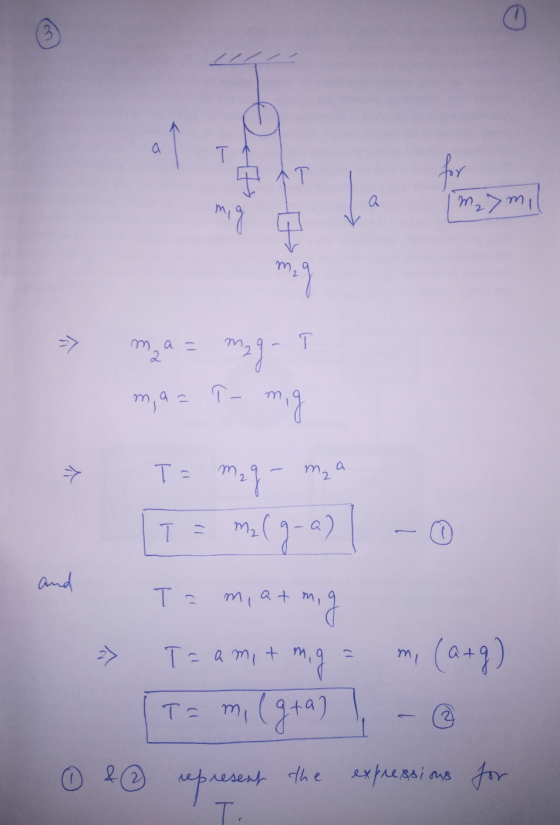
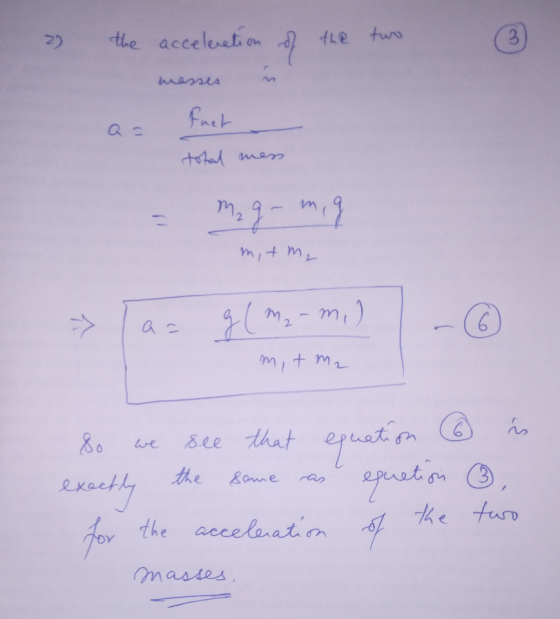
3. For experiment A, use equations 1&3 to develop a general equation for the value of...
I need questions 8-11. Thank you. comp Atwood's Machine Equipment Qty Equipment 1 Mass and Hanger...
 I need questions 8-11. Thank you.
comp Atwood's Machine Equipment Qty Equipment 1 Mass and Hanger Set 1 Photogate with Pully Photogate with Pully 1 Universal Table Clamn 1 Large Rod 1 Small Rod 1 Double rod Clamp I 1 String Part Number ME-8979 ME-6838A ME-9376B ME-8736 ME-8977 ME-9873 Background Newton's 2 Law (NSL) states that the acceleration a mass experiences is proportional to the net force applied to it, and inversely proportional to its inertial mass la t )....
I need questions 8-11. Thank you.
comp Atwood's Machine Equipment Qty Equipment 1 Mass and Hanger Set 1 Photogate with Pully Photogate with Pully 1 Universal Table Clamn 1 Large Rod 1 Small Rod 1 Double rod Clamp I 1 String Part Number ME-8979 ME-6838A ME-9376B ME-8736 ME-8977 ME-9873 Background Newton's 2 Law (NSL) states that the acceleration a mass experiences is proportional to the net force applied to it, and inversely proportional to its inertial mass la t )....
Questions 1. Equation () can also be obtained by drawing separate free body diagrams for the...
 Questions 1. Equation () can also be obtained by drawing separate free body diagrams for the two masses in the system, applying Newton's Laws to each body to get 2 equations with T (string tension force) unknowns, and solving the 2 equations simultaneously and a as m1g m 2 8 Write the 2 equations and solve them simultaneously to obtain formulas for T and a in te m2 and g. This experiment has stressed Newton's Second Law of Motion, F...
Help Choosing the coordinate axes to use is often one of the more difficult choices to...
 Help
Choosing the coordinate axes to use is often one of the more difficult choices to make when doing force problems. Almost always the best choice is to choose a coordinate system which is parallel and perpendicular to the net acceleration. For each of the two below situations draw acceleration and FBD diagrams, indicate the direction of the x- and y- axes, and then write the two Newton's law equations. Note: even if the coordinate system rotates you should NEVER...
Help
Choosing the coordinate axes to use is often one of the more difficult choices to make when doing force problems. Almost always the best choice is to choose a coordinate system which is parallel and perpendicular to the net acceleration. For each of the two below situations draw acceleration and FBD diagrams, indicate the direction of the x- and y- axes, and then write the two Newton's law equations. Note: even if the coordinate system rotates you should NEVER...
PLEASE ANSWER QUESTION 1 From Analysis: . Calculate the mean value of the four measurements of...
 PLEASE ANSWER QUESTION 1 From Analysis: . Calculate the
mean value of the four measurements of t.
Note: Just use arbitrary numbers or denote the four
measurement of t with symbols. show work.
1 Introduction Newton's Second Law states that the acceleration of a body is proportional to the net force acting on the body (a oc FNET) and inversely proportional to the mass of the body (a oc Combining these two FNET ma FNET is the sum of all...
PLEASE ANSWER QUESTION 1 From Analysis: . Calculate the
mean value of the four measurements of t.
Note: Just use arbitrary numbers or denote the four
measurement of t with symbols. show work.
1 Introduction Newton's Second Law states that the acceleration of a body is proportional to the net force acting on the body (a oc FNET) and inversely proportional to the mass of the body (a oc Combining these two FNET ma FNET is the sum of all...
Newton's Second Law: Cart and hanging mass Here is another example of Newton's Second Law. A...
 Newton's Second Law: Cart and hanging mass Here is another example of Newton's Second Law. A cart rests on a horizontal frictionless surface. It is attached to a cart hanging mass with a string that rides on a frictionless pulley. Once this system is released, it will accelerate according to Newton's Second Law. The only force on the system is caused by Hanging mass the weight of the hanging mass (mi). Fsys mig This system force is applied to the...
Plz help me solve all those problem, and explain a little! thank you so much You...
 Plz
help me solve all those problem, and explain a little! thank you so
much
You are in an elevator that is moving upwards with its speed increasing at a rate of 3 m/s2. Which diagram best represents the forces acting on you? BFN (A) EN M9 of Diagram C Diagram B Diagram D Diagram A A box of mass [M] kg is held stationary against a vertical wall by a force [FO] N at the angle (theta) degrees as...
Plz
help me solve all those problem, and explain a little! thank you so
much
You are in an elevator that is moving upwards with its speed increasing at a rate of 3 m/s2. Which diagram best represents the forces acting on you? BFN (A) EN M9 of Diagram C Diagram B Diagram D Diagram A A box of mass [M] kg is held stationary against a vertical wall by a force [FO] N at the angle (theta) degrees as...
2. Atwood's Table with Two Hanging Masses You have table of width L, masses m1, m2,...
2. Atwood's Table with Two Hanging Masses You have table of width L, masses m1, m2, and m3, two frictionless pulleys, and ideal string. Placing m2 on the table, you attach a bit of string to mass m1 the left pulley, to the left side of m2. Similarly, you hang mass m3 from the right side of m2 using the pulley on the right side of the table. The coefficient of friction of the table is mu. The acceleration of...
I need hep figuring out these three problems Force 3 Total 10 3. In the system...
 I need hep figuring out these three problems
Force 3 Total 10 3. In the system shown in Figure, a horizontal force Fx-30N acts on an object of mass m,=10kg. The horizontal surface is frictionless. m, 3kg, (a) Find and draw all the forces using free body diagram for each boxes. (b) build equations for both using Newton's 2nd law for both objects. (c) solve the equations to find the acceleration of both objects. (d) solve the equations to find...
I need hep figuring out these three problems
Force 3 Total 10 3. In the system shown in Figure, a horizontal force Fx-30N acts on an object of mass m,=10kg. The horizontal surface is frictionless. m, 3kg, (a) Find and draw all the forces using free body diagram for each boxes. (b) build equations for both using Newton's 2nd law for both objects. (c) solve the equations to find the acceleration of both objects. (d) solve the equations to find...
Pre-Lab Assignment 1. Draw separate free-body diagrams for each of the masses from Figure 6.1. Assume...
 Pre-Lab Assignment 1. Draw separate free-body diagrams for each of the masses from Figure 6.1. Assume that mi > m2. Figure 6.1 2. Using the free-body diagrams for each mass, m, and m2, develop an equation for the acceleration of the system, in terms of mì, m, and g. Do this by using Newton's second law in the vertical direction to analyze each mass separately. This will give two equations that can be solved for acceleration. Hint: You may find...
Energy, Force, and Kinematics A smooth frictionless incline is d meters in length and is at...
 Energy, Force, and Kinematics A smooth frictionless incline is d meters in length and is at an angle of theta > 30 degree with respect to the ground. A block of mass mA = m starts from rest at the top of the incline (see figure). It is connected to a lighter mass mB = m/2 by a massless string that stays taut throughout the block's descent. In terms of the given quantities m, theta , and acceleration due to...
 I need questions 8-11. Thank you.
comp Atwood's Machine Equipment Qty Equipment 1 Mass and Hanger Set 1 Photogate with Pully Photogate with Pully 1 Universal Table Clamn 1 Large Rod 1 Small Rod 1 Double rod Clamp I 1 String Part Number ME-8979 ME-6838A ME-9376B ME-8736 ME-8977 ME-9873 Background Newton's 2 Law (NSL) states that the acceleration a mass experiences is proportional to the net force applied to it, and inversely proportional to its inertial mass la t )....
I need questions 8-11. Thank you.
comp Atwood's Machine Equipment Qty Equipment 1 Mass and Hanger Set 1 Photogate with Pully Photogate with Pully 1 Universal Table Clamn 1 Large Rod 1 Small Rod 1 Double rod Clamp I 1 String Part Number ME-8979 ME-6838A ME-9376B ME-8736 ME-8977 ME-9873 Background Newton's 2 Law (NSL) states that the acceleration a mass experiences is proportional to the net force applied to it, and inversely proportional to its inertial mass la t )....
 Questions 1. Equation () can also be obtained by drawing separate free body diagrams for the two masses in the system, applying Newton's Laws to each body to get 2 equations with T (string tension force) unknowns, and solving the 2 equations simultaneously and a as m1g m 2 8 Write the 2 equations and solve them simultaneously to obtain formulas for T and a in te m2 and g. This experiment has stressed Newton's Second Law of Motion, F...
 Help
Choosing the coordinate axes to use is often one of the more difficult choices to make when doing force problems. Almost always the best choice is to choose a coordinate system which is parallel and perpendicular to the net acceleration. For each of the two below situations draw acceleration and FBD diagrams, indicate the direction of the x- and y- axes, and then write the two Newton's law equations. Note: even if the coordinate system rotates you should NEVER...
Help
Choosing the coordinate axes to use is often one of the more difficult choices to make when doing force problems. Almost always the best choice is to choose a coordinate system which is parallel and perpendicular to the net acceleration. For each of the two below situations draw acceleration and FBD diagrams, indicate the direction of the x- and y- axes, and then write the two Newton's law equations. Note: even if the coordinate system rotates you should NEVER...
 PLEASE ANSWER QUESTION 1 From Analysis: . Calculate the
mean value of the four measurements of t.
Note: Just use arbitrary numbers or denote the four
measurement of t with symbols. show work.
1 Introduction Newton's Second Law states that the acceleration of a body is proportional to the net force acting on the body (a oc FNET) and inversely proportional to the mass of the body (a oc Combining these two FNET ma FNET is the sum of all...
PLEASE ANSWER QUESTION 1 From Analysis: . Calculate the
mean value of the four measurements of t.
Note: Just use arbitrary numbers or denote the four
measurement of t with symbols. show work.
1 Introduction Newton's Second Law states that the acceleration of a body is proportional to the net force acting on the body (a oc FNET) and inversely proportional to the mass of the body (a oc Combining these two FNET ma FNET is the sum of all...
 Newton's Second Law: Cart and hanging mass Here is another example of Newton's Second Law. A cart rests on a horizontal frictionless surface. It is attached to a cart hanging mass with a string that rides on a frictionless pulley. Once this system is released, it will accelerate according to Newton's Second Law. The only force on the system is caused by Hanging mass the weight of the hanging mass (mi). Fsys mig This system force is applied to the...
 Plz
help me solve all those problem, and explain a little! thank you so
much
You are in an elevator that is moving upwards with its speed increasing at a rate of 3 m/s2. Which diagram best represents the forces acting on you? BFN (A) EN M9 of Diagram C Diagram B Diagram D Diagram A A box of mass [M] kg is held stationary against a vertical wall by a force [FO] N at the angle (theta) degrees as...
Plz
help me solve all those problem, and explain a little! thank you so
much
You are in an elevator that is moving upwards with its speed increasing at a rate of 3 m/s2. Which diagram best represents the forces acting on you? BFN (A) EN M9 of Diagram C Diagram B Diagram D Diagram A A box of mass [M] kg is held stationary against a vertical wall by a force [FO] N at the angle (theta) degrees as...
 I need hep figuring out these three problems
Force 3 Total 10 3. In the system shown in Figure, a horizontal force Fx-30N acts on an object of mass m,=10kg. The horizontal surface is frictionless. m, 3kg, (a) Find and draw all the forces using free body diagram for each boxes. (b) build equations for both using Newton's 2nd law for both objects. (c) solve the equations to find the acceleration of both objects. (d) solve the equations to find...
I need hep figuring out these three problems
Force 3 Total 10 3. In the system shown in Figure, a horizontal force Fx-30N acts on an object of mass m,=10kg. The horizontal surface is frictionless. m, 3kg, (a) Find and draw all the forces using free body diagram for each boxes. (b) build equations for both using Newton's 2nd law for both objects. (c) solve the equations to find the acceleration of both objects. (d) solve the equations to find...
 Pre-Lab Assignment 1. Draw separate free-body diagrams for each of the masses from Figure 6.1. Assume that mi > m2. Figure 6.1 2. Using the free-body diagrams for each mass, m, and m2, develop an equation for the acceleration of the system, in terms of mì, m, and g. Do this by using Newton's second law in the vertical direction to analyze each mass separately. This will give two equations that can be solved for acceleration. Hint: You may find...
 Energy, Force, and Kinematics A smooth frictionless incline is d meters in length and is at an angle of theta > 30 degree with respect to the ground. A block of mass mA = m starts from rest at the top of the incline (see figure). It is connected to a lighter mass mB = m/2 by a massless string that stays taut throughout the block's descent. In terms of the given quantities m, theta , and acceleration due to...
Most questions answered within 3 hours.
-
Where is the error in this code sequence?
String s1 = "Hello";
String s2 = "ello";...
asked 11 months ago -
Financial data for Joel de Paris, Inc., for last year
follow:
Joel de Paris, Inc.
Balance...
asked 11 months ago -
Consider this reaction:
Al2(SO4)3 (aq)+ BaCl3
(aq) Al2Cl6 (aq)- +
3BaSO4(s) . What is the...
asked 11 months ago -
Suppose that Savneet is considering increasing her
recent random sample from 20 car rentals to 40...
asked 11 months ago -
Trucks arrive at an unloading terminal at an average rate of 120
per hour.
Trucks arrive...
asked 11 months ago -
Why are methanol and ethanol completely soluble in water while
octanol is not very little soluble....
asked 11 months ago -
A facilities manager at a university reads in a research report
that the mean amount of...
asked 11 months ago -
When the CuSO4 is rehydrated by adding water to the anhydrous
compound, is this an endothermic...
asked 11 months ago -
A ray of sunlight is passing from diamond into crown glass; the
angle of incidence is...
asked 11 months ago -
A block of mass 0.249 kg is placed on top of a light, vertical
spring of...
asked 11 months ago -
how do the kidneys compensate in the presences of acidosis
a) trigger hyperventilate
b) reserve acid...
asked 11 months ago -
Question 501 pts
The rental rate of capital to the firm increases. Which of the
following...
asked 11 months ago