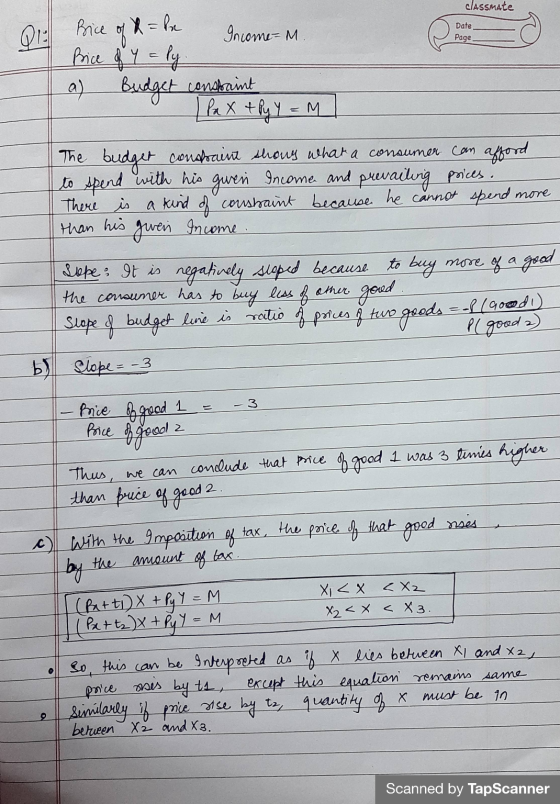
Q1. Suppose consumer consumes two goods, X and Y. The price of X is P x...
Q1. Suppose consumer consumes two goods, X and Y. The price of X
is P x , price of Y is P Y
and the consumer income is m.
a. Derive and interpret the budget constraint and its slope.
b. If slope is -3, how will you interpret it?
c. Suppose a government wants to discourage the excessive
consumption of X and
decides to impose a tax t 1 if someone consume more than X 1 but
less than X 2 and
imposes a higher tax t 2 if consumption exceeds X 2 . However
consumption of X is not
allowed to exceed the level of X 3 . Derive budget constraint and
explain with logic.
(Note: X 1 < X 2 < X 3 and t 1 < t 2 )
Q2: a. Derive indifference curve in case if both the commodities are “bad”. Explain your
answer logically?
b. What happens to the shapes of indifference curve if (i) a
consumer’s preferences
are not “Transitive”? (ii) If an assumption of “No-satiation” is
violated?
c. Explain the meaning of MRS. What is the meaning of MRS of good 1
for 2 is -
2.5?
Q3: Consider a Cobb-Douglas Utility Function
a. Find marginal utility of Y. Does marginal utility of depend on
the level of
consumption of X? how do you know? Explain
b. Find slope of the indifference curve.
c. Find MRS and draw the indifference curve for above function.
Homework Answers
Add Answer to:
Q1. Suppose consumer consumes two goods, X and Y. The price of X
is P x...
Suppose an individual’s utility function for two goods X and Y is givenby U(X,Y) = X^(3/4)Y^(1/4)...
Suppose an individual’s utility function for two goods X and Y is givenby U(X,Y) = X^(3/4)Y^(1/4) Denote the price of good X by Px, price of good Y by Py and the income of the consumer by I. a) (2 points) Write down the budget constraint for the individual. b) (4 points) Derive the marginal utilities of X and Y. c) (3 points) Derive the expression for the marginal rate of substitution of X for Y. Write down the tangency...
1. Price of x is 12 and price of y is 8. Answer the following questions...
 1. Price of x is 12 and price of y is 8. Answer the following questions for a consumer who earns $600 and whose preference can be represented with the utility functions U(x,y) x0.4y0.6 = a) Write down the utility maximization problem. (2 points) b) Does the utility function represent convex preference? Explain. (2 points) c) Write down the budget constraint. What is the slope of the budget line? (2 points) d) What is the slope of the indifference curve...
A consumer buys only two goods, X and Y. a. If the MRS between X and...
A consumer buys only two goods, X and Y. a. If the MRS between X and Y is 4 and the marginal utility of X is 20, what is the marginal utility of Y? b. If the MRS between X and Y is 3 and the marginal utility of Y is 6, what is the marginal utility of X? c. If a consumer moves downward along an indifference curve, what happens to the marginal utilities of X and Y? What...
Question 1. (Consumption-Saving Problem): Suppose that a consumer lives for two periods. The utility function of...
 Question 1. (Consumption-Saving Problem): Suppose that a consumer lives for two periods. The utility function of the consumer is given by with u> 0 where c and c2 are consumption in period 1 and period 2 respectively. Sup- pose that consumer has income y in the first period, but has no income in the second period. Consumer has to save in the first period in order to consume in the second period. Let s be the savings in the first...
Question 1. (Consumption-Saving Problem): Suppose that a consumer lives for two periods. The utility function of...
 Question 1. (Consumption-Saving Problem): Suppose that a consumer lives for two periods. The utility function of the consumer is given by with u> 0 where c and c2 are consumption in period 1 and period 2 respectively. Sup- pose that consumer has income y in the first period, but has no income in the second period. Consumer has to save in the first period in order to consume in the second period. Let s be the savings in the first...
Consider a consumer whose utility function is given by U(x, y) = x^1/4y^1/2, where x and...
Consider a consumer whose utility function is given by U(x, y) = x^1/4y^1/2, where x and y represent quantities of consumption of two consumer goods. (a) Derive and interpret the consumer’s Marshallian demand functions for x and y. (b) Derive and interpret the consumer’s Indirect Utility Function. (c) If the consumer’s income is $1000 and the prices of x and y are both $5, how should the consumer maximize her utility? What is her maximum level of utility? (d) Suppose...
Q2: a. Derive indifference curve in case if both the commodities are “bad”. Explain your b....
 Q2: a. Derive indifference curve in case if both the commodities are “bad”. Explain your b. answer logically? What happens to the shapes of indifference curve if (i) a consumer's preferences are not “Transitive”? (ii) If an assumption of "No-satiation” is violated? c. Explain the meaning of MRS. What is the meaning of MRS of good 1 for 2 is - 2.5?
4. A consumer has income I = 120. She consumes the goods V (Veggies) and M...
 4. A consumer has income I = 120. She consumes the goods V (Veggies) and M (Meat), which have prices Py = 6 and PM = 4 respectively. (a) Use the above information and plug it into the budget re- striction: PV V + PMM = I. Illustrate it in a figure, with V on the horizontal axis. How does the budget line change if the price of M falls so that PM = 2? Show in the figure. (b)...
3. Suppose the utility function for two goods, x and y, is: U = U(x,y) =...
 3. Suppose the utility function for two goods, x and y, is: U = U(x,y) = xłyż. a. Graph the indifference curve for U = 10. b. If x = 5, what must y equal to be on the U = 10 indifference curve? What is the MRS at this point? c. Derive a general expression for the MRS for this utility function. Show how it can be interpreted as the ratio of the marginal utilities. d. Does this individual...
Suppose that there two goods, X and Y , available in arbitrary nonnegative quantities (so the the...
Suppose that there two goods, X and Y , available in arbitrary nonnegative quantities (so the the consumption set is R 2 +). The consumer has preferences over consumption bundles that are monotone, strictly convex, and represented by the following (differentiable) utility function: u(x, y) = α √ x + (1 − α) √ y, where x is the quantity of good X, y is the quantity of good Y , and α ≥ 0 is a utility parameter. The...
 1. Price of x is 12 and price of y is 8. Answer the following questions for a consumer who earns $600 and whose preference can be represented with the utility functions U(x,y) x0.4y0.6 = a) Write down the utility maximization problem. (2 points) b) Does the utility function represent convex preference? Explain. (2 points) c) Write down the budget constraint. What is the slope of the budget line? (2 points) d) What is the slope of the indifference curve...
 Question 1. (Consumption-Saving Problem): Suppose that a consumer lives for two periods. The utility function of the consumer is given by with u> 0 where c and c2 are consumption in period 1 and period 2 respectively. Sup- pose that consumer has income y in the first period, but has no income in the second period. Consumer has to save in the first period in order to consume in the second period. Let s be the savings in the first...
 Question 1. (Consumption-Saving Problem): Suppose that a consumer lives for two periods. The utility function of the consumer is given by with u> 0 where c and c2 are consumption in period 1 and period 2 respectively. Sup- pose that consumer has income y in the first period, but has no income in the second period. Consumer has to save in the first period in order to consume in the second period. Let s be the savings in the first...
 Q2: a. Derive indifference curve in case if both the commodities are “bad”. Explain your b. answer logically? What happens to the shapes of indifference curve if (i) a consumer's preferences are not “Transitive”? (ii) If an assumption of "No-satiation” is violated? c. Explain the meaning of MRS. What is the meaning of MRS of good 1 for 2 is - 2.5?
 4. A consumer has income I = 120. She consumes the goods V (Veggies) and M (Meat), which have prices Py = 6 and PM = 4 respectively. (a) Use the above information and plug it into the budget re- striction: PV V + PMM = I. Illustrate it in a figure, with V on the horizontal axis. How does the budget line change if the price of M falls so that PM = 2? Show in the figure. (b)...
 3. Suppose the utility function for two goods, x and y, is: U = U(x,y) = xłyż. a. Graph the indifference curve for U = 10. b. If x = 5, what must y equal to be on the U = 10 indifference curve? What is the MRS at this point? c. Derive a general expression for the MRS for this utility function. Show how it can be interpreted as the ratio of the marginal utilities. d. Does this individual...
Most questions answered within 3 hours.
-
Where is the error in this code sequence?
String s1 = "Hello";
String s2 = "ello";...
asked 11 months ago -
Financial data for Joel de Paris, Inc., for last year
follow:
Joel de Paris, Inc.
Balance...
asked 11 months ago -
Consider this reaction:
Al2(SO4)3 (aq)+ BaCl3
(aq) Al2Cl6 (aq)- +
3BaSO4(s) . What is the...
asked 11 months ago -
Suppose that Savneet is considering increasing her
recent random sample from 20 car rentals to 40...
asked 11 months ago -
Trucks arrive at an unloading terminal at an average rate of 120
per hour.
Trucks arrive...
asked 11 months ago -
Why are methanol and ethanol completely soluble in water while
octanol is not very little soluble....
asked 11 months ago -
A facilities manager at a university reads in a research report
that the mean amount of...
asked 11 months ago -
When the CuSO4 is rehydrated by adding water to the anhydrous
compound, is this an endothermic...
asked 11 months ago -
A ray of sunlight is passing from diamond into crown glass; the
angle of incidence is...
asked 11 months ago -
A block of mass 0.249 kg is placed on top of a light, vertical
spring of...
asked 11 months ago -
how do the kidneys compensate in the presences of acidosis
a) trigger hyperventilate
b) reserve acid...
asked 11 months ago -
Question 501 pts
The rental rate of capital to the firm increases. Which of the
following...
asked 11 months ago