
Homework Answers
Add Answer to:
Radioactive Decay - Half-life and Activity 1 Radioactive decay - Half-life Time 0 1000 21 31...
please help with b-d! *10-19-1 A radioactive sample's half-life is 30.2 years 1 year - 365...
 please help with b-d!
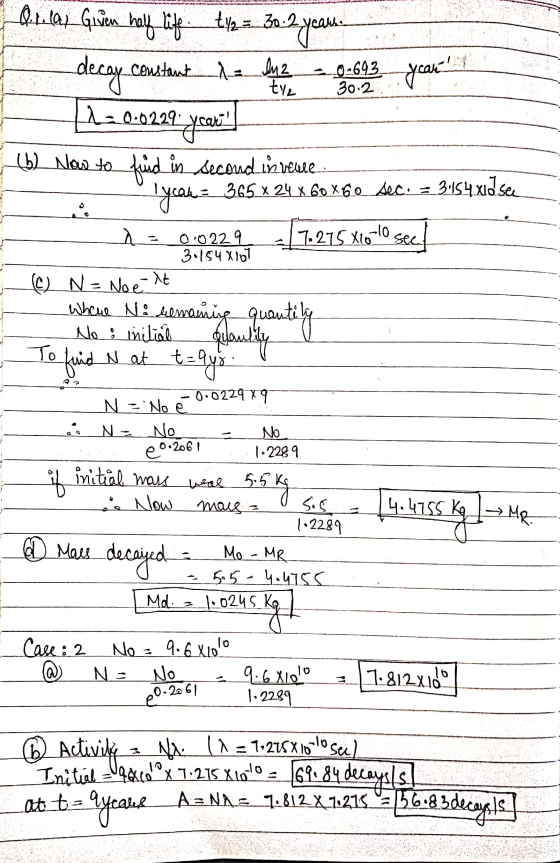
*10-19-1 A radioactive sample's half-life is 30.2 years 1 year - 365 days, 1 day - 24 hours, 1 hour 60 minutes, 1 minute - 60 seconds (a) Find its decay constant in year 1. Keep 4 decimal places. 0.6229 Correct (100,0%) Submit Find its decay constant in sl. Write the result in terms of 10 10,9 Keep 4 decimal places. 7.2764 Correct (100.0 Submit Case 1: The Initial sample is 3.30 kg. (b) What is...
please help with b-d!
*10-19-1 A radioactive sample's half-life is 30.2 years 1 year - 365 days, 1 day - 24 hours, 1 hour 60 minutes, 1 minute - 60 seconds (a) Find its decay constant in year 1. Keep 4 decimal places. 0.6229 Correct (100,0%) Submit Find its decay constant in sl. Write the result in terms of 10 10,9 Keep 4 decimal places. 7.2764 Correct (100.0 Submit Case 1: The Initial sample is 3.30 kg. (b) What is...
please help with parts in case 1 and case 2! thanks you! Correct (100,0%) submit Find...
 please help with parts in case 1 and case 2! thanks you!
Correct (100,0%) submit Find its decay constant in write the result in terms of 10 Keep 4 decimal places. 1.2327 Correct (100.046) Submit x10-7-1 Case 1: The mass of the initial radioactive sample is 6.20 kg. Some time after the initial sample was prepared, it was found that 0.447 kg radioactive materials has decayed. (h) What is the mass in kg) of the radioactive material that remains in...
please help with parts in case 1 and case 2! thanks you!
Correct (100,0%) submit Find its decay constant in write the result in terms of 10 Keep 4 decimal places. 1.2327 Correct (100.046) Submit x10-7-1 Case 1: The mass of the initial radioactive sample is 6.20 kg. Some time after the initial sample was prepared, it was found that 0.447 kg radioactive materials has decayed. (h) What is the mass in kg) of the radioactive material that remains in...
question. Correct answers for each question will be made available once the maximum number of attempts...
 question. Correct answers for each question will be made available once the maximum number of attempts have been made for each submission. Nuclear Physics - Binding Energy 1 Nuclear Physics - Binding Energy Fod work The above figure shows a nuclear reaction in which an alpha particle separates into individual nucleons. An a particle is a He nucleus (2 protons, 4 nucleons). The relevant rest masses are: He = 4.002602 u, neutron = 1.008665 u, proton = 1.007825 u. (a)...
9. [-14 Points] DETAILS SPRECALC7 4.6.017. This exercise uses the radioactive decay model. The half-life of...
 9. [-14 Points] DETAILS SPRECALC7 4.6.017. This exercise uses the radioactive decay model. The half-life of radium-226 is 1600 years. Suppose we have a 28-mg sample. (a) Find a function m(t) = moz-th that models the mass remaining after t years. m(t) = (b) Find a function m(t) = moet that models the mass remaining after t years. (Round your value to six decimal places.) m(L) = (c) How much of the sample will remain after 2500 years? (Round your...
The half-life for the radioactive decay of calcium-47 is 4.5 d. if a sample has an...
The half-life for the radioactive decay of calcium-47 is 4.5 d. if a sample has an activity of 4.5 Ci after 9.0 d, what was the initial activity of the sample?
The half-life of 131I is 8.04 days. (a) Convert the half-life to seconds. s (b) Calculate...
The half-life of 131I is 8.04 days. (a) Convert the half-life to seconds. s (b) Calculate the decay constant for this isotope. s−1 (c) Convert 0.650 μCi to the SI unit the becquerel. Bq (d) Find the number of 131I nuclei necessary to produce a sample with an activity of 0.650 μCi. 131I nuclei (e) Suppose the activity of a certain 131I sample is 7.10 mCi at a given time. Find the number of half-lives the sample goes through in...
A radioactive sample contains two different types of radioactive nuclei: A, with half-life 9.0 days, and...
A radioactive sample contains two different types of radioactive nuclei: A, with half-life 9.0 days, and B, with half-life 18.0 days. Initially, the decay rate of the A-type nucleus is 256 times that of the B-type nucleus. 1) When will their decay rates be equal?
50% of the nuclei in a radioactive sample decay in one half life. What percent decay...
50% of the nuclei in a radioactive sample decay in one half life. What percent decay in four half lives?
The half life for the decay of carbon-14 is 5.73 x 10 years. Suppose the activity...
 The half life for the decay of carbon-14 is 5.73 x 10 years. Suppose the activity due to the radioactive decay of the carbon-14 in a tiny sample of an artifact made of wood from an archeological dig is measured to be 19. Bq. The activity in a similar-sized sample of fresh wood is measured to be 20. Bq. Calculate the age of the artifact. Round your answer to 2 significant digits. years X 5 ?
CHEMWORK A certain radioactive nuclide has a half life of 1.00 hour(s). Calculate the rate constant...
 CHEMWORK A certain radioactive nuclide has a half life of 1.00 hour(s). Calculate the rate constant for this nuclide. s-1 Calculate the decay rate for 1.000 mole of this nuclide. | decays s-1 Submit Show Hints Submit Answer Try Another Version 10 item attempts remaining
 please help with b-d!
*10-19-1 A radioactive sample's half-life is 30.2 years 1 year - 365 days, 1 day - 24 hours, 1 hour 60 minutes, 1 minute - 60 seconds (a) Find its decay constant in year 1. Keep 4 decimal places. 0.6229 Correct (100,0%) Submit Find its decay constant in sl. Write the result in terms of 10 10,9 Keep 4 decimal places. 7.2764 Correct (100.0 Submit Case 1: The Initial sample is 3.30 kg. (b) What is...
please help with b-d!
*10-19-1 A radioactive sample's half-life is 30.2 years 1 year - 365 days, 1 day - 24 hours, 1 hour 60 minutes, 1 minute - 60 seconds (a) Find its decay constant in year 1. Keep 4 decimal places. 0.6229 Correct (100,0%) Submit Find its decay constant in sl. Write the result in terms of 10 10,9 Keep 4 decimal places. 7.2764 Correct (100.0 Submit Case 1: The Initial sample is 3.30 kg. (b) What is...
 please help with parts in case 1 and case 2! thanks you!
Correct (100,0%) submit Find its decay constant in write the result in terms of 10 Keep 4 decimal places. 1.2327 Correct (100.046) Submit x10-7-1 Case 1: The mass of the initial radioactive sample is 6.20 kg. Some time after the initial sample was prepared, it was found that 0.447 kg radioactive materials has decayed. (h) What is the mass in kg) of the radioactive material that remains in...
please help with parts in case 1 and case 2! thanks you!
Correct (100,0%) submit Find its decay constant in write the result in terms of 10 Keep 4 decimal places. 1.2327 Correct (100.046) Submit x10-7-1 Case 1: The mass of the initial radioactive sample is 6.20 kg. Some time after the initial sample was prepared, it was found that 0.447 kg radioactive materials has decayed. (h) What is the mass in kg) of the radioactive material that remains in...
 question. Correct answers for each question will be made available once the maximum number of attempts have been made for each submission. Nuclear Physics - Binding Energy 1 Nuclear Physics - Binding Energy Fod work The above figure shows a nuclear reaction in which an alpha particle separates into individual nucleons. An a particle is a He nucleus (2 protons, 4 nucleons). The relevant rest masses are: He = 4.002602 u, neutron = 1.008665 u, proton = 1.007825 u. (a)...
 9. [-14 Points] DETAILS SPRECALC7 4.6.017. This exercise uses the radioactive decay model. The half-life of radium-226 is 1600 years. Suppose we have a 28-mg sample. (a) Find a function m(t) = moz-th that models the mass remaining after t years. m(t) = (b) Find a function m(t) = moet that models the mass remaining after t years. (Round your value to six decimal places.) m(L) = (c) How much of the sample will remain after 2500 years? (Round your...
 The half life for the decay of carbon-14 is 5.73 x 10 years. Suppose the activity due to the radioactive decay of the carbon-14 in a tiny sample of an artifact made of wood from an archeological dig is measured to be 19. Bq. The activity in a similar-sized sample of fresh wood is measured to be 20. Bq. Calculate the age of the artifact. Round your answer to 2 significant digits. years X 5 ?
 CHEMWORK A certain radioactive nuclide has a half life of 1.00 hour(s). Calculate the rate constant for this nuclide. s-1 Calculate the decay rate for 1.000 mole of this nuclide. | decays s-1 Submit Show Hints Submit Answer Try Another Version 10 item attempts remaining
Most questions answered within 3 hours.
-
Where is the error in this code sequence?
String s1 = "Hello";
String s2 = "ello";...
asked 10 months ago -
Financial data for Joel de Paris, Inc., for last year
follow:
Joel de Paris, Inc.
Balance...
asked 10 months ago -
Consider this reaction:
Al2(SO4)3 (aq)+ BaCl3
(aq) Al2Cl6 (aq)- +
3BaSO4(s) . What is the...
asked 10 months ago -
Suppose that Savneet is considering increasing her
recent random sample from 20 car rentals to 40...
asked 10 months ago -
Trucks arrive at an unloading terminal at an average rate of 120
per hour.
Trucks arrive...
asked 10 months ago -
Why are methanol and ethanol completely soluble in water while
octanol is not very little soluble....
asked 10 months ago -
A facilities manager at a university reads in a research report
that the mean amount of...
asked 10 months ago -
When the CuSO4 is rehydrated by adding water to the anhydrous
compound, is this an endothermic...
asked 10 months ago -
A ray of sunlight is passing from diamond into crown glass; the
angle of incidence is...
asked 10 months ago -
A block of mass 0.249 kg is placed on top of a light, vertical
spring of...
asked 10 months ago -
how do the kidneys compensate in the presences of acidosis
a) trigger hyperventilate
b) reserve acid...
asked 10 months ago -
Question 501 pts
The rental rate of capital to the firm increases. Which of the
following...
asked 10 months ago